- How-To
- Importing
- 4 min read
- Last verified 14 November 2026
How to import goods into India
Learn the registration, documents and filing steps to bring goods into India legally, from DGFT's IEC to ICEGATE's Bill of Entry and customs clearance.

General information, not legal advice. Rules, fees and forms change. Confirm with the agency named in the sources, or a licensed professional, before you file or ship.
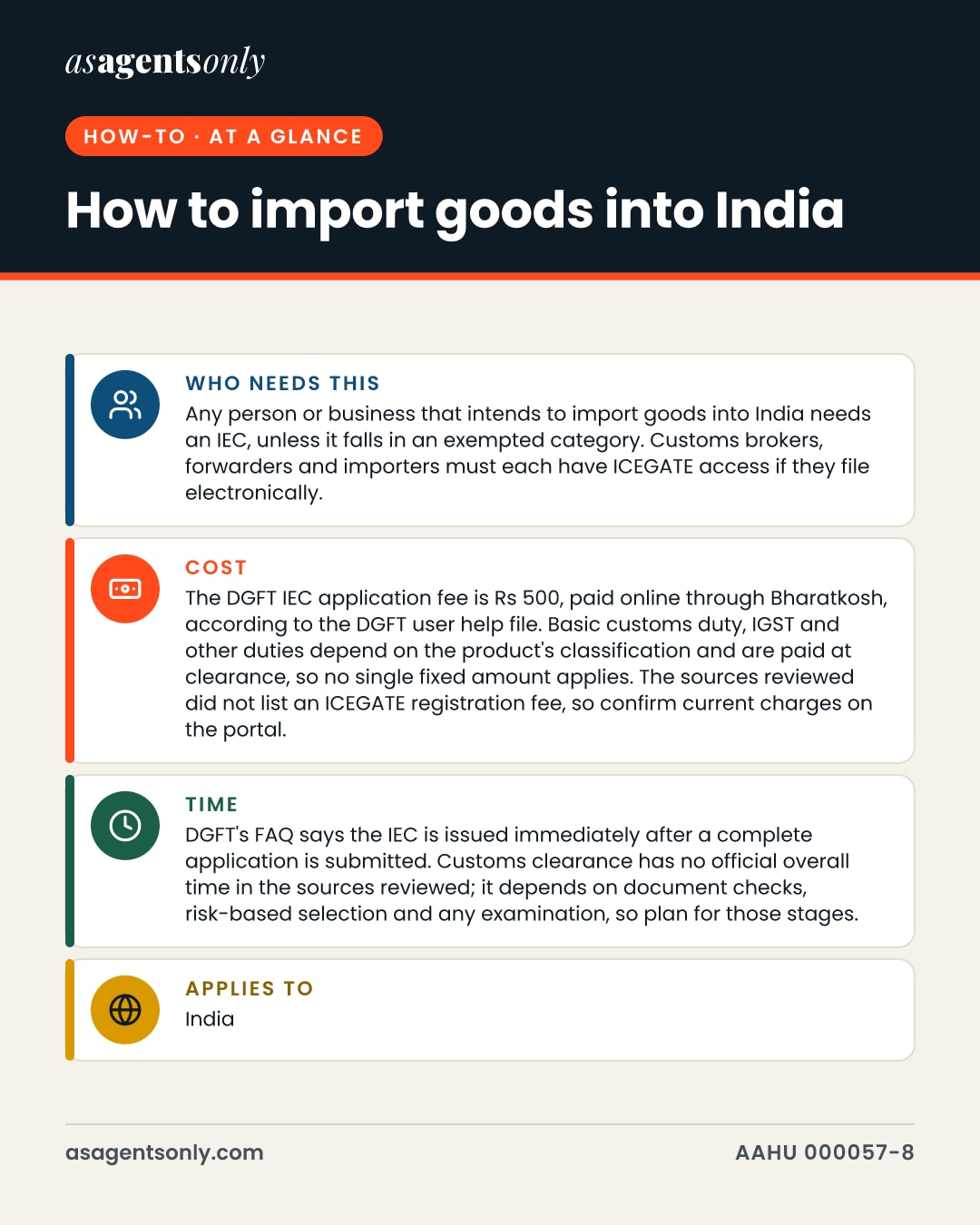
- Who needs this
- Any person or business that intends to import goods into India needs an IEC, unless it falls in an exempted category. Customs brokers, forwarders and importers must each have ICEGATE access if they file electronically.
- Cost
- The DGFT IEC application fee is Rs 500, paid online through Bharatkosh, according to the DGFT user help file. Basic customs duty, IGST and other duties depend on the product's classification and are paid at clearance, so no single fixed amount applies. The sources reviewed did not list an ICEGATE registration fee, so confirm current charges on the portal.
- Time
- DGFT's FAQ says the IEC is issued immediately after a complete application is submitted. Customs clearance has no official overall time in the sources reviewed; it depends on document checks, risk-based selection and any examination, so plan for those stages.
- Applies to
- India
India's import process runs through the Directorate General of Foreign Trade (DGFT) for the Importer Exporter Code (IEC) and through the Central Board of Indirect Taxes and Customs (CBIC) for filing and clearing goods on ICEGATE. This guide covers the general sequence for a commercial shipment cleared for home consumption. Product rules, such as Quality Control Orders and duty rates, vary by product, so check each item before you buy or ship.
Step by step
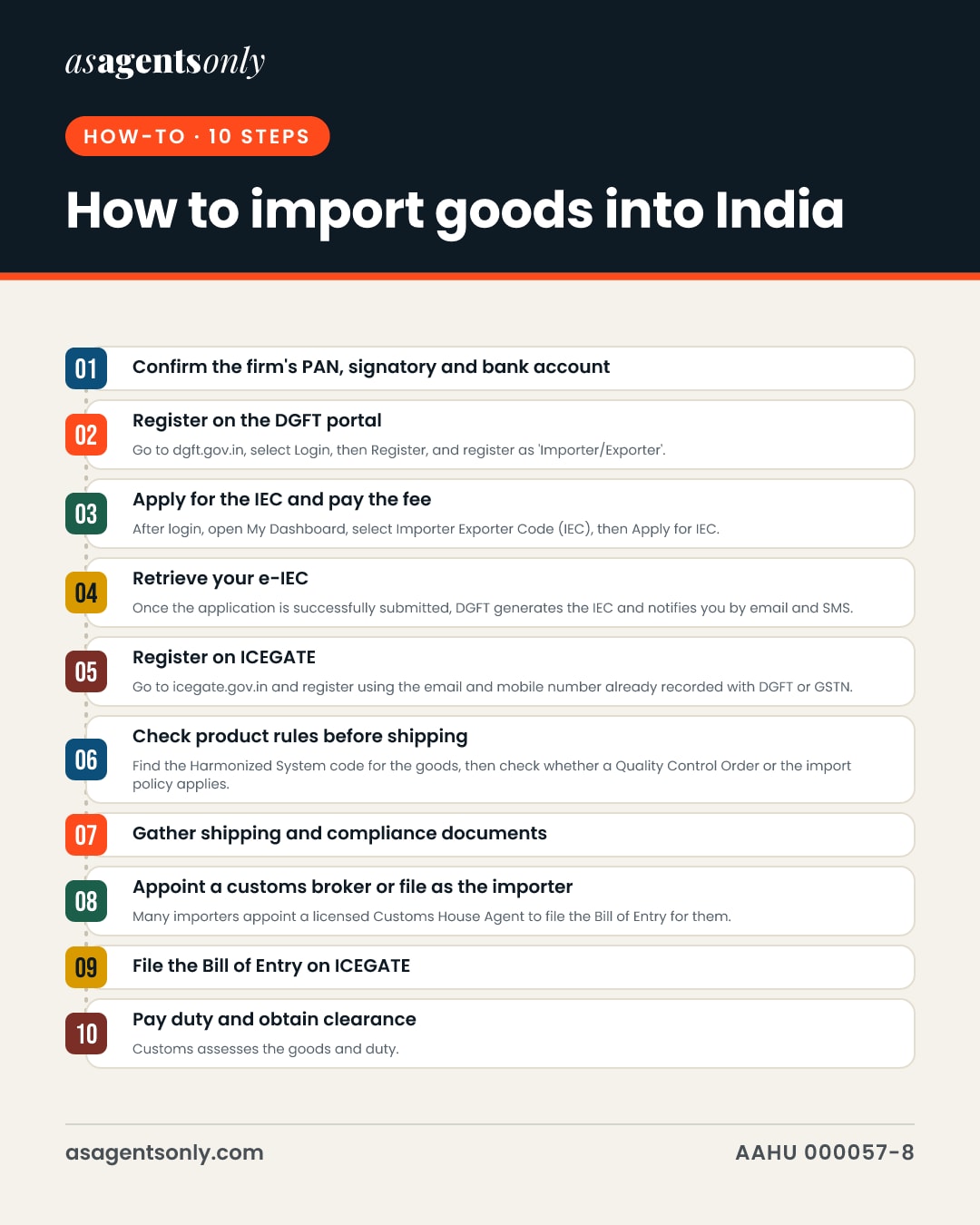
Confirm the firm's PAN, signatory and bank account
Before you apply to DGFT, have a valid PAN for the firm, a digital signature or Aadhaar for a member who will sign, and an active bank account in the firm's name. Make sure the firm name matches across the PAN, the bank account and the DGFT application, because mismatches stop the application.
Register on the DGFT portal
Go to dgft.gov.in, select Login, then Register, and register as 'Importer/Exporter'. Verify your email and mobile by OTP, then log in with the temporary password sent to your email and change it.
Apply for the IEC and pay the fee
After login, open My Dashboard, select Importer Exporter Code (IEC), then Apply for IEC. Complete the general, proprietor/partner/director and bank sections, sign with your DSC or Aadhaar, and pay the Rs 500 fee through Bharatkosh. One user can apply for or link only one IEC.
Retrieve your e-IEC
Once the application is successfully submitted, DGFT generates the IEC and notifies you by email and SMS. Download and keep the e-IEC from your dashboard for use on ICEGATE and in customs filings.
Register on ICEGATE
Go to icegate.gov.in and register using the email and mobile number already recorded with DGFT or GSTN. Upload a Class 3 digital signature certificate. ICEGATE issues your ICEGATE ID only after approval, so keep the reference ID active, since it expires after 15 days if the form is not submitted.
Check product rules before shipping
Find the Harmonized System code for the goods, then check whether a Quality Control Order or the import policy applies. Products under a Quality Control Order must carry the BIS Standard Mark under a valid BIS licence, so ask the supplier for its licence before the goods leave the origin country.
Gather shipping and compliance documents
Collect the bill of lading or airway bill, the commercial invoice and the packing list, or a commercial invoice cum packing list. Add any product-specific certificates, such as a certificate of origin or inspection certificate, required by the commodity or the notification you claim.
Appoint a customs broker or file as the importer
Many importers appoint a licensed Customs House Agent to file the Bill of Entry for them. The broker's customs broker code is entered on the Bill of Entry, so confirm the code and the broker's access to ICEGATE before filing.
File the Bill of Entry on ICEGATE
Use the Bill of Entry web form on ICEGATE for home consumption and enter the IEC, importer details, Customs House, country of origin and, if you want IGST credit, your GSTIN. Upload the supporting documents in e-SANCHIT and sign them digitally. Under the Customs Act, the Bill of Entry must be presented before the end of the day preceding the day the carrying vessel or aircraft arrives, and a prior Bill of Entry can be filed in advance of arrival.
Pay duty and obtain clearance
Customs assesses the goods and duty. Goods cleared for home consumption need the import duty paid and an order from the proper officer. Check the status of the Bill of Entry through ICEGATE's Document Status enquiry using the BE number, BE date and location.
Documents you will need
- Firm PAN and proof of incorporation, partnership or registration
- Bank account proof in the firm's name, such as a cancelled cheque or bank certificate
- Class 3 digital signature certificate of an authorized signatory, or Aadhaar for e-sign
- Valid IEC and e-IEC printout
- ICEGATE ID and password, once issued
- GSTIN, if you intend to claim input tax credit on IGST
- Bill of lading or airway bill, commercial invoice and packing list (or commercial invoice cum packing list)
- Commodity-specific certificates, licences or BIS registration numbers, where applicable
Common mistakes
- Mismatched names across the PAN, bank account and DGFT application; make the firm name identical everywhere before submitting.
- Registering on ICEGATE with contact details that differ from DGFT or GSTN records; update those records first, because ICEGATE data cannot be changed after registration.
- Assuming the goods are free to import without checking Quality Control Orders; check the HS code and BIS requirements before the shipment is booked.
- Signing ICEGATE documents with a digital signature other than the one registered on ICEGATE, which produces an invalid signature error.
- Omitting the GSTIN from the Bill of Entry when you want to claim input tax credit on IGST, since the credit depends on that declaration.
In pictures
The same facts as this page, as images to save or share. Tap one to open it full size.
Official sources
- Directorate General of Foreign Trade (DGFT) IEC Module User Help File V4.1Directorate General of Foreign Trade (DGFT)
- Handbook of Procedures 2023Directorate General of Foreign Trade (DGFT), Government of India
- FAQ's On ICEGATEICEGATE, Central Board of Indirect Taxes and Customs
- Customs Act, 1962Central Board of Indirect Taxes and Customs (CBIC)
- Bill of Entry (BE) Web Form user manualICEGATE, Central Board of Indirect Taxes and Customs
- eSANCHIT Process GuideCentral Board of Indirect Taxes and Customs
- Customs Import Export ProceduresDirectorate General of Foreign Trade (DGFT)
- India - Standards for TradeU.S. International Trade Administration (trade.gov)
- Bureau of Indian Standards notifies 187 Quality Control Order's covering 769 products under compulsory certificationPress Information Bureau, Government of India, published 12 March 2025
- ITC (HS), 2022 Schedule 1 General Notes Regarding Import PolicyDirectorate General of Foreign Trade (DGFT)
- Indian Customs gears up for GST roll-out: Guidance Note for Importers and ExportersCentral Board of Excise and Customs (hosted by DGFT)
- ANF-2A Application Form for Issue/Modification in Importer Exporter Code (IEC) NumberDirectorate General of Foreign Trade (DGFT)
Claims ledger: 34 facts and where each comes from
- The IEC is a 10-digit identification number issued by the DGFT, Department of Commerce, Government of India.3
- Anyone who intends to import or export must have an IEC, although certain categories are exempt under the Handbook of Procedure, paragraph 2.07.13
- Applicants apply online on dgft.gov.in with the applicable fee and requisite documents, and the IEC is auto-generated and sent by email and SMS.2
- To apply, a user registers at dgft.gov.in via Login, then Register as Importer/Exporter, then uses Apply for IEC on the dashboard.1
- The IEC application needs a valid firm PAN, a valid login, and an active DSC or Aadhaar of a firm member, plus an active firm bank account for the online fee.1
- The application fee for a new IEC is Rs 500, paid through the Bharatkosh payment gateway.1
- A user can link or apply for only one IEC.1
- The average time to receive the IEC is immediate after successful submission of the application.1
- The name of the firm and the bank account name must match, and white spaces must be removed before proceeding.1
- ICEGATE registration must use the email ID and mobile number registered with DGFT or GSTN.4
- A reference ID generated during ICEGATE registration is valid for 15 days, after which the user must restart the process.4
- The ICEGATE ID is generated by the system only after the registration is approved by the ICEGATE approving authority.4
- The digital signature used on ICEGATE must be a Class 3, individual, encrypted certificate.3
- Validations at ICEGATE for filing include that the ICEGATE ID is registered and active, and that the file is digitally signed.3
- The mandatory documents for importing into India were notified by DGFT Notification No. 08/2015-2020 dated 4 June 2015, and include the bill of lading or airway bill, commercial invoice and packing list.7
- A commercial invoice cum packing list is also accepted in place of separate invoice and packing list.7
- Other supporting documents depend on the commodity, the notification claimed and Participating Government Agency requirements.7
- Bill of Entry types for ICEGATE filing are home consumption, warehouse (in-bond) and ex-bond.6
- The Bill of Entry requires the IEC, importer name and address, the Customs House Code, the BE type, the customs broker code and the country of origin.6
- Under Section 46(3) of the Customs Act, 1962, the importer must present the bill of entry before the end of the day preceding the day the carrying aircraft, vessel or vehicle arrives at the customs station.5
- A prior Bill of Entry is valid if the vessel or aircraft carrying the goods arrives within 30 days from the date the Bill of Entry is presented.3
- Under Section 47 of the Customs Act, 1962, the proper officer may permit clearance for home consumption once the import duty and charges are paid.5
- India levies basic customs duty as specified in the First Schedule of the Customs Tariff Act, 1975, along with goods-specific duties such as anti-dumping duty and safeguard duty.8
- IGST rates depend on the classification of the imported goods in the Schedules notified under Section 5 of the IGST Act.8
- IGST and GST compensation cess are levied on imports under sub-sections 7 and 9 of Section 3 of the Customs Tariff Act, 1975.12
- An importer must declare its GSTIN in the Bill of Entry to claim input tax credit of IGST paid on imports.12
- Credit of basic customs duty is not available as input tax credit.12
- Foreign manufacturers of specified products must register with and obtain certification from BIS before their goods can be exported to India.9
- Under a Quality Control Order, the concerned ministry directs mandatory use of the BIS Standard Mark under a valid BIS licence.10
- As of 12 March 2025, 187 Quality Control Orders covering 769 products had been notified for compulsory BIS certification.10
- Manufacturers and exporters of products subject to mandatory Indian Standards must obtain a BIS licence to use the Standard mark on their products.11
- If the Bill of Entry is filed without using the EDI system, the importer must submit supporting documents such as certificate of origin, certificate of inspection, bill of exchange and commercial invoice cum packing list.8
- If customs finds no irregularities after examining and assessing the Bill of Entry, the officials issue a pass out order allowing the goods to be released.8
- Users can check the status of a Bill of Entry on ICEGATE by entering the BE number, BE date and location under the Document Status enquiry.3
Every figure on this page is tied to a cited source, last checked on 14 November 2026. Pages like this are re-checked every three months. Found something out of date? Tell the desk.