- How-To
- Importing
- 4 min read
- Last verified 10 November 2026
How to claim duty drawback
Learn how to claim US duty drawback: confirm eligibility, file electronically in ACE, meet the deadlines, and keep records that support the refund.

General information, not legal advice. Rules, fees and forms change. Confirm with the agency named in the sources, or a licensed professional, before you file or ship.
- Who needs this
- Claimants in the United States, such as importers, manufacturers or exporters, who can show the import, the export or destruction, and the duties paid. Customs brokers may file on a client's behalf, and the claimant must confirm its own role under 19 CFR Part 190 before filing.
- Cost
- The sources reviewed do not list a government filing fee for the drawback claim itself, so confirm current charges with CBP before you file. Accelerated payment requires a bond, which carries its own cost.
- Time
- Filing has a legal deadline: a complete claim must be transmitted within five years after the designated goods were imported. Processing time is not stated as a fixed number in the sources reviewed. Accelerated payment can pay the refund before liquidation, while a standard claim is paid after liquidation.
- Applies to
- US
Duty drawback is a refund of certain duties, taxes and fees paid on imported goods that are later exported or destroyed under U.S. Customs supervision. This guide covers the U.S. electronic claim process under 19 CFR Part 190, which replaced the paper process. Use it when you have imported goods that left the United States or were destroyed and you want the duty refunded.
Step by step
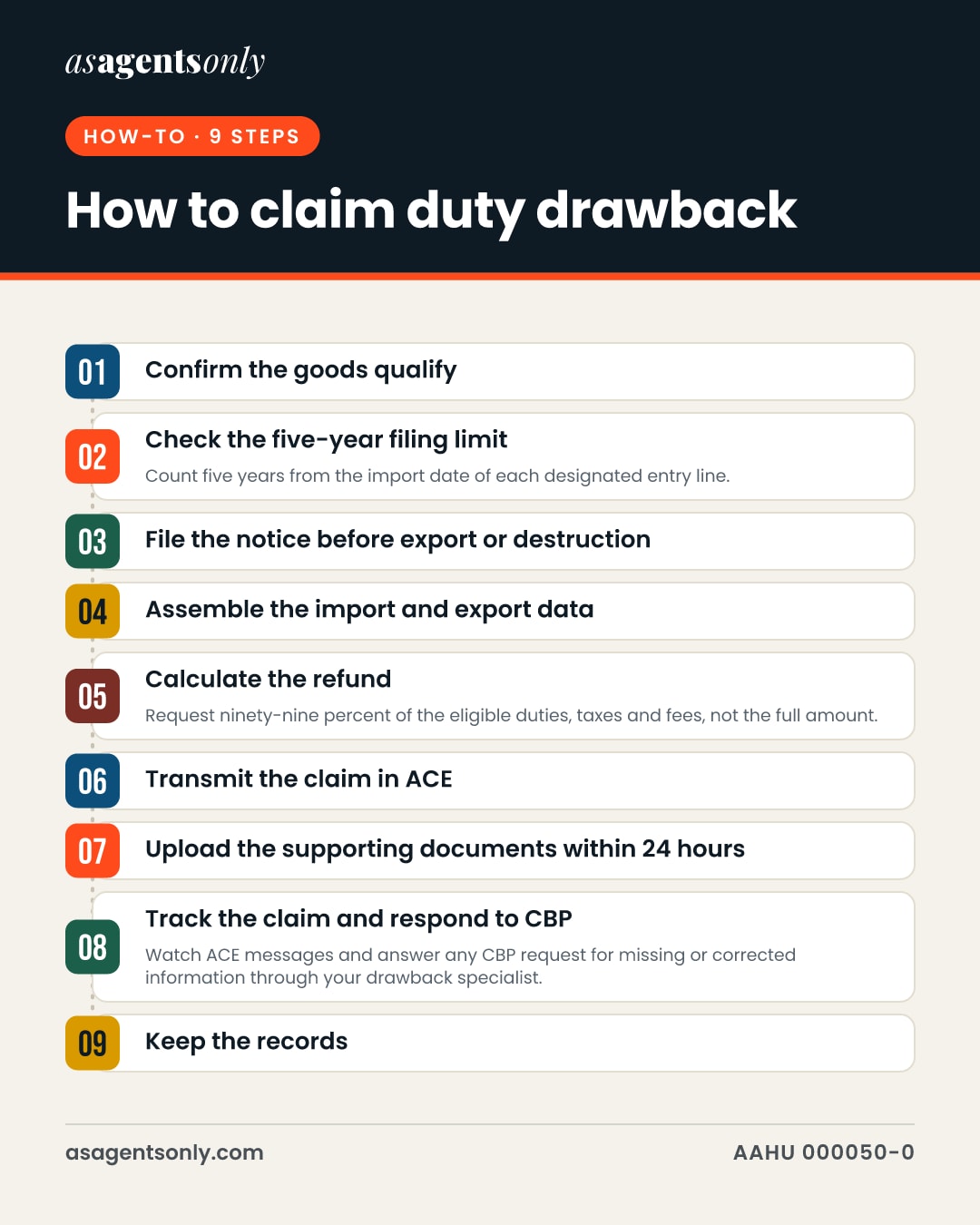
Confirm the goods qualify
Check that the goods were imported and duty-paid, and that they will be exported or destroyed under CBP supervision and not used in the United States first. Identify the drawback type (manufacturing, unused merchandise, rejected merchandise, and others) under 19 CFR Part 190 before you calculate anything.
Check the five-year filing limit
Count five years from the import date of each designated entry line. A complete claim transmitted to CBP after that date is not timely, so calendar the deadline when the goods are imported, not when they leave.
File the notice before export or destruction
For unused merchandise and similar claims, file a Notice of Intent to Export, Destroy, or Return Merchandise for Purposes of Drawback on CBP Form 7553 before the goods leave or are destroyed, unless you hold a waiver privilege. CBP may examine the goods, and a claim can be denied if the goods leave after CBP has said it will examine them.
Assemble the import and export data
For each designated import entry line, gather the entry number, line item number, a description, the HTSUS classification from the entry, and the duties, taxes and fees paid. For each exported article, gather the HTSUS or Schedule B number from the Electronic Export Information when one is required, plus proof of export or destruction.
Calculate the refund
Request ninety-nine percent of the eligible duties, taxes and fees, not the full amount. For substitution claims, use per unit averaging and the lesser-of rule. Claims for more than ninety-nine percent are not paid until you correct the calculation.
Transmit the claim in ACE
File the drawback entry electronically through the Automated Commercial Environment using a CBP-authorized system, either by self-filing through the Automated Broker Interface or through a licensed customs broker. Include your claimant identification number, the port code of the drawback office, the drawback provision claimed and the calculated refund for each duty, tax or fee.
Upload the supporting documents within 24 hours
Upload the required documents through the Document Imaging System within 24 hours of ACE acceptance, including CBP Form 7553 where it applies and evidence of exportation or destruction. If uploads come later than that window, the official filing date becomes the date the upload is complete.
Track the claim and respond to CBP
Watch ACE messages and answer any CBP request for missing or corrected information through your drawback specialist. Keep the complete claim intact, because a claim that is incomplete or wrongly calculated can be rejected or delayed.
Keep the records
Retain all records that support the claim for three years after the drawback claim is liquidated, or longer if another law requires it. Records include import, export, calculation and certification records, and CBP can ask for them in an audit.
Documents you will need
- Import entry numbers, line item numbers and entry summary data for each designated import
- Duties, taxes and fees paid on each designated line, with the HTSUS classification
- Evidence of exportation or destruction under CBP supervision, including export data and, where required, Electronic Export Information or Schedule B numbers
- CBP Form 7553 notice of intent to export, destroy or return merchandise, where it applies
- Claimant identification number, broker identification number if used, and the port code of the drawback office
- Bond information, only if you request accelerated payment
- Refund calculation worksheet showing per unit averaging, the lesser-of comparison and the ninety-nine percent figure
- Manufacturing records, such as bills of material or formulas, for manufacturing drawback claims
Common mistakes
- Filing on paper or on the old Form 7551: paper drawback claims are no longer accepted, so file the entry electronically in ACE.
- Missing the 24-hour upload window: upload every required document within 24 hours of acceptance, or the filing date moves to the upload completion date.
- Claiming one hundred percent of the duty: request ninety-nine percent unless CBP has said a different percentage applies.
- Assuming every duty is refundable: Section 232 duties are not drawback eligible, so check each duty line before you include it.
- Discarding records early: keep supporting records for three years after liquidation, not three years after export.
In pictures
The same facts as this page, as images to save or share. Tap one to open it full size.
Official sources
- DrawbackU.S. Customs and Border Protection
- 19 CFR 190.51 - Completion of drawback claimseCFR (Office of the Federal Register)
- 19 CFR Part 190 - Modernized DrawbackeCFR (Office of the Federal Register)
- Modernized Drawback (final rule)U.S. Customs and Border Protection, Federal Register, published 18 December 2018
- Drawback Frequently Asked Questions (FAQs)U.S. Customs and Border Protection
- Drawback in ACEU.S. Customs and Border Protection
- Agency Information Collection Activities: Drawback Process RegulationsU.S. Customs and Border Protection, Federal Register, published 30 October 2020
- Search - CROSS Ruling (H326262)U.S. Customs and Border Protection
Claims ledger: 19 facts and where each comes from
- Drawback is the refund of certain duties, internal revenue taxes and certain fees collected upon importation of goods, refunded when the goods are exported or destroyed.1
- Paper drawback claims are no longer accepted after February 22, 2019, and all drawback claims must be filed electronically in ACE.1
- A complete drawback claim consists of a successful claim acceptance in ACE plus the DIS submission of all applicable documents within 24 hours of ACE acceptance.6
- When filing an ABI drawback claim, the paper CBP Form 7551 is no longer required.6
- CBP Form 7553 is a required document that must be provided to CBP within 24 hours of filing the drawback claim, unless the claimant has one-time waiver or waiver of prior notice privileges.1
- The amount of drawback requested on the drawback entry is generally to be 99 percent of the duties, taxes and fees eligible for drawback.2
- Claims exceeding 99 percent (or 100% when 100% of the duty is available for drawback) will not be paid until the calculations have been corrected by the claimant.2
- The drawback entry is to be filed through a CBP-authorized electronic system and must include the claimant identification number and the port code for the drawback office where the claim is filed.2
- The official date of filing is the date CBP receives a complete claim through a CBP-authorized system, including upload of all required supporting documentation.2
- A complete drawback claim is timely filed if it is successfully transmitted not later than 5 years after the date on which the merchandise designated as the basis for the claim was imported.3
- Records relating to a drawback claim must be retained for 3 years after liquidation of the claim, or longer if required by law.3
- Under the rule, the drawback amount for substitution claims is 99 percent of the lesser of the duties paid on the imported merchandise or the duties that would apply to the substituted merchandise if imported.4
- Per unit averaging means the equal apportionment of the amount of duties, taxes and fees eligible for drawback for all units covered by a single line item on an entry summary to each unit of merchandise.8
- Drawback for payment by CBP is a privilege, not a right, subject to compliance with prescribed rules and regulations administered by CBP.4
- Section 232 duties are not drawback eligible.5
- All claims must be filed electronically through the Automated Broker Interface per the requirements in the ACE Business Process Document and the Drawback CATAIR.5
- A bond is generally not required for a drawback claim, except when the claimant has been preapproved for accelerated payment and requests it, in which case an active and sufficient bond must be on file.5
- From February 24, 2019 onward, TFTEA-Drawback under part 190 is the only legal framework for filing drawback claims.7
- Exports to Canada or Mexico may be governed by the NAFTA and USMCA trade agreements, which have their own regulations in 19 CFR parts 181 and 182.5
Every figure on this page is tied to a cited source, last checked on 10 November 2026. Pages like this are re-checked every three months. Found something out of date? Tell the desk.