- How-To
- Importing
- 4 min read
- Last verified 11 November 2026
How to use a foreign‑trade zone
Learn how to activate a U.S. foreign-trade zone, admit goods on CBP Form 214, and move them out under the right entry or bond filing.

General information, not legal advice. Rules, fees and forms change. Confirm with the agency named in the sources, or a licensed professional, before you file or ship.
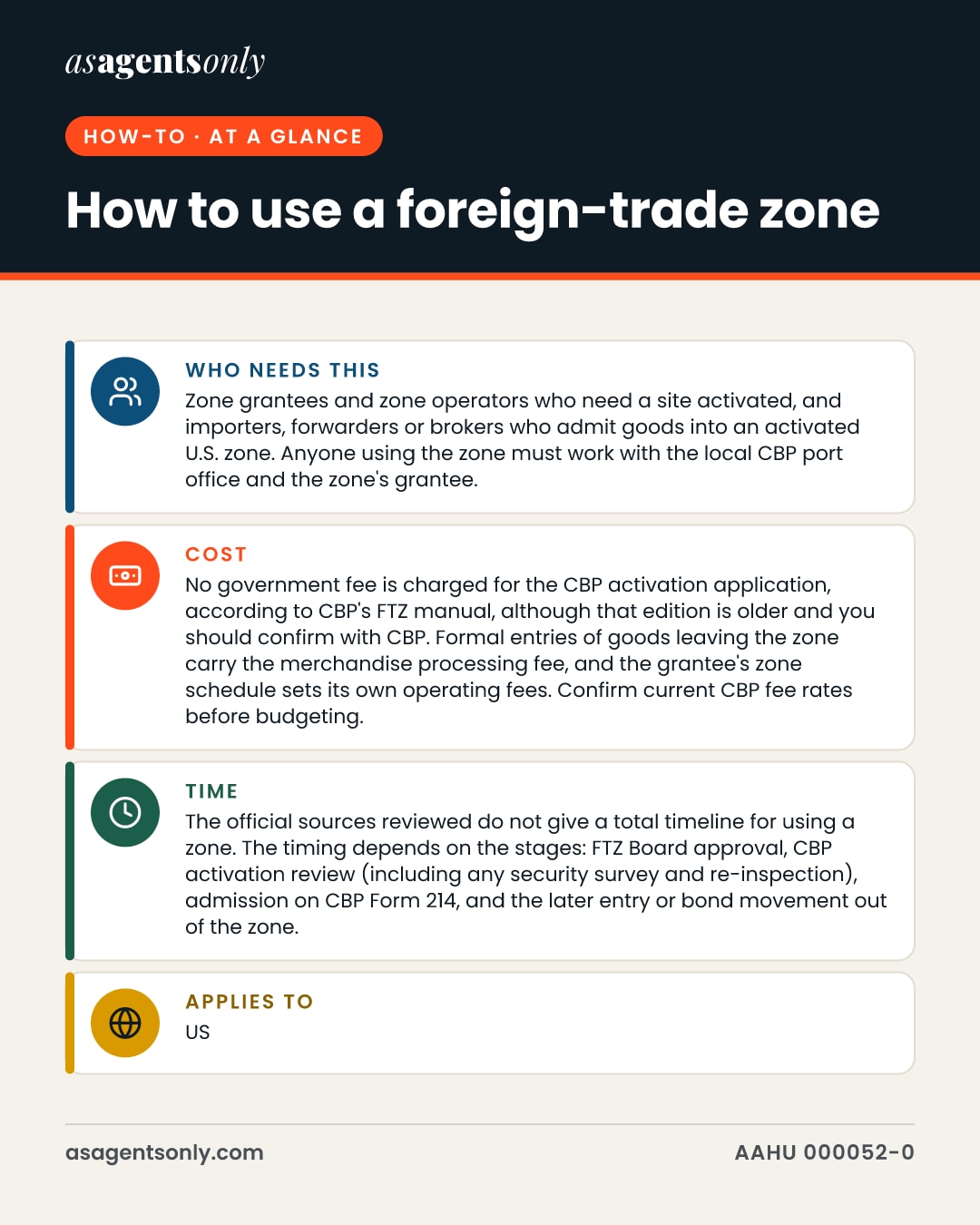
- Who needs this
- Zone grantees and zone operators who need a site activated, and importers, forwarders or brokers who admit goods into an activated U.S. zone. Anyone using the zone must work with the local CBP port office and the zone's grantee.
- Cost
- No government fee is charged for the CBP activation application, according to CBP's FTZ manual, although that edition is older and you should confirm with CBP. Formal entries of goods leaving the zone carry the merchandise processing fee, and the grantee's zone schedule sets its own operating fees. Confirm current CBP fee rates before budgeting.
- Time
- The official sources reviewed do not give a total timeline for using a zone. The timing depends on the stages: FTZ Board approval, CBP activation review (including any security survey and re-inspection), admission on CBP Form 214, and the later entry or bond movement out of the zone.
- Applies to
- US
A foreign-trade zone (FTZ) is a secured site where imported goods can be stored, handled or made into other products before they pay U.S. duty. Use this guide when you plan to bring goods into a U.S. zone, whether you are an operator setting up a site or a company storing or processing goods there. The rules below are U.S. rules set by the Foreign-Trade Zones Board and U.S. Customs and Border Protection (CBP), so check the current text of the governing regulations before you file.
Step by step
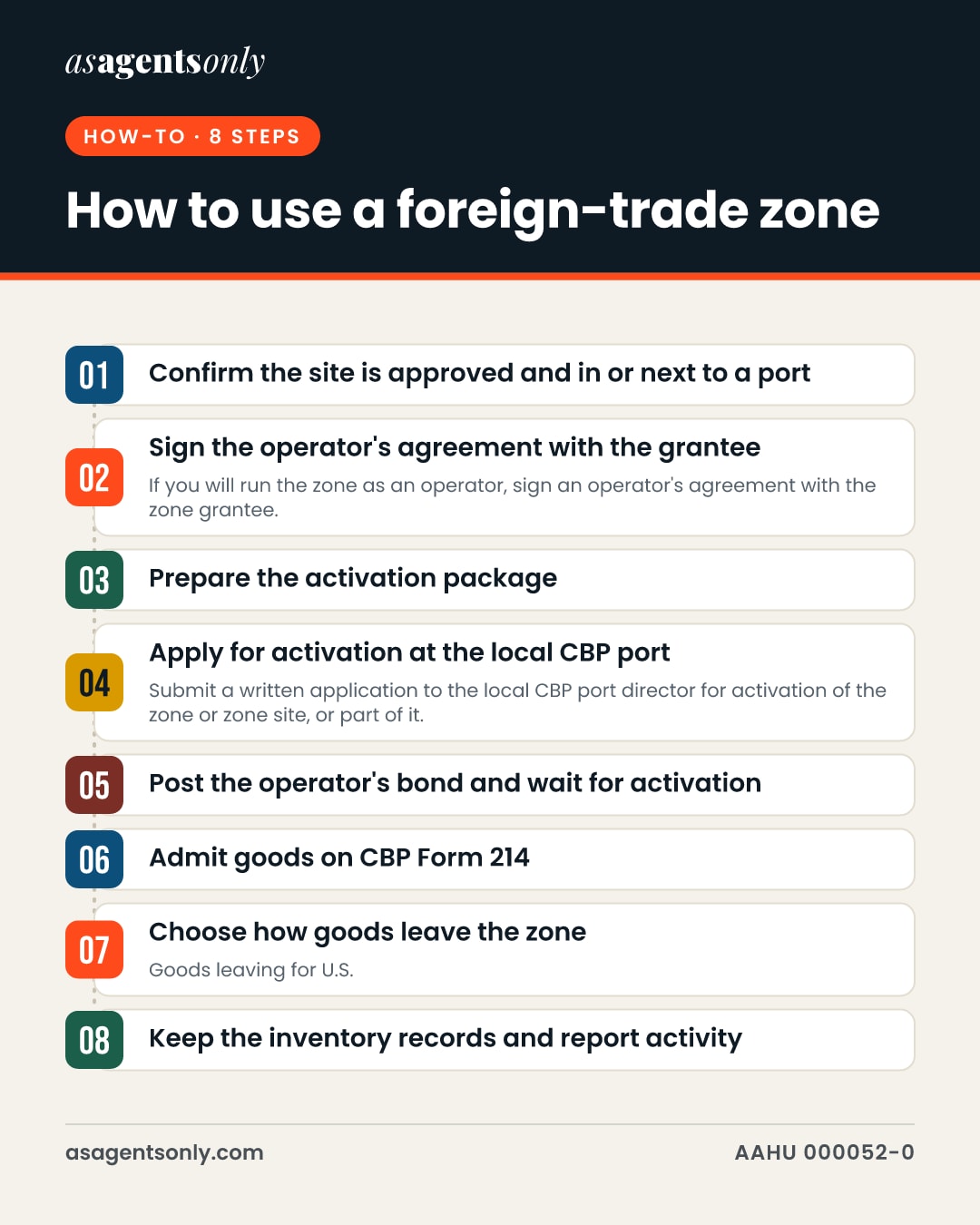
Confirm the site is approved and in or next to a port
Check that the Foreign-Trade Zones Board has approved the zone or subzone and that the site is within or adjacent to a CBP port of entry. Zone activity occurs only after the site is activated by CBP, so a Board approval alone does not let you start operating. Ask the zone grantee for the zone's approval record.
Sign the operator's agreement with the grantee
If you will run the zone as an operator, sign an operator's agreement with the zone grantee. Under the Board's rules, the grantee's written concurrence is needed when an operator applies for activation. Keep the signed agreement in your activation file.
Prepare the activation package
Assemble a blueprint of the area to be activated with measurements, all openings and buildings, plus a gauge table where tanks are involved. Add a procedures manual in English that describes the inventory control and recordkeeping system, certified by the operator or grantee. The grantee's written concurrence goes in the same package.
Apply for activation at the local CBP port
Submit a written application to the local CBP port director for activation of the zone or zone site, or part of it. No particular form is required; a written request on letterhead is acceptable under CBP's FTZ manual. If the port director asks, fingerprints on form FD 258 may be required from the operator, grantee or principal officers.
Post the operator's bond and wait for activation
After approval, the operator's bond is executed on CBP Form 301, and once the port director accepts the bond the zone or zone site is considered activated. Merchandise may not be admitted until that bond is on file. Keep the activation approval with your zone records.
Admit goods on CBP Form 214
For each shipment, file a uniquely and sequentially numbered CBP Form 214 with the port director and receive a permit before the goods enter the zone. Include a statistical copy on CBP Form 214-A, or use CBP's electronic e214 filing. Foreign goods admitted this way are not subject to formal entry or duty until they leave the zone for U.S. consumption.
Choose how goods leave the zone
Goods leaving for U.S. consumption need an entry for consumption, such as CBP Form 7501 or its electronic equivalent, or a weekly entry for qualified zones. Goods leaving for export or for another port move under in-bond or transfer procedures. Zone-restricted goods cannot go to U.S. consumption unless the Board has approved that return.
Keep the inventory records and report activity
The operator keeps a lot file or an authorized inventory record for each CBP Form 214 and remains liable under its bond for the merchandise admitted. Each operator with activity during the year must send its information to the grantee for the zone's annual report to the Board. Keep records ready for CBP and Board monitoring visits.
Documents you will need
- Board approval record for the zone or subzone, and the zone's grantee details
- Signed operator's agreement and the grantee's written concurrence
- Blueprint of the activated area, gauge table where tanks are involved, and the English procedures manual
- Operator's bond on CBP Form 301 and any FD 258 fingerprint cards if requested
- For each shipment: the commercial invoice, bill of lading and the CBP Form 214 with its statistical copy (CBP Form 214-A or e214 data)
- For removals: CBP Form 7501 or its electronic equivalent, or the weekly entry (entry type 06) with its supporting schedule
- CBP Form 216 approval, if you will manipulate, manufacture, exhibit or destroy goods in the zone
Common mistakes
- Starting operations after Board approval but before CBP activation; the Board's rules require both approvals, so get the CBP activation approval first.
- Admitting goods without a numbered CBP Form 214 and permit, which means the goods are not traceable under CBP's rules; file the form before the goods arrive.
- Missing the 15 calendar day limit on a temporary deposit, which leads to general order; file the complete CBP Form 214 in time.
- Removing goods from the zone under an estimated weekly entry for an HTS line that was not listed on it; add a supplemental entry first.
- Changing the activities or merchandise in the zone without checking scope; a change may need new FTZ Board authority, so confirm with the grantee and the Board's staff first.
In pictures
The same facts as this page, as images to save or share. Tap one to open it full size.
Official sources
- About FTZsInternational Trade Administration, Foreign-Trade Zones Board
- 19 CFR 146.6 - Procedure for activationU.S. Government Publishing Office (eCFR)
- 19 CFR Part 146 - Foreign Trade ZonesU.S. Government Publishing Office (eCFR)
- Foreign-Trade Zones ManualU.S. Customs and Border Protection
- FTZ RegsInternational Trade Administration, Foreign-Trade Zones Board
- ACE Frequently Asked QuestionsU.S. Customs and Border Protection
- ACR Business Rules Document for TradeU.S. Customs and Border Protection
- Expanded Weekly Entry Procedure for Foreign Trade ZonesU.S. Customs and Border Protection, Federal Register, published 7 June 2005
- GranteesInternational Trade Administration, Foreign-Trade Zones Board
- Agency Information Collection Activities: Application for Foreign-Trade Zone Admission and/or Status DesignationU.S. Customs and Border Protection, Federal Register
Claims ledger: 26 facts and where each comes from
- A zone site may not be used for zone activity until CBP officials have separately approved it for FTZ activation, and zone activity stays under CBP supervision.1
- After FTZ Board approval, the operator must sign an operator's agreement with the grantee and then apply to CBP for activation before admitting merchandise.1
- An application for activation must include the grantee's written concurrence when the operator applies, plus a blueprint, a gauge table where appropriate, and a procedures manual.2
- The port director may require fingerprints on form FD 258, or electronically, when an operator or grantee files an application for activation.2
- Upon the port director's approval and acceptance of the executed bond, the zone or zone site is considered activated and merchandise may be admitted.2
- The operator's bond for an activated zone is executed on CBP Form 301.2
- No fee is charged or collected by CBP in connection with an application for activation.4
- No particular form is required for an application for activation; a written request on the applicant's letterhead will suffice.4
- Merchandise may be admitted to a zone only upon application on a uniquely and sequentially numbered CBP Form 214 and the issuance of a permit by the port director.3
- The applicant presents the CBP Form 214 to the port director with a statistical copy on CBP Form 214-A, unless direct transmittal of statistical information has been arranged.3
- A temporary deposit in a zone requires a complete and accurate CBP Form 214 within 15 calendar days, with no exceptions granted by the port director, or the merchandise will be placed in general order.3
- Zone-restricted merchandise may not be removed to Customs territory for domestic consumption except where the Board determines the return to be in the public interest.3
- The operator must open and maintain a lot file containing a copy of each CBP Form 214 and the examination invoice.3
- The operator is liable under its bond for merchandise admitted in the quantity and condition described on the CBP Form 214, subject to any discrepancy report.3
- Foreign merchandise that leaves a zone for consumption is entered on CBP Form 7501 or its electronic equivalent, or through the appropriate entry documents under CBP regulations.3
- The estimated weekly entry, entry type 06, permits selected qualified zones to file an estimate for removals for consumption during any selected 7-day period.7
- Goods not listed as an HTS line-item combination on the estimated weekly entry are not authorized for entry for consumption.6
- Foreign-status goods may be admitted before payment of U.S. duties, and a formal customs entry with duty payment is not made until the goods are shipped from the zone to the U.S. market.1
- Zone sites must be within or adjacent to a CBP port of entry.1
- Any merchandise that is not prohibited from entry into the territory of the United States may be admitted to a zone.1
- CBP Form 216 is used by companies to request approval to manipulate, manufacture, exhibit, or destroy merchandise in an FTZ.10
- Production activity involving foreign-status components requires case-by-case authorization in advance from the FTZ Board.1
- A zone grantee must submit a zone schedule establishing the policies, procedures and fees for the zone before operation of any site or subzone.9
- Each zone grantee must submit a complete and accurate annual report to the Board within 90 days after the end of the reporting period.5
- Each operator that had FTZ activity during the year must provide its information to the grantee to be included in the zone's report.1
- The merchandise processing fee is assessed on importers to offset the administrative costs of processing imported merchandise that is formally entered or released.8
Every figure on this page is tied to a cited source, last checked on 11 November 2026. Pages like this are re-checked every three months. Found something out of date? Tell the desk.