- How-To
- Importing
- 5 min read
- Last verified 13 November 2026
How to act as importer of record for a foreign seller
Learn how to act as U.S. importer of record for a foreign seller: get an IOR number, post a bond, name a U.S. resident agent and pick a filing route.

General information, not legal advice. Rules, fees and forms change. Confirm with the agency named in the sources, or a licensed professional, before you file or ship.
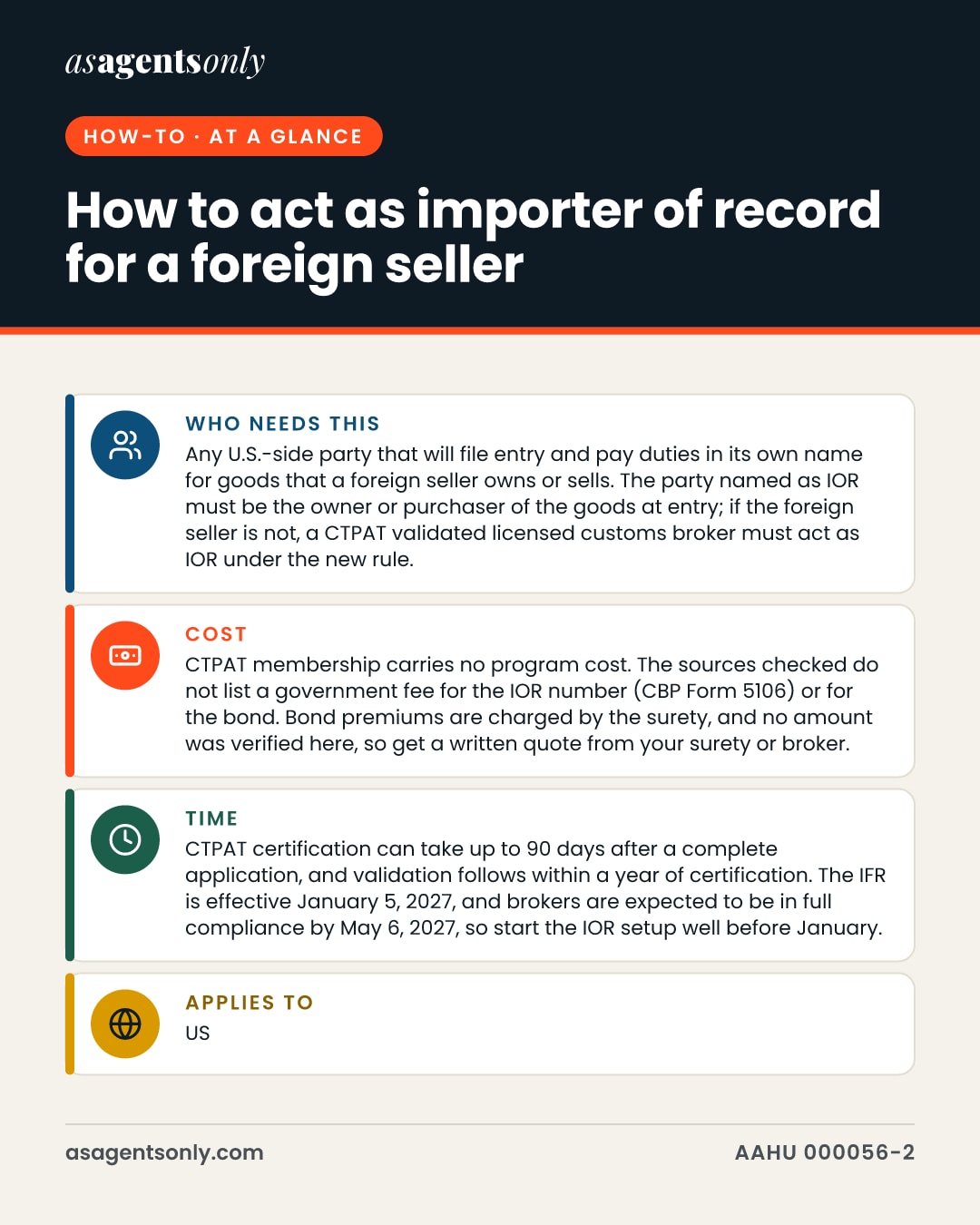
- Who needs this
- Any U.S.-side party that will file entry and pay duties in its own name for goods that a foreign seller owns or sells. The party named as IOR must be the owner or purchaser of the goods at entry; if the foreign seller is not, a CTPAT validated licensed customs broker must act as IOR under the new rule.
- Cost
- CTPAT membership carries no program cost. The sources checked do not list a government fee for the IOR number (CBP Form 5106) or for the bond. Bond premiums are charged by the surety, and no amount was verified here, so get a written quote from your surety or broker.
- Time
- CTPAT certification can take up to 90 days after a complete application, and validation follows within a year of certification. The IFR is effective January 5, 2027, and brokers are expected to be in full compliance by May 6, 2027, so start the IOR setup well before January.
- Applies to
- US
This guide covers what a U.S.-side party must do to enter goods in its own name as importer of record (IOR) for a foreign seller's goods. You need it before the first entry, and especially now, because a U.S. Customs and Border Protection (CBP) interim final rule on foreign IORs takes effect January 5, 2027. Rules in force today still apply until then.
Step by step
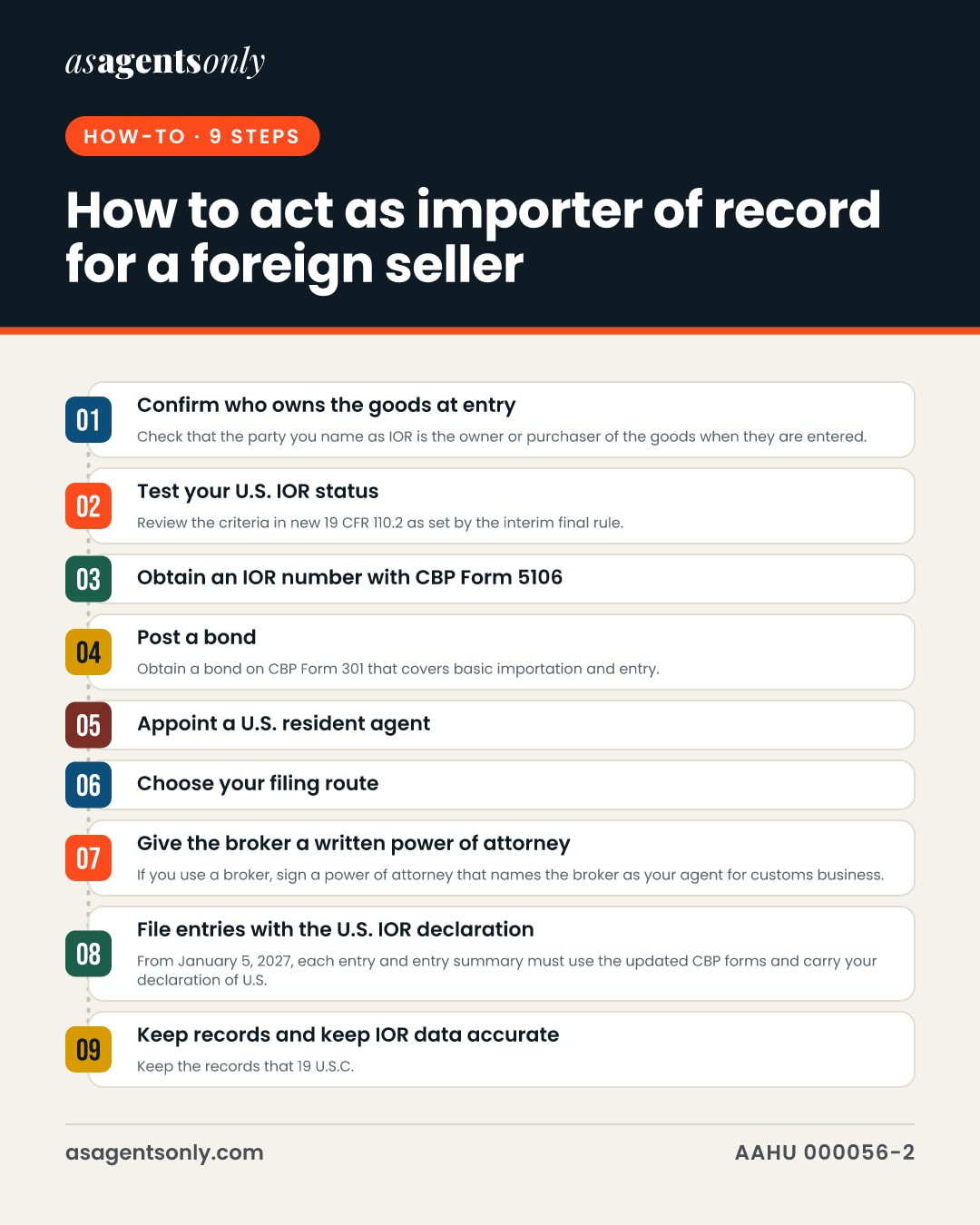
Confirm who owns the goods at entry
Check that the party you name as IOR is the owner or purchaser of the goods when they are entered. If the foreign seller keeps ownership, the filing must go through a licensed customs broker that is CTPAT validated, because that is the route the rule allows for foreign parties.
Test your U.S. IOR status
Review the criteria in new 19 CFR 110.2 as set by the interim final rule. An entity can qualify through ownership (at least 51% beneficial ownership and control by U.S. citizens or lawful permanent residents) or through significant unencumbered U.S. real property, and a U.S. subsidiary of a foreign parent may still be classified as a foreign IOR. If you do not clearly qualify, plan on the foreign IOR route.
Obtain an IOR number with CBP Form 5106
Submit CBP Form 5106, Create/Update Importer Identity Form, through the Automated Broker Interface or by email to a CBP Center of Excellence and Expertise, either yourself or through your broker. A foreign entity with no EIN or SSN requests a CBP-assigned number on the form, and CBP returns an IOR number.
Post a bond
Obtain a bond on CBP Form 301 that covers basic importation and entry. You may use a single transaction bond or a continuous bond, and a nonresident corporation's surety must be a resident corporate surety.
Appoint a U.S. resident agent
Name a resident agent in the state where your port of entry is located who is authorized to accept service of process for your company. Keep that agent current, because CBP requires it before a nonresident corporation can enter goods.
Choose your filing route
Either apply to CTPAT yourself through the CTPAT Portal, which requires a Company Profile and a Security Profile, or appoint a licensed customs broker that is CTPAT validated. Self-application requires an active U.S. import record, a valid continuous bond and a business office staffed in the United States or Canada.
Give the broker a written power of attorney
If you use a broker, sign a power of attorney that names the broker as your agent for customs business. Confirm that the broker is CTPAT validated and licensed and that it will verify your U.S. IOR status before filing.
File entries with the U.S. IOR declaration
From January 5, 2027, each entry and entry summary must use the updated CBP forms and carry your declaration of U.S. IOR status. Filing informally is not prohibited by this rule, but CBP is monitoring those entries and may restrict them later.
Keep records and keep IOR data accurate
Keep the records that 19 U.S.C. 1508 requires and update CBP Form 5106 whenever your name, address, phone or EIN changes. CBP may void an IOR number that carries inaccurate information, which stops all entries under that number.
Documents you will need
- Legal name, physical address, mailing address, email and valid phone number of the IOR, which must belong to the IOR itself
- IRS EIN or SSN if assigned; otherwise a request for a CBP-assigned number on CBP Form 5106
- Proof of organization under U.S. law (such as corporate charter) and records of beneficial ownership, citizenship or permanent residence where relevant
- Financial statements and evidence of U.S. assets or property, which CBP may request to verify IOR status
- Six-digit NAICS code and D-U-N-S Number where available, as requested on CBP Form 5106
- CBP Form 301 bond with a resident corporate surety, and the surety's information
- Name and address of the U.S. resident agent authorized to accept service of process
- Power of attorney to the CTPAT validated licensed broker, if you use one
- For self-application to CTPAT: CTPAT Portal account, continuous bond, IOR number, U.S. or Canadian staffed office, and completed security profile
Common mistakes
- Assuming a foreign seller can file as IOR after January 5, 2027 without CTPAT validation or a CTPAT validated broker; avoid this by confirming the route before the first post-January entry.
- Entering a broker's or a third party's phone number on CBP Form 5106; use a valid number that belongs to the IOR, because CBP treats the mismatch as inaccurate data.
- Leaving out the U.S. resident agent or using a surety that is not a resident corporate surety; name both before the first entry.
- Treating the interim final rule as already in force; it takes effect January 5, 2027, while the Form 5106 accuracy enforcement that began September 18, 2026 applies now.
- Assuming informal entry is unrestricted for foreign IORs; CBP is monitoring those entries and may restrict them, so do not build a plan that depends on informal entry alone.
In pictures
The same facts as this page, as images to save or share. Tap one to open it full size.
Official sources
- Heightened Requirements for Foreign Importers of Record (interim final rule)Federal Register (U.S. Customs and Border Protection), published 6 November 2026
- Strengthening Customs EnforcementU.S. Customs and Border Protection
- Importer Create/Update Identity Form (CBP Form 5106) FAQU.S. Customs and Border Protection
- Accuracy of Importer of Record Data Submitted to CBPFederal Register (U.S. Customs and Border Protection), published 19 August 2026
- 19 CFR 141.18 Entry by nonresident corporationeCFR (U.S. National Archives)
- 19 CFR Part 141 Subpart E Presentation of Entry PaperseCFR (U.S. National Archives)
- Importing into the United States: A Guide for Commercial ImportersU.S. Customs and Border Protection
- 19 CFR Part 113 Subpart G CBP Bond ConditionseCFR (U.S. National Archives)
- Customs Trade Partnership Against Terrorism (CTPAT)U.S. Customs and Border Protection
- CTPAT ImportersU.S. Customs and Border Protection
- Applying for CTPATU.S. Customs and Border Protection
- 19 CFR 24.5 Filing identification numbereCFR (U.S. National Archives)
- CBP Form 5106 Create/Update Importer Identity Form (06/26)U.S. Customs and Border Protection
- Delayed ComplianceU.S. Customs and Border Protection
- CBP strengthens Importer of Record requirementsAJOT (trade press)
Claims ledger: 34 facts and where each comes from
- CBP's interim final rule on foreign importers of record becomes operative on January 5, 2027.1
- A foreign party that is not itself a CTPAT validated IOR must appoint a licensed customs broker that is CTPAT validated to file its entries.1
- If the foreign party is not the owner or purchaser of the goods being entered, the designated CTPAT validated broker must act as the importer of record.1
- The rule requires licensed customs brokers to verify that a client qualifies as a U.S. IOR before filing an entry for it.2
- New 19 CFR 110.2(a) sets out who qualifies as a U.S. IOR.1
- An entity can meet the U.S. IOR ownership test with at least 51% beneficial ownership and control by U.S. citizens or lawful permanent residents.2
- A foreign IOR is an entity that has not satisfied criteria such as at least 51% beneficial ownership or direct ownership of a significant amount of unencumbered U.S. real property.1
- Some U.S. subsidiaries of foreign parent companies may be classified as foreign IORs under the new ownership-based analysis.15
- A CBP-assigned number is an importer identification number that CBP issues when an individual or entity has no EIN or SSN for CBP Form 5106 purposes.3
- An entity with no EIN or SSN, such as a foreign-domiciled entity without U.S. tax identifiers, may request a CBP-assigned number.3
- An individual or entity must have an IOR number to make entry or to request CBP services that may result in a bill or refund.3
- To become an IOR and make entry, an individual or entity, or a licensed customs broker on its behalf, must submit CBP Form 5106 via the Automated Broker Interface or by email to a Center of Excellence and Expertise.4
- Beginning September 18, 2026, CBP will void an IOR number if the IOR or its broker fails to provide complete and accurate information.4
- CBP may void an IOR number immediately if the information on CBP Form 5106 is inaccurate or incomplete.3
- The phone number on CBP Form 5106 must be valid and belong to the IOR, and a customs broker may not supply its own phone number in its place.3
- A nonresident corporation may not enter merchandise for consumption unless it has a resident agent in the state where the port of entry is located, authorized to accept service of process, and files a bond on CBP Form 301 with a resident corporate surety.5
- The importer of record, customs broker, or a duly authorized agent must be resident in the United States for purposes of receiving service of process.6
- A foreign corporation entering merchandise in its name must have a resident agent in the state where the port of entry is located.7
- The surety on a CBP bond required from a nonresident individual or organization must be incorporated in the United States.7
- A bond for basic importation and entry may be either a single transaction bond or a continuous bond.8
- Participation in CTPAT is voluntary and there are no costs associated with joining the program.9
- After a complete CTPAT application, the program has up to 90 days to certify the company or reject the application.9
- A certified CTPAT company is validated within a year of certification.9
- To be a CTPAT importer, a company must have an active U.S. IOR number and a valid continuous import bond registered with CBP, and must operate a business office staffed in the United States or Canada.10
- Active is defined as having imported goods into the U.S. within the past 12 months.10
- The CTPAT application is completed online in the CTPAT Portal and has two components: the Company Profile and the Security Profile.11
- Beginning January 5, 2027, brokers must verify, before filing an entry for a client that declares itself a U.S. IOR, that the client meets the IFR requirements.14
- All customs brokers are expected to be in full compliance with the rule no later than May 6, 2027.1
- Beginning January 5, 2027, updated entry forms and their electronic equivalents must be used for each entry and entry summary filing.1
- CBP has not implemented a prohibition on informal entries by foreign IORs in this rule, but CBP will continue to monitor them and may later prohibit them.1
- All importers, foreign and U.S., are subject to recordkeeping requirements under 19 U.S.C. 1508.1
- Each person or organization that intends to file an import entry must file CBP Form 5106 with the first formal entry it submits or its first request for services that results in a bill or refund.12
- Failure to provide the information requested on CBP Form 5106 results in denial of a CBP-assigned importer number and an inability to pay duties, taxes and fees on an entry.13
- Brokers must keep records of their verification of a client's U.S. IOR status for five years from the date of verification.1
Every figure on this page is tied to a cited source, last checked on 13 November 2026. Pages like this are re-checked every three months. Found something out of date? Tell the desk.