- How-To
- Importing
- 4 min read
- Last verified 12 November 2026
How to use a customs or bonded warehouse
Learn how to store imported goods in a customs warehouse in the EU or UK, pay duty and VAT only on release, and keep the records authorities check.

General information, not legal advice. Rules, fees and forms change. Confirm with the agency named in the sources, or a licensed professional, before you file or ship.
- Who needs this
- Importers and their agents who want to defer duty and import VAT, and businesses that want to run a warehouse for storing goods. Running a warehouse needs authorisation from the customs authority, while depositing goods in a public warehouse does not in the United Kingdom.
- Cost
- The official guidance reviewed does not list an application fee for a customs warehouse authorisation. The main payments are the customs duty and import VAT due when goods leave the warehouse for free circulation, and a guarantee may be required for the warehousekeeper.
- Time
- HMRC recommends applying at least two months before you want to start using a warehouse in the United Kingdom. In the EU, the sources reviewed do not give a fixed processing time, so ask the customs authority of the Member State concerned for its timetable.
- Applies to
- EU, UK
A customs warehouse is premises authorised by customs where goods from outside the EU or UK can be stored without paying duty and import VAT until they are released. Some traders say bonded warehouse; this guide uses the official term customs warehouse. Use this process when you import goods you cannot or do not want to clear straight away, or when you need to hold stock before sale or re-export.
Step by step
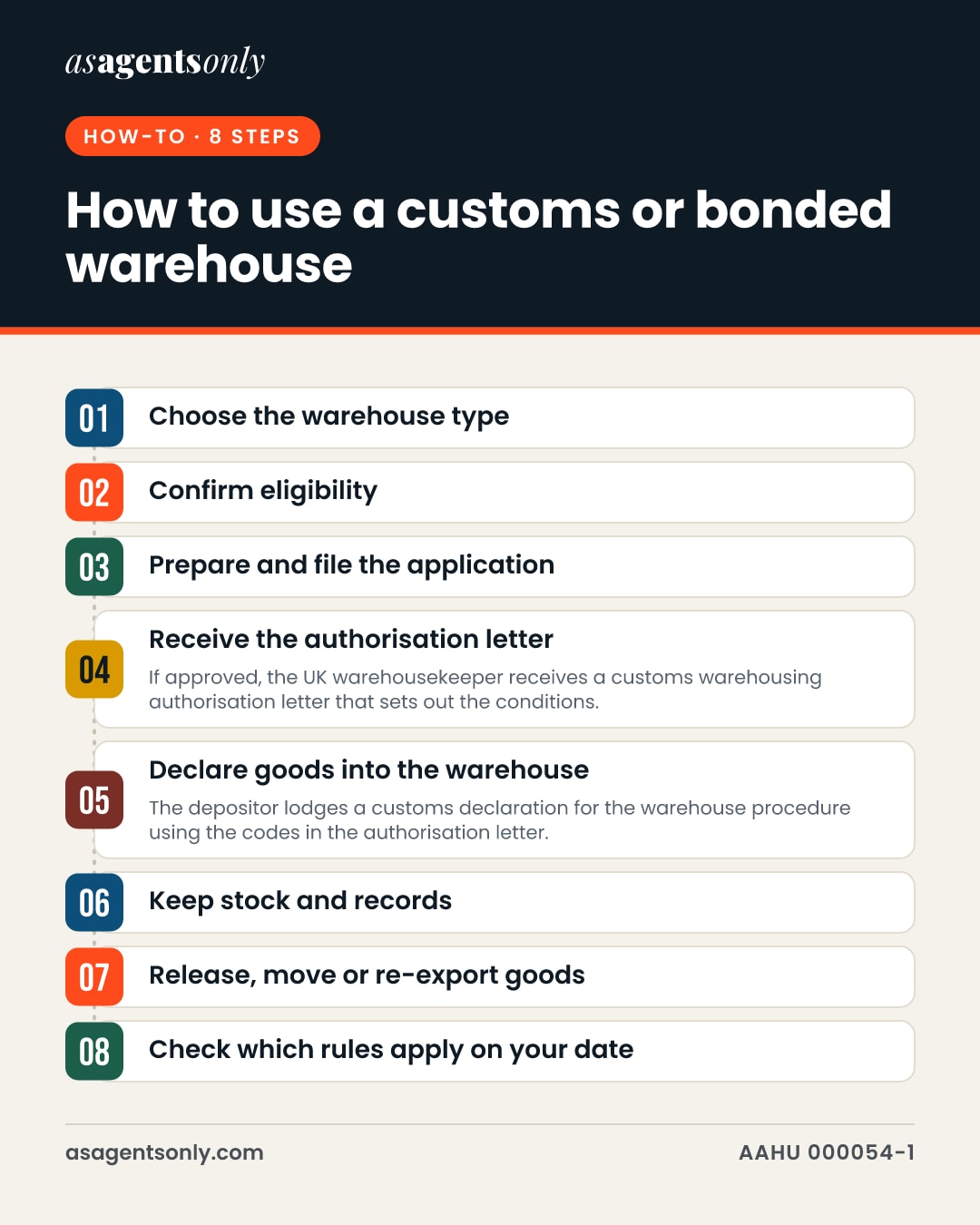
Choose the warehouse type
Decide between a public customs warehouse, which any person may use, and a private customs warehouse, which only one authorised person may use. In the United Kingdom, a private warehouse is run by the same person who deposits the goods. Write this down, because it sets who must hold the authorisation.
Confirm eligibility
In the United Kingdom, apply to HMRC to operate a customs warehouse as a warehousekeeper, and check that you are established in the UK, hold an EORI number, and are financially solvent. In the EU, the operator must be established in the customs territory of the Union, give the necessary assurance of proper conduct, and provide a guarantee where a customs debt may arise.
Prepare and file the application
Gather the documents listed below and file with HMRC through its customs warehouse application process, or with the customs authority of the Member State where the premises are located. HMRC may ask for more information or arrange a site visit before it decides.
Receive the authorisation letter
If approved, the UK warehousekeeper receives a customs warehousing authorisation letter that sets out the conditions. In the UK, the letter also gives the procedure codes and additional procedure codes that depositors must use. In the EU, the authorisation sets the conditions for operating the storage facility.
Declare goods into the warehouse
The depositor lodges a customs declaration for the warehouse procedure using the codes in the authorisation letter. In the United Kingdom, goods must be moved directly to the warehouse named in the declaration once HMRC has accepted it. An agent may declare on the holder's behalf only with the holder's prior written approval and must return a copy of the declaration to the holder.
Keep stock and records
Keep inventory records that show what is in the warehouse, its customs status and every movement, in a form the customs authority approves. Report stock differences, changes to the business such as a new owner, and any risk of insolvency to HMRC or your supervising customs authority without delay. In the UK, keep records for four years after the procedure is discharged.
Release, move or re-export goods
Before goods are used in the market, they must be removed from the warehouse and released for free circulation, and duty and taxes become payable on release. In the UK, goods may be removed only after HMRC accepts the entry, and the acceptance date sets the duty rate. If goods are re-exported instead, suspended UK duty and import VAT do not become due.
Check which rules apply on your date
In the EU, the current Union Customs Code still applies today, and the new Union Customs Code applies from 21 September 2027. In the UK, the Customs (Special Procedures and Outward Processing) (EU Exit) Regulations and HMRC guidance apply. Confirm the current text before you act, because the rules change.
Documents you will need
- EORI number of the applicant and of any agent
- Proof that the applicant is established in the UK or in the EU customs territory
- Proof of business need, and for a public warehouse, letters of intent from customers stating expected annual VAT and duty suspension figures
- Evidence of financial solvency and details of any guarantee for duty and VAT
- Commodity codes of the goods, at least six digits in the UK, with descriptions
- Written procedures for goods entering and leaving the warehouse
- Inventory records, including screenshots of the Warehouse Management System or Duty Management System
- Site plans showing the perimeter, entrances, fire exits, CCTV, security gates and the marked customs area
- List of signatories signed by a director or company secretary
- Details of any planned usual forms of handling or other processing
- Written approval from the authorisation holder if an agent will declare goods
Common mistakes
- Releasing goods before the entry is accepted: the duty point is created on acceptance, so check the acceptance evidence before physically removing stock.
- Treating any work on goods as allowed: significant repairs such as panel beating are not usual forms of handling, so move the goods out of the procedure first.
- Sending an incomplete application: missing information may delay or refuse the application, so check the full document list before filing.
- Letting an agent declare without written approval: the agent needs prior written approval from the authorisation holder.
- Assuming the new EU code already applies: the current Union Customs Code remains in use until the new regulation applies from 21 September 2027.
In pictures
The same facts as this page, as images to save or share. Tap one to open it full size.
Official sources
- How to use a customs warehouseHM Revenue & Customs
- Apply to operate a customs warehouseHM Revenue & Customs, published 21 January 2020
- Special procedure: customs warehousing - Using a customs warehouseHM Revenue & Customs
- Regulation (EU) No 952/2013 (Union Customs Code)EUR-Lex, Publications Office of the European Union
- Customs warehousingEuropean Commission, Taxation and Customs Union
- StorageEuropean Commission, Taxation and Customs Union
- Regulation (EU) 2026/2108 establishing the Union Customs Code and the European Union Customs AuthorityEUR-Lex, Publications Office of the European Union, published 19 September 2026
- EU Customs ReformEuropean Commission, Taxation and Customs Union
- VIT13300 - VAT Input Tax basics: recipient of supplyHM Revenue & Customs
- Requested Procedure 71: Entry to a Customs Warehouse (CW)HM Revenue & Customs
Claims ledger: 44 facts and where each comes from
- This is for businesses who want to store their own goods.1
- The warehouse authorisation holder and the depositor are the same person in a private customs warehouse.1
- You do not need to be authorised by HMRC to be a depositor in a public or private customs warehouse.1
- You'll need to pay any Customs Duty due and import VAT when you remove your goods from a customs warehouse to free circulation.1
- You'll not need to complete a declaration when you move goods between warehouses covered by the same authorisation.1
- Goods sold while in a customs warehouse are not charged supply VAT unless they are retail sales.1
- You must be authorised by HMRC to run a customs warehouse as a warehousekeeper.2
- We recommend that you apply for an authorisation at least 2 months before you want to start using the warehouse.2
- You can store goods from outside the UK in a customs warehouse and delay paying duty and VAT until they are released for free circulation.2
- The list of signatories authorised to contact HMRC must be signed by a director or company secretary.2
- To run a customs warehouse and become a warehousekeeper, authorisation from HMRC is required.3
- Before a warehousekeeper can apply to operate a public customs warehouse, they must show an economic need for it.3
- Applicants must be established in the UK, have an EORI number and be financially solvent.4
- A guarantee is needed for customs duty and VAT unless the applicant is an Authorised Economic Operator or meets its conditions.4
- If applying for customs warehousing authorisation in both Northern Ireland and Great Britain, a separate application must be completed for each.4
- HMRC may need to contact the applicant to request more information or arrange a site visit.4
- Approved applicants receive a customs warehousing authorisation letter setting out the conditions of their authorisation.4
- Warehousekeepers must tell HMRC about changes to their business that may affect their authorisation.4
- Customs warehousing goods must be declared using the procedure code and additional procedure codes in the customs warehousing authorisation letter.4
- Goods declared for storage must be moved directly to the customs warehouse named in the declaration once HMRC has accepted the declaration.7
- Applicants for a customs warehouse must be persons who will use the premises primarily for storage of goods and have a satisfactory logistical system to record movements.7
- Agents must have prior written approval from the authorisation holder to enter goods to customs warehousing on their behalf and return a copy of the declaration to the holder.16
- A customs warehouse operator must notify HMRC immediately of any event that could result in insolvency.8
- For goods declared for a customs warehouse procedure and kept in the customs warehouse, records must be kept for 4 years from the discharge of that procedure.8
- Goods must not be physically removed from the customs warehouse until the warehousekeeper has evidence that HMRC have released the goods.5
- Duties become payable when an entry is presented and accepted by HMRC.5
- The date of acceptance of the declaration establishes the duty rates that apply.5
- Usual forms of handling can be carried out without prior authorisation if done infrequently.6
- Usual forms of handling are allowable only if they do not change the nature of the goods and are a relatively limited operation.6
- The repair of a car with significant damage, such as panel beating or technical welding, is a non-allowable operation.6
- Customs warehouse authorisation allows you to suspend duty and import VAT payments until the goods enter free circulation.14
- If the goods are re-exported, the suspended duty and import VAT do not become due.14
- Where goods are entered into warehousing, import VAT becomes due at the point the goods are removed from the warehouse and enter free circulation.15
- Running storage facilities requires authorisation from the customs authorities, and the applicant must be established in the EU customs territory.10
- Public customs warehouses can be used by any person, while private customs warehouses can only be used by one authorised person.10
- Provide a guarantee where a customs debt or other charges are incurred.10
- Non-Union goods may be stored in premises or any other location authorised for that procedure by the customs authorities and under customs supervision.9
- The holder of the authorisation shall keep appropriate records in a form approved by the customs authorities.9
- The conditions under which the storage operation is permitted shall be set out in the authorisation.9
- Before goods under this procedure can be consumed in the EU, they must be removed from the warehouse and released for free circulation.11
- Import duty and other related taxes such as VAT or excise become due immediately when goods are released for free circulation.11
- The EU Customs Reform has entered into force and will be gradually implemented.13
- This Regulation shall apply from 21 September 2027.12
- The repeal of the current Union Customs Code takes effect only after a 12-month adaptation period.12
Every figure on this page is tied to a cited source, last checked on 12 November 2026. Pages like this are re-checked every three months. Found something out of date? Tell the desk.