- Explainer
- Documents
- 4 min read
- Last verified 13 November 2026
Air waybill vs bill of lading
Learn how an air waybill and a bill of lading differ in mode, negotiability and title, and which document your shipment needs.

In short
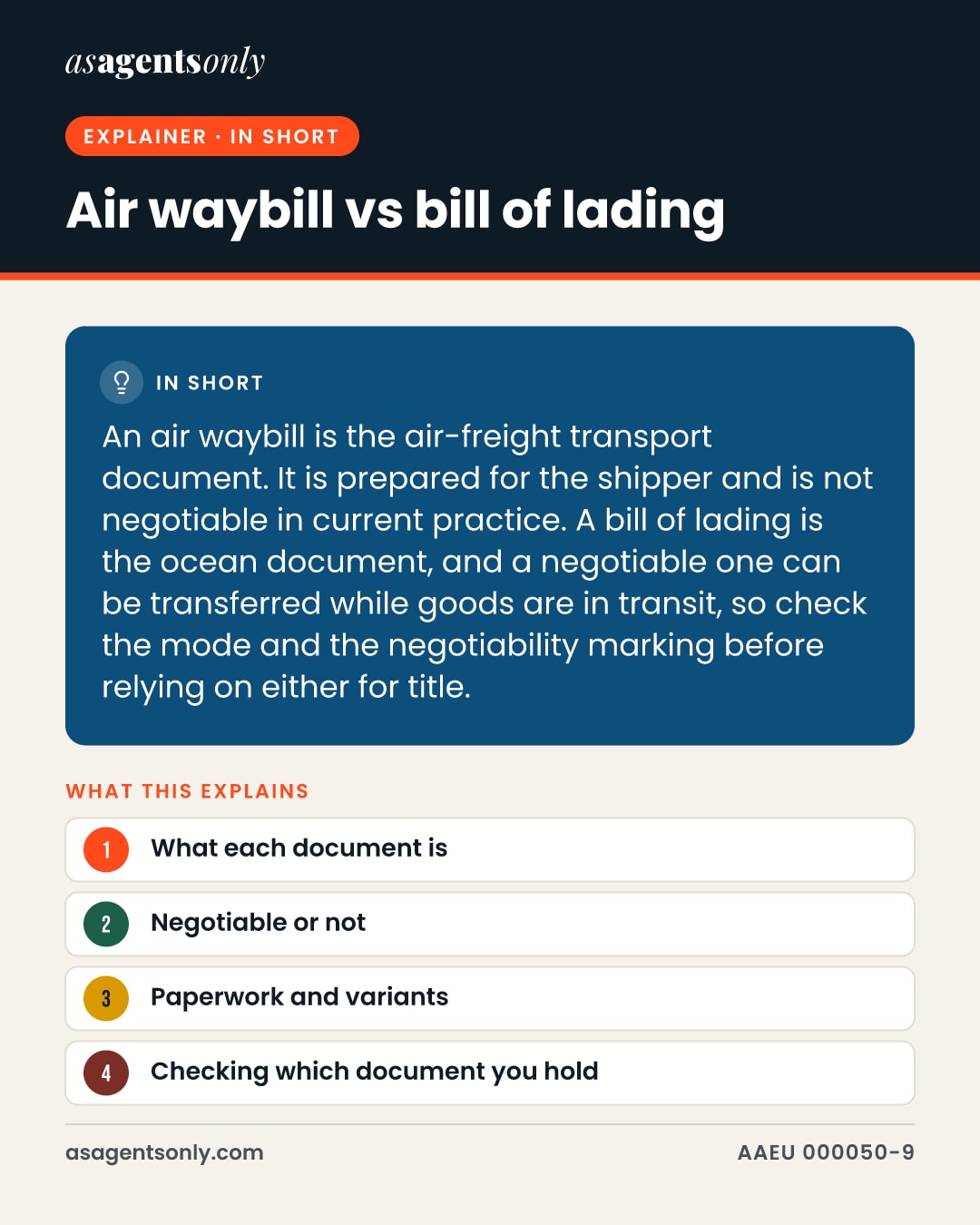
An air waybill is the air-freight transport document. It is prepared for the shipper and is not negotiable in current practice. A bill of lading is the ocean document, and a negotiable one can be transferred while goods are in transit, so check the mode and the negotiability marking before relying on either for title.
Shippers, forwarders and carriers often treat these two documents as interchangeable. They are not. Both evidence a contract of carriage, but they belong to different modes of transport, and only some bills of lading can pass ownership of goods while they are moving.
What each document is
The air waybill is the transport document for air freight. It is prepared by or on behalf of the shipper and evidences the contract between the shipper and the aircraft operator. The International Civil Aviation Organization describes its two main functions as a contract of carriage and evidence of receipt of the goods.
A bill of lading is the document for ocean shipments. It is a contract between the owner of the goods and the carrier. A UNECE overview lists the bill of lading for sea freight, and separate waybills for air, road and rail, so the mode usually decides which document applies.
Negotiable or not
In current practice, air waybills are usually not negotiable. The UNCTAD air carriage guide explains that air transport is fast, so there is normally no need for a document that enables the sale of goods in transit. The U.S. International Trade Administration says air waybills are shipper-specific and are not negotiable, unlike the 'order' bills of lading used for vessel shipments.
Bills of lading can be either straight or negotiable. A straight bill of lading is non-negotiable. A shipper's order bill of lading is negotiable and can be used to buy, sell or trade the goods while they are in transit. A negotiable bill of lading made out 'to order' lets the right to the goods pass along a chain of holders.
Legal labels differ by country. The UK government guide describes the air waybill as a document of title that proves ownership, and also as non-negotiable. UNCTAD notes that some jurisdictions have clear rules on how these documents differ, while others have none, so check the rules that apply to your trade lane.
Paperwork and variants
For air freight, IATA states that the air waybill is required for each shipment and needs a minimum of eight copies. The shipper is responsible for the accuracy of the information on it. Under IATA Resolution 672, an electronic air waybill can replace the paper version, so the requirement for a paper air waybill has been removed.
Forwarders consolidating cargo use two types. A master air waybill is issued to a forwarder by the airline. A house air waybill is issued by the forwarder to each shipper whose goods are consolidated.
On the ocean side, a sea waybill is a non-negotiable document that evidences a contract for carriage by sea. A non-vessel-operating common carrier issues its own house bill of lading, and the U.S. Federal Maritime Commission regulates those carriers.
Checking which document you hold
Read the document before you rely on it. An air waybill is generally marked as non-negotiable, so it cannot be endorsed to a new owner. If you plan to sell the goods in transit or use the documents to secure payment, you need a negotiable bill of lading, which an air waybill cannot provide.
Ask your buyer, bank and carrier which document each requires, and confirm the national rules that apply at origin and destination. The same cargo can need different documents depending on the country and the commercial terms.
Side by side
| Compared | Air waybill | Bill of lading |
|---|---|---|
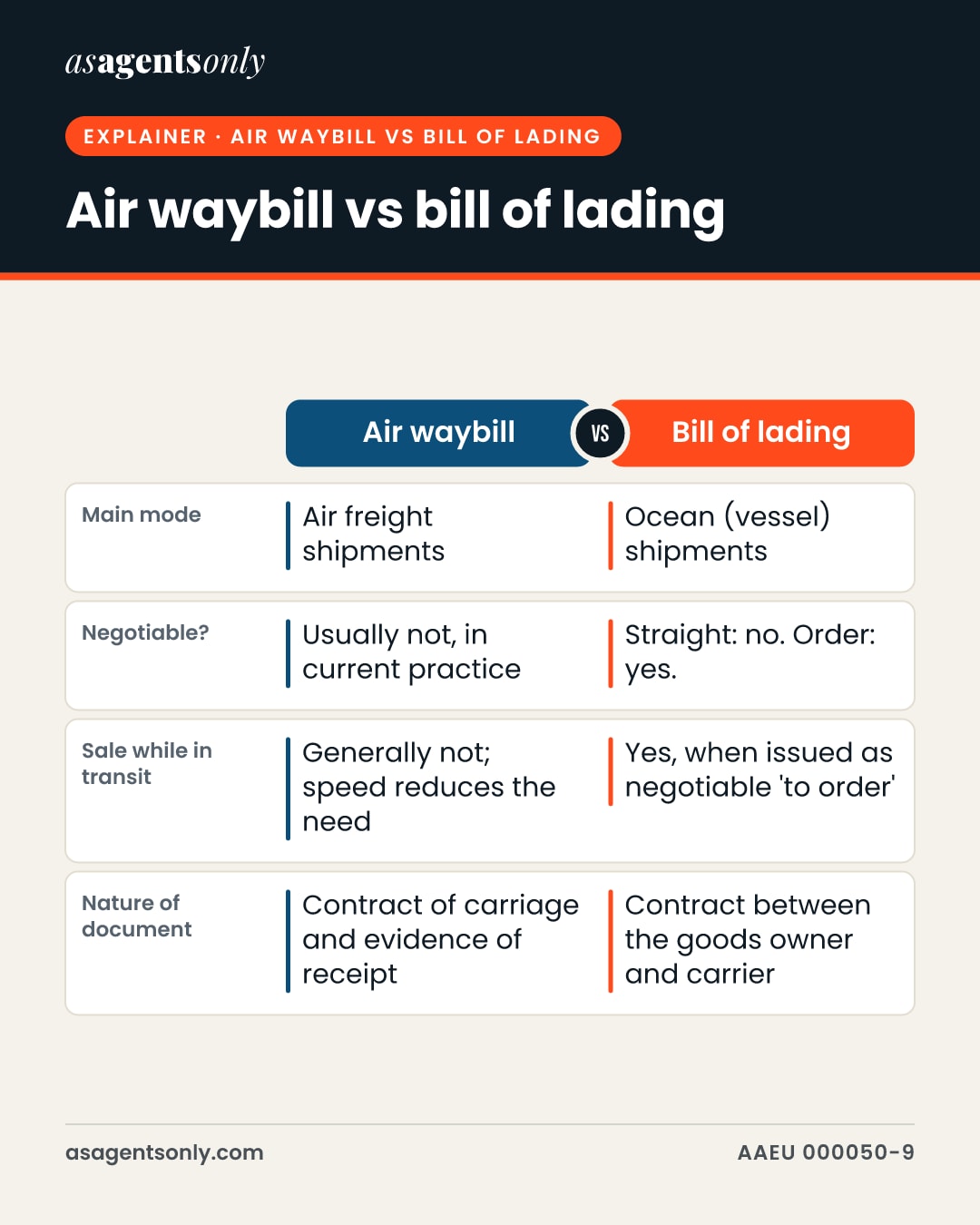
| Main mode | Air freight shipments | Ocean (vessel) shipments |
| Negotiable? | Usually not, in current practice | Straight: no. Order: yes. |
| Sale while in transit | Generally not; speed reduces the need | Yes, when issued as negotiable 'to order' |
| Nature of document | Contract of carriage and evidence of receipt | Contract between the goods owner and carrier |
Example
Illustrative example only, not a real shipment: a seller in one country ships machine parts by air to a buyer abroad. The forwarder receives a house air waybill from its consolidator, and the airline's master air waybill covers the consolidated load. The buyer cannot sell the parts to a third party while they are in the air, because the air waybill does not transfer title. If the same parts moved by sea on a negotiable 'to order' bill of lading, the seller could endorse that document to a new buyer during the voyage.
In pictures
The same facts as this page, as images to save or share. Tap one to open it full size.
Official sources
- Common Export DocumentsU.S. International Trade Administration
- 15 CFR 30.1 Purpose and definitionsU.S. Government (eCFR)
- Waybill BRSUNECE
- Understanding international trade termsGOV.UK (business.gov.uk)
- Ocean Transportation IntermediariesFederal Maritime Commission
Claims ledger: 24 facts and where each comes from
- An air waybill is prepared by or on behalf of a shipper and evidences the contract between the shipper and the aircraft operator.5
- The air waybill has two main functions: a contract of carriage and evidence of the receipt of goods.5
- Air waybills are usually not negotiable in current practice, because air transport is fast and there is normally no need for a document that enables sale of goods in transit.3
- Air waybills are shipper-specific and are not negotiable documents, unlike 'order' bills of lading used for vessel shipments.1
- A shipper's order bill of lading is negotiable and can be used to buy, sell or trade the goods while in transit.1
- A straight bill of lading is non-negotiable.1
- A bill of lading is a contract between the owner of the goods and the carrier.1
- A negotiable bill of lading made out to order allows the right embodied in the document to be transferred along a chain of parties.2
- UNCTAD notes that in some jurisdictions there is clear, defined opinion on how waybills and bills of lading differ, while in other jurisdictions there is none.2
- The UK government guide describes the air waybill as a document of title that proves ownership and as non-negotiable.10
- Waybills are either negotiable or non-negotiable, and the bill of lading is the term used for sea freight while the air waybill is used for air freight.7
- A sea waybill is a non-negotiable document that evidences a contract for the carriage of goods by sea and names the consignee to whom the carrier will deliver.12
- The Federal Maritime Commission describes a non-vessel-operating common carrier as a common carrier that issues its own house bill of lading or equivalent document and does not operate the vessels.11
- The air waybill is the shipping document used for air freight, and it is generally similar to a straight non-negotiable bill of lading and used for similar purposes.6
- An air waybill is a non-negotiable document that is required for each air cargo shipment, with a minimum of 8 copies.4
- The shipper is responsible for the validity of all information on the air waybill and is liable for any damages incurred due to incorrect information.4
- IATA Electronic Air Waybill Resolution 672 removes the requirement for a paper air waybill.8
- The Multilateral e-AWB Agreement, IATA Resolution 672, provides a single standard agreement that airlines and freight forwarders can sign once with IATA.9
- A master air waybill is issued by or on behalf of freight forwarders offering a consolidation service and specifies the contract between the forwarder and the aircraft operator.5
- A freight forwarder offering a consolidation service issues its own house air waybill to the shipper, which may act as a multimodal transport document.5
- Air waybill numbers have eleven digits, and the first three digits are the aircraft operator prefix.5
- Under the Montreal Convention 1999, the air waybill is made out by the consignor in three original parts.13
- The air waybill or cargo receipt is prima facie evidence of the conclusion of the contract and of the acceptance of the cargo.13
- A seaway bill is not a document of title, and under the UNCTAD study straight bills of lading have limited use as security for payment.2
Every figure on this page is tied to a cited source, last checked on 13 November 2026. Pages like this are re-checked every six months. Found something out of date? Tell the desk.