- How-To
- Warehousing
- 4 min read
- Last verified 19 October 2026
How to build a stable, shippable pallet load
Learn how to build a palletized unit load that holds its shape, stays inside the pallet edges, is secured, and meets wood packaging rules for export.

- Who needs this
- Shippers, packers, warehouse staff and forwarders who build or accept palletized cargo. Under the CTU Code, the packer is the party that loads or places the cargo, and that role can be held by the consignor, shipper, forwarder or carrier.
- Cost
- The CTU Code is non-mandatory guidance and sets no fee. The sources reviewed show no government fee for building a pallet load. Wood pallets that must meet ISPM 15 are treated by approved providers, who set their own prices, and no official fee is stated here.
- Time
- The sources reviewed give no standard duration for building a pallet load. Plan time for packing and securing, then for any ISPM 15 treatment and marking of wood pallets, which must happen before the wood is used for export.
- Applies to
- Worldwide
A pallet load is the unit most shippers hand to a carrier, forwarder or warehouse, so its build quality decides whether goods arrive intact. This guide covers the packing, securing and documentation steps that keep a load stable through handling and transport. The main international reference is the IMO/ILO/UNECE Code of Practice for Packing of Cargo Transport Units (CTU Code). It is guidance, not a binding law, so national and carrier rules still apply to your lane.
Step by step
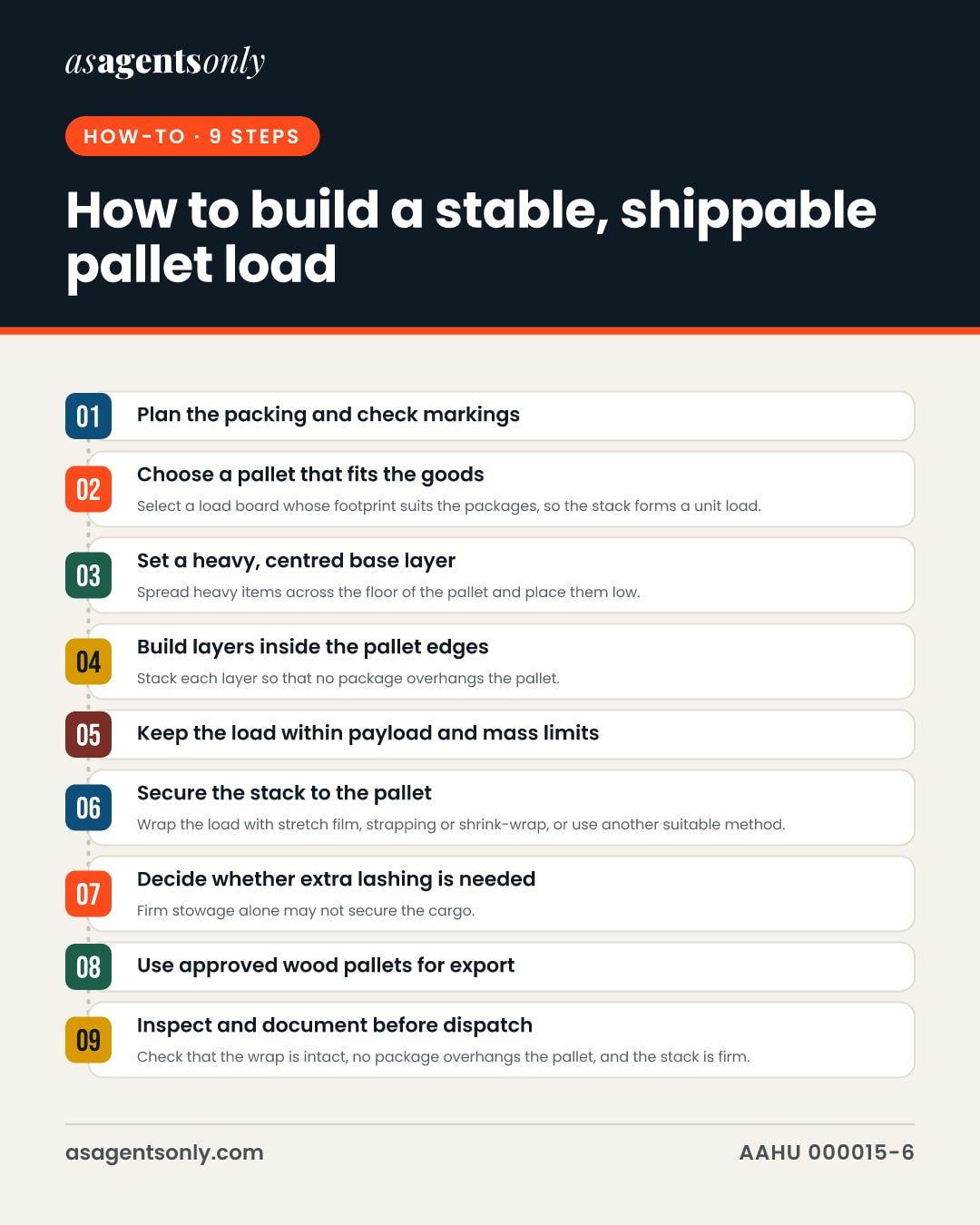
Plan the packing and check markings
Before stacking, plan the packing order and keep incompatible cargo apart, as the CTU Code asks packers to do where practical. Read the markings on each package and handle and pack it in line with them.
Choose a pallet that fits the goods
Select a load board whose footprint suits the packages, so the stack forms a unit load. If the pallet is wood and will cross a border, it must also meet the wood packaging rules of the importing country (see the treatment step below).
Set a heavy, centred base layer
Spread heavy items across the floor of the pallet and place them low. Keep the centre of gravity centred over the pallet, inside the area where packages can be placed and secured.
Build layers inside the pallet edges
Stack each layer so that no package overhangs the pallet. Offset cartons from layer to layer so the stack holds together better than with aligned columns. Stop when the load is ready to be secured, not when the pallet is full.
Keep the load within payload and mass limits
Check the permitted payload of the pallet and the transport unit, and the maximum gross mass set by the applicable road and rail rules, before you finish loading. Reduce the load if either limit would be exceeded.
Secure the stack to the pallet
Wrap the load with stretch film, strapping or shrink-wrap, or use another suitable method. Where gaps between packages and the pallet are wide, stretch wrap alone is not enough, so add strapping or another method.
Decide whether extra lashing is needed
Firm stowage alone may not secure the cargo. Select securing methods suited to the cargo, the mode of transport and the transport unit, and add lashing where the unit type or the cargo calls for it.
Use approved wood pallets for export
For shipments into countries that apply ISPM 15, use wood packaging that has been treated and marked under an approved system. Treatment should come before marking. Only an approved facility, authorized by the national plant protection organization, should apply the ISPM 15 mark.
Inspect and document before dispatch
Check that the wrap is intact, no package overhangs the pallet, and the stack is firm. Describe the goods and their packaging on the cargo documents, and give the carrier the mass of the cargo and the packing and securing material when it is needed.
Documents you will need
- A packing list that describes the goods and their packaging, with package counts written as words for small numbers
- Gross mass of the load, including the packing and securing material, when the carrier needs it
- Evidence of ISPM 15 treatment and marking for wood pallets or dunnage, if the destination applies the standard
- Any dangerous goods declaration and segregation information for the load, under the rules that apply to the mode of transport
- Package markings and handling instructions, such as the direction of use, to show on the outside of the load
Common mistakes
- Relying on stretch wrap alone to hold a loose or gappy load; where gaps are wide, add strapping or another suitable method.
- Letting cartons overhang the pallet edge; keep every package inside the cargo area so it cannot shift or protrude.
- Shipping untreated or unmarked wood pallets to a country that applies ISPM 15; confirm the destination rule before you build the load.
- Loading heavy items high or off-centre; place them low and centre the weight to keep the centre of gravity correct.
- Exceeding the payload or mass limit to fit one more layer; stop loading when the limit is reached.
In pictures
The same facts as this page, as images to save or share. Tap one to open it full size.
Official sources
- Code of Practice for Packing of Cargo Transport Units (CTU Code) - 2025 revisionUNECE Inland Transport Committee, Working Party on Intermodal Transport and Logistics
- Code of Practice for Packing of Cargo Transport Units (2014 edition)International Labour Organization
- Code of Practice for Packing of Cargo Transport Units (definitions and section 7)International Labour Organization
- Wood Packaging MaterialsU.S. Customs and Border Protection
- Explanatory document for ISPM 15 (Regulation of wood packaging material in international trade)International Plant Protection Convention Secretariat, FAO
- Requirements for wood packaging and dunnageEuropean Commission, Food Safety
Claims ledger: 27 facts and where each comes from
- The CTU Code is a non-mandatory global code of practice for the handling and packing of shipping containers for transportation by sea and land.1
- The 2025 revision of the CTU Code was finalised by the ILO-IMO-ECE Group of Experts at its meeting held from 15 to 19 December 2025.2
- The aim of the CTU Code is to give advice on the safe packing of cargo transport units (CTUs) to those responsible for the packing and securing of the cargo.5
- The packer is the party that loads, places or fills the cargo within or on the CTU; the packer may be contracted by the consignor, the shipper, the freight forwarder or the carrier.5
- Packers should ensure that the packing process is planned in advance as far as practical and that incompatible cargoes are segregated.5
- Packages should be handled and packed in accordance with their markings (if any).5
- A unit load is a palletized load or prepacked unit with a footprint conforming to pallet dimensions and suitable for loading into a CTU.4
- Do distribute heavy cargo appropriately over the floor area.5
- Do load with the centre of gravity correctly located in the CTU.5
- The cargo deck is the area within the CTU boundaries onto which packages may be placed and secured.3
- Any kind of palletized cargo can be packed and preferably stowed from boundary to boundary.5
- Packages cannot leave the cargo space or protrude outside the cargo deck.6
- Do not exceed the permitted payload limits of the unit or the maximum allowed gross mass according to the CSC, national road and rail regulations.5
- Whether firm stowage alone provides sufficient cargo securing depends on the type of CTU, and additional securing may be needed.5
- Do select the securing methods best adapted to the characteristics of the cargo, the mode of transport and the properties of the CTU.5
- Palletized loads can be secured by strapping, shrink-wrapping, stretch-wrapping or other suitable means.4
- The use of stretch wrapping to secure a box to the pallet is not recommended where the gaps between the box and the pallet are excessive.6
- Where cargo is carried by road or rail only, the packer need only provide the mass of the cargo and any packing and securing material to the carrier when the tare of the transport vehicle is not known.7
- A description of the cargo should include a description of the goods and the packaging.7
- The U.S. Department of Agriculture adopted international standards for wood packaging materials established by the International Plant Protection Convention in 2002, known as ISPM 15.8
- Most wood packaging materials are covered by the rule, including pallets, crates, boxes, and pieces of wood used to support or brace cargo.8
- To comply with ISPM 15, wood packaging material must undergo one of three approved treatments: heat treatment, fumigation with methyl bromide, or dielectric heating.8
- Heat treatment requires the wood to reach a minimum core temperature of 56°C for at least 30 minutes.8
- Approval of a facility to use the ISPM 15 mark should only be given by a national plant protection organization or an organization officially authorized by it.9
- In general, treatment should precede the marking of the wood packaging material.9
- All wood packaging material and dunnage from non-EU countries must be heat treated or fumigated in line with ISPM15 procedures, officially marked, and debarked.10
- Many incidents in transport are attributed to poor practices in the packing of cargo transport units, including inadequate securing of the cargo, overloading, and incorrect declaration of contents.3
Every figure on this page is tied to a cited source, last checked on 19 October 2026. Pages like this are re-checked every three months. Found something out of date? Tell the desk.