- Explainer
- Warehousing
- 4 min read
- Last verified 16 October 2026
AMRs vs AGVs in the warehouse
How automated guided vehicles (AGVs) and autonomous mobile robots (AMRs) differ in routing, flexibility and use, and which safety standard applies.

In short
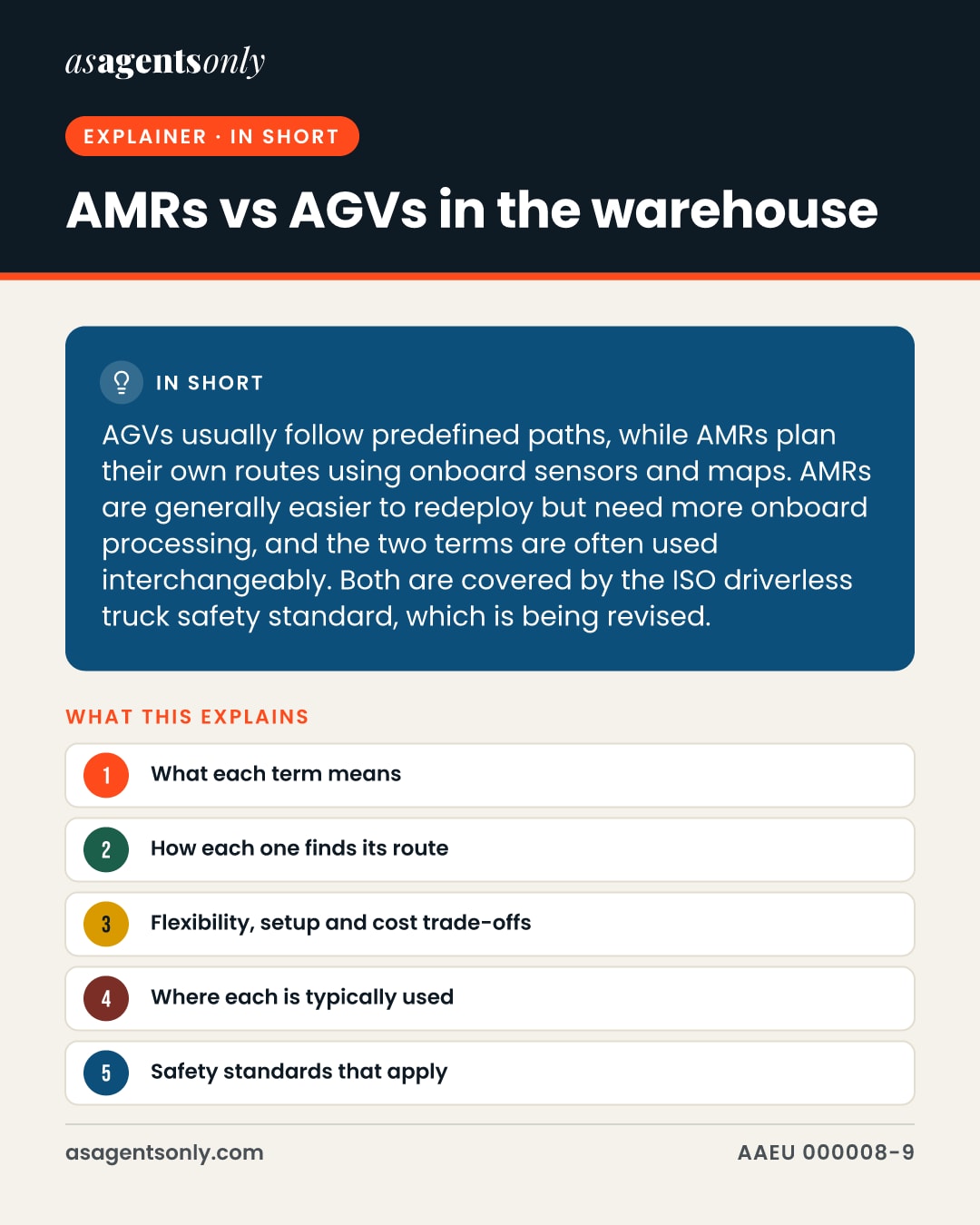
AGVs usually follow predefined paths, while AMRs plan their own routes using onboard sensors and maps. AMRs are generally easier to redeploy but need more onboard processing, and the two terms are often used interchangeably. Both are covered by the ISO driverless truck safety standard, which is being revised.
Warehouses use two families of driverless vehicles to move goods across the floor. Both are wheel-based load carriers that run without a human driver, but they differ in how they decide where to go. Industry usage is not fully consistent, so this explainer describes the usual distinction and notes where sources disagree.
What each term means
The Mobile Automation Group (MAG), part of MHI, describes both AGVs and AMRs as computer-controlled, wheel-based load carriers that are normally battery powered and run on a plant or warehouse floor.
The same group names path determination as the main difference between the two. Academic work is less firm: a 2026 preprint notes that the two terms are often used interchangeably in the literature, and one author treats an AGV as an AMR once it meets certain autonomy criteria.
For a buyer or operator, the practical question is less the label than what the vehicle does at the site: how it finds its route, how much it needs installed in the building, and what loads it carries.
How each one finds its route
Most AGVs follow predefined paths, although there may be areas where they have more freedom. Guidance can come from an installed wire, a magnetic strip, or a set of sensors that follow fixed markings, so the route is largely set in advance.
AMRs can determine their own path. They build or use a map of the site, localize themselves with onboard sensors, and follow suggested paths when those exist. A patent filing describes AMR navigation as relying on a map plus location-determining methods such as simultaneous localization and mapping.
Trade press reports that some AGVs have started using natural-environment navigation, which narrows the gap. The gap is also narrowing in the other direction, since AMR-style navigation is now applied to robotic pallet lift trucks and tuggers.
Flexibility, setup and cost trade-offs
A patent filing states that AMRs are generally simpler to deploy and reconfigure, but they need heavier onboard processing and sensing. An AGV system that depends on installed guidance may take more work to change when the layout changes.
Trade press also argues that size alone no longer decides the choice. One vendor executive is quoted as saying that form factor alone is not a reliable guide, so the task mix and the level of central control should drive the decision.
The right choice depends on how often routes change, how many loads move per shift, and whether a site already has guidance infrastructure. Each site should test these factors rather than rely on a general rule.
Where each is typically used
Trade press reports that AMRs are especially visible in goods-to-person picking, where shelving or totes are brought to a picker. AGVs have a long record of moving totes and loads along fixed routes.
The boundary is blurring. One AGV supplier has piloted goods-to-person systems with AGVs and mobile storage units, while AMR vendors offer models that move pallet-sized loads.
For a warehouse with a stable, repeated route, an AGV may be a natural fit. For a site with changing layouts or mixed picking tasks, an AMR may be worth evaluating. Neither type is automatically the better option.
Safety standards that apply
ISO 3691-4 is the International Standard for safety requirements for driverless industrial trucks and their systems. Its 2023 edition is published, and the standard lists both "automated guided vehicle" and "autonomous mobile robot" among the names used for these trucks.
The standard does not cover trucks guided only by mechanical means such as rails, or remotely controlled trucks. A revised version, ISO/DIS 3691-4, is a draft that will replace the 2023 edition, and its voting period closed in September 2026. Check ISO for the current status before relying on either document.
MHI panelists have suggested that users weigh a vehicle's size and the harm it could cause to a person at full speed when deciding which standard applies. National regulators may add their own requirements, so check with the authority in the country where the vehicles will operate.
Side by side
| Compared | AGV | AMR |
|---|---|---|
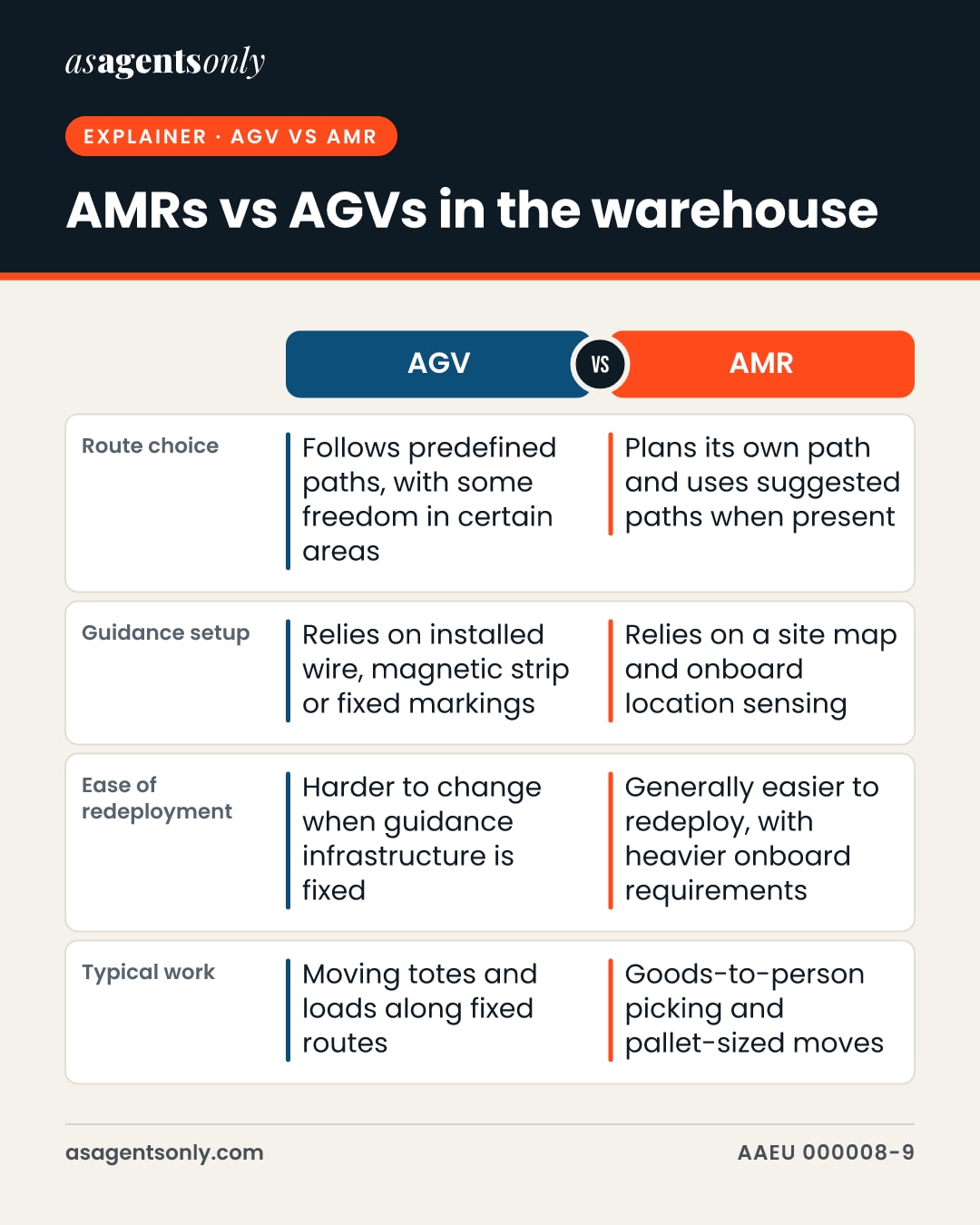
| Route choice | Follows predefined paths, with some freedom in certain areas | Plans its own path and uses suggested paths when present |
| Guidance setup | Relies on installed wire, magnetic strip or fixed markings | Relies on a site map and onboard location sensing |
| Ease of redeployment | Harder to change when guidance infrastructure is fixed | Generally easier to redeploy, with heavier onboard requirements |
| Typical work | Moving totes and loads along fixed routes | Goods-to-person picking and pallet-sized moves |
Example
Illustrative example (not a real site): A distribution center has a fixed tug route that carries carts between the receiving dock and a staging area on the same loop every shift. It also has a picking zone where the layout changes often and shelving must be brought to pickers. A planner might assign the fixed tug route to AGVs that follow installed guidance, and test AMRs in the picking zone because they plan their own routes and are generally easier to redeploy when the layout changes. Both vehicle types would then be reviewed against the current ISO 3691-4 edition and local rules before purchase.
In pictures
The same facts as this page, as images to save or share. Tap one to open it full size.
Official sources
- ISO 3691-4:2023 - Driverless industrial trucks and their systemsInternational Organization for Standardization (ISO)
- ISO/DIS 3691-4 - Driverless industrial trucks and their systems (draft)International Organization for Standardization (ISO)
- MAG - Mobile Automation GroupMHI, Mobile Automation Group
- AGVs gain in flexibility and applicationsSupply Chain 24/7
- AGVs set new standards for inventory transportationSupply Chain 24/7
- Opportunistic information and inventory exchange via serendipitous encounters of autonomous mobile robots (patent US 11829127)United States Patent and Trademark Office (USPTO)
- Updated Safety Standards For Autonomous Vehicles Detailed In MAG's MODEX 2020 Education SessionMHI (Material Handling Institute)
Claims ledger: 20 facts and where each comes from
- The Mobile Automation Group describes AGVs and AMRs as computer-controlled, wheel-based load carriers, normally battery powered, that run on a plant or warehouse floor.3
- The Mobile Automation Group names how each vehicle determines the path it follows as the main difference between AGVs and AMRs.3
- Most AGVs stick to predefined paths, though some areas of a plant or warehouse may give them more freedom.3
- AMRs decide their own route, although they will use suggested paths when those exist.3
- A patent filing says AGVs can be guided by a deployed wire, a magnetic strip, or a set of sensors, with paths planned in advance.6
- A patent filing says AMRs navigate using a map of the location and onboard location mechanisms, such as SLAM.6
- A patent filing describes AMRs as generally easier to deploy and reconfigure than AGVs, but needing more complex onboard processing and sensors.6
- Trade press reports that some AGVs have started using natural-environment guidance, similar to AMR navigation.5
- Trade press reports that AMRs are prominent in goods-to-person picking.5
- Trade press reports that AMR-style navigation is now applied to robotic lift trucks and tuggers that move pallets.4
- A trade press executive argues that larger loads no longer automatically call for AGVs.4
- A preprint notes that the two terms are often used interchangeably in the literature.8
- ISO 3691-4:2023 is listed as published, with a publication date of June 2023.1
- ISO notes that a next version of ISO 3691-4 is under development.1
- ISO/DIS 3691-4 is a draft that will replace ISO 3691-4:2023, and its voting closed on 2026-09-10.2
- ISO/DIS 3691-4 lists automated guided vehicle and autonomous mobile robot among the names used for driverless industrial trucks.2
- The standard's definition treats a powered truck designed to operate automatically as a driverless industrial truck.2
- The standard does not apply to trucks guided only by mechanical means, such as rails, or to remotely controlled trucks.2
- MHI panelists suggested weighing vehicle size and the potential damage a vehicle could do to a person at full speed when choosing the applicable standard.7
- MHI panelists observed that the standards tend to address either AGVs or AMRs, without significant overlap.7
Every figure on this page is tied to a cited source, last checked on 16 October 2026. Pages like this are re-checked every six months. Found something out of date? Tell the desk.