- Explainer
- Rates
- 4 min read
- Last verified 19 October 2026
Peak season and congestion surcharges explained
What peak season and congestion surcharges are, how carriers justify them, and the U.S. notice rules and checks that apply to them.

In short
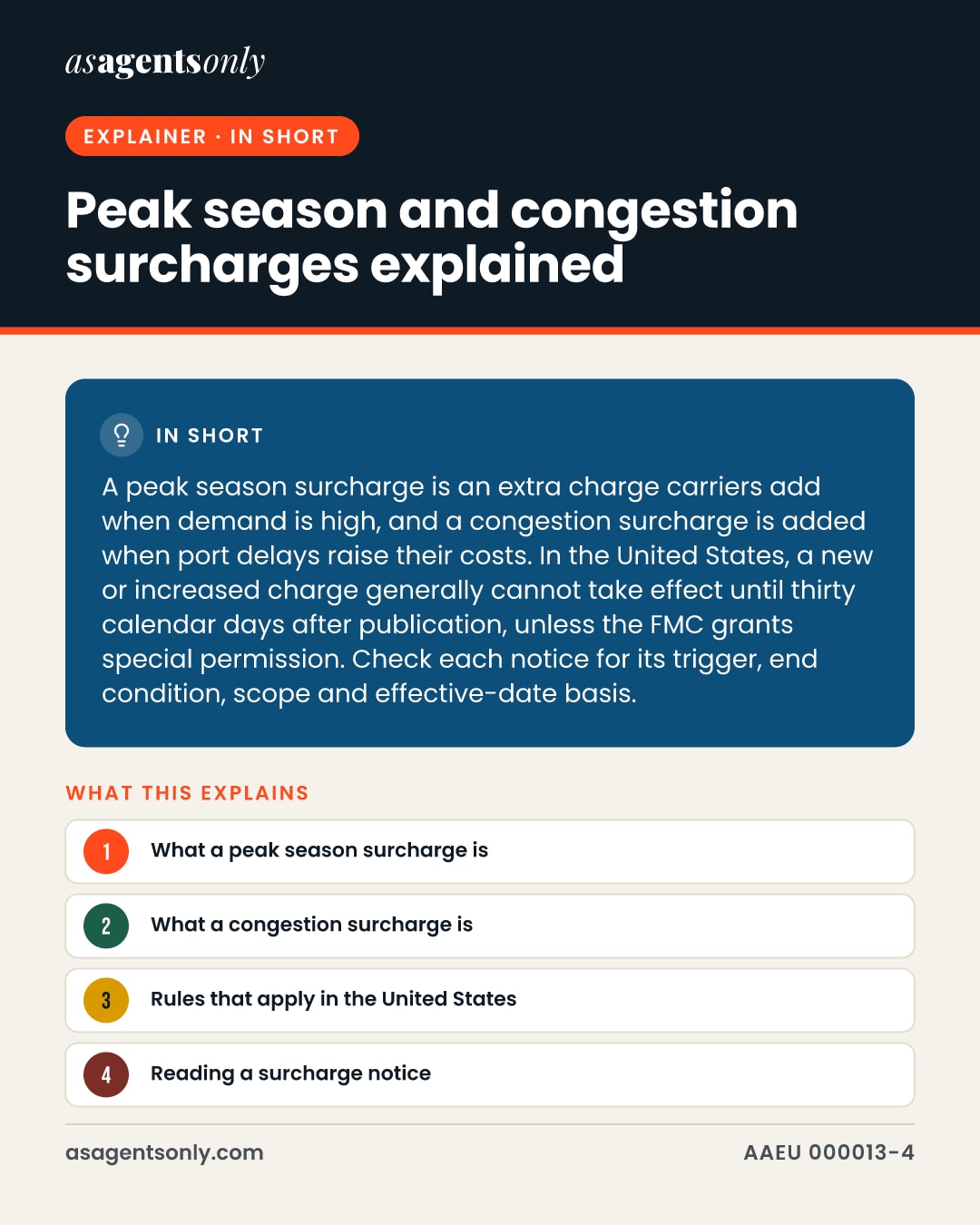
A peak season surcharge is an extra charge carriers add when demand is high, and a congestion surcharge is added when port delays raise their costs. In the United States, a new or increased charge generally cannot take effect until thirty calendar days after publication, unless the FMC grants special permission. Check each notice for its trigger, end condition, scope and effective-date basis.
Ocean carriers add charges on top of base freight when demand or port conditions push up their costs. Two of the most common are the peak season surcharge (PSS) and the congestion surcharge. They are often confused, but they respond to different conditions. This explainer covers the U.S. Federal Maritime Commission (FMC) rules that apply to carriers' ocean tariffs and what to check on a notice. Rules in other countries and trades vary, and this page does not verify them.
What a peak season surcharge is
A peak season surcharge is a charge a carrier adds when many shippers want space at the same time. Carriers have described it as a way to handle higher volume and higher transport costs. In one FMC proceeding record, a carrier witness said the charge is usually applied when the market calls for higher rates because demand is up, and that paying it does not guarantee vessel space. The same record describes the timing as typically falling in a July and August window, when importers stock up for the year-end season.
Notices usually state a start date and an end. Many carriers keep a PSS in force until further notice. Others set fixed windows. A 2026 notice from Tropical Shipping, for example, set a window running from October 4, 2026 to March 7, 2027. Read the window, not only the start date, before you book.
What a congestion surcharge is
A congestion surcharge is added when delays at a port raise a carrier's costs. Carriers say the charge recovers the extra cost of ships waiting for berths and of extra handling. In August 2026, RCL applied a port congestion surcharge on import shipments to Khor Fakkan, United Arab Emirates, because vessel waiting times there exceeded seven days. The charge was payable by the consignee locally before cargo release, on top of base freight.
Congestion can reach well beyond one port. In June 2026, a trade publication reported that container ports had reached a four-year high for ships waiting to berth. A congestion surcharge is therefore a signal to check the port, not just the carrier.
Rules that apply in the United States
For ocean cargo in U.S. foreign commerce, the FMC's tariff rules set the baseline. Under 46 CFR 520.8, a new or increased charge that raises a shipper's cost may not take effect sooner than thirty calendar days after publication. The same section allows certain charges that a carrier only collects for another party to take effect on publication, but carriers may not mark those up above cost.
The FMC can permit less than the statutory notice for good cause through special permission under 46 U.S.C. 40501(e). Notice is also not the same as approval. In 2021, the FMC asked eight carriers to show that their congestion surcharges had proper notice, a defined purpose, a clear trigger and a clear end condition. At the time, the agency reported that no action had yet been taken against any carrier. Early in the Red Sea crisis, several carriers asked the FMC to waive the 30-day notice for surcharges, and the FMC granted those permissions. Confirm current rules in the official eCFR text before you rely on them.
Reading a surcharge notice
Check five things: the trigger, the end condition, the scope (origin, destination, equipment, cargo and vessel), the date basis, and whether the charge sits on top of base freight. The date basis matters. MSC's 2026 peak season surcharge from North Europe to the United States was tied to the gate-in date. Maersk uses a Price Calculation Date, and in FMC-regulated trades that date is the last container gate-in date. Hapag-Lloyd's Southwest Africa surcharge applies to cargo loaded on board from a stated date. Match the notice's date rule to your own shipment dates.
Surcharges are rarely the whole bill. CMA CGM says its peak season surcharges are additional to basic freight, and that bunker-related, terminal handling and other local charges may also apply. Congestion charges can also be settled in different ways. CMA CGM's Conakry charge is settled with freight and is subject to space availability. Ask the carrier to confirm in writing what is charged, to which cargo, and when it ends.
Side by side
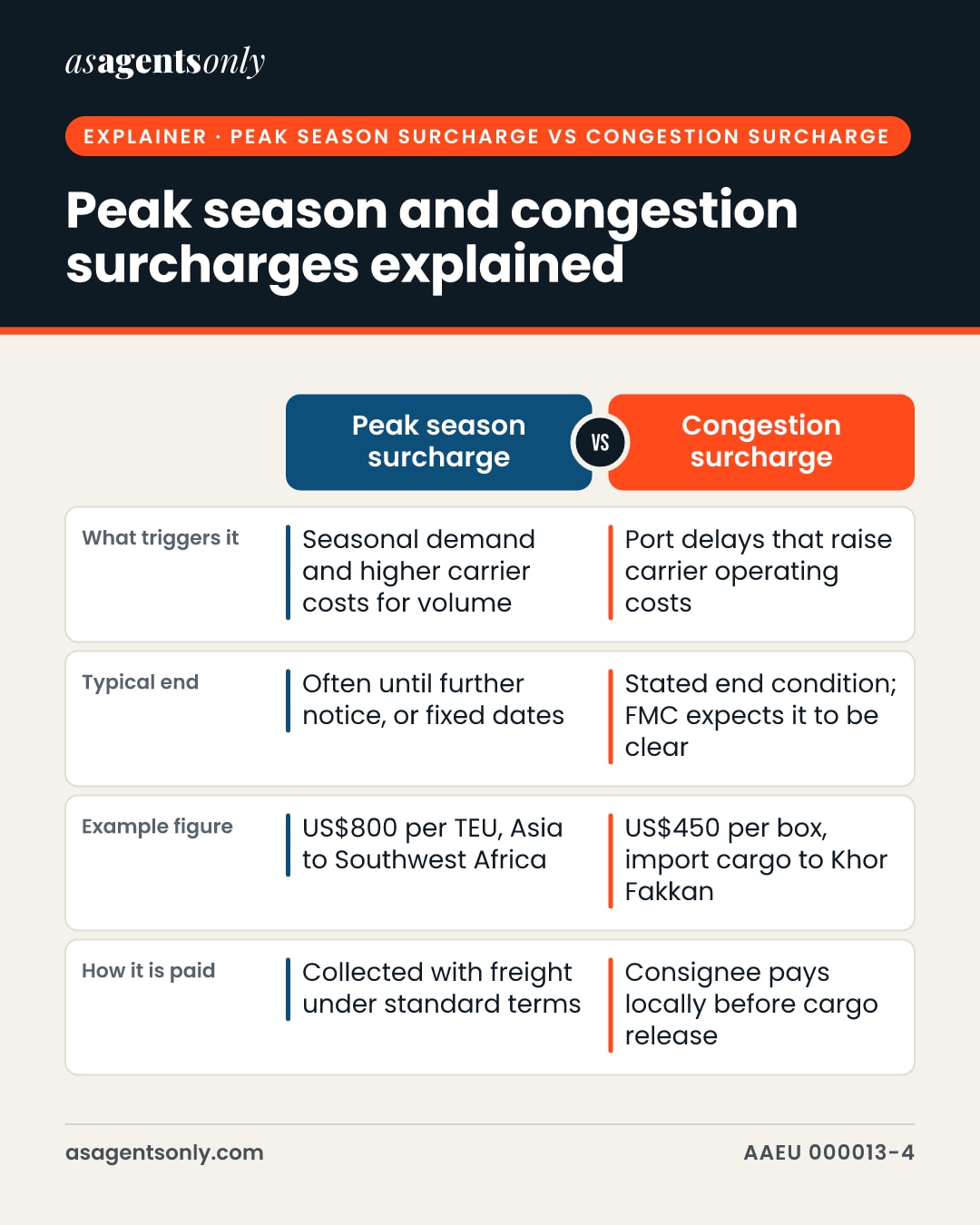
| Compared | Peak season surcharge | Congestion surcharge |
|---|---|---|
| What triggers it | Seasonal demand and higher carrier costs for volume | Port delays that raise carrier operating costs |
| Typical end | Often until further notice, or fixed dates | Stated end condition; FMC expects it to be clear |
| Example figure | US$800 per TEU, Asia to Southwest Africa | US$450 per box, import cargo to Khor Fakkan |
| How it is paid | Collected with freight under standard terms | Consignee pays locally before cargo release |
Example
Real case: RCL published a port congestion surcharge notice on August 23, 2026, for import shipments to Khor Fakkan, UAE, at US$450 per box, where vessel waits exceeded seven days. The charge applies only to cargo already picked up, gated in or on the water aboard the listed vessels and voyages. Illustrative only: a consignee with ten boxes on one of those listed voyages would see the charge applied to each box and would pay it locally before release. A box on a different vessel would not fall under this notice, which is why scope checks matter.
In pictures
The same facts as this page, as images to save or share. Tap one to open it full size.
Official sources
- 46 CFR 520.8 Effective datesOffice of the Federal Register, National Archives (eCFR)
- 46 CFR 520.14 Special permissionOffice of the Federal Register, National Archives (eCFR)
- FMC opens new inquiry into carrier surchargesPort Technology International
- FMC responds to shipper complaints with probe into shipping surchargesThe Loadstar, published 5 August 2021
- FMC urged to evaluate surcharges amid Red Sea crisisSupply Chain Dive
- MSC introduces peak season surcharge from North Europe to North AmericaContainer News, published 18 July 2026
- Maersk introduces peak season surcharges on key trade routesContainer News, published 23 April 2026
- Hapag-Lloyd updates Southwest Africa surchargeContainer News, published 14 October 2026
- RCL introduces congestion surcharge for Khor Fakkan shipmentsContainer News, published 23 August 2026
- CMA CGM introduces reefer port congestion surcharge for ConakryContainer News, published 7 January 2026
- Rate rises loom as port congestion hits four-year highThe Loadstar, published 30 June 2026
- Tropical Shipping Announces a Peak Season Surcharge Effective October 4th, 2026 through March 7th, 2027Tropical Shipping, published 8 September 2026
- Federal Maritime Commission docket record, Yang Ming testimony excerptsFederal Maritime Commission
Claims ledger: 22 facts and where each comes from
- Under 46 CFR 520.8, a new or increased charge that raises a shipper's cost may not take effect sooner than thirty calendar days after publication.1
- Under 46 CFR 520.8, certain charges that a carrier only collects for an outside agency may take effect on publication, but carriers may not mark them up above cost.1
- Under 46 U.S.C. 40501(e), the FMC may, for good cause shown, permit rate increases on less than the statutory notice.2
- Ocean carriers must provide shippers a 30-day notice and keep published tariffs clear and definite.3
- The FMC will assess whether a surcharge followed proper notice, had a clearly defined purpose, and had a clear trigger and a clear end condition.5
- In August 2021, the FMC's Bureau of Enforcement asked eight carriers, including CMA CGM, Hapag-Lloyd, HMM, Matson, MSC, OOCL, SM Line and Zim, for details on congestion surcharges, with responses due 13 August.4
- Early in the Red Sea crisis, carriers asked the FMC to waive the 30-day notice for surcharges, and the FMC granted those permissions.6
- At the time of the FMC inquiry, no action had yet been taken against any ocean carrier.16
- A carrier witness described peak season surcharges as usually applied when the market warrants an increase in rates due to higher demand.15
- A carrier witness said a peak season surcharge does not guarantee space, and that such charges typically occur in a July and August time frame.15
- The peak season surcharge is designed to deal with increased volume and the higher transportation costs carriers face.15
- Tropical Shipping's Peak Season Surcharge is effective for all cargo received from October 4th, 2026 through March 7th, 2027.14
- MSC's peak season surcharge from North Europe to the United States is US$1,000 for 40-foot dry and high-cube containers, based on gate-in date, and remains in force until further notice.7
- In FMC-regulated trades, Maersk's peak season surcharge date is the last container gate-in date, and the surcharge is collected in line with standard freight payment terms.8
- Hapag-Lloyd's updated peak season surcharge of US$800 per TEU applies to cargo loaded on board from 25 October 2026 and remains valid until further notice.10
- CMA CGM's peak season surcharges are additional to basic freight rates, and bunker-related, terminal handling and other local charges may also apply.9
- RCL published its Port Congestion Surcharge notice on August 23, 2026.11
- RCL's Port Congestion Surcharge is US$450 per box on import shipments to Khor Fakkan, UAE, where vessel waiting times exceed seven days.11
- Consignees must pay the RCL charge locally at Khor Fakkan before cargo is released, and it applies in addition to base freight, fuel adjustments and standard terminal handling charges.11
- The RCL surcharge applies to cargo already picked up, gated in or on the water aboard the designated vessels.11
- CMA CGM's Port Congestion Surcharge for Conakry is USD 1,500 or EUR 1,300 per TEU, settled with freight, and subject to space availability.12
- Congestion in container ports has reached a four-year high, with nearly 3.7m teu, or 11% of the global fleet, tied up awaiting berths.13
Every figure on this page is tied to a cited source, last checked on 19 October 2026. Pages like this are re-checked every six months. Found something out of date? Tell the desk.