- How-To
- Warehousing
- 4 min read
- Last verified 15 October 2026
How to stuff and secure cargo in a container
Learn how to load, secure and seal cargo in a container so it arrives safely, using the IMO/ILO/UNECE CTU Code and the SOLAS verified gross mass rule.

- Who needs this
- The packer, which is the party that loads, places or fills the cargo in or on the unit. The packer may be the consignor, the shipper, a freight forwarder or the carrier, depending on the contract. Warehouse staff, forwarders and drivers who handle the loaded unit also need the same securing knowledge.
- Cost
- No government fee is stated for the CTU Code, which can be downloaded free after completing a short registration form. The sources reviewed give no fee for weighing a packed container for the verified gross mass requirement; weighing charges are set by the weighbridge or service provider.
- Time
- The sources reviewed do not give a fixed duration for stuffing and securing. Planning the packing in advance and obtaining the verified gross mass early enough for the ship stowage plan are the stages that usually take the most time.
- Applies to
- Worldwide
This guide explains how cargo is packed, blocked, lashed and sealed inside a freight container before it moves by sea, road, rail or a combination. The main reference is the IMO/ILO/UNECE Code of Practice for Packing of Cargo Transport Units (CTU Code), which gives advice for everyone in the chain, from the packer to the people who unpack the unit. The Code is guidance, so national and carrier rules still apply on top of it.
Step by step
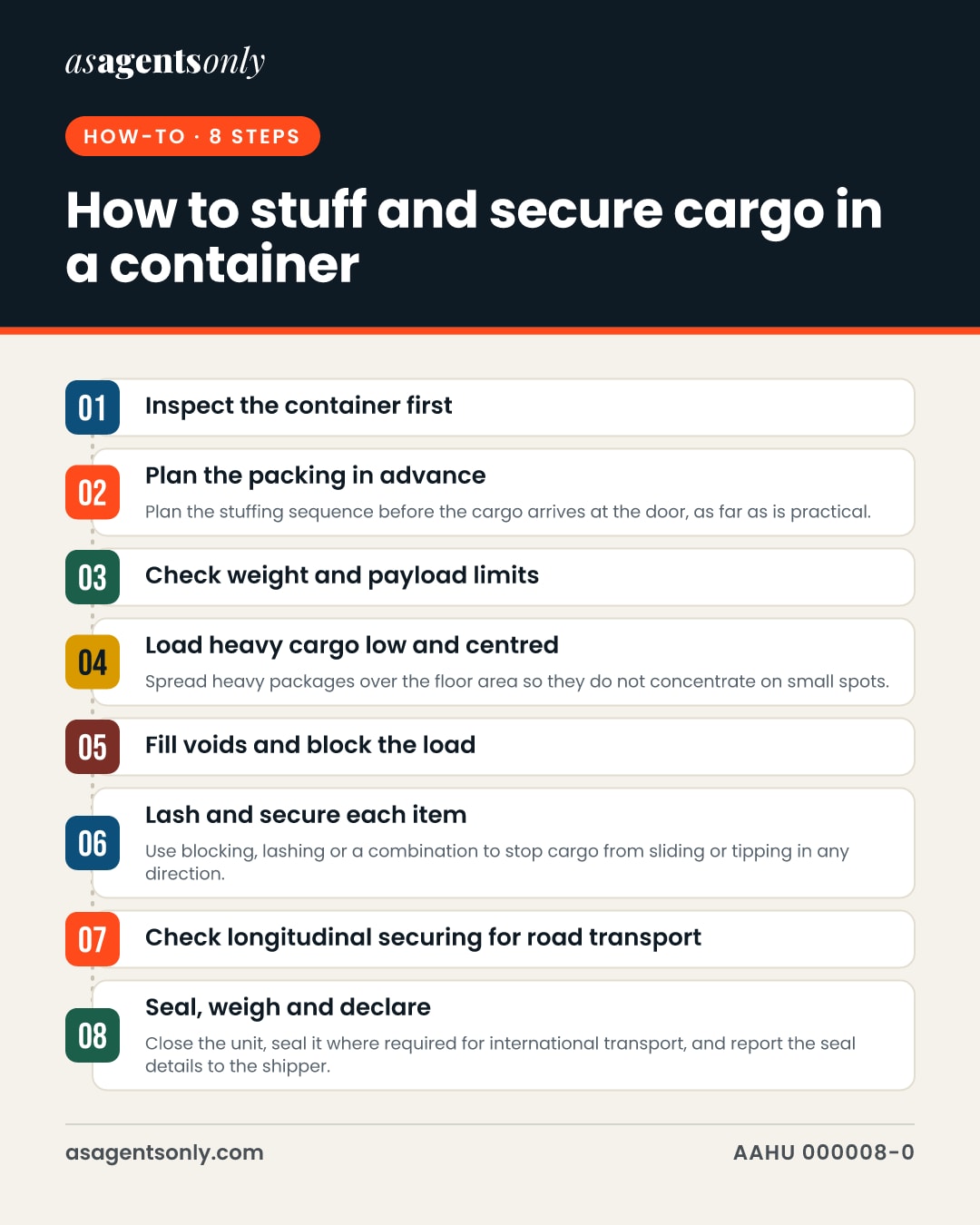
Inspect the container first
Before loading, check that the unit is clean and free from contamination, because the Code says all CTUs should be provided clean. Confirm the unit is suitable for the cargo, such as a closed or sheeted container for goods sensitive to rain, dust or theft. Record the unit number so it can be matched to the transport documents.
Plan the packing in advance
Plan the stuffing sequence before the cargo arrives at the door, as far as is practical. Keep incompatible cargoes apart, and follow any special handling instructions for the goods. Dangerous goods must be packed according to the applicable dangerous goods regulations, placed near the door where possible, and marked on the unit.
Check weight and payload limits
Do not exceed the permitted payload of the unit or the maximum allowed gross mass under the Convention for Safe Containers (CSC) approval plate and national road and rail rules. Where the cargo weight is uncertain, weigh the packed unit before it is presented for loading. The Code also expects the unit to be suited to the cargo, such as a unit able to carry concentrated loads for heavy packages.
Load heavy cargo low and centred
Spread heavy packages over the floor area so they do not concentrate on small spots. Keep the centre of gravity in the correct place and avoid eccentric loading. Do not stow heavy goods on top of light goods, and avoid irregular layers where possible.
Fill voids and block the load
Where the cargo is form-locked, meaning packed tightly against the unit walls, fill empty spaces so the load cannot move. Use blocking, bracing or dunnage such as empty pallets or timber battens, and place filling material that will not shrink or deform permanently. Keep gaps small but leave enough room for safe unloading.
Lash and secure each item
Use blocking, lashing or a combination to stop cargo from sliding or tipping in any direction. Distribute the forces over a large enough area of the unit, secure each loaded item separately where needed, and use non-slip material or hooks and shackles where they apply. Do not overtighten lashings so that packages or goods are damaged, and do not overstress the securing points.
Check longitudinal securing for road transport
For a fully packed container moved by road, the longitudinal securing should be able to withstand a stated acceleration, and friction and wall resistance must balance. If the balance cannot be met, reduce the cargo mass or transfer the forces to the main structure of the unit. Set lashing pre-tension using the labelled value, or the rule of thumb in the Code where no label exists.
Seal, weigh and declare
Close the unit, seal it where required for international transport, and report the seal details to the shipper. The packer must determine the gross mass accurately and pass it to the shipper. Under the SOLAS verified gross mass rule, the shipper must state the verified weight in the shipping document and submit it to the ship master and terminal in time for the stowage plan, or the container will be refused loading.
Documents you will need
- Packing list with the description, quantity and marks of every package
- Cargo weight for each package and the total packed weight
- Unit identification number of the container
- Seal number, if the unit is sealed
- Verified gross mass figure and the method used to obtain it
- Dangerous goods declaration, marks and placards, where any goods are dangerous
- Fumigation mark or record, if any fumigant was used during packing
- Securing plan or lashing details, including the number and capacity of securing devices
Common mistakes
- Stacking cargo in a pyramid shape and lashing it after loading; the securing points become hard to reach, so arrange the lashings before loading.
- Placing heavy goods on top of light goods or loading unevenly; redistribute the load so the centre of gravity sits low and central.
- Treating the CTU Code as binding law; it is non-mandatory, so check the national rules of each country on the route and the carrier's requirements.
- Shipping a packed container without a verified gross mass; under SOLAS, a container without it can be denied loading onto a ship.
- Loading long, heavy or irregular timber logs into a general purpose container; the side walls may bulge, so use a platform or flatrack unit instead.
In pictures
The same facts as this page, as images to save or share. Tap one to open it full size.
Official sources
- Code of Practice for Packing of Cargo Transport Units, 2014 EditionILO, IMO and UNECE
- Safe transport of containersInternational Maritime Organization (IMO)
- MSC.1/Circ.1497, IMO/ILO/UNECE Code of Practice for Packing of Cargo Transport Units (CTU Code)International Maritime Organization (IMO), published 16 December 2014
- Informative material related to the IMO/ILO/UNECE Code of Practice for Packing of Cargo Transport Units (MSC.1/Circ.1498)International Maritime Organization (IMO)
- Verification of the gross massInternational Maritime Organization (IMO)
Claims ledger: 34 facts and where each comes from
- The CTU Code is a non-mandatory global code of practice for handling and packing shipping containers for transport by sea and land.2
- The CTU Code gives advice to those who pack and secure cargo, and also to parties in the supply chain up to those who unpack the unit.2
- The CTU Code is not meant to conflict with or replace any existing national or international regulations on packing and securing cargo in CTUs.2
- The packer is the party that loads, places or fills the cargo within or on the CTU, and may be contracted by the consignor, shipper, freight forwarder or carrier.5
- The packing process should be planned in advance as far as practical, incompatible cargoes should be segregated, and special handling instructions observed.1
- Packers should ensure that the load is properly distributed in the CTU and that stowage and packing techniques suit the nature of the cargo.2
- A CTU should be suitable for the particular cargo; climatically sensitive cargo may require ventilated containers or a controlled atmosphere unit.8
- Cargo sensitive to rain, snow, dust, sunlight or theft should be carried in a closed or sheeted CTU.2
- Heavy cargo should be distributed appropriately over the floor area, with the centre of gravity correctly located, and heavy goods should not be stowed on top of light goods.2
- Heavy cargo should not be concentrated on small areas of the floor, and eccentric load distribution should be avoided.5
- The permitted payload of the unit and the maximum allowed gross mass under the CSC approval and national road and rail regulations must not be exceeded.1
- In the case of form locking, the cargo is stowed completely against the boundaries of the CTU, and the empty space between units and boundaries should be minimized.5
- In form locking, void spaces should be filled, and empty pallets inserted vertically and tightened with timber battens may be used for this purpose.7
- Material that may deform or shrink permanently, such as rags of gunny cloth or solid foam of limited strength, should not be used to fill voids.7
- Cargo must be secured to prevent it from sliding and tipping in any direction, using blocking, lashing or a combination of these methods.1
- Cargo should be secured so that forces are distributed over an appropriate area of the unit, and each single loaded item should be secured independently where necessary.2
- Non-slip surface material should be used to stop packages sliding where appropriate, and hooks or shackles should be used to fasten lashings where applicable.2
- Securing devices must not be overstressed, and must not be overtightened so that the packaging or goods are damaged.2
- Lashings used for direct securing elongate under load, so the lashing should be as short as practicable and its direction as close as possible to the intended restraining effect.6
- For a fully packed freight container in road transport, longitudinal securing should be able to withstand an acceleration of 0.8 g.6
- If the securing balance cannot be satisfied, the mass of the cargo should be reduced or the longitudinal forces transferred to the main structure of the container.6
- For assessing a friction securing arrangement by calculation, a rule of thumb value of 10% of the breaking strength of the lashing, but not more than 10 kN, may be used where no standard pre-tension marking is available.6
- Stowage in the shape of a pyramid and securing by lashing is extremely difficult in a freight container, because the securing points are not accessible after the cargo is loaded, unless the lashings are arranged before loading.5
- General purpose CTUs are not suitable for certain long, heavy and irregular cargo items such as timber logs, as the side walls may suffer bulging damage.5
- Relative humidity of 40% or more leads to an increasing risk of corrosion of ferrous metals.1
- Dangerous goods should be packed according to applicable dangerous goods regulations and placed near the door of the CTU where possible.5
- CTUs used for international transport should be sealed, and the packer should report seal details to the shipper.2
- The packer must accurately determine the gross mass of the CTU and transmit it to the shipper.2
- On 1 July 2016, requirements to verify the gross mass of a packed container entered into force under SOLAS.4
- The verified gross mass is a condition for loading a packed container onto a ship, and a container without it sufficiently in advance for the stowage plan will be denied loading onto a ship to which SOLAS applies.4
- The shipper is responsible for providing the verified weight by stating it in the shipping document and submitting it to the master and the terminal representative in advance.9
- In Canada, the Cargo, Fumigation and Tackle Regulations require every shipper of cargo loaded in Canadian waters to comply with SOLAS Chapter VI, Regulation 2.10
- The 2025 revision of the CTU Code was finalized by a group of experts in December 2025 and is listed for the UNECE Working Party session of 12 to 14 October 2026.3
- The CTU Code was approved by the IMO Maritime Safety Committee as MSC.1/Circ.1497 and revoked the earlier 1997 guidelines.5
Every figure on this page is tied to a cited source, last checked on 15 October 2026. Pages like this are re-checked every three months. Found something out of date? Tell the desk.