- How-To
- Warehousing
- 4 min read
- Last verified 17 October 2026
How to receive and check inbound freight at the dock
Learn how to check inbound freight at the dock: confirm the paperwork, inspect seals and units, scan labels, and record discrepancies before put-away.

- Who needs this
- Dock staff, receiving clerks, warehouse supervisors and consignees who accept inbound goods need this process. The UNECE and ILO guidance on packing cargo transport units also addresses dock workers who load and unload them and the people who unpack them.
- Cost
- This guide lists no government fee for receiving freight. Your costs are internal labour, equipment and any checking terms set in your contract with the supplier or carrier.
- Time
- The sources do not give a standard duration for receiving. The stages that take the most time are matching the electronic advance notice to the goods, inspecting seals and damage, and checking contents when your contract requires it. Electronic matching at the receiving bay is intended to speed up receiving.
- Applies to
- Worldwide
This guide walks a receiving team through the checks made when a truck, trailer, container or pallet arrives at a dock. You need it whenever goods come in by road, rail or sea and must be accepted, counted and put away. The safety rules are national, so the steps below name the United States standard where one applies and note where your national regulator sets the equivalent rule.
Step by step
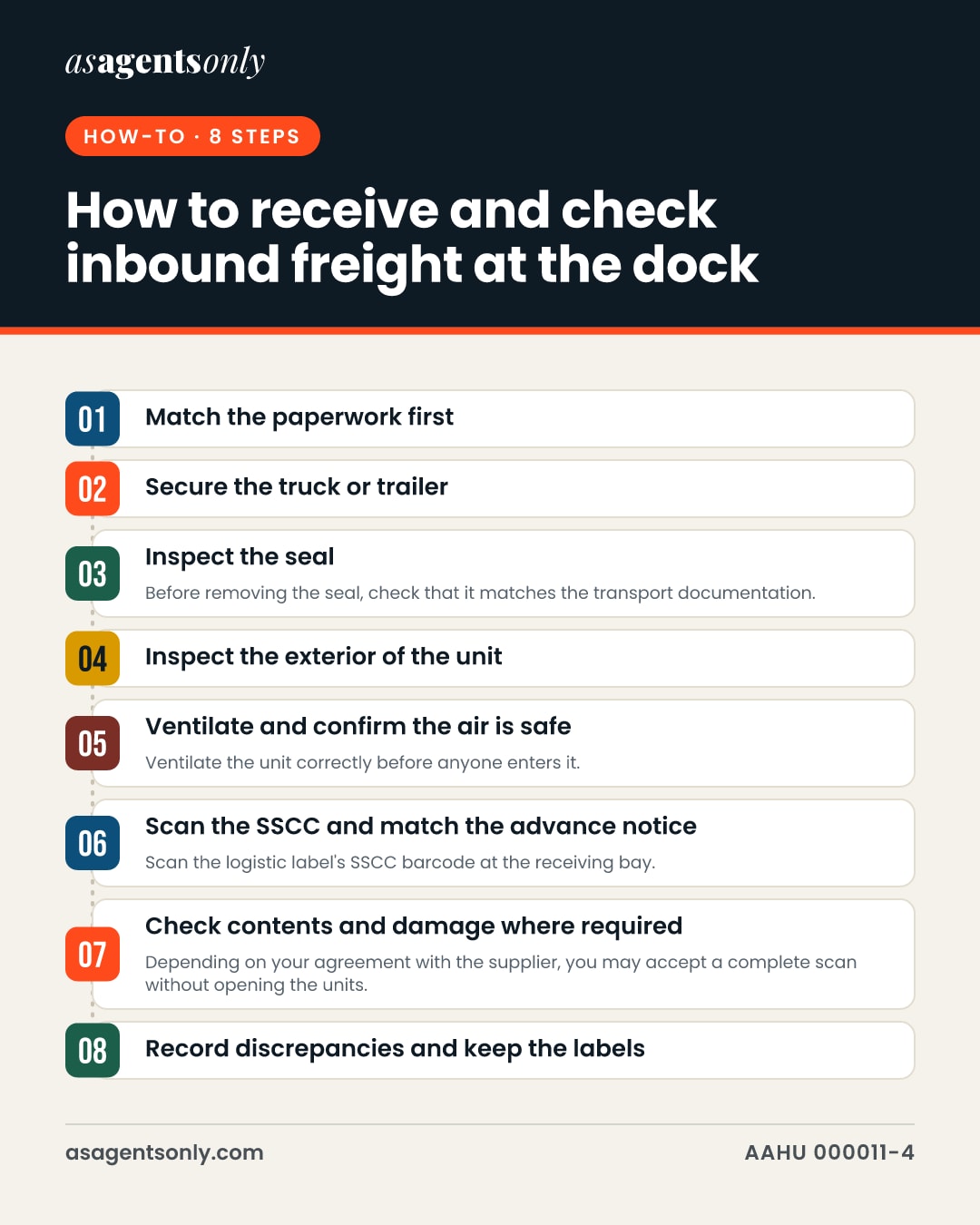
Match the paperwork first
Before the doors open, compare the identification number of the container or vehicle, and the seal serial number if one is fitted, with the transport documentation. The UNECE-published CTU Code (2025 revision) gives this check for the unpacker. If the numbers differ, stop and clarify with the shipper or carrier before accepting the unit.
Secure the truck or trailer
Before any forklift boards the vehicle, the brakes must be set and wheel chocks placed under the rear wheels, under OSHA's powered industrial trucks standard, 29 CFR 1910.178(k)(1). Check the dockboard is secured and check the trailer floor for breaks and weakness before a forklift drives onto it. Do not use a forklift to open or close freight doors.
Inspect the seal
Before removing the seal, check that it matches the transport documentation. Look for signs of tampering and compare the seal number with your paperwork. Note any mismatch on the documents before you go further.
Inspect the exterior of the unit
Look at the outside of the container, trailer or vehicle for leakage, signs of infestation, cracks, bent panels or significant distortion. Record any damage and notify the CTU operator or carrier, as the ILO and UNECE guidance advises.
Ventilate and confirm the air is safe
Ventilate the unit correctly before anyone enters it. Confirm that the atmosphere inside is not hazardous before you permit people to go in, as the CTU Code's unpacking duties require.
Scan the SSCC and match the advance notice
Scan the logistic label's SSCC barcode at the receiving bay. Under GS1 guidance, the scan can be linked to the electronic advance ship notice so the contents are matched automatically. When the scanned data matches the notice, the received quantity updates the warehouse system and stock level.
Check contents and damage where required
Depending on your agreement with the supplier, you may accept a complete scan without opening the units. Where your contract calls for a check, or the unit holds several products, count the contents against the notice and inspect for damage before you sign for the goods.
Record discrepancies and keep the labels
Write any shortage, overage, damage or seal problem on the cargo documents and tell the carrier or shipper as your contract requires. Keep the logistic labels on the goods until put-away is complete so the stock can be traced if needed.
Documents you will need
- The transport document or bill of lading for the shipment
- The electronic advance ship notice or despatch advice, if the supplier sends one
- The container, trailer or vehicle identification number
- The seal number, where a seal is fitted
- The purchase order or delivery instruction, for the expected quantities
- The SSCC or other logistic label information on each logistic unit
- Any dangerous goods transport document, if the shipment includes dangerous goods
- Your receiving contract or the supplier's delivery terms, for checking rules
Common mistakes
- Accepting a scanned pallet without checking the contents when your contract requires a check. Confirm the agreement with the supplier before you rely on the scan alone.
- Driving a forklift onto a trailer whose floor you have not inspected. Check for breaks and weakness first, as OSHA's standard requires.
- Opening a sealed unit before comparing the seal with the documents. Check the seal first so any tampering is recorded.
- Removing the logistic labels before put-away is complete. Keep them on until the stock is placed, so it can be traced.
- Signing for damaged goods without writing the damage on the documents. Note it at the dock and notify the carrier or shipper.
In pictures
The same facts as this page, as images to save or share. Tap one to open it full size.
Official sources
- Code of Practice for Packing of Cargo Transport Units (CTU Code), 2025 revisionUNECE, with IMO and ILO
- 1910.178 - Powered industrial trucksOSHA, United States Department of Labor
- Powered Industrial Trucks (Forklift) eTool: Load HandlingOSHA, United States Department of Labor
Claims ledger: 20 facts and where each comes from
- The CTU Code is a non-mandatory global code of practice for handling and packing shipping containers for sea and land transport.9
- Chapter 14 of the 2025 revision of the CTU Code gives advice on receiving and unpacking cargo transport units.1
- The unpacker of a CTU must check the identification number on the unit and, where it is sealed, the seal serial number against the transport documentation.1
- The unpacker must check the seal before removing it to confirm it conforms with the transport documentation, and must ventilate the CTU before entry and confirm the atmosphere is not hazardous.2
- The unpacker should check the exterior of the CTU for signs of leakage or infestation.1
- The receiver should check that a CTU is externally in good condition and not significantly distorted, cracked or bent, and should document and notify any damage to the CTU operator.9
- Under 29 CFR 1910.178(k)(1), the brakes of highway trucks must be set and wheel chocks placed under the rear wheels to prevent rolling while powered industrial trucks board them.3
- Under 29 CFR 1910.178, trucks shall not be used for opening or closing freight doors.3
- Under 29 CFR 1910.178, the flooring of trucks, trailers and railroad cars must be checked for breaks and weakness before vehicles are driven onto it.3
- Under 29 CFR 1910.30(a)(2), portable dockboards must be secured in position by anchoring or by devices that prevent slipping.4
- Under 29 CFR 1910.178(l)(1)(i), the employer must ensure each powered industrial truck operator is competent, shown by completing the training and evaluation in that paragraph.3
- The SSCC is the single mandatory element for all GS1 logistic labels.5
- Scanning the SSCC barcode on each logistic unit allows the physical movement of units to be matched with the electronic business messages that refer to them.5
- One scan of the SSCC at a receiving bay can be linked to a pre-received electronic advance ship notice to speed receiving and put-away.6
- Depending on the agreement between supplier and receiver, the SSCC may be scanned and the goods accepted as complete, or the receiver may check the logistic units for contents and damage.5
- When the SSCC is scanned it should match the advance ship notice information, and the received amount should be added automatically to the warehouse system and update stock levels.5
- Labels should not be removed before put-away is complete, and are preferably kept to assist traceability.5
- Checks will depend on the contract between the receiver and their supplier.5
- The SSCC is typically encoded into a GS1-128 barcode and included on a GS1 Logistics Label.7
- The SSCC is a unique 18-digit number.8
Every figure on this page is tied to a cited source, last checked on 17 October 2026. Pages like this are re-checked every three months. Found something out of date? Tell the desk.