- Explainer
- Ocean
- 5 min read
- Last verified 25 October 2026
Transshipment hubs explained
What a transshipment hub is, how containers move through one, why carriers use them, and the rules and risks to check before you book.

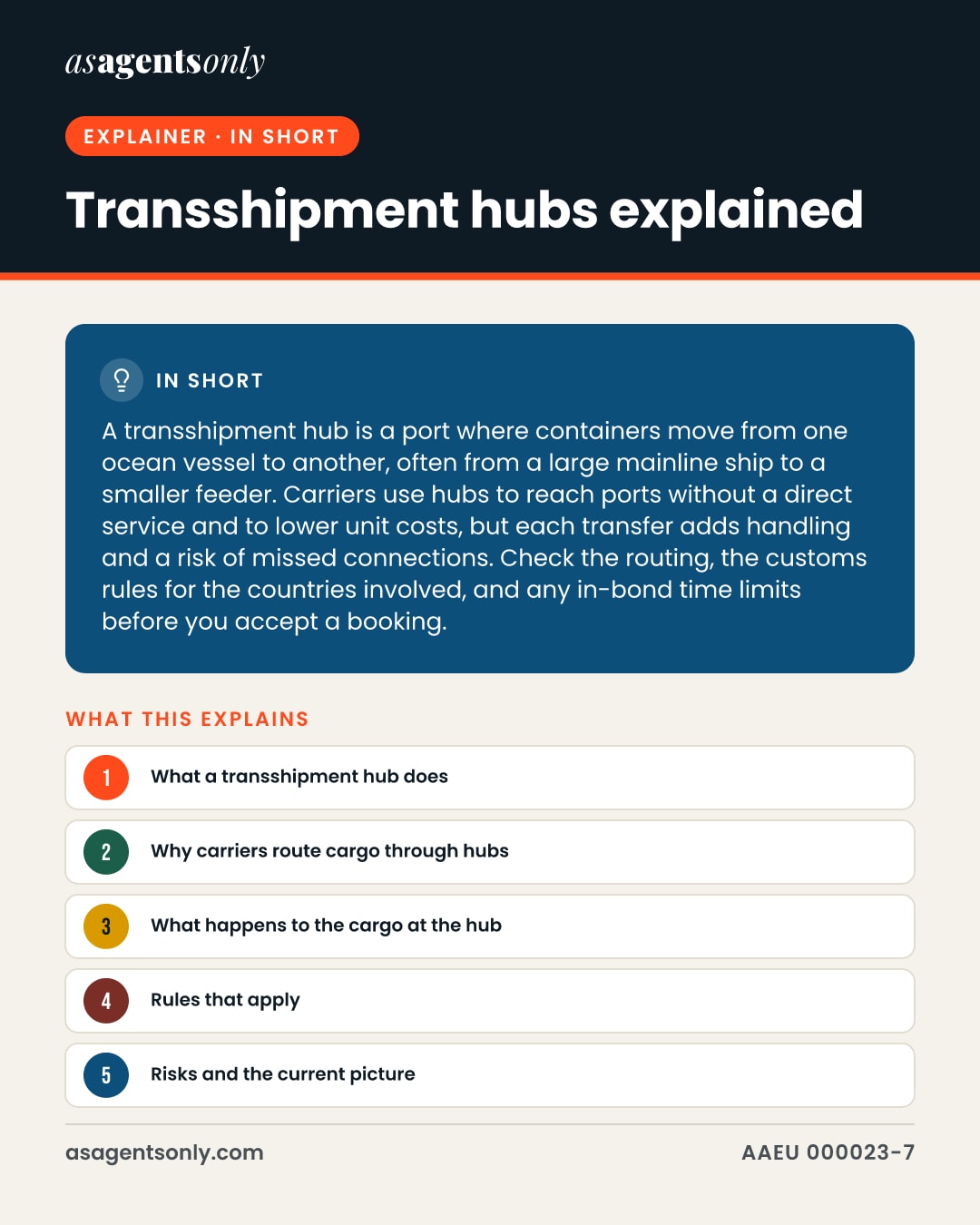
In short
A transshipment hub is a port where containers move from one ocean vessel to another, often from a large mainline ship to a smaller feeder. Carriers use hubs to reach ports without a direct service and to lower unit costs, but each transfer adds handling and a risk of missed connections. Check the routing, the customs rules for the countries involved, and any in-bond time limits before you accept a booking.
Most container cargo does not travel from origin to destination on one ship. Hubs are the points where routes meet, so shippers, forwarders, brokers and carriers all need to understand how they work, what they cost in time and risk, and which rules apply when cargo changes ships. The term is also spelled transhipment in some government texts.
What a transshipment hub does
A transshipment hub is a port where containers leave one ocean vessel and continue on another. The World Bank's container port glossary treats a hub as the point where mainline ships and smaller regional feeders exchange cargo. Carriers build regional networks around these ports: large vessels serve the main routes between hubs, and smaller ships link the hubs to nearby ports.
Hubs also work in the other direction. A hub can collect cargo from its regional spokes and pass it on to other regions, so the same port may handle inbound and outbound flows at once.
Why carriers route cargo through hubs
The main reasons are cost and reach. Routing cargo through a hub can lower shipping costs, make use of economies of scale, and widen the range of services offered. Transshipment services also give shippers more routing options, especially toward smaller ports, and can shorten transit times.
A transfer is also used where no direct route exists, where the destination port cannot take large vessels, where shipments are consolidated, or where legal or political restrictions apply. A direct connection, by contrast, means the cargo needs no transfer in a third country.
What happens to the cargo at the hub
At a hub, each container is discharged, held in temporary storage, sorted, and loaded onto the onward vessel. Terminals usually berth the ships that exchange large volumes next to each other, with transfer boxes stacked in nearby yard blocks, so the moves stay short.
Feeder ships often wait longer than mainline ships at transshipment ports, because they wait until there is enough cargo to fill them. Statistics also count transshipment differently. The World Bank counts a transshipped box as two lifts at the intermediate port, and empty boxes are included. In transshipment centers, empty containers can make up a large share of traffic, so headline volume figures say little about cargo that starts or ends locally.
Rules that apply
Customs authorities use transhipment as the name of a procedure. Under the WCO's guidance, goods move from the importing means of transport to the exporting one under Customs control, within one Customs office. Where a national procedure allows it, goods can change conveyance without paying import or export duties, and they are generally expected to be in the same condition afterward.
In the United States, U.S. Customs and Border Protection treats this kind of step as a transfer under its in-bond rules. In-bond cargo can change conveyance at any time, CBP notification is not required for that change, and the transfer does not extend the maximum in-transit time. Cargo moved in-bond must be entered, exported, or admitted to a foreign-trade zone within 15 calendar days after the entire shipment arrives at the destination or exportation port. Confirm the current text of the in-bond regulation before relying on these points, because rules can change.
For ocean carriers serving the United States, the Federal Maritime Commission regulates the international ocean transportation system. A 2000 FMC notice said nonexclusive transshipment agreements were exempt from filing while exclusive ones had to be filed, and the current 46 CFR Part 535 provides for optional filing of nonexclusive agreements. Foreign-to-foreign legs are generally not filed with the Commission. Check the current regulation for any agreement you rely on.
Risks and the current picture
Each transfer adds a handling step and a point where the schedule can slip. The industry has not formally defined when a container connection is secure or when it is at risk of being missed, and there is no agreed standard for when cargo must be reassigned. Terminals, feeders and mainline operators need shared definitions to keep connections on track.
Hub patterns also change. Trade press reporting on an analysis of UNCTAD's port connectivity data says carriers are moving services from Asia's largest hubs toward smaller regional ports, and that the change looks more lasting than a short-term correction. Before you assume a hub will be used, ask the carrier for the current service string and the planned connection times.
Side by side
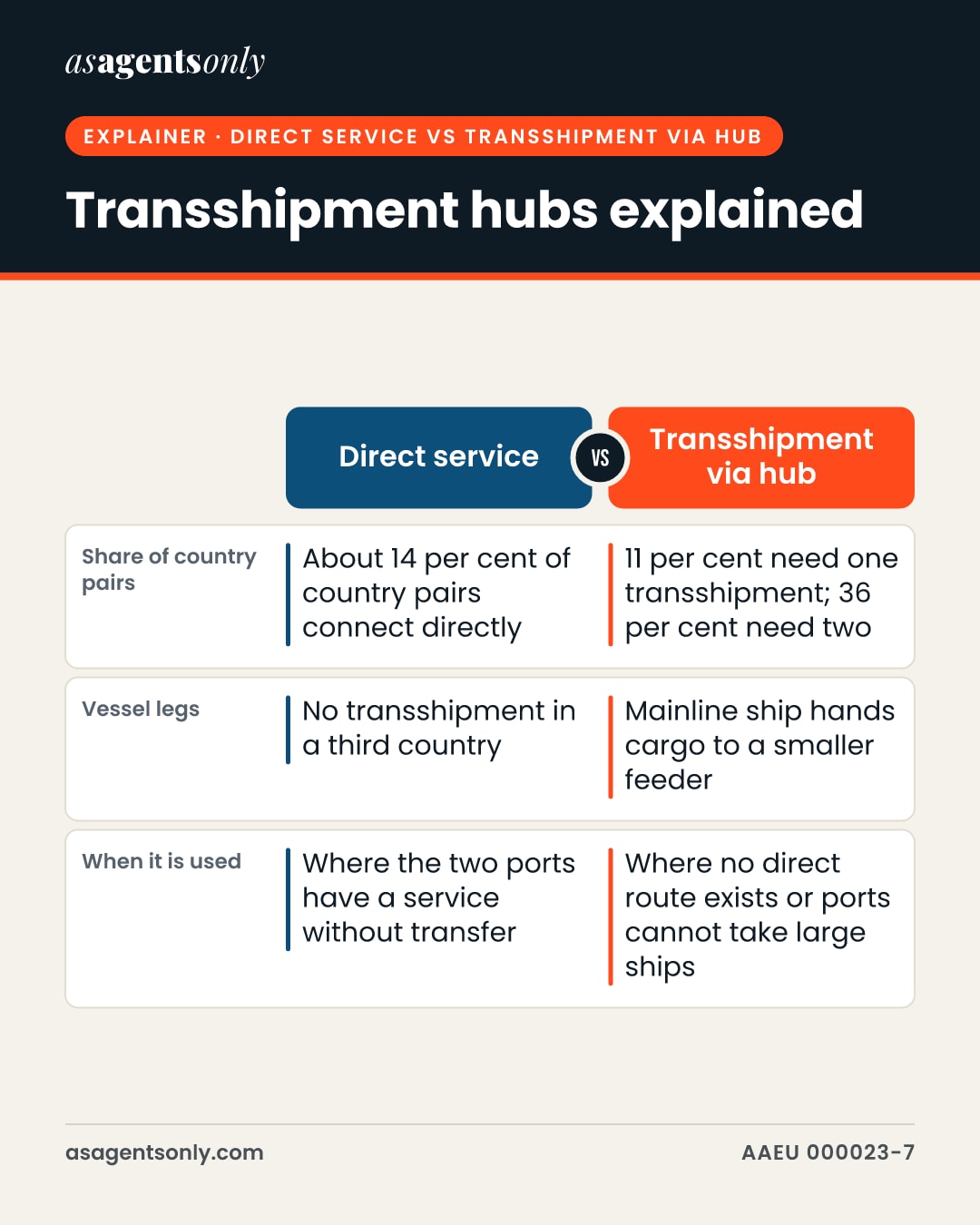
| Compared | Direct service | Transshipment via hub |
|---|---|---|
| Share of country pairs | About 14 per cent of country pairs connect directly | 11 per cent need one transshipment; 36 per cent need two |
| Vessel legs | No transshipment in a third country | Mainline ship hands cargo to a smaller feeder |
| When it is used | Where the two ports have a service without transfer | Where no direct route exists or ports cannot take large ships |
Example
Illustrative example, not a real shipment: a shipper in a regional port city wants goods delivered to a port that has no direct service from its origin. The forwarder books the cargo through a hub. The mainline ship discharges the container at the hub, the terminal holds it until the feeder is ready, and the feeder carries it to the regional port. The shipper accepts the longer route because it is the only service, but asks the carrier for the scheduled connection time and what happens if the first ship arrives late, since a missed connection can mean the cargo is reassigned to another vessel.
In pictures
The same facts as this page, as images to save or share. Tap one to open it full size.
Official sources
- Container port traffic (TEU) - GlossaryWorld Bank DataBank
- Kyoto Convention Guidelines to Specific Annex E Chapter 2: TranshipmentWorld Customs Organization
- Ocean Common Carriers Subject to the Shipping Act of 1984Federal Maritime Commission (Federal Register notice, 2000)
- 46 CFR Part 535 - Ocean Common Carrier and Marine Terminal Operator Agreements Subject to the Shipping Act of 1984Electronic Code of Federal Regulations
- 19 CFR Part 18 - Transportation in Bond and Merchandise in TransitElectronic Code of Federal Regulations (U.S. Customs and Border Protection)
- Changes to the In-Bond Process (final rule)U.S. Customs and Border Protection, Federal Register
- Transshipment in the United StatesU.S. International Trade Commission
- Liner networks shift away from Asia's mega hubsSplash247 (trade press)
- Federal Maritime Commission home pageFederal Maritime Commission
Claims ledger: 31 facts and where each comes from
- The World Bank's container port glossary treats a hub as the point where mainline ships and smaller regional feeders exchange cargo.2
- Large liners on the major routes between regional hubs gain scale economies, while smaller ships provide faster feeder services on short or low-traffic routes.10
- A hub can also take cargo from its regional spokes and pass it on to other regions.10
- Transshipment can be seen as routing cargo to lower shipping costs, use economies of scale and widen the range of services.10
- Transshipment services give shippers more routing options, especially toward smaller ports, and can reduce transit times.10
- Hub transfers are used where no direct shipping route exists, where destination ports cannot accommodate large vessels, where shipments are consolidated, or where legal or political restrictions must be navigated.3
- Containers at a transfer are unloaded, temporarily stored, sorted and reloaded onto another vessel for onward transport.3
- In transshipment hubs, planners often berth ships that exchange large volumes at adjacent berths, with transshipment containers placed in nearby yard blocks.2
- Feeder ships tend to wait longer than larger vessels at transshipment ports, because they wait until cargo reaches maximum utilization.2
- The World Bank counts transshipment traffic as two lifts at the intermediate port, and the count includes empty units.4
- Empty containers may make up as much as 40 percent of traffic at transshipment centers.4
- The WCO defines transhipment as a Customs procedure in which goods move from the importing means of transport to the exporting one under Customs control, within one Customs office.5
- Some administrations let goods change conveyance under Customs control without paying import or export duties and taxes.5
- Goods are generally expected to be in the same condition after a transhipment transfer as before it.5
- In-bond transportation moves imported merchandise, secured by a bond, from one port to another before appraisement and without paying duties.9
- In its 2017 final rule, CBP renamed the in-bond transshipment section 'Transfers' and used the term transfer in its place.9
- Merchandise in transit in-bond may be transferred to another conveyance at any time.8
- CBP notification is not required for an in-bond transfer to another conveyance.8
- A transfer to another conveyance does not extend the maximum in-transit time.8
- Merchandise covered by an in-bond shipment must be entered, exported or admitted to a foreign-trade zone within 15 calendar days of the entire shipment's arrival at the destination or exportation port.8
- The Federal Maritime Commission is the independent federal agency responsible for regulating the U.S. international ocean transportation system.12
- A 2000 FMC notice stated that nonexclusive transshipment agreements are exempt from filing, while exclusive transshipment agreements must still be filed.6
- The current 46 CFR Part 535 provides for optional filing of nonexclusive transshipment agreements.7
- Foreign-to-foreign portions of agreements are generally not filed with the Commission, even for information.6
- On average about 14 per cent of country pairs are connected directly, about 11 per cent need one transshipment, about 36 per cent need two, and about 28 per cent need three.1
- A connection is direct when there is no need for transhipment in a third country.1
- Regular container services and hub transshipment operations mean that nearly all countries are connected to each other.1
- There is no formal industry definition of when a container connection is secure, when it is at risk of missing, or when cargo must be reassigned.3
- Terminals, feeders and mainline operators need shared definitions and standards to keep connections on track.3
- Trade press reports that carriers are shifting services from Asia's largest transshipment hubs toward smaller regional ports.11
- Sea-Intelligence's analysis of UNCTAD's Port Liner Shipping Connectivity Index says the changes are becoming more structural than short-term.11
Every figure on this page is tied to a cited source, last checked on 25 October 2026. Pages like this are re-checked every six months. Found something out of date? Tell the desk.