- Explainer
- Ocean
- 4 min read
- Last verified 11 October 2026
Demurrage vs detention
Demurrage is charged for cargo or space at a terminal after free time; detention is charged for a container kept outside the terminal past free time.

In short
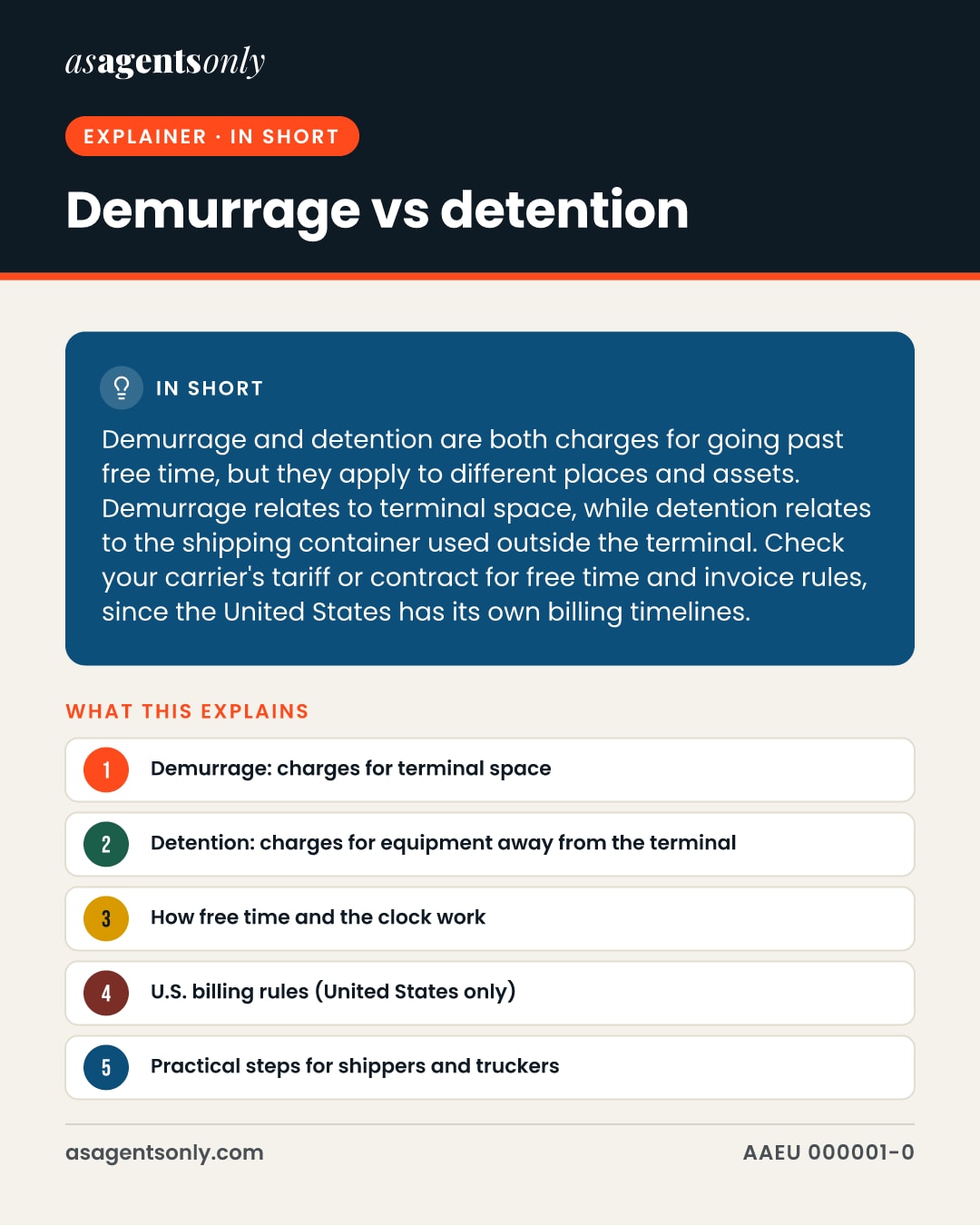
Demurrage and detention are both charges for going past free time, but they apply to different places and assets. Demurrage relates to terminal space, while detention relates to the shipping container used outside the terminal. Check your carrier's tariff or contract for free time and invoice rules, since the United States has its own billing timelines.
Ocean carriers and terminals charge for two kinds of time: how long a box occupies terminal space, and how long a carrier's container stays away from the terminal. Both charges start only after a free time window closes. The terms are used differently across ports and companies, so the wording on your invoice and in your contract matters.
Demurrage: charges for terminal space
Demurrage is the charge tied to space used at a marine terminal, rail ramp or inland container yard after free time has ended. The Federal Maritime Commission (FMC), the U.S. regulator, defines the wider group of charges in its 2020 interpretive rule. Under that rule, demurrage and detention cover charges, including per diem, tied to terminal space or shipping containers, but not freight.
Demurrage accrues when cargo or a container stays on the terminal beyond the free time allowed. Carriers cannot charge demurrage during free time, but once free time expires they may charge it.
Detention: charges for equipment away from the terminal
Detention is the charge for keeping a carrier's container beyond free time after it has left the terminal. The FMC describes detention as a charge for extended use of intermodal equipment. For imports, it generally begins when the container is picked up and ends when the empty is returned to the place the carrier designates.
Labels vary. Some carriers and ports use per diem for the same idea, and the FMC's rule includes per diem within its definition. Read the tariff or contract to see which label applies to each line on your invoice.
How free time and the clock work
Free time is the grace period in which neither demurrage nor detention applies. In an earlier FMC report, the agency noted that five working days was the standard allowance at most U.S. ports, with four working days at New York/New Jersey and Los Angeles/Long Beach. Treat those figures as historical and check the current tariff.
Demurrage and detention are generally counted in calendar days, although California is an exception for detention and per diem. When free time begins can depend on the terminal where a container was discharged. Some carrier tariffs extend free time when the carrier cannot make cargo available, for a period matching that inability.
U.S. billing rules (United States only)
The FMC's billing rule took effect on May 28, 2024. Carriers and terminals must issue a demurrage or detention invoice within 30 calendar days of when the charge was last incurred. A billed party has at least 30 calendar days to request mitigation, refund or waiver, and an invoice missing required information removes the obligation to pay that charge.
In September 2025, the D.C. Circuit set aside only 46 C.F.R. 541.4, which limited who could receive an invoice. The rest of the rule remains in effect. Other countries have their own regulators and contract practices, so confirm the rules that apply where the charge is billed.
Practical steps for shippers and truckers
Get the free time, its start and end rules, and the return location in writing before the box moves. Track the last free day for each container. If a charge is wrong, dispute it on time; under the U.S. rule, billed parties have 30 calendar days from the invoice date to contest it.
Ask the carrier for extra free time if it could not deliver or receive the container within the window, because some tariffs allow this. Outcomes depend on the facts and the contract, so no step guarantees a waiver.
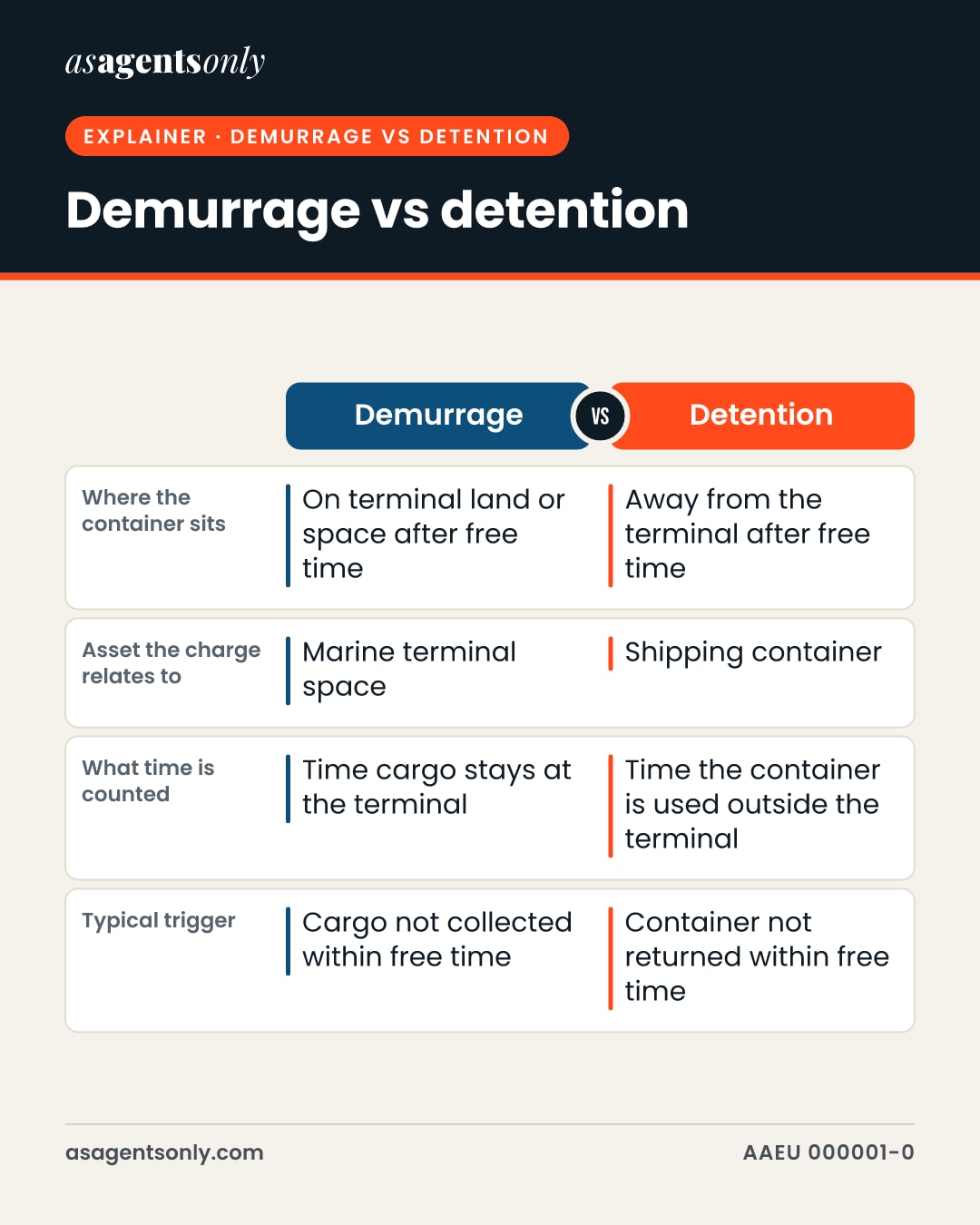
Side by side
| Compared | Demurrage | Detention |
|---|---|---|
| Where the container sits | On terminal land or space after free time | Away from the terminal after free time |
| Asset the charge relates to | Marine terminal space | Shipping container |
| What time is counted | Time cargo stays at the terminal | Time the container is used outside the terminal |
| Typical trigger | Cargo not collected within free time | Container not returned within free time |
Example
Illustrative example (fictional figures, written as words): An importer has four days of free time at a terminal. The box is still on the terminal on day six, so demurrage has run for two days past the window. The importer then picks up the box, and the empty is returned on day nine. Detention applies only after the detention free time in the contract ends, and it stops when the empty is returned to the place the carrier named. Each charge should appear on the invoice with the dates it was incurred.
In pictures
The same facts as this page, as images to save or share. Tap one to open it full size.
Official sources
- Interpretive Rule on Demurrage and Detention Under the Shipping ActFederal Maritime Commission (Federal Register)
- Detention and DemurrageFederal Maritime Commission
- FMC Publishes Final Rule on Detention and Demurrage Billing PracticesFederal Maritime Commission, published 23 February 2024
- U.S. Court of Appeals Issues Decision in Case on Demurrage and Detention Billing PracticesFederal Maritime Commission
- Demurrage and Detention Billing RequirementsFederal Register (FMC final rule), published 26 February 2024
Claims ledger: 19 facts and where each comes from
- The FMC's 2020 interpretive rule covers charges, including per diem, tied to marine terminal space or shipping containers, but not freight.1
- During free time carriers cannot assess demurrage; once free time ends, carriers can charge it.1
- The FMC says detention covers extended use of intermodal equipment, while demurrage accrues when a container exceeds free time on a marine terminal.2
- Free time is the grace period during which neither demurrage nor detention applies.3
- Five working days has been the standard free time at most U.S. ports, with four working days at New York/New Jersey and Los Angeles/Long Beach.3
- Demurrage and detention are generally counted in calendar days, and California is an exception for detention and per diem.3
- A carrier tariff may extend free time by the length of time the carrier could not make cargo available for delivery.3
- The time of day when free time begins may depend on the terminal where a container was discharged.3
- For imports, detention generally begins at pickup and ends when the empty is returned to the place the carrier designates.3
- Vessel-operating common carriers and marine terminal operators must issue demurrage and detention invoices within 30 calendar days from when charges were last incurred.4
- A billed party has at least 30 calendar days to request mitigation, refund or waiver of fees.4
- An invoice that omits required information removes the billed party's obligation to pay that charge.4
- Invoices must include identifiable information so that billed parties understand the charges they receive.4
- The rule took effect on May 28, 2024.5
- On September 23, 2025, the D.C. Circuit set aside only 46 C.F.R. 541.4, which limited who could receive an invoice.5
- The rest of 46 C.F.R. part 541 remains in effect, including the 30-day issuance deadline for invoices.5
- Billed parties have 30 calendar days from the date the invoice is issued to contest demurrage and detention charges.6
- Demurrage is the charge a merchant pays for container use inside the terminal beyond free time; detention is the same charge for use outside the terminal.7
- Shipping lines use demurrage and detention charges to encourage merchants to move or return containers promptly.7
Every figure on this page is tied to a cited source, last checked on 11 October 2026. Pages like this are re-checked every six months. Found something out of date? Tell the desk.