- How-To
- Warehousing
- 4 min read
- Last verified 25 October 2026
How to run a cycle count
Learn how to plan, run and reconcile a cycle count in a warehouse, from choosing locations to checking variances and meeting US customs rules where they apply.

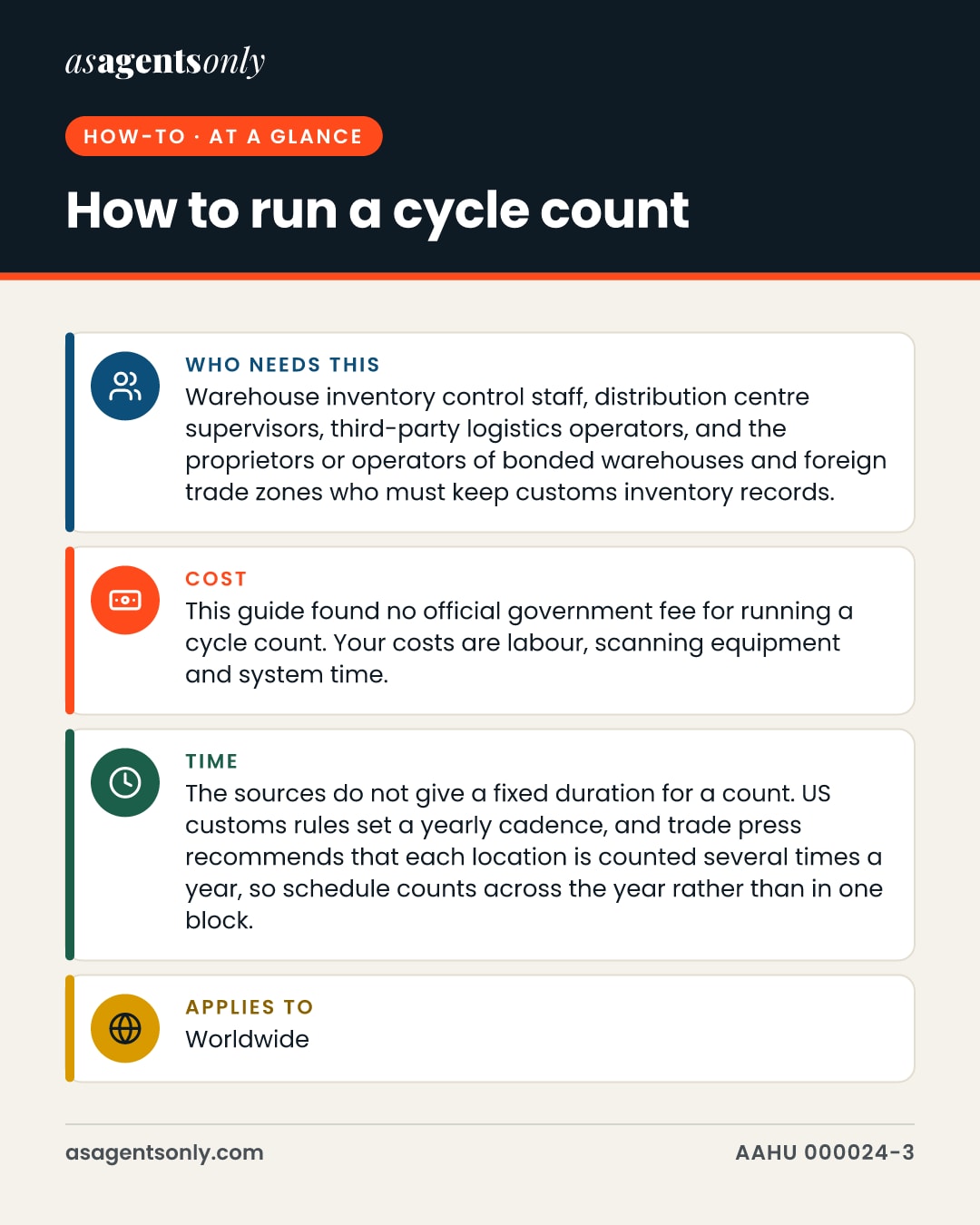
- Who needs this
- Warehouse inventory control staff, distribution centre supervisors, third-party logistics operators, and the proprietors or operators of bonded warehouses and foreign trade zones who must keep customs inventory records.
- Cost
- This guide found no official government fee for running a cycle count. Your costs are labour, scanning equipment and system time.
- Time
- The sources do not give a fixed duration for a count. US customs rules set a yearly cadence, and trade press recommends that each location is counted several times a year, so schedule counts across the year rather than in one block.
- Applies to
- Worldwide
A cycle count checks a small part of your stock on a regular schedule, instead of shutting the site for one full physical inventory. You need it whenever your system quantities must match what is on the shelf or in the bin. The steps below are a general method. Where a country's customs or free-zone rules apply, the rules of that country govern. The only government rules this guide located are those of the United States, so check the local authority for any other country.
Step by step
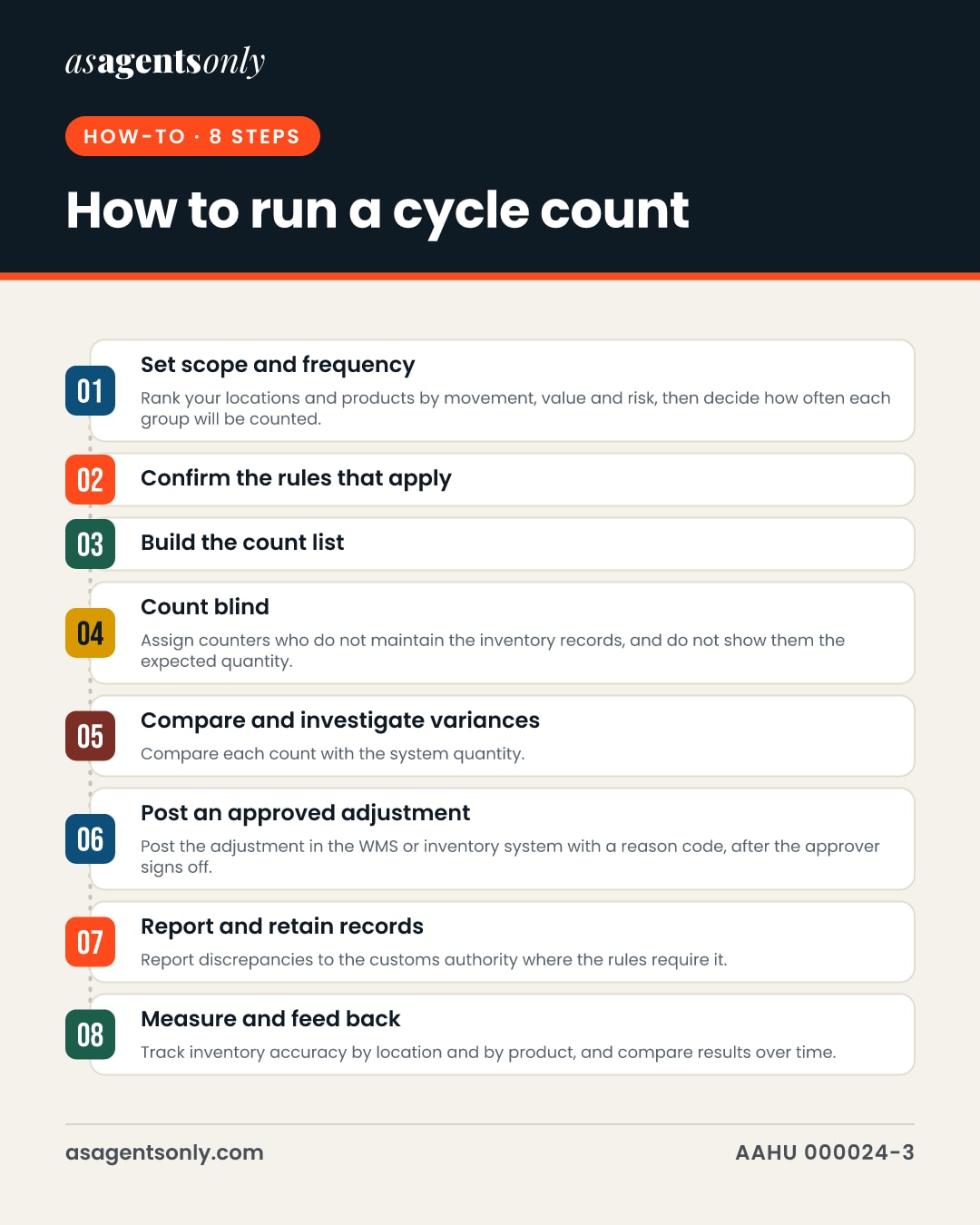
Set scope and frequency
Rank your locations and products by movement, value and risk, then decide how often each group will be counted. Record the plan in your warehouse management system (WMS) or inventory system so the schedule is tracked. You get a dated count plan.
Confirm the rules that apply
If the site is a US bonded warehouse, follow the inventory control rules for bonded warehouses, including the advance notice of count dates to U.S. Customs and Border Protection (CBP). If it is a US foreign trade zone, follow the US foreign trade zone regulations. Other countries have their own rules, which you must confirm with the local customs authority. You get a written list of the rules and any notice dates that apply.
Build the count list
Use your WMS to generate the locations that have not been counted within your chosen recent window, and count the active locations where mismatches are most likely. Do not always start the count at the same aisle or bin. You get a task list with location labels.
Count blind
Assign counters who do not maintain the inventory records, and do not show them the expected quantity. Scan the location label, which should carry a GS1 Global Location Number (GLN), and the item barcodes, using the GS1 Global Trade Item Number (GTIN) for products and the Serial Shipping Container Code (SSCC) for pallets. You get count records with a time stamp and a counter name.
Compare and investigate variances
Compare each count with the system quantity. Where the difference is outside the tolerance in your written procedure, have a second team recount the location. Check for unposted moves, damage, missing labels and mis-putaway before you accept the difference. You get a confirmed count or a documented variance.
Post an approved adjustment
Post the adjustment in the WMS or inventory system with a reason code, after the approver signs off. In a US bonded warehouse that uses FIFO procedures, additions and deductions must be posted within the time limit set by the US bonded warehouse inventory control rules. Keep the audit trail that links withdrawals to the customs entry. You get an adjusted balance and an audit record.
Report and retain records
Report discrepancies to the customs authority where the rules require it. For US bonded warehouses, CBP can ask for a record balance showing the quantity in each storage location, so keep those balances available. You get a set of records that can be produced on request.
Measure and feed back
Track inventory accuracy by location and by product, and compare results over time. Use the root causes you find to change putaway, replenishment and picking steps. You get a trend that shows whether the count programme is working.
Documents you will need
- Written cycle count procedure, including tolerances and who approves adjustments
- Count schedule and the list of locations and products for each cycle
- Current system quantity for each location, hidden from counters during a blind count
- GLN location labels and GTIN item barcodes, plus SSCC labels for pallets where used
- Count sheets or handheld scanner records with counter name and time
- Variance log with recount results and root-cause notes
- For US bonded warehouses or foreign trade zones: the customs entry or warehouse entry numbers, notice dates given to CBP, and inventory records
- Prior accuracy results by location and product
Common mistakes
- Counting the same locations again and again. Generate a list of locations not counted recently from your WMS so coverage spreads across the site.
- Letting the people who keep the records do the counting. Use blind counts by staff who do not maintain the inventory records, so the count is independent.
- Assuming cycle counts replace every annual requirement. In the US, a bonded warehouse must take at least one annual physical inventory or cycle counts covering each category within the year, and foreign trade zone rules allow continuous counts only as part of an ongoing programme.
- Adjusting a variance without finding the cause. Recount, check for unposted moves and damage, and record the reason before you approve the change.
- Using a product barcode to identify a location, or the reverse. Use the GLN for locations and the GTIN for trade items so the record points to the right place.
In pictures
The same facts as this page, as images to save or share. Tap one to open it full size.
Official sources
- 19 CFR 19.12 - Inventory control and recordkeeping systemeCFR (Office of the Federal Register, National Archives), for U.S. Customs and Border Protection
- 19 CFR Part 146 - Foreign Trade ZoneseCFR (Office of the Federal Register, National Archives)
- 19 CFR 19.4 - CBP and proprietor responsibility and supervision over warehouseseCFR (Office of the Federal Register, National Archives)
- Rethink Cycle Counting in your OperationsSupply Chain 24/7 (trade press)
- Why inventory management is crucial in mitigating riskThe Loadstar (trade press)
- Inventory Management 101: Time to revisit the principlesSupply Chain 24/7 (trade press)
- Response letter on inventory counts (correspondence file)U.S. Securities and Exchange Commission (correspondence filed by a registrant)
- Warehouse KPI Examples: What KPIs Really Matter?Material Handling Institute (MHI)
Claims ledger: 17 facts and where each comes from
- US bonded warehouse proprietors must carry out at least one annual physical inventory of all merchandise, or cycle counts that cover every category at least once in the year.1
- CBP must receive advance notice of the dates of a bonded warehouse inventory so that its personnel can observe or take part if they choose.1
- Where FIFO procedures are used in a US bonded warehouse, each addition to or deduction from an inventory category must be posted within 2 business days after the event.1
- For US foreign trade zone operators, the annual physical inventory requirement applies unless continuous cycle counts are taken as part of an ongoing inventory control program.2
- On request by a customs officer, a US bonded warehouse proprietor must provide a record balance that states the quantity in each storage location, so a physical count can verify the record.4
- The Global Location Number is the GS1 identification key used for parties and places such as companies, warehouses, factories and stores.3
- The Serial Shipping Container Code identifies logistics units such as unit loads on pallets, roll cages and parcels.3
- Active cycle counting is run by specialised staff in the most active warehouse locations, where discrepancies are most likely to be found.5
- A cycle count can be targeted at fast-moving product, high-value product or high-concern SKUs, which lets a team focus its effort.5
- A WMS can generate a list of locations that have not been counted within a recent time period, which helps avoid starting again at the same location.5
- When a shortage or other exception is recorded at a location, the system should trigger a cycle count there, and the picker should not stop picking to investigate in depth.5
- Trade press reports that inventory accuracy has risen from 75% or 80% to more than 99% where cycle counting is well implemented.5
- Physical inventory cycle counts should occur at regular intervals so that each warehouse location is audited multiple times per year, and full stock counts should occur at least once per year.6
- Involving an outside auditor to observe the stock count and certify the results may be beneficial.6
- The putaway and replenishment process can be used to verify inventory accuracy at the location level, because the operator is already at the location.7
- One listed company told the SEC staff that its inventory counts were performed as blind counts by personnel who were not responsible for maintaining and reconciling the inventory records.8
- Inventory accuracy shows whether the inventory in your system matches what is physically in a storage location.9
Every figure on this page is tied to a cited source, last checked on 25 October 2026. Pages like this are re-checked every three months. Found something out of date? Tell the desk.