- Explainer
- Warehousing
- 4 min read
- Last verified 24 October 2026
Container freight stations: LCL consolidation and deconsolidation
How a container freight station groups less-than-container loads for export and splits them after import, and which rules govern the handling.

In short
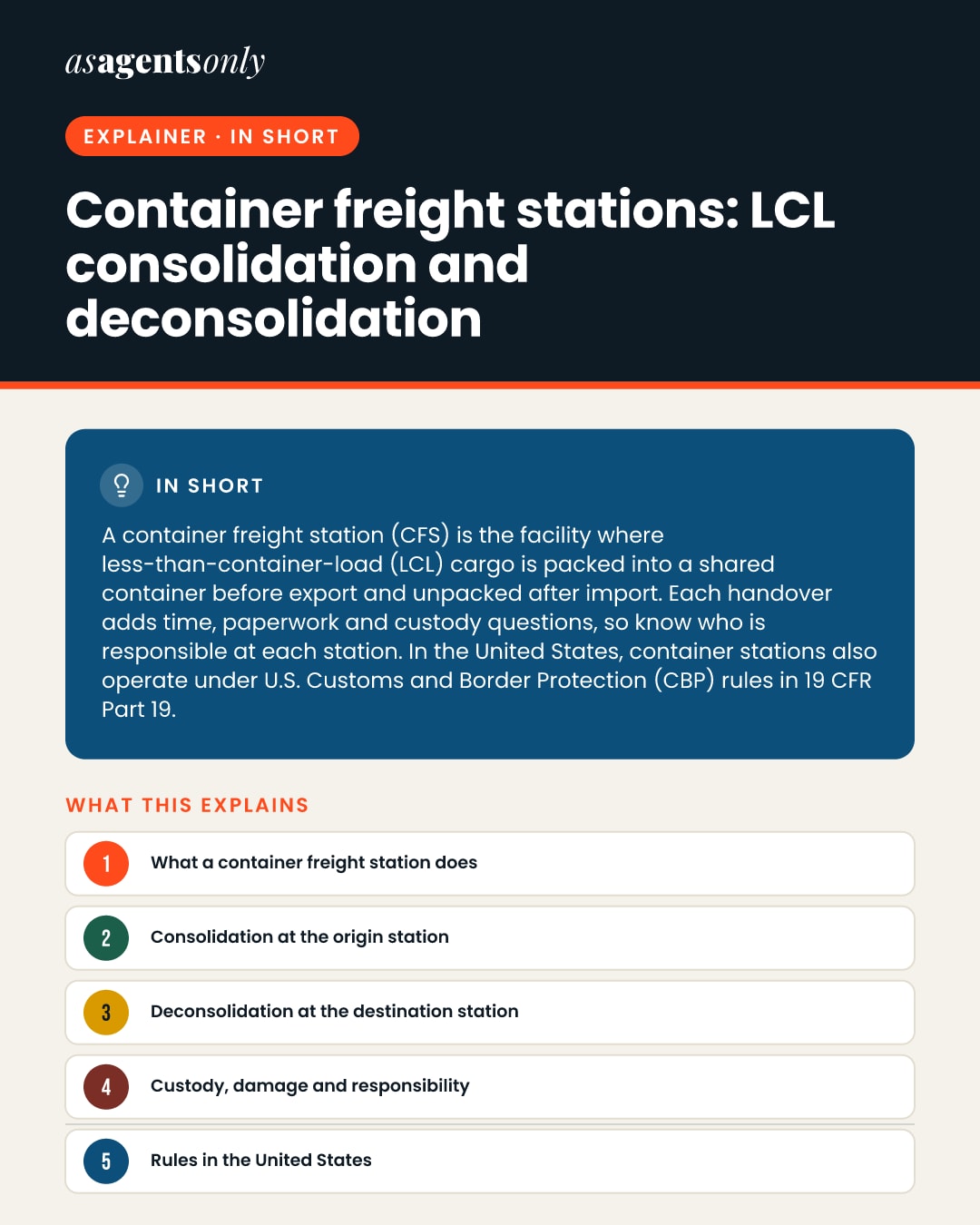
A container freight station (CFS) is the facility where less-than-container-load (LCL) cargo is packed into a shared container before export and unpacked after import. Each handover adds time, paperwork and custody questions, so know who is responsible at each station. In the United States, container stations also operate under U.S. Customs and Border Protection (CBP) rules in 19 CFR Part 19.
LCL cargo rarely fills a container alone. Several shippers' consignments share one box, so someone has to group them at the origin and separate them again at the destination. The container freight station is where that work happens. The steps are simple to describe, but the custody, documents and liability questions around them catch newcomers out.
What a container freight station does
A CFS is a facility that prepares LCL shipments for the next leg of their journey, either by grouping them or by separating them. CFS facilities are typically located close to transportation hubs such as ocean ports and terminals.
A container yard is a different place. Container yards do not provide consolidation or deconsolidation of LCL shipments. That is why LCL cargo usually goes through a CFS at both ends of the voyage.
Consolidation at the origin station
Consolidation is the grouping step. Consolidating shipments means combining individual LCL shipments into an FCL (full container load) to prepare them for loading onto a vessel. Consolidation is the process managed by the forwarder or carrier whereby the LCL shipments sharing a container are stuffed together.
On the export side, the station's work follows a fixed order. Shipments are received, recorded, consolidated into containers, and documentation (manifests, customs paperwork) is prepared and verified before containers are sealed for port delivery. Bills of lading for LCL cargo often read CFS to CFS. The shipping line's responsibility begins at the CFS at the port of load and ends at the CFS at the port of discharge.
Deconsolidation at the destination station
Deconsolidation is the reverse. Deconsolidation is the opposite, that happens near a port at the end of the port to port leg. Incoming containers are unpacked and individual consignments sorted for onward delivery.
After the box is opened, the consignee, or recipient, is notified that they should start preparing for customs clearance. Cargo may wait at the station for a while. Short-term warehousing for cargo awaiting clearance, pickup, or further movement is one of the station's functions. Because the consolidation and deconsolidation steps add handling, LCL tends to take slightly longer than FCL.
Custody, damage and responsibility
Several parties share one container, so a damage claim can be hard to settle. If damage occurs, determining responsibility becomes complex. Written records of each step matter for that reason.
The IMO/ILO/UNECE CTU Code gives practical advice that applies at the station. The consignee or receiver of a container is responsible for detecting any damage to the CTU and notifying the carrier, and for confirming the atmosphere inside is not hazardous before anyone enters. Before unpacking, check that the identification number on the CTU and, where sealed, the seal serial number, match the transport documentation. Record every package as it is removed, noting any markings and damages. If a dangerous goods package has damage so severe that contents leak out, the immediate area should be evacuated until the hazard potential has been assessed.
Rules in the United States
In the United States, a container station is a regulated facility, not just a warehouse. A container station may be established at a port upon filing an application, its approval by the port director, and the posting of a bond on Customs Form 301. Carriers, warehouses, cartmen and container stations that handle in-bond cargo must obtain an Activity Code 2 (C2) bond under 19 CFR 113.63.
Custody passes at a defined point. If merchandise is transferred directly to a container station from an importing carrier, the importing carrier remains liable under the terms of its bond until the container station operator formally receipts for it. Containers covered by one warehouse entry may not be mixed with goods covered by another entry. Bonded merchandise has time limits too. Merchandise must not remain in a bonded warehouse beyond 5 years from the date of importation, unless the Center director permits a longer period on proper request and good cause shown.
The CTU Code is not mandatory anywhere. It is a non-mandatory global code of practice for the handling and packing of shipping containers. A 2025 revision has been finalised by the ILO-IMO-ECE Group of Experts at its meeting held from 15 to 19 December 2025. Check its adoption status before you cite it as current guidance.
Side by side
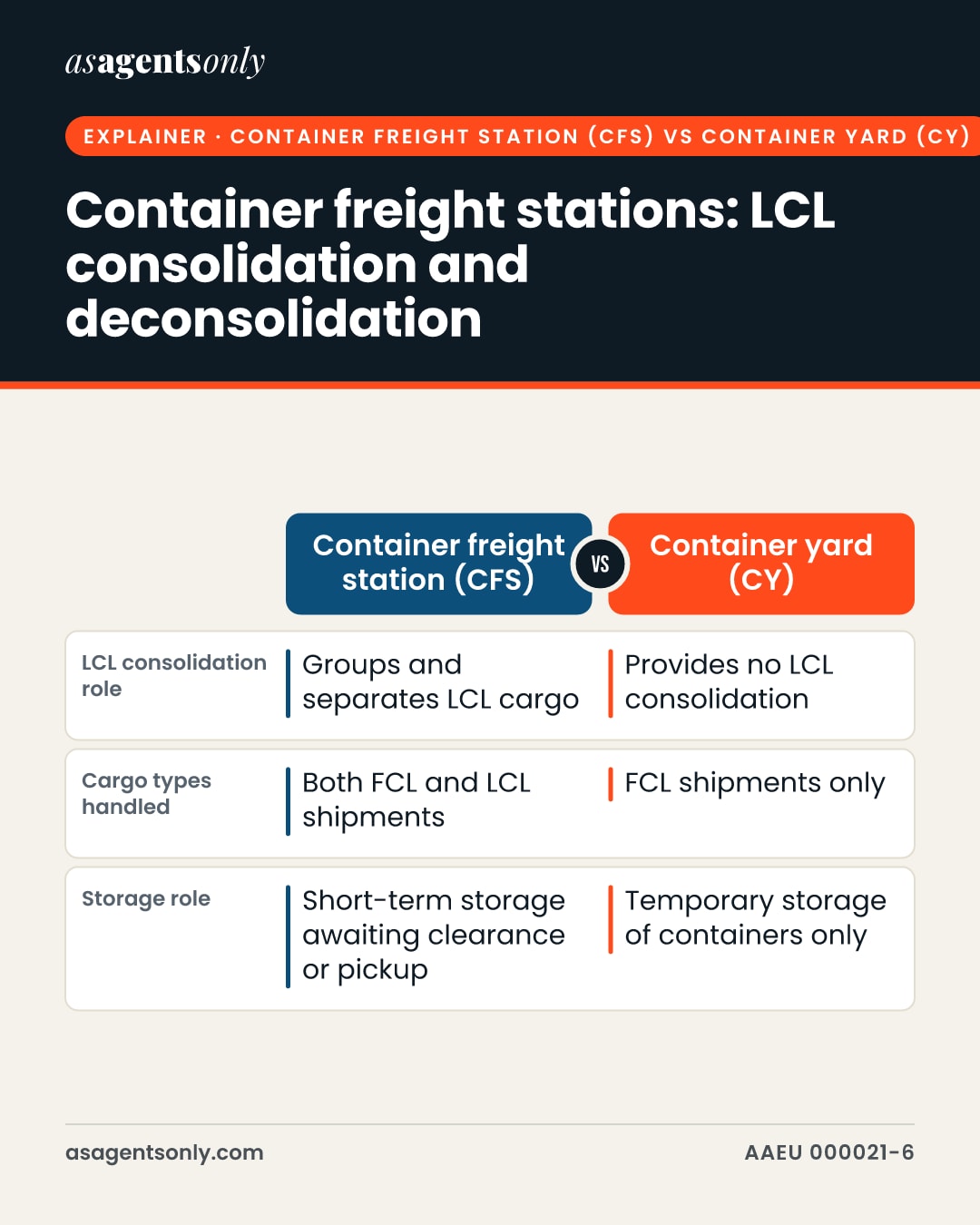
| Compared | Container freight station (CFS) | Container yard (CY) |
|---|---|---|
| LCL consolidation role | Groups and separates LCL cargo | Provides no LCL consolidation |
| Cargo types handled | Both FCL and LCL shipments | FCL shipments only |
| Storage role | Short-term storage awaiting clearance or pickup | Temporary storage of containers only |
Example
Illustrative example, with invented details: a furniture importer books less-than-container-load space for one small pallet. The origin station logs the pallet and packs it with eleven other consignments bound for the same port into one container. Documents are checked before the box is sealed. At the destination station, the container is opened, each consignment is sorted, and the importer is told to prepare for customs clearance. Because the bill of lading runs CFS to CFS, responsibility for the pallet is tied to those two stations.
In pictures
The same facts as this page, as images to save or share. Tap one to open it full size.
Official sources
- IMO/ILO/UNECE Code of Practice for Packing of Cargo Transport Units (CTU Code)International Maritime Organization
- Code of Practice for Packing of Cargo Transport Units, 2025 revisionUNECE Working Party on Intermodal Transport and Logistics
- 19 CFR Part 19: General ProvisionsU.S. Government (eCFR)
- 19 CFR Part 19: Container StationsU.S. Government (eCFR)
- 19 CFR Part 144: Warehouse and Rewarehouse Entries and WithdrawalsU.S. Government (eCFR)
- U.S. Customs and Border Protection Bonded WarehouseU.S. Customs and Border Protection
- Automated In-Bond Processing Business Process DocumentU.S. Customs and Border Protection
- Shipping BasicsFreightos
- MSC.1/Circ.1497 IMO/ILO/UNECE Code of Practice for Packing of Cargo Transport UnitsInternational Maritime Organization
Claims ledger: 39 facts and where each comes from
- The CTU Code is a non-mandatory global code of practice for the handling and packing of shipping containers.2
- The IMO Maritime Safety Committee approved the CTU Code and circulated it as MSC.1/Circ.1497, dated 16 December 2014.16
- A 2025 revision of the CTU Code was finalised by an ILO-IMO-ECE Group of Experts at its meeting held from 15 to 19 December 2025.3
- The CTU Code's advice covers those who receive a container and unpack it, not only the packer.1
- Chapter 12 of the CTU Code contains advice on the receipt and unpacking of CTUs and is supplemented by annex 5 on receiving CTUs.18
- The consignee or receiver of a CTU is responsible for detecting damage to the CTU and notifying the carrier.18
- Before a CTU is opened, the consignee must confirm the atmosphere inside is not hazardous before anyone enters.18
- Before unpacking, check that the identification number on the CTU and the seal serial number match the transport documentation.18
- Record every package as it is removed, noting any markings and damages.17
- If a package containing dangerous goods is so damaged that contents leak out, the immediate area should be evacuated until the hazard potential has been assessed.18
- Unless otherwise agreed, the consignee is responsible for ensuring a unit is returned completely clean and free of cargo residues.16
- A container freight station is a facility where LCL shipments are prepared for the next leg by consolidating or deconsolidating them.10
- Consolidation combines LCL shipments into an FCL for loading onto a vessel, and deconsolidation separates them for final delivery.10
- CFS facilities are typically located close to transportation hubs such as ocean ports and terminals.10
- Container yards do not provide consolidation or deconsolidation of LCL shipments.10
- A container freight station deals with both FCL and LCL shipments, whereas a container yard deals with FCL shipments only.10
- At the export side, shipments are received, recorded, consolidated into containers, and documentation is verified before containers are sealed for port delivery.12
- Incoming containers are unpacked and individual consignments sorted for onward delivery.12
- Short-term storage is provided for cargo awaiting clearance, pickup, or further movement.12
- The consignee is notified that they should start preparing for customs clearance after deconsolidation.10
- The consolidator's responsibility on an LCL bill of lading runs from the CFS at the load port to the CFS at the discharge port.11
- Consolidation is managed by the forwarder or carrier, and deconsolidation happens near a port at the end of the port-to-port leg.14
- LCL tends to take slightly longer than FCL due to consolidation and deconsolidation.13
- If damage occurs in a shared load, determining responsibility becomes complex.15
- A container station may be established at a port upon filing an application, its approval by the port director, and posting a bond on Customs Form 301.6
- Carriers, warehouses, cartmen and container stations that handle in-bond cargo must obtain an Activity Code 2 (C2) bond under 19 CFR 113.63.9
- If merchandise is transferred directly to a container station from an importing carrier, the importing carrier remains liable under its bond until the station operator formally receipts for it.6
- Except when the station operator moves merchandise in its own vehicle, merchandise may only be transferred to a container station by a bonded cartman or bonded carrier.6
- The space used for breaking bulk and delivering cargo must be secured against access by unauthorized persons.6
- Containers covered by one warehouse entry, general order or seizure may not be mixed with goods covered by any other entry.5
- Importers may, on application approved by the port director on Customs Form 3499, examine, sample, and repack merchandise in a bonded warehouse.5
- The proprietor is responsible for safekeeping of merchandise and records concerning merchandise entered in Customs bonded warehouses.4
- Records must provide an audit trail from deposit through withdrawal from the bonded warehouse.4
- Records concerning bonded merchandise must be retained for 5 years after the date of the final withdrawal under the entry.5
- Merchandise must not remain in a bonded warehouse beyond 5 years from the date of importation, unless the Center director permits a longer period on proper request and good cause shown.7
- A Customs bonded warehouse allows imported dutiable merchandise to be stored without payment of duty for up to 5 years from the date of importation.8
- General Order merchandise is any merchandise not claimed or entered for 15 days after arrival in the United States.8
- Class 8 bonded warehouses are established for cleaning, sorting, repacking, or otherwise changing the condition of imported merchandise, but not manufacturing it.8
- Containerized cargo may be moved to a designated container station before an entry is filed, for the purpose of breaking bulk and redelivery.4
Every figure on this page is tied to a cited source, last checked on 24 October 2026. Pages like this are re-checked every six months. Found something out of date? Tell the desk.