- Explainer
- Ocean
- 4 min read
- Last verified 23 October 2026
Shipping alliances explained
How shipping alliances work: what carriers share, how US and EU regulators oversee them, and what this means for shippers and forwarders.

In short
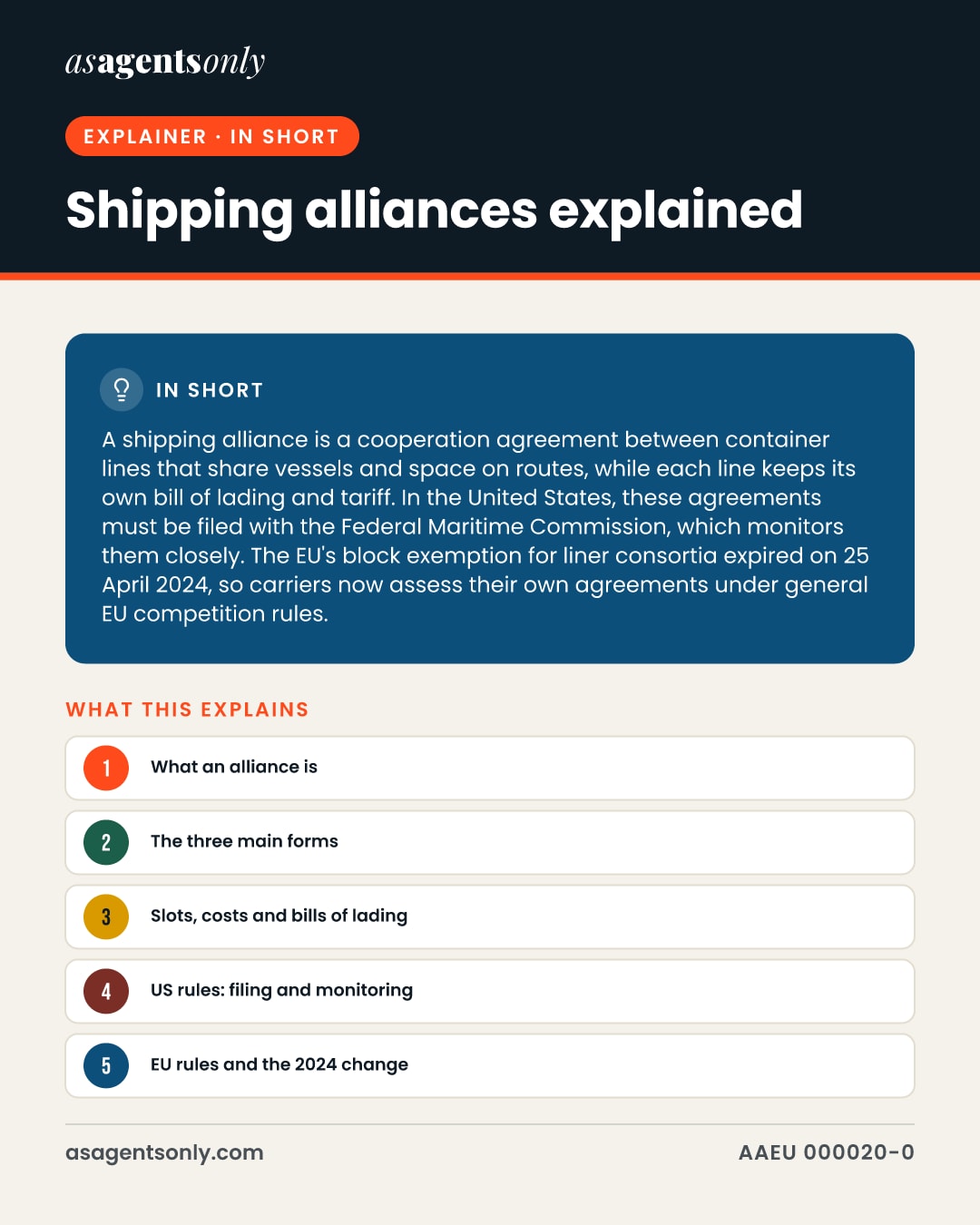
A shipping alliance is a cooperation agreement between container lines that share vessels and space on routes, while each line keeps its own bill of lading and tariff. In the United States, these agreements must be filed with the Federal Maritime Commission, which monitors them closely. The EU's block exemption for liner consortia expired on 25 April 2024, so carriers now assess their own agreements under general EU competition rules.
Container lines form alliances so they can offer more sailings and port coverage without buying every ship alone. Most shippers and forwarders only see the results: a partner's ship on your lane, a changed service loop, or a booking that names one carrier while another operates the vessel. Knowing the main forms of cooperation, and how regulators treat them, helps you read schedules, bills of lading and service notices with less guesswork.
What an alliance is
An alliance is a cooperation agreement between ocean carriers, usually container lines, to share vessels and space on routes. The European Commission describes consortia as joint service agreements that carriers use to make their operations more efficient.
The OECD and ITF, in a report, say global alliances are operational cooperation. They cover ship utilisation, sailing schedules, containers and joint terminal use. They do not cover joint sales, marketing or pricing, and the partners keep their own identities in the market.
The three main forms
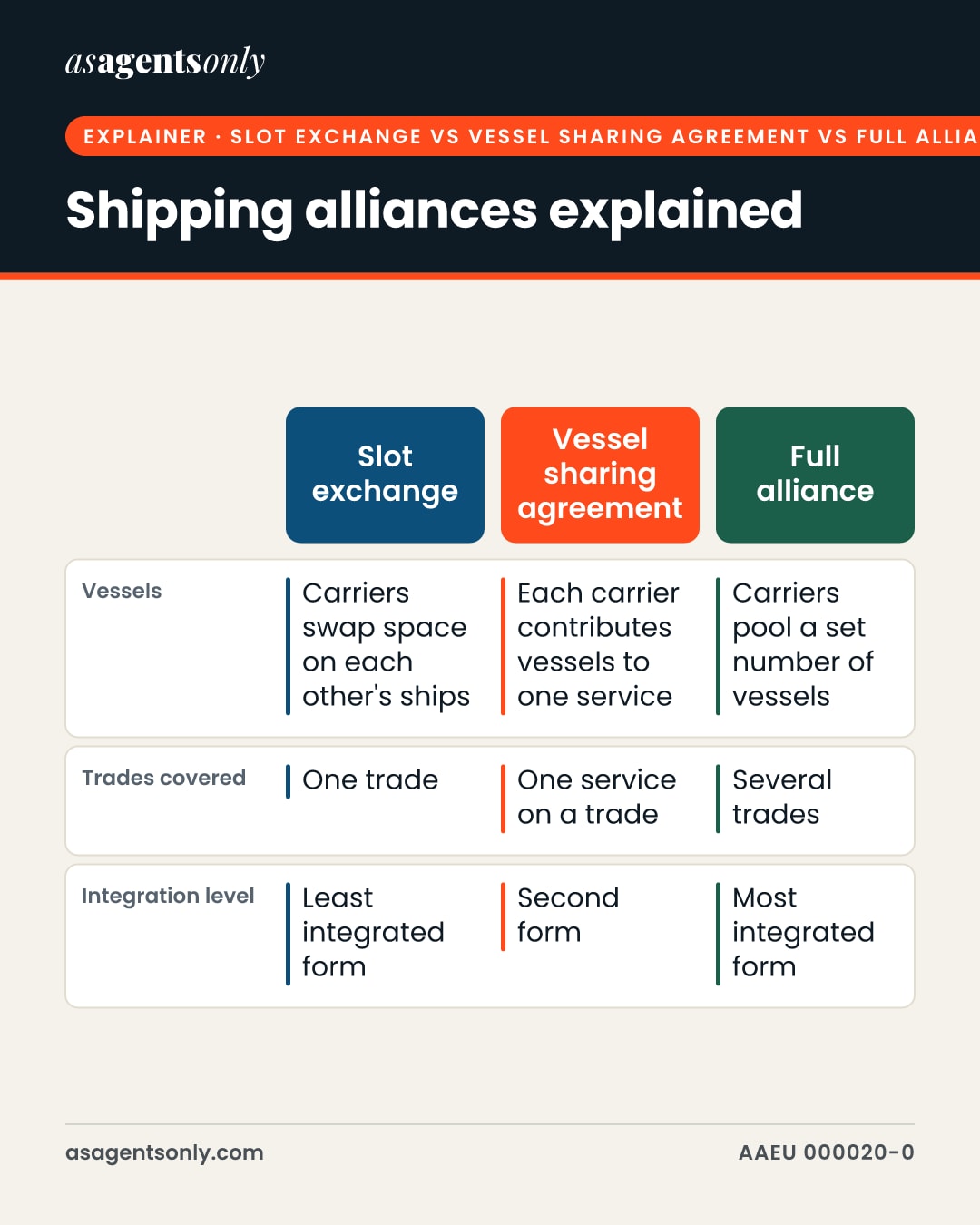
The European Commission ranks consortium forms from least to most integrated. A slot exchange is the lightest form: carriers swap space on each other's ships operating on one trade. A vessel sharing agreement is the second form: each carrier puts vessels into a given service and receives slots in proportion to what it contributes. A full alliance is the most integrated form: carriers pool a set number of vessels and run them jointly across several trades.
The Commission also notes that a stand-alone slot charter, where one carrier buys space from another without any reciprocal joint service, is not a consortium under EU rules. Carriers often use several of these tools at once, so a single partnership may combine them.
Slots, costs and bills of lading
In an alliance, slots are usually allocated by contribution. The OECD and ITF report describes the general principle that a carrier's benefits relate to what it puts into the pool. Under one major alliance agreement on file with the FMC, the basic slot allocation is intended to match each party's contribution on a trade lane basis, unless the parties agree otherwise.
To settle imbalances, the OECD and ITF report says alliances use a reference cost model and clear exchanged slot positions at the end of the month. Your contract is still with the carrier you booked. Under the OCEAN Alliance agreement, each line operates under its own name, issues its own bill of lading, publishes its own tariff and collects its own freight. Check the carrier named on your bill of lading, and ask which carrier operates the vessel, because the two can differ.
US rules: filing and monitoring
The Federal Maritime Commission states that its statute and regulations require agreements that let ocean common carriers collaborate to be filed with the Commission. Staff review them on filing and monitor those that raise competitive concerns, including all three alliances. An agreement generally takes effect 45 days after filing unless the Commission issues a Request for Additional Information, as it did for the Premier Alliance.
The Premier Alliance Agreement, filed on 28 October 2024, was delayed by that request and took effect on 9 February 2025. Gemini Cooperation was filed on 31 May 2024, and the Commission said alliance agreements are subject to enhanced examination and continuous oversight. The Commission now requires the three global alliances and their members to provide enhanced pricing and capacity information. The FMC also states that carriers in an alliance still compete on price and service, and that an alliance is not a merger or joint venture.
EU rules and the 2024 change
The EU's Consortia Block Exemption Regulation allowed liner consortia to cooperate under conditions. The European Commission decided not to extend it and let it expire on 25 April 2024, saying it no longer promoted competition in shipping. The Commission was clear that this does not make cooperation between shipping lines unlawful under EU antitrust rules.
Carriers operating to or from the EU now assess their co-operation agreements against the Horizontal Block Exemption Regulation and the Specialisation Block Exemption Regulation, and against EU antitrust rules generally. Because these rules are complex and may be amended, check the current text with the European Commission or a qualified adviser before relying on any arrangement.
Side by side
| Compared | Slot exchange | Vessel sharing agreement | Full alliance |
|---|---|---|---|
| Vessels | Carriers swap space on each other's ships | Each carrier contributes vessels to one service | Carriers pool a set number of vessels |
| Trades covered | One trade | One service on a trade | Several trades |
| Integration level | Least integrated form | Second form | Most integrated form |
Example
Illustrative example only, with invented carriers: Carrier A and Carrier B agree a shared service on an Asia to US East Coast route. Carrier A contributes two ships and Carrier B contributes one. If the parties set the basic slot allocation equal to contribution, Carrier A holds the larger share of slots on that service. A shipper booking space with Carrier B still receives a Carrier B bill of lading, under Carrier B's name and tariff, even though some sailings run on Carrier A's ships.
In pictures
The same facts as this page, as images to save or share. Tap one to open it full size.
Official sources
- OCEAN Alliance Agreement, FMC Agreement No. 012426 historyFederal Maritime Commission
- Premier Alliance Agreement Taking EffectFederal Maritime Commission
- FMC Issues Request for Additional Information Regarding Premier Alliance AgreementFederal Maritime Commission
- FMC Seeks Public Comments on Premier Alliance AgreementFederal Maritime Commission
- Gemini Cooperation Agreement to Take EffectFederal Maritime Commission
- New Monitoring Requirements Give FMC More Insight into Alliance Carrier OperationsFederal Maritime Commission
- Federal Maritime Commission 64th Annual Report, Fiscal Year 2025Federal Maritime Commission
- Federal Maritime Commission 63rd Annual Report, Fiscal Year 2024Federal Maritime Commission
- Commission decides not to extend antitrust block exemption for liner shipping consortia (press release IP/23/4742)European Commission, published 10 October 2023
Claims ledger: 30 facts and where each comes from
- The OCEAN Alliance agreement authorizes its parties to share vessels, charter and exchange space on one another's vessels, and cooperate in the major East-West trades.1
- The OCEAN Alliance agreement was extended so its term runs through 31 March 2032.1
- Under the OCEAN Alliance agreement, each line operates under its own name, issues its own bill of lading, publishes its own tariff and collects its own freight.1
- The Premier Alliance Agreement, FMC Agreement No. 201435, takes effect on 9 February 2025.2
- The Premier Alliance Agreement was filed on 28 October 2024.3
- Agreements become effective 45 days after filing unless the Commission issues a Request for Additional Information.3
- The Commission uses a Request for Additional Information to obtain documents and verifiable information needed where the original filing lacked sufficient detail.3
- A 15-day public comment period opens after a Request for Additional Information is published in the Federal Register.3
- Activities conducted under agreements filed with the Commission and in effect are exempt from federal antitrust laws.4
- The Gemini Cooperation Agreement was filed with the Federal Maritime Commission on 31 May 2024.5
- Parties participating in alliance agreements must agree to monitoring conditions and requirements.5
- Carrier alliance agreements are subject to enhanced examination and continuous oversight.5
- The three global ocean carrier alliances, 2M, OCEAN and THE, and their member companies must provide enhanced pricing and capacity information.6
- Under the new requirements, carriers in an alliance must submit pricing information on the major trade lanes, and carriers and alliances must submit comprehensive capacity management information.6
- The Commission's statutory authority and regulations require agreements that allow collaboration among ocean common carriers to be filed with the Commission.7
- There are three alliances with agreements on file at the Federal Maritime Commission.7
- Agreements are not mergers nor joint ventures.8
- Ocean carriers in these agreements compete with one another based on price and service.8
- The European Commission decided not to extend the Consortia Block Exemption Regulation and let it expire on 25 April 2024.9
- The expiry of the Consortia Block Exemption Regulation does not mean that cooperation between shipping lines becomes unlawful under EU antitrust rules.9
- Carriers operating to or from the EU assess their co-operation agreements against the Horizontal Block Exemption Regulation and the Specialisation Block Exemption Regulation.9
- Consortia are defined as joint service agreements between carriers designed to rationalise their operations.10
- A slot exchange agreement is the least integrated form of consortium, in which carriers exchange space on each other's vessels operated on a given trade.10
- A vessel sharing agreement is the second form of consortium, in which each carrier contributes vessels to a given service and is entitled to slots in proportion to its vessel contribution.10
- The most integrated form of consortium is an alliance, in which carriers pool a pre-decided number of vessels and operate them jointly on a number of trades.10
- A stand-alone slot charter, where a carrier buys space on another carrier's vessels, is not reciprocal and does not involve joint services, so it is not a consortium within the meaning of the Regulation.10
- Global alliances are cooperation agreements between container lines on operational matters.11
- Cooperation in global alliances does not cover joint sales, marketing, pricing, joint ownership of assets, pooling of revenues, or joint management.11
- Each alliance has a reference cost model to clear exchanged slot positions at the end of the month.11
- The general principle of an alliance is that the benefits a carrier gets are related to what it puts in, in terms of pooled vessels.11
Every figure on this page is tied to a cited source, last checked on 23 October 2026. Pages like this are re-checked every six months. Found something out of date? Tell the desk.