- Explainer
- Ocean
- 4 min read
- Last verified 21 October 2026
What a blank sailing is
A blank sailing is a scheduled ocean voyage that a carrier cancels or skips ports on, and why it matters when you plan cargo.

In short
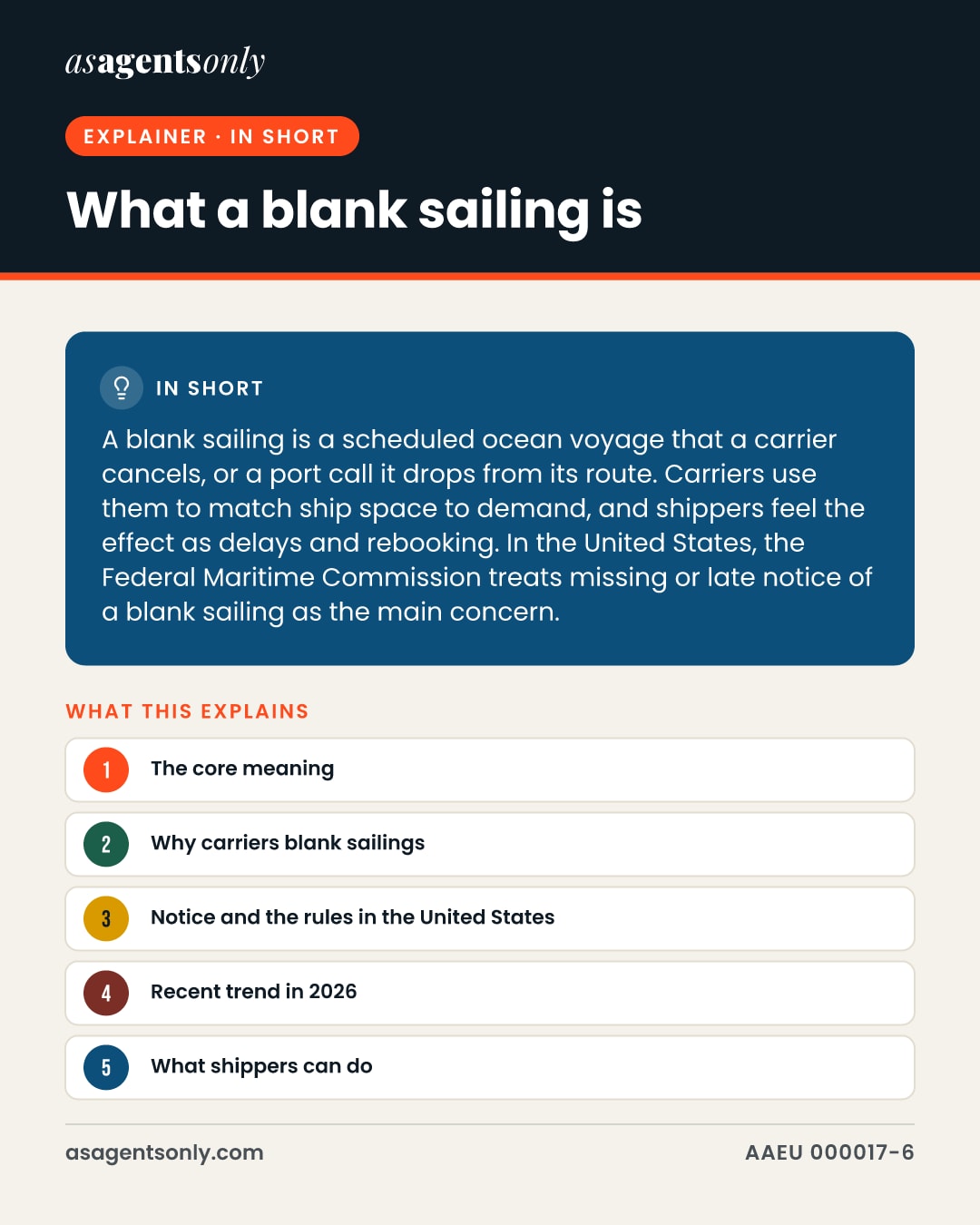
A blank sailing is a scheduled ocean voyage that a carrier cancels, or a port call it drops from its route. Carriers use them to match ship space to demand, and shippers feel the effect as delays and rebooking. In the United States, the Federal Maritime Commission treats missing or late notice of a blank sailing as the main concern.
Ocean container services run on published schedules, so a change to one sailing can alter when cargo arrives, or whether it sails on the planned ship at all. The industry term for one specific kind of change is 'blank sailing.' The term appears in regulations, carrier notices and market reports, and the meaning is not always the same across them, so it helps to know the core definition first.
The core meaning
A blank sailing is a scheduled voyage that a carrier cancels, or a voyage on which the carrier skips one or more scheduled ports. The United States regulator defines the term in its rule on unreasonable refusals to deal. Under that definition, the sailing may skip specific ports while still running the rest of its route, or the entire sailing may be canceled.
Trade analysts use the same idea. A cancelled voyage and a dropped port call both reduce the space a shipper expected on a given ship, which is why the term is used for both outcomes. The shipper's question is usually not whether the carrier has a reason, but whether the cargo still moves on time.
Why carriers blank sailings
Carriers usually decide before the ship leaves port, and they often decide after reviewing bookings. Container lines can cancel sailings well ahead of departure when cargo bookings are weak. Low demand is the most common reason in the trade press, since a carrier may pull a sailing rather than run it with too little cargo.
Other triggers named by analysts include port congestion, moving ships to busier trade lanes, and weather or labor disruption. The FMC has also noted that legitimate transportation factors can make a blank sailing necessary, and that it will not presume every blank sailing is reasonable. In the second quarter of 2024, the FMC reported that blank sailings removed capacity mainly because of fleet rearrangements and operational issues.
Notice and the rules in the United States
The FMC's focus is on notice. In its rule, the Commission said blank sailings are not deemed unreasonable in themselves; the lack of adequate notice is the relevant factor. The rule lists blank sailings or schedule changes made with no advance notice, or with insufficient notice, as a non-binding example of conduct that may be considered unreasonable when linked to a refusal to provide cargo space. The Commission did not set a fixed notice period, saying the answer depends on the circumstances.
The final rule took effect on September 23, 2024, though some provisions, including the documented export policy paragraph, were delayed. Alliance carriers file advance notices of blank sailings with the FMC, which uses them to monitor capacity. An FMC fact-finding report suggested at least seven days' notice as a practice. That was a recommendation, not a binding rule, and other countries set their own notice expectations.
Recent trend in 2026
Blank sailings are a regular part of supply planning. Lloyd's List reported that container lines blanked a meaningful share of scheduled capacity across four key east-west trades in the first half of 2026, well above the same period in 2019. Drewry's weekly tracker showed a much smaller share for the coming weeks.
Because these figures change every week, treat any single number as a snapshot. Check the carrier's own notices and a current tracker before you plan.
What shippers can do
Trade analysts recommend several steps. Using more than one ocean line reduces exposure when one sailing is canceled. Booking earlier leaves more room to reroute. Safety stock and flexible delivery windows can soften delays. Carriers typically issue blank sailing notices in advance, so monitoring those notices is part of routine planning.
Side by side
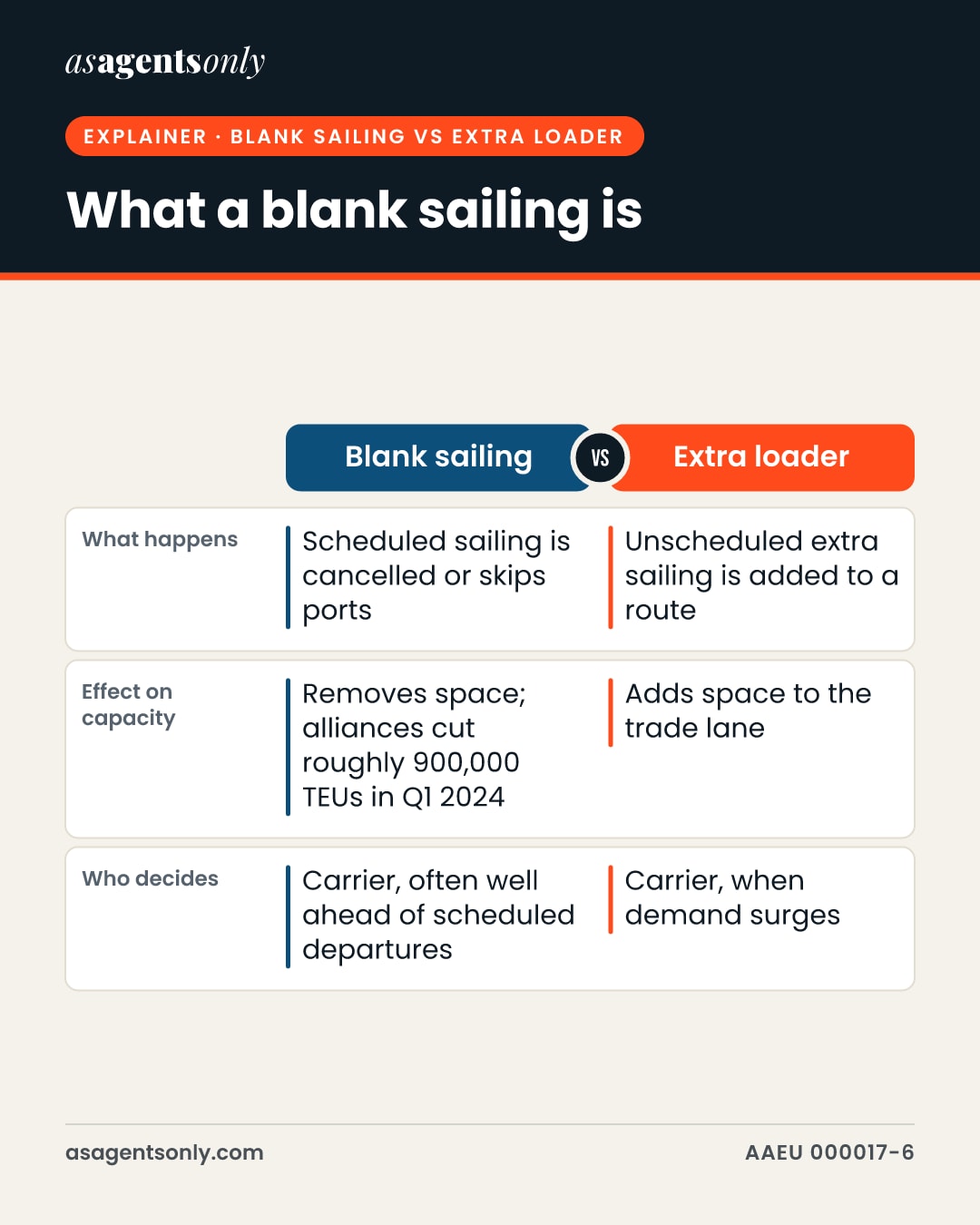
| Compared | Blank sailing | Extra loader |
|---|---|---|
| What happens | Scheduled sailing is cancelled or skips ports | Unscheduled extra sailing is added to a route |
| Effect on capacity | Removes space; alliances cut roughly 900,000 TEUs in Q1 2024 | Adds space to the trade lane |
| Who decides | Carrier, often well ahead of scheduled departures | Carrier, when demand surges |
Example
Illustrative example only, not a real shipment: an importer books a container on a sailing from an Asian port to a United States East Coast port. A few days before departure, the carrier cancels that voyage. The importer must rebook the cargo on a later sailing, which may delay delivery and can add storage charges at the port. The practical lesson is to check carrier notices early and keep a backup routing in the plan.
In pictures
The same facts as this page, as images to save or share. Tap one to open it full size.
Official sources
- Definition of Unreasonable Refusal To Deal or Negotiate With Respect to Vessel Space Accommodations Provided by an Ocean Common CarrierFederal Register (U.S. Federal Maritime Commission final rule), published 23 July 2024
- Agreement MonitoringFederal Maritime Commission
- Federal Maritime Commission 63rd Annual Report, Fiscal Year 2024Federal Maritime Commission
- Federal Maritime Commission Fact Finding Investigation 29 Final ReportFederal Maritime Commission
- Blank sailings settle at higher baseline in 1H26Lloyd's List, published 20 July 2026
- Cancelled Sailings Tracker - 09 OctDrewry Supply Chain Advisors, published 9 October 2026
- Supply Chain 101: What Blank Sailings Mean for ShippersSupply Chain 24/7
Claims ledger: 21 facts and where each comes from
- In 46 CFR Part 542, the FMC defines blank sailing to cover a sailing that skips one or more specific ports while still running the rest of the route, or a sailing that is entirely canceled.1
- Container lines blank (cancel) sailings well ahead of scheduled departures if cargo bookings are too weak.8
- The FMC is unwilling to find that blank sailings will always be reasonable in every case, although legitimate transportation factors may necessitate one.1
- Low demand: if there aren't enough containers to justify the route, the sailing may be pulled to save money.7
- Ports such as Los Angeles/Long Beach, Rotterdam, and Shanghai sometimes get so congested that ships skip a call to avoid days of waiting.7
- Carriers sometimes need to move vessels to busier trade lanes.7
- Storms, canal droughts, labor strikes, and regional conflict can all force last-minute changes.7
- In Q2 2024, the capacity removed through blank sailings was roughly 640,000 TEUs, mainly due to fleet rearrangements and operational issues.3
- The alliance carriers collectively removed approximately 900,000 TEUs in capacity through blank sailings in Q1 2024.3
- The FMC lists blank sailings or schedule changes with no advance notice or insufficient advance notice as a non-binding example of conduct that may be considered unreasonable when linked to a refusal to provide cargo space accommodations.1
- Blank sailings themselves are not deemed unreasonable by the FMC; it is the lack of adequate notice that is relevant to the reasonableness analysis.1
- The FMC declines to specify how much notice is required, because that depends on the circumstances.1
- The final rule is effective September 23, 2024, except for instruction 2 adding § 542.1(j), and instruction 3 adding § 542.99, which are delayed.1
- For the alliances, the carriers report advance notices of blank (canceled) sailings to the FMC.2
- Advance notice of blank sailings should be given at least seven days in advance, according to the FMC's fact-finding report.4
- Container lines blanked 10%-14% of scheduled capacity across four key east-west trades in the first half of 2026, far above the 6%-8% recorded in the same period in 2019.5
- Drewry's 09 Oct 2026 analysis expects 34 blank sailings from week 42 to week 46, representing a 5% cancellation rate.6
- Using multiple ocean carriers reduces the risk when a sailing is canceled; booking earlier gives more room to reroute when delays occur.7
- Carriers typically issue blank sailing advisories in advance.7
- An extra loader is an unscheduled extra sailing, the opposite of a blank sailing.9
- Two extra loaders were deployed on the trans-Pacific eastbound to deal with surging demand.9
Every figure on this page is tied to a cited source, last checked on 21 October 2026. Pages like this are re-checked every six months. Found something out of date? Tell the desk.