- Explainer
- Ocean
- 4 min read
- Last verified 12 October 2026
What terminal handling charges (THC) cover
THC pays for a container's handling at a port terminal, such as lifts, yard moves and gate work; it is separate from ocean freight.

In short
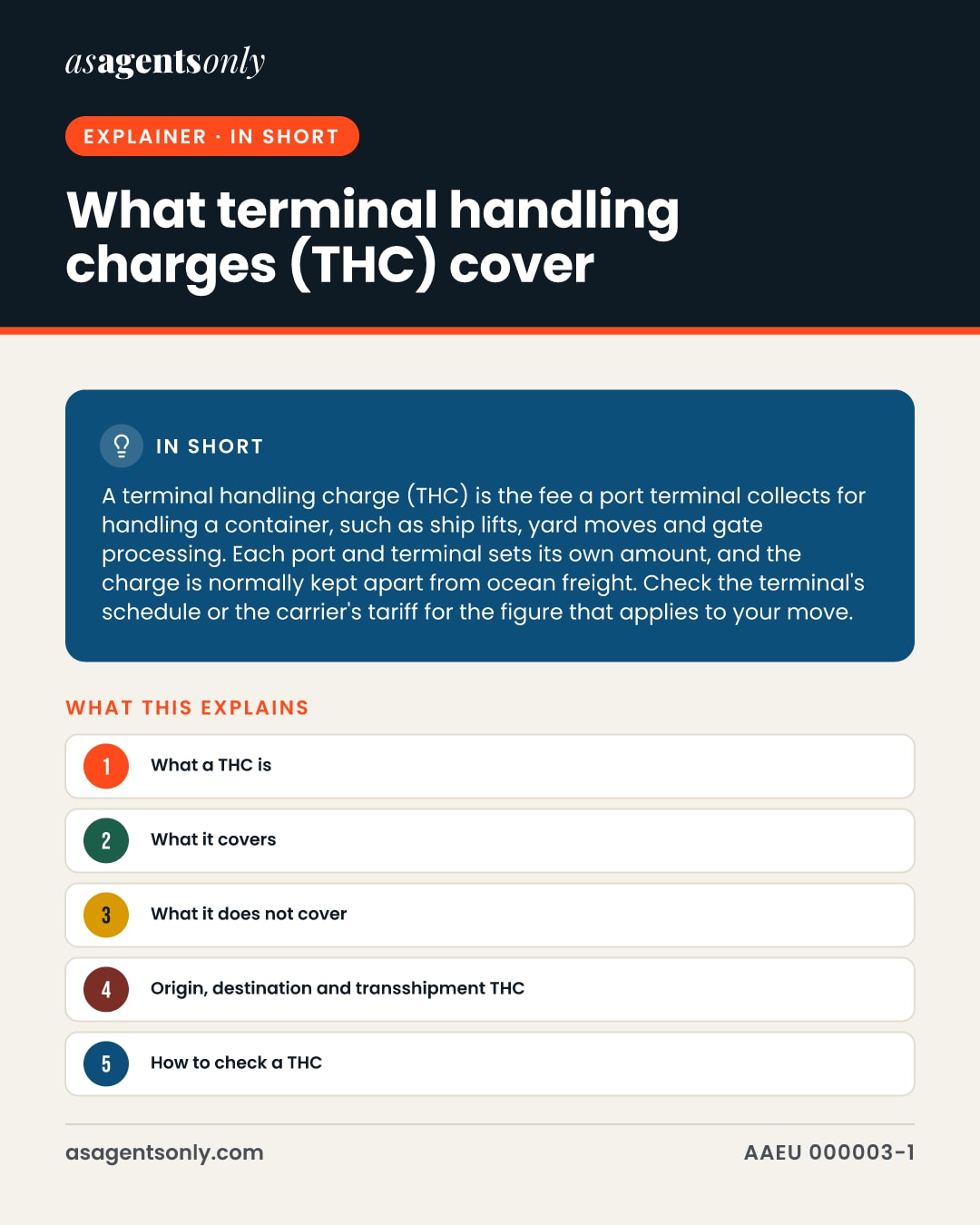
A terminal handling charge (THC) is the fee a port terminal collects for handling a container, such as ship lifts, yard moves and gate processing. Each port and terminal sets its own amount, and the charge is normally kept apart from ocean freight. Check the terminal's schedule or the carrier's tariff for the figure that applies to your move.
Ocean freight quotes often list a line called THC, and newcomers often ask what it pays for. The charge comes from the terminal, not from the ship, and its scope is narrower than many people assume. This explainer sets out what it covers, how origin and destination charges differ, what it does not cover, and how to check it.
What a THC is
A terminal handling charge, usually written THC, is the fee a port terminal collects for the work it does on a container at its facility. The amount is local. Each port and terminal sets its own THC, so the figure can change from one port call to the next on the same service, and it can differ between terminals inside one port.
The charge has roots in stevedoring. Ports first handled loading and unloading themselves or through operators, then began billing port users for that work, and that billing became the THC. In port economics, a specific port tariff is a charge for one particular service, which is how a THC is best understood.
What it covers
In practice, THC pays for the terminal's moves on a container: lifting it off or onto the ship, moving it around the yard, holding it briefly and processing it at the gate. The cost behind it includes access, equipment upkeep and use, and stevedoring labor.
A published tariff makes the scope concrete. The London Gateway public tariff says its basic terminal handling fee includes a quay crane lift, two yard moves, free storage days where they apply, and standard documentation. Vessel mooring is billed separately to the vessel operator, and container weighing is a separate line.
Some charges sit outside THC. Wharfage, a charge for cargo passing over a wharf, is sometimes billed as its own fee rather than inside THC, so read the quote line by line.
What it does not cover
THC is not ocean freight. In the United States, the Federal Maritime Commission's demurrage and detention rule excludes freight charges from its definition, so the two sit in different categories. Detention and demurrage are also separate from THC: detention is billed for extended use of intermodal equipment, and demurrage applies when a container stays on a marine terminal past free time.
Terminal charges can also be split by who benefits. The Federal Maritime Commission has distinguished charges for services performed for the vessel from those performed for cargo interests, so the responsible party depends on the service and on the tariff terms.
Origin, destination and transshipment THC
Origin THC and destination THC are normally billed by the terminal on the export and import moves. Whoever the sales contract makes responsible settles the origin or destination fee, either with the port or with the carrier, depending on the location. A transshipment THC is usually absorbed by the carrier, which includes it in the freight price.
Different container types can carry different THC amounts because handling methods differ. Refrigerated and hazardous boxes are common examples of containers that need extra handling steps.
How to check a THC
Ask the carrier or forwarder for the THC that applies to your port, terminal, direction and container type, then compare it with the carrier's published figure. Forwarders normally add no margin on THC, and many carriers post it on their websites.
Where a terminal makes its schedule public, FMC rules under 46 CFR Part 525 require the schedule to be available online in electronic form and to set out the rates and conditions for receiving, handling, storing and delivering cargo. Keep the tariff name, rule number and date with your records, because a figure may change between quotes.
Side by side
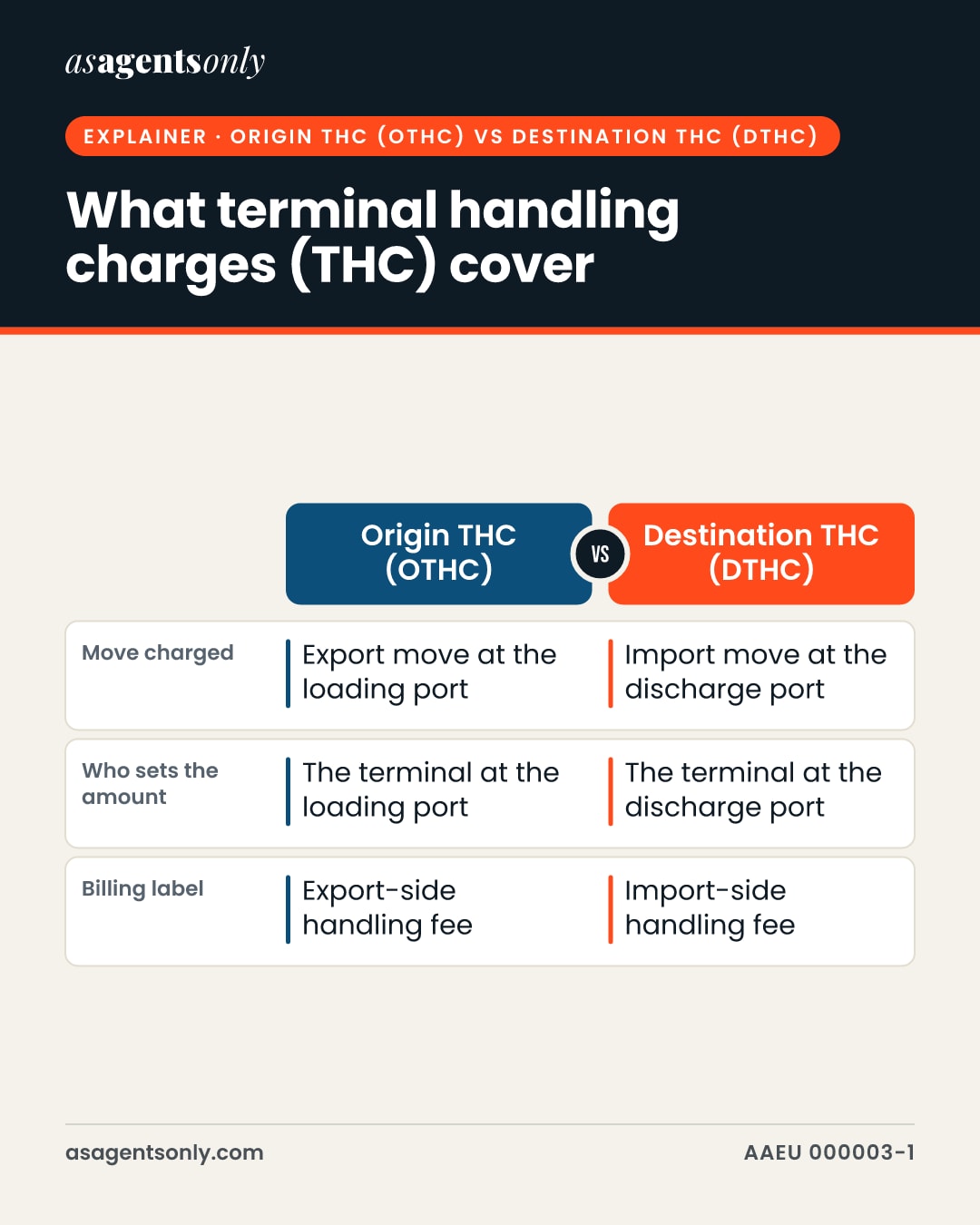
| Compared | Origin THC (OTHC) | Destination THC (DTHC) |
|---|---|---|
| Move charged | Export move at the loading port | Import move at the discharge port |
| Who sets the amount | The terminal at the loading port | The terminal at the discharge port |
| Billing label | Export-side handling fee | Import-side handling fee |
Example
Example (illustrative, not a real quote): A shipper books three full containers from a port in Country A to a port in Country B on one carrier's service. The quote lists ocean freight, an origin THC and a destination THC. The origin THC pays for the terminal's work on the boxes at the loading port, and the destination THC pays for the same kind of work at the discharge port. Because each terminal sets its own amount, the two THC lines can differ, and neither is part of the ocean freight line.
In pictures
The same facts as this page, as images to save or share. Tap one to open it full size.
Official sources
- DP World London Gateway Public Tariff 2024DP World London Gateway
- eCFR :: 46 CFR Part 525 -- Marine Terminal Operator SchedulesOffice of the Federal Register (eCFR)
- Federal Maritime Commission decisions, volume 27 (terminal charges)Federal Maritime Commission
- Port pricing (UNCTAD TD/B/C.4/110/Rev.1)United Nations Conference on Trade and Development
- Demurrage and Detention Billing RequirementsFederal Register (FMC final rule), published 26 February 2024
- Detention and DemurrageFederal Maritime Commission
Claims ledger: 27 facts and where each comes from
- Each port and terminal sets its own THC, so a route's charges can vary from port to port, even on one carrier's service.7
- Terminals inside the same port can also apply different THC amounts.7
- Ports moved from doing stevedoring to invoicing port users for the handling work, and that invoicing became the THC.7
- Whoever the sales contract makes responsible for the origin or destination handling fee settles it, either with the port or with the carrier.7
- A carrier includes transshipment handling in its ocean freight price rather than billing it separately.7
- Handling methods differ by container type, so THC amounts can differ by type.7
- Stevedoring labor, access, and the upkeep and use of equipment all feed into the THC figure.6
- Property in scope for THC can be a wharf, a carrier's terminal, or a container freight station.6
- Wharfage is sometimes billed as its own fee rather than inside THC.6
- Some carriers quote a single port-to-port price with THC already included.6
- Forwarders add no margin on THC, and carriers often post the figure on their websites.6
- The handling fee runs from the moment a box is received at port, through holding in a terminal yard, to loading it aboard.10
- Lifting a box off the ship, moving it inside the terminal and gate processing fall within the THC line.8
- The export-side handling fee is billed under the origin label.8
- The import-side handling fee is billed under the destination label.8
- This terminal's basic handling fee bundles a quay crane lift, two yard moves, free storage days where they apply, and standard documents.1
- Vessel mooring and unmooring at this terminal are handled by terminal staff and billed to the vessel operator, not to cargo owners.1
- Verified gross mass weighing is priced as a separate line item at this terminal.1
- The rules for marine terminal operator schedules are codified at 46 CFR Part 525.2
- A terminal schedule must set out rates and conditions tied to receiving, handling, storing and delivering cargo.2
- Where a terminal makes its schedules public, they must be available online in electronic form.2
- Freight charges fall outside the FMC's demurrage and detention definition.9
- Detention is billed for extended use of intermodal equipment, while demurrage applies once a container stays on a terminal past free time.12
- One carrier tariff quoted in an FMC proceeding applies origin and destination terminal charges assessed by the underlying ocean carrier.3
- The Federal Maritime Commission has distinguished charges for services done for the vessel from charges for services done for cargo interests.4
- A specific port tariff is a charge for one particular port service, unlike port dues, which pay for general use of the port.5
- Destination handling covers unloading, inspection, storage and coordination for onward delivery at the arrival port.11
Every figure on this page is tied to a cited source, last checked on 12 October 2026. Pages like this are re-checked every six months. Found something out of date? Tell the desk.