- Explainer
- Rates
- 4 min read
- Last verified 17 October 2026
Bunker surcharges (BAF) explained
How a bunker adjustment factor (BAF) surcharge is built, how carriers update it, and how to check the rate and its effective date.

In short
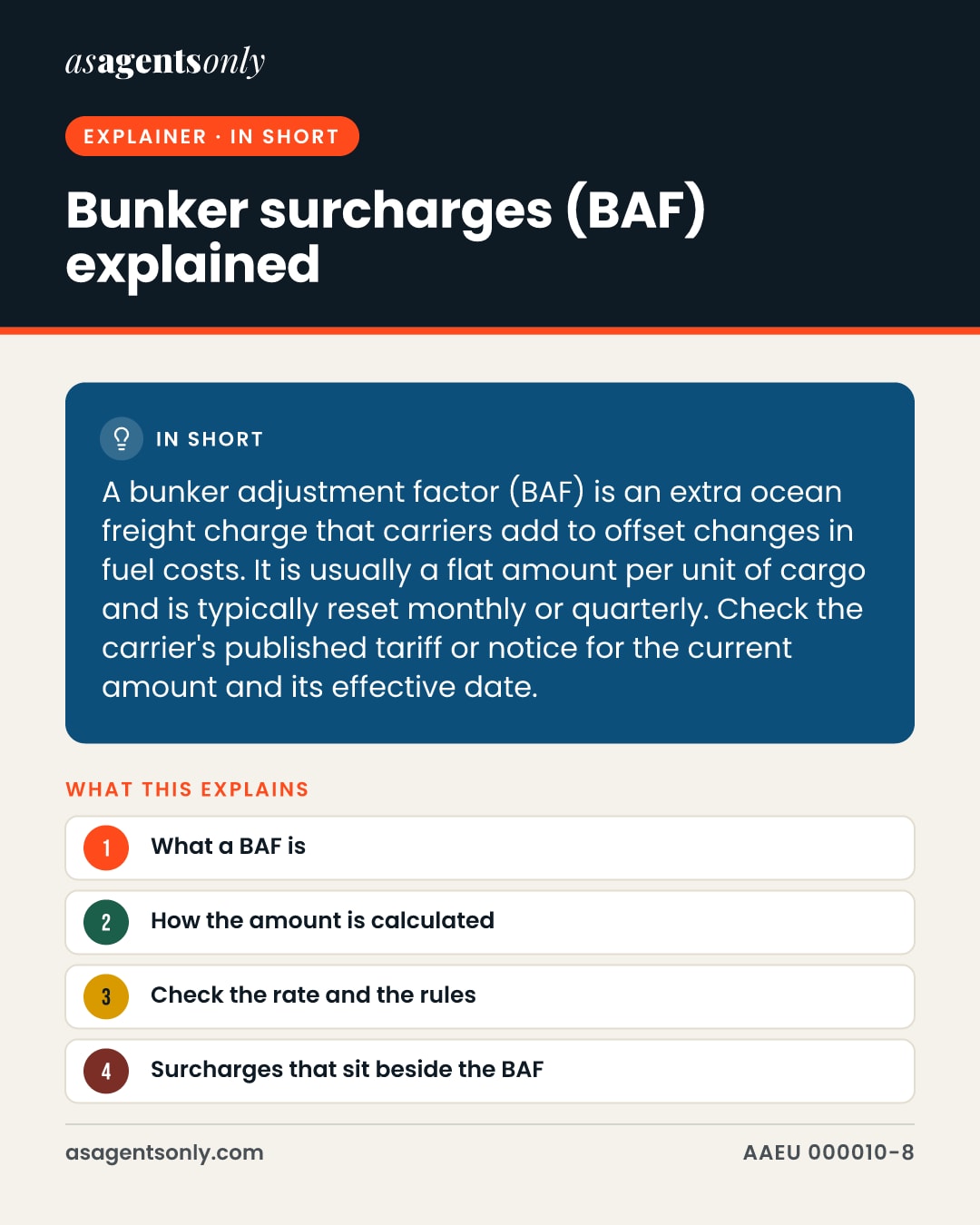
A bunker adjustment factor (BAF) is an extra ocean freight charge that carriers add to offset changes in fuel costs. It is usually a flat amount per unit of cargo and is typically reset monthly or quarterly. Check the carrier's published tariff or notice for the current amount and its effective date.
Ocean carriers buy the fuel that runs their ships, and its price can swing sharply within one contract period. The bunker adjustment factor, usually shortened to BAF, is the separate charge many carriers add to pass part of that swing to the cargo owner. This explainer covers how the charge is built, how often it changes, and where a reader can verify the figure for a given shipment.
What a BAF is
Ocean lines add a BAF to absorb changes in what they pay for ship fuel, which the industry calls bunkers. It is a surcharge on top of the base ocean freight, so it normally appears as its own line on a quote or invoice. Labels differ by carrier. The same kind of charge may appear as a BUC or as a Standard Bunker Adjustment Factor, so read the line name carefully.
The practice is old. The first BAF appeared in 1974, after oil shocks pushed bunker prices up. Early versions were percentage increases on the freight rate. A July 2009 report from the U.S. DOT Volpe Center described the flat fee per unit of cargo as the method then used in industry.
On containers, the amount is generally stated per twenty-foot equivalent unit (TEU). A forty-foot box counts as two TEU.
How the amount is calculated
A common model multiplies three inputs: the change in the bunker price, the fuel burned per unit of cargo, and a share that reflects how much of the risk is passed to the shipper. The 2009 Volpe report used this structure as a model, not as a universal rule. Technical inputs vary considerably from one carrier to another, so the same fuel price can produce different charges.
The base freight rate is assumed to already include fuel at the price prevailing when the quote was made. The BAF therefore reflects only the difference from that baseline. Carriers often take fuel prices from third-party indices, and VLSFO is a common reference fuel. Many carriers use a rolling average of prices rather than the spot price on a single day, often covering one to three months.
Some formulas use a buffer so that small price moves do not change the charge. One U.S. military shipping contract discussed in the 2009 report set a threshold of 20% in either direction from the baseline price. Updates typically come monthly or quarterly.
Check the rate and the rules
Start with the carrier's published tariff and the terms of your own service contract. Most carriers post their current BAF on their website. Carrier advisories are often a courtesy summary; the public tariff governs. Freightos suggests that smaller shippers ask for an all-inclusive port-to-port charge, which can simplify the invoice.
In the United States, the Federal Maritime Commission's tariff rules require at least 30 days between publication and the effective date of a tariff change that increases a shipper's cost, unless the agency grants special permission for a shorter period. A tariff charge must also be in effect when the carrier receives the cargo. These rules are national, so other countries may apply different requirements.
For forwarders, a non-vessel-operating common carrier (NVOCC) may pass through a carrier's published surcharges, but it must list the named charges in its own tariff and must not mark them up above cost. The FMC also says surcharges must be reasonable, clearly defined and tied to a specific, measurable purpose. A party that believes it was wrongly billed can seek voluntary resolution through the FMC's Office of Consumer Affairs and Dispute Resolution Services.
Surcharges that sit beside the BAF
A BAF is not the only fuel-related line. Some carriers add an emergency bunker surcharge during periods of volatility. Swire Shipping, for example, said its emergency bunker surcharge would apply in addition to its existing BAF for part of 2026.
Currency adjustment factors (CAFs) are a different charge. They are usually a percentage of the base rate and compensate carriers for exchange-rate changes. Because of the Middle East conflict, the FMC has said it is closely monitoring the impact on shipping conditions through the Strait of Hormuz, so surcharge levels in 2026 may change at short notice. Always confirm the current figure before you commit to a rate.
Side by side
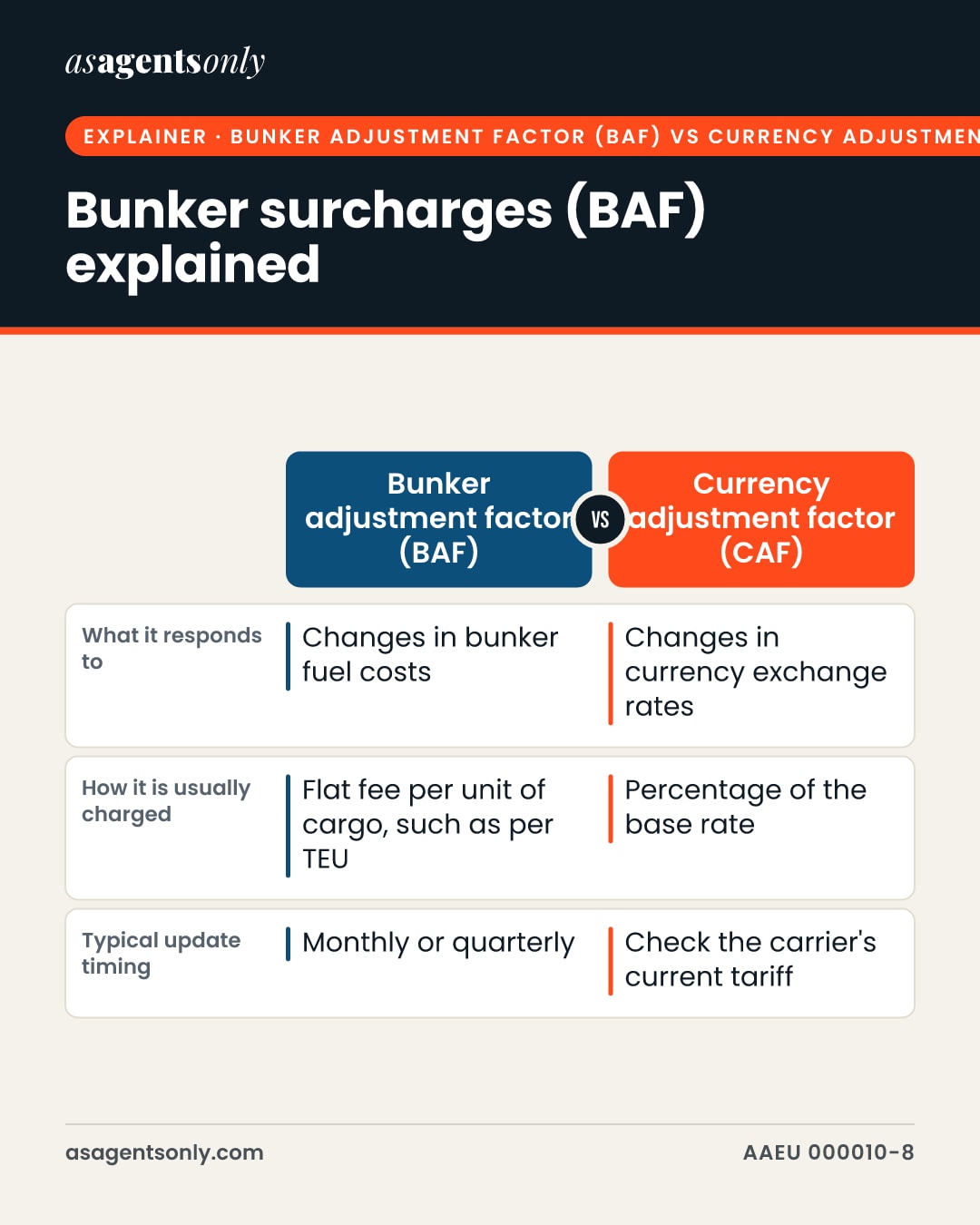
| Compared | Bunker adjustment factor (BAF) | Currency adjustment factor (CAF) |
|---|---|---|
| What it responds to | Changes in bunker fuel costs | Changes in currency exchange rates |
| How it is usually charged | Flat fee per unit of cargo, such as per TEU | Percentage of the base rate |
| Typical update timing | Monthly or quarterly | Check the carrier's current tariff |
Example
Illustrative example (all figures invented): a shipper books one forty-foot container, which counts as two TEU. If the carrier's BAF for that lane is two hundred dollars per TEU, the BAF line is four hundred dollars on top of the base freight. A real case: ANL said its BAF for dry cargo between Australia and Tonga, Samoa and American Samoa would be US$619 per TEU, for shipments loaded on or after 1 October 2026.
In pictures
The same facts as this page, as images to save or share. Tap one to open it full size.
Official sources
- Commission Advisory Regarding Red Sea SurchargesFederal Maritime Commission
- Commission Statement Regarding Strait of Hormuz SurchargesFederal Maritime Commission
- FMC Monitoring and Review of Surcharges and FeesFederal Maritime Commission
- 46 CFR Part 520 -- Carrier Automated TariffsU.S. Government (eCFR)
- July 2009 Calculation of Bunker Fuel, Currency, and Inland FreightU.S. DOT Volpe Center / U.S. DOD USTRANSCOM
- ANL adjusts Pacific Islands bunker surcharges from OctoberContainer News, published 9 September 2026
- Swire Shipping revises emergency bunker surcharge across global tradesContainer News, published 1 May 2026
Claims ledger: 29 facts and where each comes from
- Shipping lines charge a fee called BAF to cover fluctuations in global bunker costs.5
- Labels for the same kind of charge include BAF, BUC (Bunker Contribution), and Standard Bunker Adjustment Factor (SBF).5
- The first BAF appeared in 1974 after the oil shocks caused a significant rise in bunker prices.9
- In a July 2009 report, the flat fee per unit of cargo was described as the method used in industry today, after percentage increases on the freight rate.9
- BAF is based on TEU, to smooth out the effect of oil price fluctuations on carrier costs.8
- The 2009 report gives the BAF as the change in bunker price multiplied by fuel consumed per cargo unit and by a risk sharing factor, meaning the share of risk borne by the shipper.9
- The technical factors of a BAF vary considerably from one commercial carrier to another.9
- Fuel costs at prices applicable on the date of the bid are assumed to be incorporated into the base freight rate, so the BAF is an adjustment relative to the base fuel price.9
- Carriers quote fuel prices from third-party sources such as Bunkerworld, Platts Bunker Wire, or Bunker Index.9
- In industry, the price used is typically a rolling average, usually between one and three months.9
- The USC-5/6 contract set the price threshold for bunker fuel at 20% in either direction off the baseline price.9
- BAF is typically indexed to VLSFO and updated monthly or quarterly.6
- A BAF surcharge is based on oil prices and typically updated quarterly in a 12-month ocean container shipping contract.7
- Most carriers usually display their BAF on their home page, so the charge should be easy to check.8
- Smaller customers usually receive, or should ask for, an all-inclusive port-to-port charge.8
- The FMC encourages shippers to access and review their common carrier's tariff.2
- Parties should be familiar with the terms of their service contract.2
- Commission regulations at 46 CFR 520.8(a)(1&2) require common carriers to provide at least 30 days between the publication and effective date of a change to a tariff that results in an increased cost to shippers.1
- 46 CFR 520.14(c) outlines a process through which a common carrier may submit a Special Permission request showing good cause to reduce the 30-day waiting period.1
- Per 46 CFR 520.7(c), a tariff rate, charge, or rule must be in effect at the time the carrier or its agent receives cargo.1
- An NVOCC may cross-reference an ocean common carrier tariff to charge its shipper the carrier's published and effective surcharges, but it must clearly list the named charges and must not mark them up above cost.4
- All fees and surcharges must be reasonable, clearly defined, and serve a specific measurable purpose.3
- The Office of Consumer Affairs and Dispute Resolution Services facilitates voluntary outcomes when there are disagreements between parties involved in containerized ocean shipments.3
- The FMC is closely monitoring the impact the current conflict in the Middle East is having on shipping conditions through the Strait of Hormuz.2
- Swire Shipping noted that the emergency bunker surcharge will be applied in addition to the existing BAF for the first quarter of 2026.12
- A currency adjustment factor is expressed as a percentage of a base rate applied to compensate ocean carriers for currency fluctuations.10
- ANL will apply a BAF of US$619 per TEU for dry cargo moving between Australia and Tonga, Samoa and American Samoa.11
- The revised BAF applies to all shipments loaded on or after 1 October 2026.11
- The increase described in the Seaboard Marine advisory is applicable to all tariff and contract rates.13
Every figure on this page is tied to a cited source, last checked on 17 October 2026. Pages like this are re-checked every six months. Found something out of date? Tell the desk.