- Explainer
- Rates
- 4 min read
- Last verified 15 October 2026
How freight rate indices work (WCI, SCFI, FBX)
Learn how the WCI, SCFI and FBX are calculated, what each one covers, and how to use them as benchmarks rather than guaranteed prices.

In short
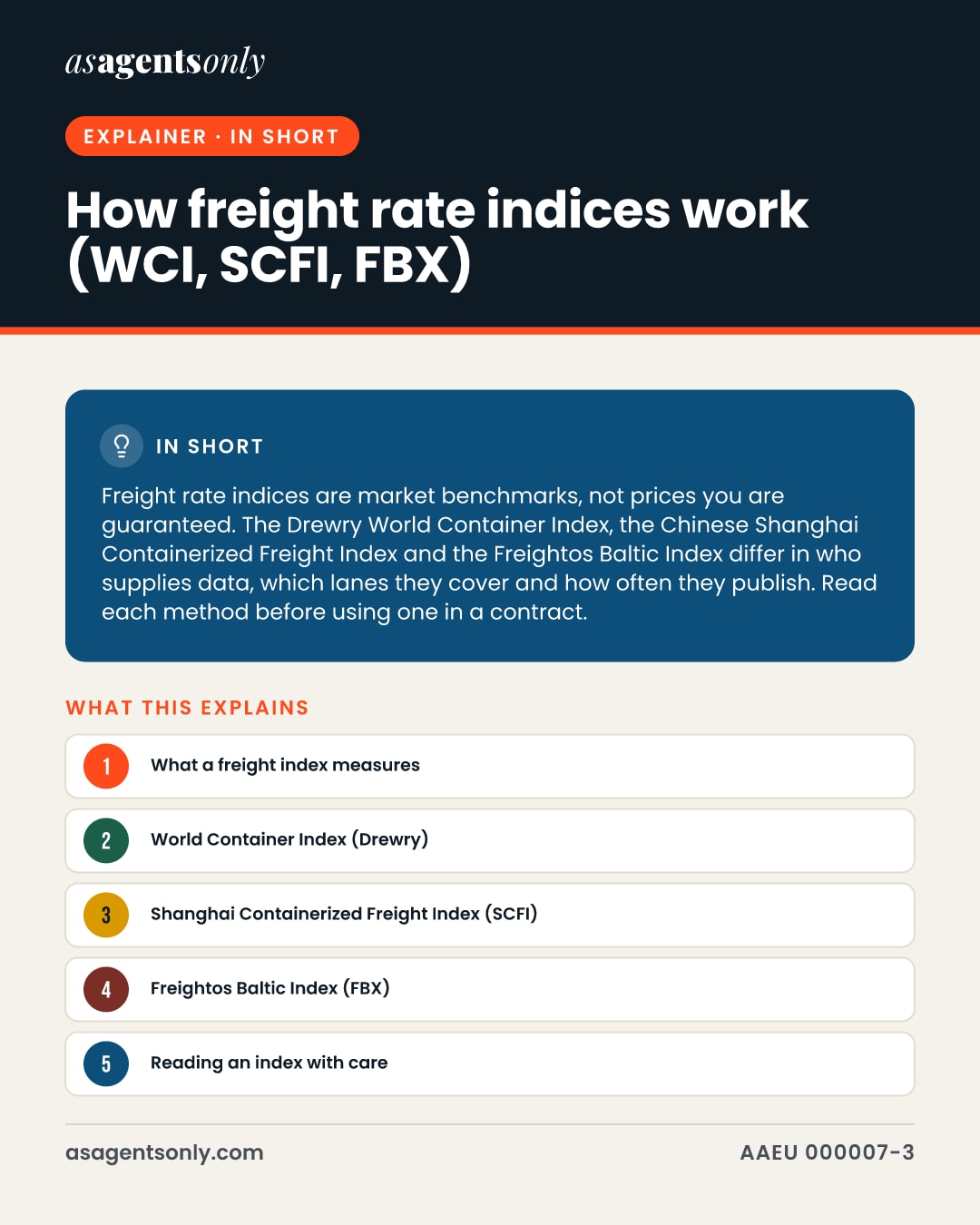
Freight rate indices are market benchmarks, not prices you are guaranteed. The Drewry World Container Index, the Chinese Shanghai Containerized Freight Index and the Freightos Baltic Index differ in who supplies data, which lanes they cover and how often they publish. Read each method before using one in a contract.
Market reports often quote one number as the going rate for a container. In ocean shipping that number usually comes from a published index. Three names come up most: the Drewry World Container Index (WCI), the Shanghai Containerized Freight Index (SCFI) and the Freightos Baltic Index (FBX). Each reports container prices on a set of lanes, but each collects and calculates its figures differently, so the three do not always move together.
What a freight index measures
An index gathers prices from several market participants at regular intervals and reduces them to one benchmark for a lane or a group of lanes. A global figure is then built from the lane results, typically as a weighted average. Lane results may be stated per 40-foot container or per TEU, depending on the publisher.
An index describes what the market looked like in a given week or day. It is not a quote your forwarder must honour, and it does not replace the terms of your own contract.
World Container Index (Drewry)
Drewry Shipping Consultants compiles the WCI. It is a weekly composite of eight route indices, all stated in US dollars per 40-foot container. Four of the lanes run from Shanghai to Rotterdam, Genoa, Los Angeles and New York; the others run in the opposite direction or between Europe and the US East Coast.
The WCI uses agreed rates, not quotes, tariffs, bids or offers. Each agreed rate must have a validity of at least seven calendar days and no more than one calendar month. Drewry then takes the median of the submitted rates and discards any rate more than 30% above or below it. The remaining rates are averaged by carrier, and the mean of those carrier averages becomes the route figure for the week. Only the final figure is published, so no individual panellist or line can be identified.
Shanghai Containerized Freight Index (SCFI)
The Shanghai Shipping Exchange, a Chinese body, compiles and publishes the SCFI. The composite uses 16 October 2009 as its base period, with a base value of 1,000 points. The index is published weekly and reflects spot rates for exports from Shanghai to 15 ports around the world.
Each route rate is an all-in figure covering ocean freight and related maritime surcharges. Terminal handling charges at both ends and inland on-carriage are excluded. Route rates are arithmetic averages, and the composite is a weighted average of them. Sample data come from the panel behind the China Containerized Freight Index, which includes liner companies, consignors and forwarders.
Do not confuse the SCFI with the SCFIS. The SCFI reflects booking rates, while the separate SCFIS uses rates settled after a vessel departs.
Freightos Baltic Index (FBX)
Freightos produces the FBX with the Baltic Exchange, which provides oversight. The daily index covers twelve trade lanes, and its headline figure is a weighted average of those lanes. The weekly figure averages five business days and is published each Friday.
For each lane, Freightos uses the median price, weighted by carrier, so that single outlying rates carry less weight. The inputs are rolling spot tariffs and surcharges from carriers, freight forwarders and high-volume shippers. Where a lane has fewer than ten valid rates, the Baltic Exchange guide allows additional rates to enter under a waterfall method.
Lookback rules are stated differently in two places. A Freightos page for one lane says only rates created or modified within the last three months are used. The Baltic Exchange FBX Guide refers to rates created or modified within 35 days. Check the current document before relying on a specific window.
Reading an index with care
An index is a benchmark, not a price guarantee. An index-linked contract ties a rate to a published benchmark so the price adjusts as the index moves. That can reduce repeated renegotiation, but the adjustment terms sit in your contract, so read them closely.
Index moves can reflect capacity decisions as well as demand. Carriers can cancel sailings to adjust capacity, so a fall in an index may partly reflect supply management rather than weaker demand.
Methods differ between providers, so the same week can show different direction in each index. Before using an index, read the publisher's current methodology, confirm that its lanes and unit match your cargo, and check its publication schedule. Nothing here forecasts where rates will go.
Side by side
| Compared | World Container Index (WCI) | Shanghai Containerized Freight Index (SCFI) | Freightos Baltic Index (FBX) |
|---|---|---|---|
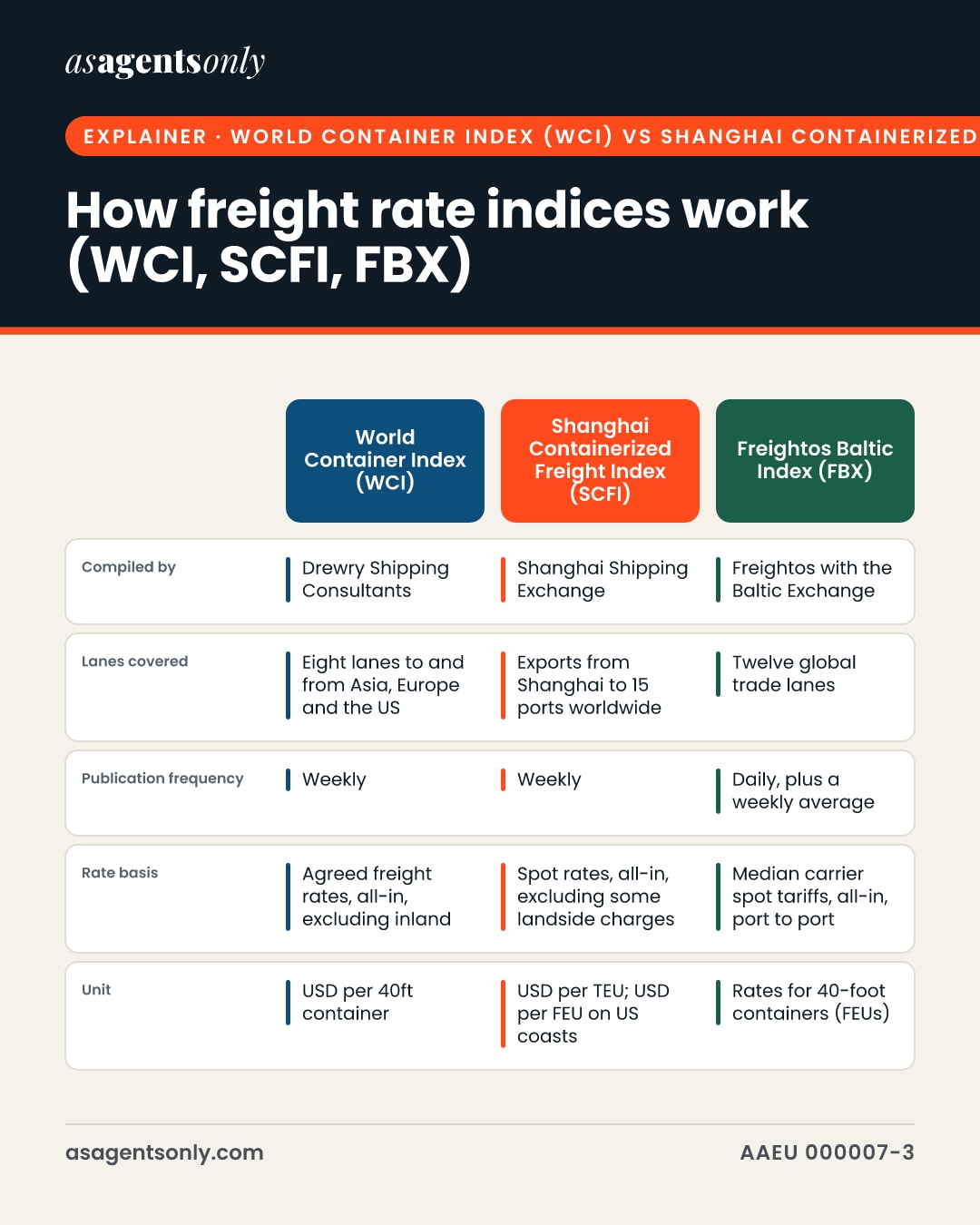
| Compiled by | Drewry Shipping Consultants | Shanghai Shipping Exchange | Freightos with the Baltic Exchange |
| Lanes covered | Eight lanes to and from Asia, Europe and the US | Exports from Shanghai to 15 ports worldwide | Twelve global trade lanes |
| Publication frequency | Weekly | Weekly | Daily, plus a weekly average |
| Rate basis | Agreed freight rates, all-in, excluding inland | Spot rates, all-in, excluding some landside charges | Median carrier spot tariffs, all-in, port to port |
| Unit | USD per 40ft container | USD per TEU; USD per FEU on US coasts | Rates for 40-foot containers (FEUs) |
Example
Real case, as reported by Drewry for 08 October 2026: the WCI fell 2% to $4,351 per 40ft container, driven by lower rates on the Transpacific and Asia-Europe routes during China's Golden Week. Read this as the composite for that week. It does not show what any one shipper paid, and the SCFI or FBX for the same week may point in a different direction.
In pictures
The same facts as this page, as images to save or share. Tap one to open it full size.
Official sources
- World Container Index: MethodologyDrewry Shipping Consultants
- World Container Index - 08 OctDrewry Shipping Consultants, published 8 October 2026
- World Container Index assessed by DrewryLloyd's List
- Shanghai Containerized Freight Index: questions and answersShanghai Shipping Exchange
- What is the Freightos Baltic Index (FBX)Freightos Help Center
- Guide to Freightos Baltic Global Container Index (FBX)Baltic Exchange
- What is the global container index?FreightWaves
- Freightos TerminalFreightos
- Container servicesBaltic Exchange
Claims ledger: 40 facts and where each comes from
- The WCI is a weekly composite of eight route-specific indices, all reported in USD per 40ft container.1
- The WCI composite weights each route by its trade volume, with volume expressed in million TEU per annum.1
- WCI routes include Shanghai to Rotterdam, Shanghai to Genoa, Shanghai to Los Angeles and Shanghai to New York, plus four routes in other directions.1
- Only freight rates agreed between participants, on which cargo is or will move, count; quotes, tariffs, estimates, bids or offers are excluded.1
- Each agreed rate must have a validity of not less than 7 calendar days and not more than 1 calendar month.1
- The median of submitted rates is calculated, and any rate more than 30% above or below that median is discarded.1
- The remaining rates are grouped by carrier, averaged per carrier, and the mean of the carrier averages is the route's WCI rate for the week.1
- Only the final WCI rate is published; individual panellists' rates and individual shipping lines' rates are not reported.1
- The WCI value includes ocean freight, bunker adjustment and applicable surcharges, plus terminal handling where common, but excludes inland transport surcharges.1
- WCI rates are reported container yard to container yard and do not include intermodal inland charges.1
- Drewry Shipping Consultants compiles the World Container Index, a composite of freight rates on eight major routes to and from the US, Europe and Asia.3
- On 08 Oct 2026 the WCI fell 2% to $4,351 per 40ft container, driven by lower rates on the Transpacific and Asia-Europe routes during China's Golden Week.2
- Each global index provider calculates its global index rate differently.9
- Carriers can blank, or cancel, sailings to adjust capacity, which can make an index move differ from the underlying demand change.9
- The SCFI was created by the Chinese government in 2005 and is operated by the Shanghai Shipping Exchange.9
- A global container index is a weighted average of individual lane indices.9
- The Shanghai Shipping Exchange acts as the freight index compilation and publication organ for the SCFI.4
- The SCFI composite uses 16 October 2009 as its basis period, with a basis index of 1,000 points.4
- SCFI route rates cover spot ocean freight plus related maritime surcharges.4
- Terminal handling charges at both ends, port facility security surcharge and inland on-carriage charges are not included in SCFI route rates.4
- The SCFI freight unit is USD per TEU, and USD per FEU applies on US east and west coasts.4
- SCFI route rates use an arithmetic mean, and the composite index is a weighted average.4
- SCFI sample data come from the panelists of the CCFI, including liner companies, consignors and freight forwarding enterprises.4
- SCFI is reported only once a week and covers spot rates for export from Shanghai to 15 ports around the world.5
- The SCFIS uses rates settled after containerships depart, while the SCFI uses booking rates.11
- The FBX flagship index is a weighted average of twelve underlying regional route indexes.5
- The daily FBX Container Index, in partnership with Freightos, reflects spot rates for 40-foot containers on 12 tradelanes.12
- FBX is a daily ocean container index issued by Freightos and the Baltic Exchange, covering 12 global trade lanes and a composite.6
- FBX provides market rates for 40-foot containers (FEUs).5
- FBX data is aggregated and anonymized from live business databases, with tens of millions of price points updated daily.5
- Index values use the median price of all prices, weighted by carrier, to reduce the influence of outliers.8
- Rates are calculated at 06:00 UTC and published at 14:00 UTC; the daily index covers a 48-hour window.8
- The weekly index is an average of the five business days of the same week and is published each Friday.8
- Only rates created or modified within the last 3 months and valid during the 48 hours are included in the FBX01 index.8
- Container Box Benchmarks are the median all-in price, port to port, for a standard forty-foot non-refrigerated container, based on carriers' rolling tariffs and related surcharges.7
- Where a tradelane has fewer than ten valid rates, additional rates contribute under a waterfall methodology.7
- Input Data includes port-to-port rates created or modified within the last 35 days of publication day and valid on or 7 days prior.7
- The FBX Global Index is a weighted average of tradelane indices, weighted by each tradelane's share of carrier volume, and tradelane volumes are reviewed annually.7
- An index-linked freight contract ties a shipping rate to a published benchmark so that pricing adjusts as market conditions shift.10
- The FBX is published daily, and with oversight from the Baltic Exchange it complies with international and European securities guidelines.6
Every figure on this page is tied to a cited source, last checked on 15 October 2026. Pages like this are re-checked every six months. Found something out of date? Tell the desk.