- Explainer
- Rates
- 4 min read
- Last verified 13 October 2026
Spot vs contract ocean freight rates
Learn how spot and contract ocean freight rates differ in commitment, price movement and U.S. filing rules, and why shippers often use both.

In short
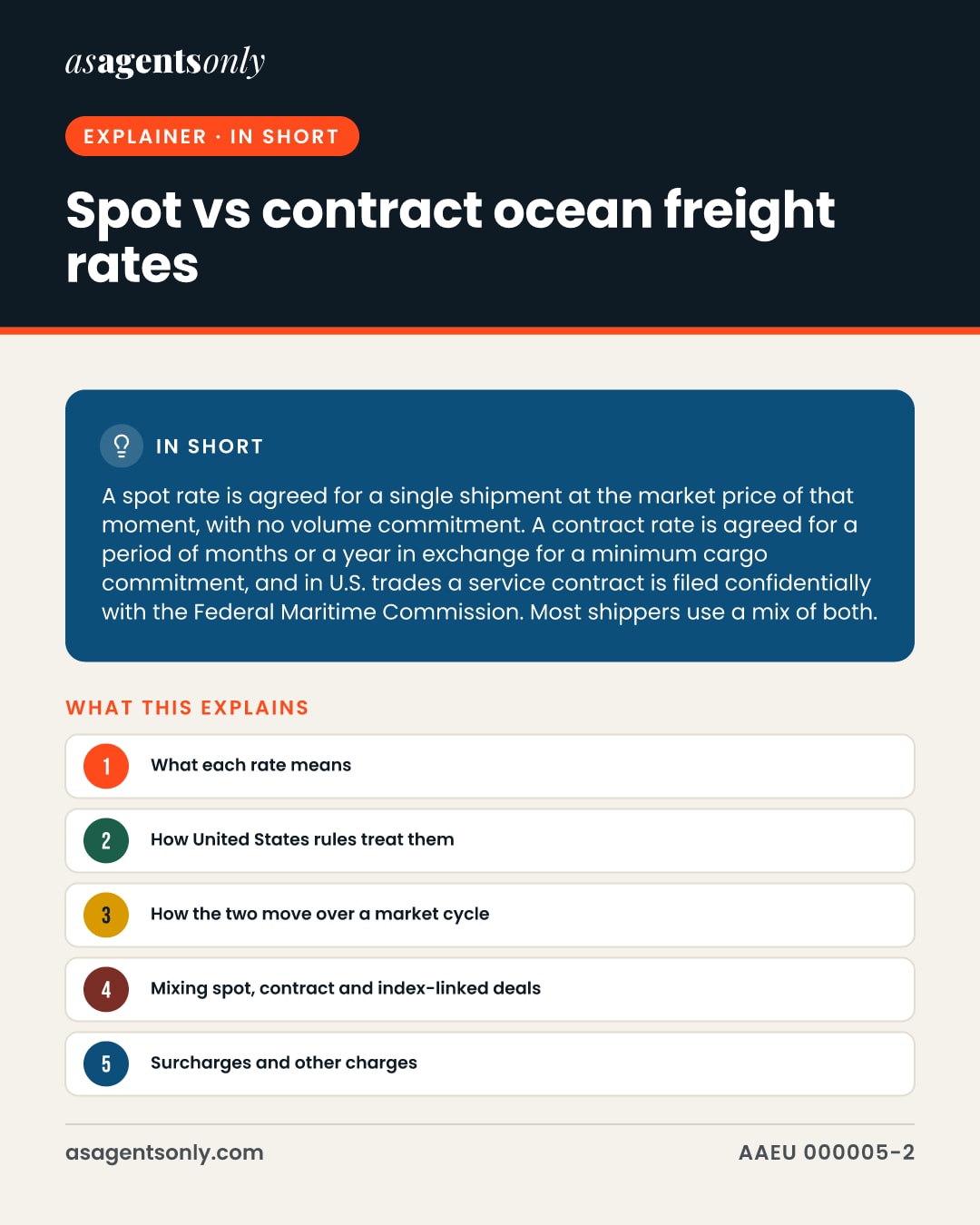
A spot rate is agreed for a single shipment at the market price of that moment, with no volume commitment. A contract rate is agreed for a period of months or a year in exchange for a minimum cargo commitment, and in U.S. trades a service contract is filed confidentially with the Federal Maritime Commission. Most shippers use a mix of both.
Ocean freight is priced in two main ways. Some cargo moves on a rate agreed for one booking at market prices, and some moves on a rate agreed in advance for months. Knowing which applies, and what each one commits the shipper to, shapes budget risk and the terms the shipper can expect from a carrier.
What each rate means
A spot rate is agreed for a single shipment, often days before pickup. The shipper pays the market price of that moment and makes no volume commitment, so it keeps full flexibility and full exposure to price moves. Spot rates can rise above contract rates in tight markets and fall below them when capacity loosens.
A contract rate is agreed for a longer period, typically several months or a year. In exchange, the shipper commits to a minimum quantity of cargo over a fixed period, and the carrier commits to a rate and a defined service level. The shipper gets a rate it can budget against, but it carries the volume obligation.
How United States rules treat them
In the United States, the Federal Maritime Commission (FMC) is the independent agency that regulates the international ocean transportation system. Under its regulations, all ocean freight rates, surcharges and accessorial charges in liner trades must be published in carrier tariffs or agreed to in service contracts filed with the Commission. Service contracts are filed confidentially through SERVCON, the FMC's automated filing system.
The FMC's final rule allows carriers to file original service contracts up to thirty days after their effective date. Original signed contracts, amendments and associated records must be kept for five years from termination. These are U.S. rules. Shippers in other countries should check the rules of their own national trade regulator, which may differ.
How the two move over a market cycle
Spot rates follow near-term supply and demand, while contract rates tend to be steadier. Contract pricing still reflects the market, because carriers set new contract levels with the spot market in view. The FMC has noted that the number of original service contracts filed has risen along with spot market and single-shipment contracts of limited duration.
Xeneta reported that a rise in spot rates during the fourth quarter did not necessarily lift contract rates for contracts starting in January. It also reported that on the Far East to Mediterranean lane, contracts lasting more than six months carried rates 45% lower than contracts of three to six months, in the period it analyzed. Longer commitments can therefore carry a price advantage, but the reader should check current data before relying on any gap.
Mixing spot, contract and index-linked deals
Most shippers combine both. A base volume under contract covers the steady part of a trade lane, and a spot portion covers peaks, urgent cargo or new lanes. Index-linked contracts sit between the two: each shipment is priced at a rate that reflects market movement during the contract period, which makes them flexible but still carries their own risks.
Xeneta treats any freight contract valid for three months or more as long-term, and considers a short-term contract to be 28 days or less. Long-term contracts usually keep rates and surcharges at the agreed level for their full length, barring major disruptive global events. Short-term deals allow more frequent renegotiation as rates move.
Surcharges and other charges
The headline rate is only the base freight charge. Bunker adjustment factor surcharges, which are adjusted quarterly, have been common on both fixed and spot rates. Port fees, detention and other accessorial charges can sit beside the base rate and change the total cost.
The shipper should compare total ocean cost, including every surcharge, when it sets a spot quote against a contract rate. Comparing base rates alone can give a misleading result.
Side by side
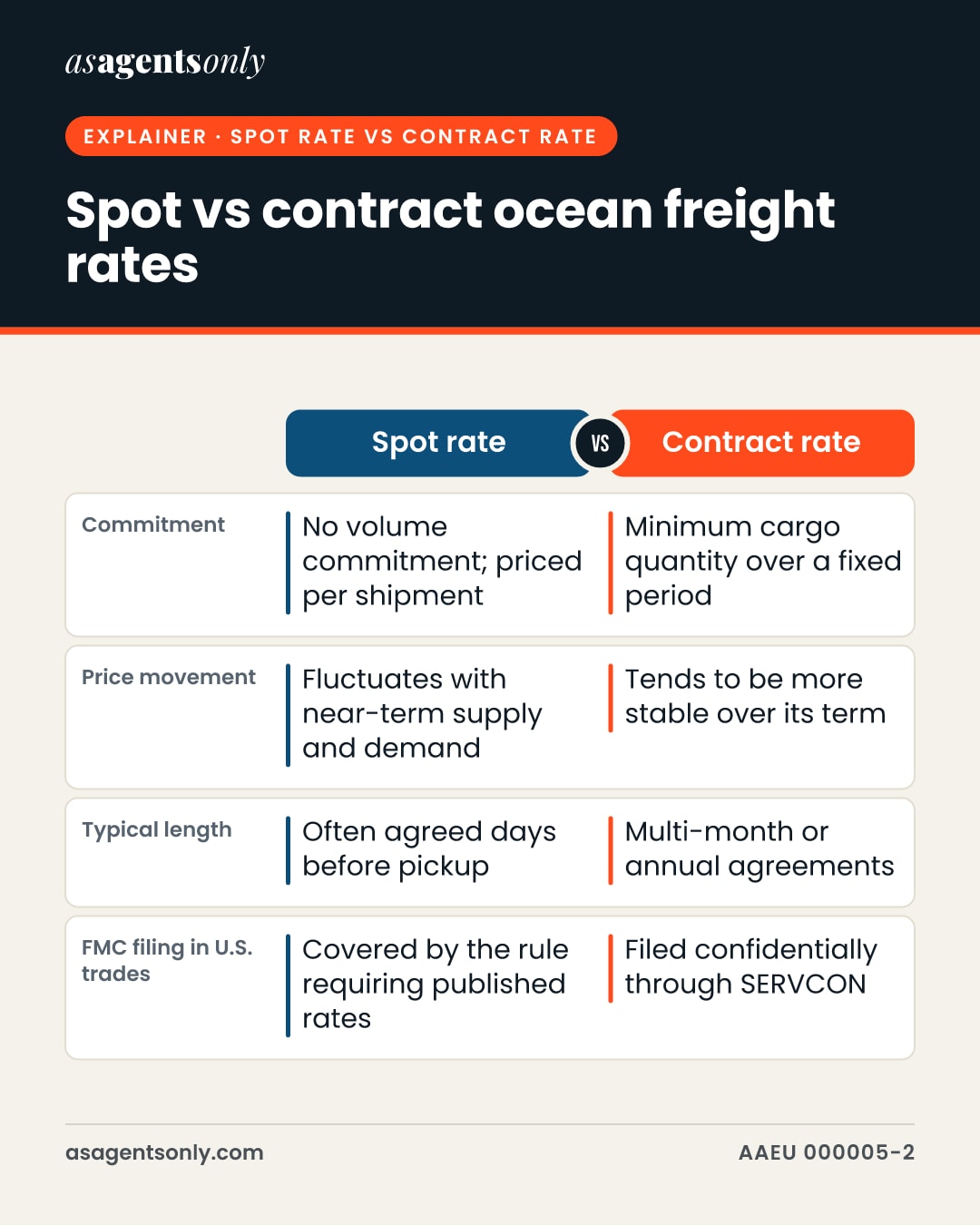
| Compared | Spot rate | Contract rate |
|---|---|---|
| Commitment | No volume commitment; priced per shipment | Minimum cargo quantity over a fixed period |
| Price movement | Fluctuates with near-term supply and demand | Tends to be more stable over its term |
| Typical length | Often agreed days before pickup | Multi-month or annual agreements |
| FMC filing in U.S. trades | Covered by the rule requiring published rates | Filed confidentially through SERVCON |
Example
Illustrative example only, not market data: a shipper expects to move about two hundred forty-foot containers a year on one trade lane. It signs a one-year contract for most of that volume at a fixed base rate and keeps the rest on spot bookings. If the market rises during the year, the contracted boxes stay at the agreed base rate while the spot boxes cost more. If the market falls, the contracted boxes may cost more than the spot boxes. In both cases, surcharges on each part must be added before the two are compared.
In pictures
The same facts as this page, as images to save or share. Tap one to open it full size.
Official sources
- How to File Service ContractsFederal Maritime Commission
- Service Contracts (final rule)Federal Register, Federal Maritime Commission, published 23 April 2021
- FMC FY 2024 Congressional Budget JustificationFederal Maritime Commission
- Service Contracts and NVOCC Service ArrangementsFederal Register, Federal Maritime Commission, published 29 February 2016
- AboutFederal Maritime Commission
- What are ocean container rates?FreightWaves
Claims ledger: 25 facts and where each comes from
- Spot rates are negotiated on a per-shipment basis, often days before pickup.7
- They fluctuate based on near-term supply and demand.7
- Contract rates are part of multi-month or annual agreements between shippers and carriers and tend to be more stable.7
- In tight markets, spot rates often rise above contract rates; when capacity loosens, spot rates may fall below contract rates.7
- Spot rates offer flexibility with no commitment but full exposure to market volatility.6
- Long-term contracts lock in your budget in exchange for a volume commitment.6
- Most shippers combine both to balance flexibility and stability.6
- the shipper commits to provide a certain minimum quantity of cargo over a fixed period of time1
- Confidential service contracts are filed through SERVCON, the Commission's automated service contract filing system.1
- Service contracts and their related amendments and notices must be filed confidentially with the FMC.1
- Original signed service contracts, amendments, and associated records must be maintained for five years from the termination of the contract1
- The final rule allows ocean common carriers to file original service contracts up to 30 days after their effective date.2
- FMC regulations require all ocean freight rates, surcharges, and accessorial charges in liner trades be published in ocean common carrier tariffs or agreed to in service contracts filed with the Commission.4
- The Federal Maritime Commission (FMC) is the independent federal agency responsible for regulating the U.S. international ocean transportation system5
- Over time, the number of original service contracts filed has increased with the rise in spot market or single shipment service contracts of a limited duration.3
- An important takeaway from 12 months ago is that spot rates rising in Q4 does not necessarily translate into higher long term rates for contracts starting on 1 January.9
- From the Far East to Mediterranean, contracts lasting more than six months (vast majority of these were annual contracts) had rates 45% lower than contracts lasting three to six months.9
- Long-term contracts: These contracts are often fixed for a year or longer (at Xeneta, any freight contract with a validity of three months or more is considered long-term).8
- Short-term contracts: Here, rates and surcharges are fixed for a shorter period (Xeneta considers a short-term contract as 28 days or less).8
- Index-linked contracts: These contracts map rates to an external index, so each shipment during that contract will be priced at a rate that reflects market fluctuations.8
- They typically keep rates and surcharges at the same agreed level for the entire contract length barring any major disruptive global events.8
- In recent years, it has been common for these contracts to be subject to what is known as a floating, quarterly bunker adjustment factor (BAF) surcharge.10
- This BAF surcharge is a per TEU calculation for fuel that lies within each of the fixed-rates and spot-rates mentioned above.10
- Detention: the charge the merchant pays for detaining carrier's equipment outside the port, terminal or depot, beyond the free time.8
- Generally, when people refer to ocean container rates, they are either referring to fixed-rates (contract rates), or variable-rates (spot rates).10
Every figure on this page is tied to a cited source, last checked on 13 October 2026. Pages like this are re-checked every six months. Found something out of date? Tell the desk.