- Explainer
- Warehousing
- 5 min read
- Last verified 26 October 2026
Container stuffing and stripping: blocking, bracing, lashing and dunnage
What blocking, bracing, lashing and dunnage do when a container is stuffed or stripped, and which international rules and limits apply.

In short
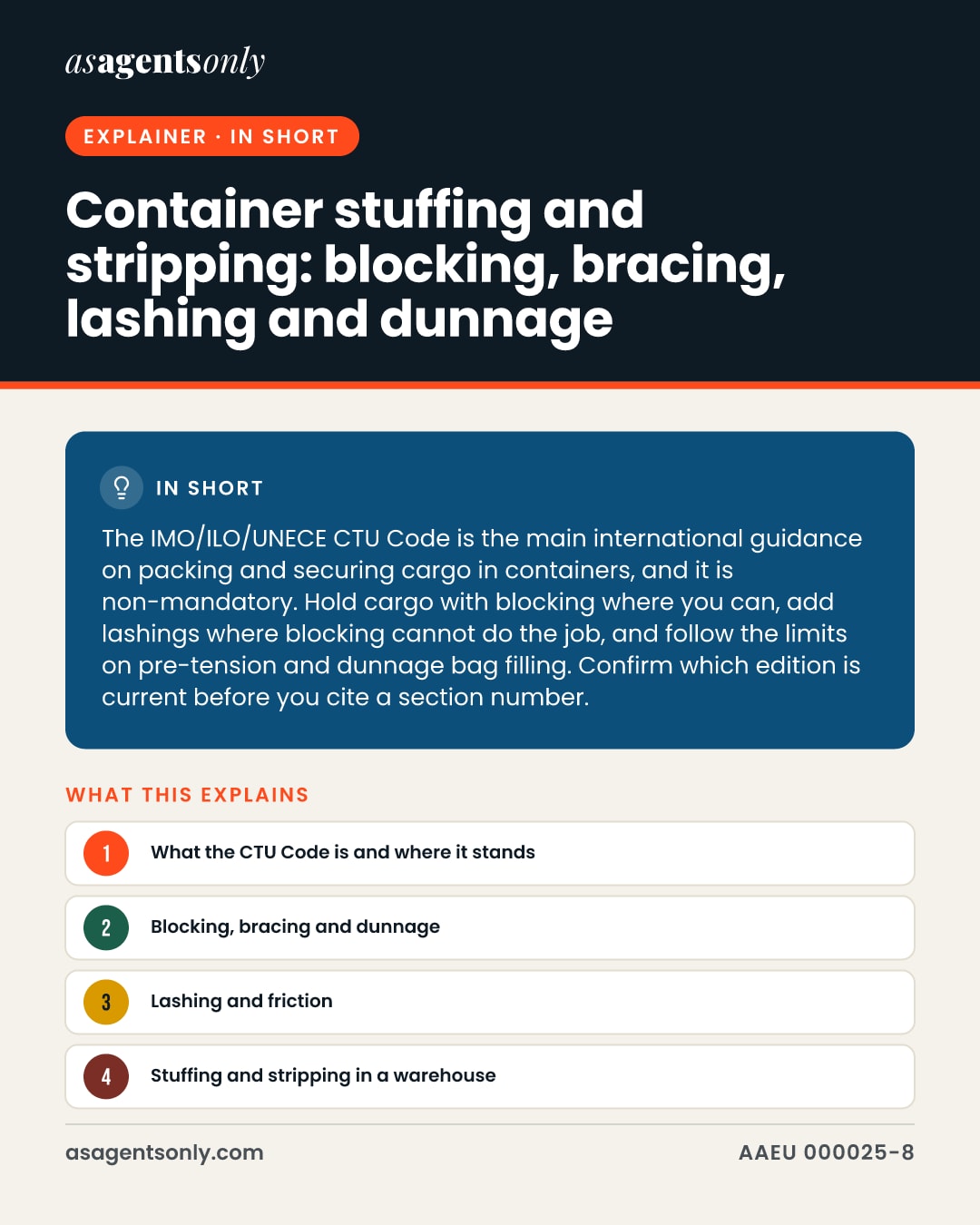
The IMO/ILO/UNECE CTU Code is the main international guidance on packing and securing cargo in containers, and it is non-mandatory. Hold cargo with blocking where you can, add lashings where blocking cannot do the job, and follow the limits on pre-tension and dunnage bag filling. Confirm which edition is current before you cite a section number.
Stuffing (loading cargo into a container) and stripping (unloading it) are where many cargo-securing failures start and where workers get hurt. The rules below come from the CTU Code, a joint guidance text from the International Maritime Organization, the International Labour Organization and the UNECE, and from a few related safety sources.
What the CTU Code is and where it stands
The IMO/ILO/UNECE Code of Practice for Packing of Cargo Transport Units (CTU Code) gives advice on the safe packing of cargo transport units to those who pack and secure cargo, and to those who train them. It is a non-mandatory code, so a national law, a carrier's terms or a sales contract can set stricter duties. Check those as well.
The edition IMO currently lists is the 2014 edition. A revised version was finalized by an expert group, and the UNECE working party was invited to consider adopting it, possibly as a 2026 edition. Confirm whether that revision has been adopted and published before you rely on any section number from it.
Packing errors have real consequences. The Code warns that improper or careless packing, or a lack of proper blocking, bracing and lashing, can cause personnel injury, and that serious and costly damage may occur to the cargo or the equipment.
Blocking, bracing and dunnage
Blocking, bracing and shoring hold cargo by compression. The cargo is stowed directly against strong structural parts of the unit, or timber beams, empty pallets or dunnage bags fill the gaps between the cargo and the unit's solid boundaries. Forces move through these arrangements by compression with minimal deformation.
Heavy cargo cannot simply be stowed wall to wall. It needs bracing and blocking against the frame, or lashing to the securing points. Where packages can sit tight against both sides of a container with strong sides, the Code suggests leaving the remaining gap in the middle, which lowers the sideways force the bracing must carry. Transverse battens should be braced against frame members such as bottom or top rails or corner posts where possible.
Dunnage bags need care. Follow the manufacturer's instructions on filling pressure and the maximum gap. Do not use a bag to fill the space at the doorway unless precautions stop the door from opening violently. Blocking made with nailed-on scantlings suits only minor securing demands.
Lashing and friction
Lashing is needed when blocking cannot secure the cargo. The mass of the cargo alone does not secure it, because vibration can move it. The Code's basic rule is to use blocking or lashing, or a combination of both, to stop cargo from sliding and tipping in any direction.
Lashings stretch. They transfer force only within an elastic range and act like a spring. If loaded beyond the maximum securing load (MSL), the stretch can become permanent and the lashing goes slack. Pre-tension should never exceed 50% of the MSL. For sliding prevention, a vertical lashing angle of 30 to 60 degrees is preferred. Do not fasten web lashings with knots, and do not overtighten them so that packaging or goods are damaged.
Re-check during the journey. Securing arrangements should be checked and upgraded where practicable at suitable points on a multimodal route, including re-tightening lashings and adjusting blocking. Top-over lashings are discouraged for sliding prevention unless the cargo has limited mass.
Stuffing and stripping in a warehouse
When stuffing, do not pack incompatible goods that must be segregated, and fill void spaces when necessary. Use hooks or shackles to fasten lashings where applicable, and do not secure cargo with devices that overstress the unit or the cargo. The proposed revised text also says that placing a unit on its end and pouring cargo in through the open doors is not permitted.
When stripping, make sure cargo does not move as lashings or blocking are removed. Low-friction items such as piles of steel plates may shift suddenly, and unstable items may topple when retaining straps come off. Open the valves of inflatable dunnage bags and release the air before removing them. Securing material should be strong enough, in good condition, and comply with the International Standards for Phytosanitary Measures No. 15 for wood. The proposed revised text advises disposing of dunnage, securing materials and waste in a safe and environmentally friendly manner.
Fumigation is a warehouse hazard. Fumigated containers are seldom labeled with warnings, even where regulations require it. Workers who unload containers in warehouses or logistics companies can be exposed if they open containers that have not been checked and declared gas free. Containers should not be opened until a risk assessment concludes it is safe, for example from shipping documents or approved measurements of the container atmosphere.
Side by side
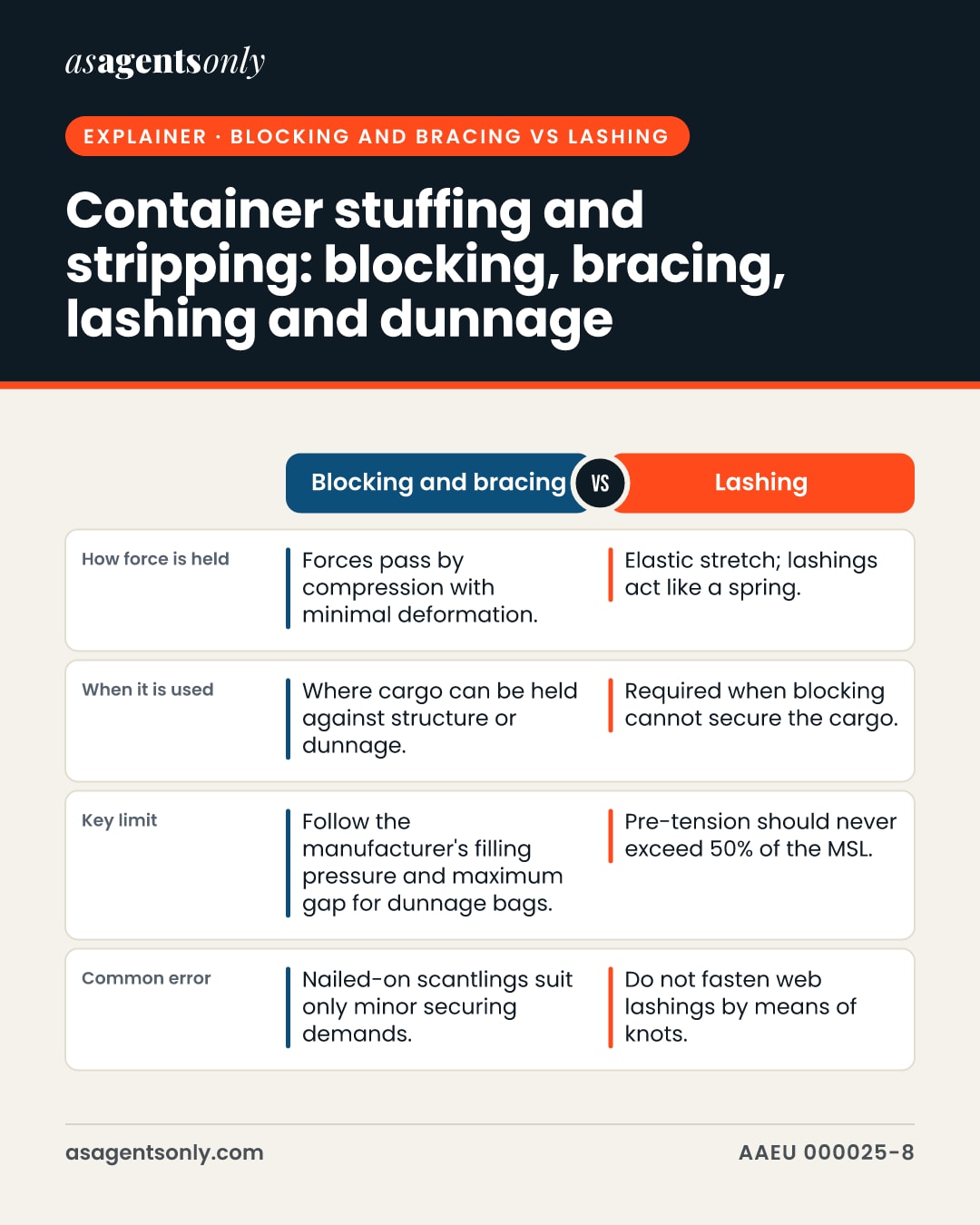
| Compared | Blocking and bracing | Lashing |
|---|---|---|
| How force is held | Forces pass by compression with minimal deformation. | Elastic stretch; lashings act like a spring. |
| When it is used | Where cargo can be held against structure or dunnage. | Required when blocking cannot secure the cargo. |
| Key limit | Follow the manufacturer's filling pressure and maximum gap for dunnage bags. | Pre-tension should never exceed 50% of the MSL. |
| Common error | Nailed-on scantlings suit only minor securing demands. | Do not fasten web lashings by means of knots. |
Example
Illustrative example, not a real case: a warehouse crew stuffs a container with pallets of bagged goods, and the last row of pallets stops short of the doors. The crew fills the gap with dunnage, follows the bag maker's filling limits, and blocks the front row against the frame instead of relying on the doors to hold it. At the destination, the stripping team first confirms from the shipping papers that the container is declared gas free, then removes lashings one at a time, and releases the air from any dunnage bags before pulling them out.
In pictures
The same facts as this page, as images to save or share. Tap one to open it full size.
Official sources
- MSC.1/Circ.1497 IMO/ILO/UNECE Code of Practice for Packing of Cargo Transport Units (CTU Code)International Maritime Organization, published 16 December 2014
- Code of Practice for Packing of Cargo Transport Units (CTU Code), 2014 EditionInternational Labour Organization
- Listing of current IMO publications as at 15 September 2026International Maritime Organization, published 15 September 2026
- 4 Securing of cargo in CTUs - CTU CodeUNECE Wiki
- Health risks and prevention practices during handling of fumigated containersOSHwiki (European Agency for Safety and Health at Work)
Claims ledger: 34 facts and where each comes from
- The CTU Code gives advice on the safe packing of cargo transport units to those responsible for the packing and securing of the cargo.1
- Improper or careless packing, or lack of proper blocking, bracing and lashing, may be the cause of personnel injury when cargo is handled or transported.1
- Serious and costly damage may occur to the cargo or to the equipment.1
- Do not pack incompatible goods which should be segregated.1
- The Maritime Safety Committee, at its ninety-third session (14 to 23 May 2014), approved the IMO/ILO/UNECE Code of Practice for Packing of Cargo Transport Units.1
- The CTU Code is a non-mandatory global code of practice for the handling and packing of shipping containers.2
- Do fill void spaces when necessary.2
- Packers should ensure securing materials are strong enough, in good order, and in compliance with the International Standards for Phytosanitary Measures, No. 15.2
- IMO/ILO/UNECE CTU Code, 2014 Edition is listed as a current IMO publication.3
- The Working Party is invited to consider the revised version of the Code, adopt it, and request its publication, possibly as the 2026 edition.4
- Blocking, bracing or shoring is a securing method where cargo is stowed against strong structural elements of the CTU or additional materials such as timber beams, empty pallets or dunnage bags fill gaps.5
- Forces are transferred in blocking by compression with minimal deformation.5
- If dunnage bags are used for filling gaps, the manufacturer's instructions on filling pressure and the maximum gap should be accurately observed.5
- Dunnage bags should not be used as a means of filling the space at the doorway, unless precautions are taken to ensure they cannot cause the door to open violently.5
- Blocking by nailed-on scantlings should be used for minor securing demands only.5
- Lashings transfer forces under a certain elastic elongation only and act like a spring.5
- If lashings are loaded more than the specific MSL, elongation may become permanent and the lashing will fall slack.5
- The pre-tension should never exceed 50% of the MSL of the lashing.6
- For sliding prevention by lashings the vertical lashing angle should preferably be in the range of 30 degrees to 60 degrees.6
- The use of top-over lashings for sliding prevention is discouraged unless the cargo has limited mass.6
- Securing arrangements in CTUs should be checked and upgraded if necessary during transport, including re-tightening of lashings and adjusting of blocking arrangements.6
- Do use blocking or lashing or a combination of these methods to prevent the cargo from sliding and tipping in any direction.7
- Whenever the cargo cannot be secured by blocking, lashing is required.7
- The mass of the cargo alone does not sufficiently secure the cargo as the cargo can move due to vibrations.7
- Do not fasten web lashings by means of knots.7
- Do not overtighten securing devices so that the packaging or goods are damaged.7
- When removing lashing or blocking devices, care should be taken to ensure that cargo items do not move when released.7
- The valves of inflatable dunnage bags should be opened and the air released.7
- Items with low friction such as piles of steel plates may suddenly shift when retaining straps are removed.7
- Fumigated containers were found with very few exceptions not labelled or declared as chemically treated.8
- Workers unloading containers could be exposed if they open containers that have not been checked and declared gas free, including workers in warehouses and logistics companies.8
- Containers should not be opened until the risk assessment concludes that it is safe, for instance based on shipping documents or by approved measurements of the container atmosphere.8
- Placing the CTU vertically on its end and pouring the cargo in through the open doors is not permitted.9
- Dispose of dunnage, securing materials and waste in a safe and environmentally friendly manner.9
Every figure on this page is tied to a cited source, last checked on 26 October 2026. Pages like this are re-checked every six months. Found something out of date? Tell the desk.