- How-To
- Warehousing
- 4 min read
- Last verified 23 October 2026
How to plan container weight distribution and verify gross mass
Plan how cargo sits inside a container, verify its gross mass by one of the two SOLAS methods, and pass the signed figure to the carrier before cutoff.

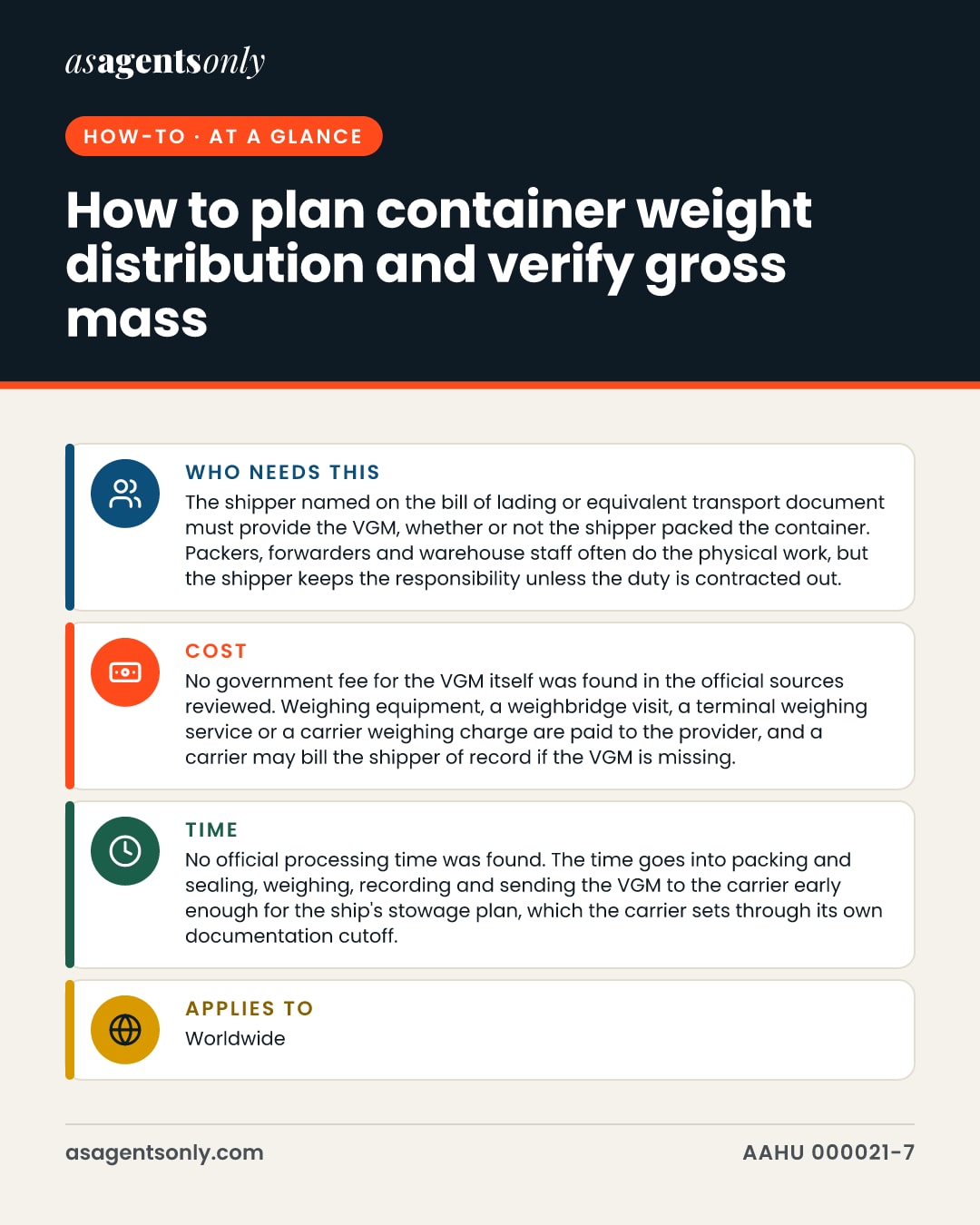
- Who needs this
- The shipper named on the bill of lading or equivalent transport document must provide the VGM, whether or not the shipper packed the container. Packers, forwarders and warehouse staff often do the physical work, but the shipper keeps the responsibility unless the duty is contracted out.
- Cost
- No government fee for the VGM itself was found in the official sources reviewed. Weighing equipment, a weighbridge visit, a terminal weighing service or a carrier weighing charge are paid to the provider, and a carrier may bill the shipper of record if the VGM is missing.
- Time
- No official processing time was found. The time goes into packing and sealing, weighing, recording and sending the VGM to the carrier early enough for the ship's stowage plan, which the carrier sets through its own documentation cutoff.
- Applies to
- Worldwide
This guide covers two linked tasks for a packed container: placing cargo so the load is balanced, and verifying the gross mass (VGM) before the box is loaded on a ship. SOLAS made VGM mandatory for packed containers loaded on ships in international service. The planning habits also help for road, rail and inland moves, but each country's rules and each carrier's cutoffs still apply.
Step by step
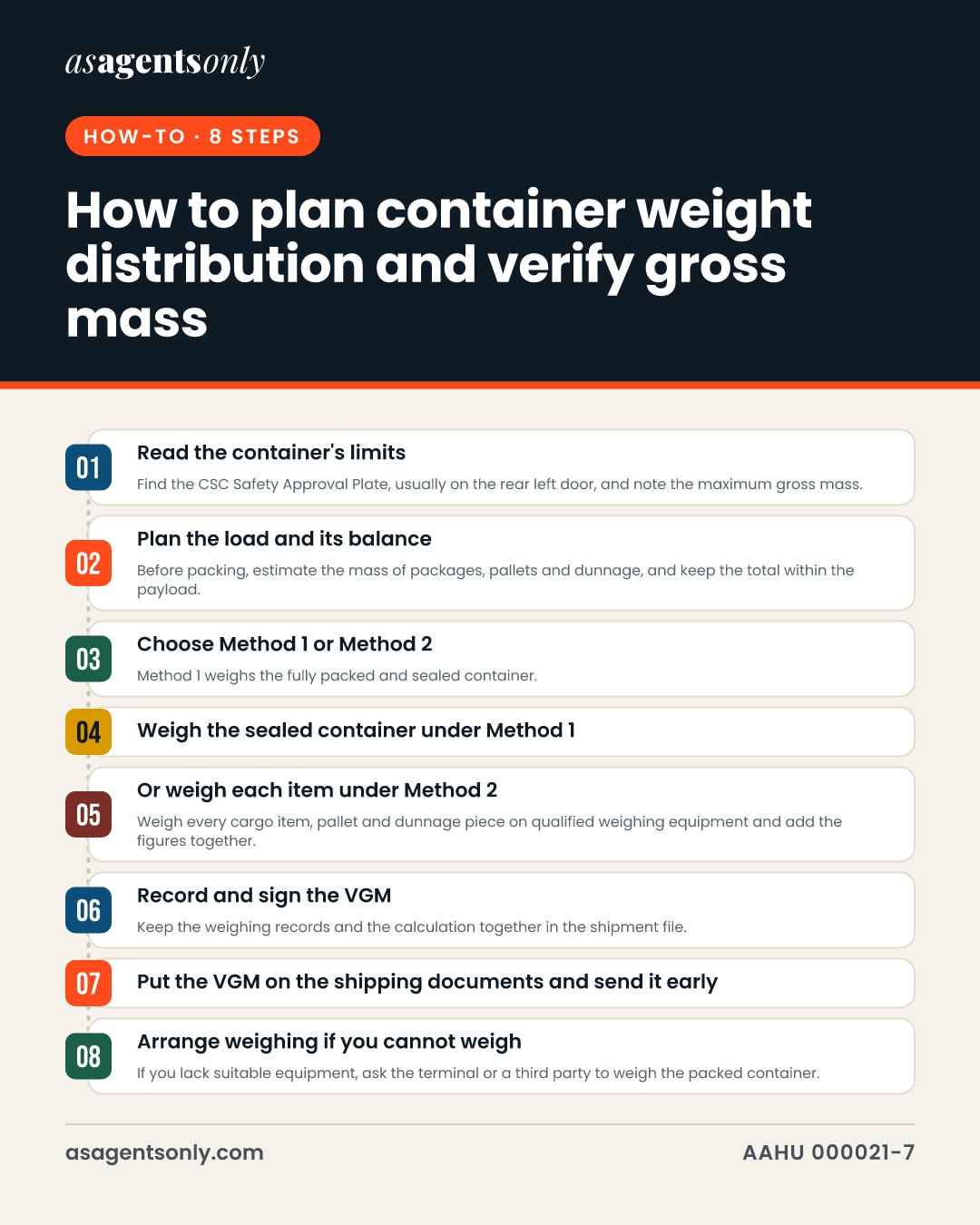
Read the container's limits
Find the CSC Safety Approval Plate, usually on the rear left door, and note the maximum gross mass. Check the tare and payload painted on the door or rear end, then calculate payload as maximum gross mass minus tare. Use these figures as the ceiling for the whole load.
Plan the load and its balance
Before packing, estimate the mass of packages, pallets and dunnage, and keep the total within the payload. Place the cargo so its centre of gravity sits near the middle of the box, avoid one-sided loading, and keep heavy goods off light goods. Record the plan so the packing team works from the same figures.
Choose Method 1 or Method 2
Method 1 weighs the fully packed and sealed container. Method 2 weighs each cargo item, pallet and piece of dunnage and adds the container tare. The choice is the shipper's, but Method 2 must use a certified method approved by the competent authority of the country where packing was completed, and the UK requires MCA approval for it.
Weigh the sealed container under Method 1
After packing and sealing, weigh the container on a weighbridge or with lifting equipment fitted with load cells, using calibrated and certified equipment. Keep the printed weight, the equipment's calibration and maintenance records, and any corrective actions. In Canada, OIML-standard equipment may be used where it is used only to check packed container gross mass.
Or weigh each item under Method 2
Weigh every cargo item, pallet and dunnage piece on qualified weighing equipment and add the figures together. Take the container tare from the ISO 6346 marking on the box; if the container is not ISO-marked, weigh it clean and empty. The sum of the items plus the tare is the VGM.
Record and sign the VGM
Keep the weighing records and the calculation together in the shipment file. The VGM statement commonly shows the certifier's first name, last name, date and company name, and it must include packing material. Keep these records available for inspection by the national authority.
Put the VGM on the shipping documents and send it early
Enter the verified gross mass for each container on the shipping document and transmit it to the carrier and terminal in advance, so the ship's stowage plan can use it. Show the container number, the gross mass and any seal number on the transport documents as well. Check the carrier's documentation cutoff for your sailing.
Arrange weighing if you cannot weigh
If you lack suitable equipment, ask the terminal or a third party to weigh the packed container. The master or terminal may obtain the VGM on the shipper's behalf, but the commercial parties should agree who weighs, how, and who pays. Confirm the arrangement before the cutoff.
Documents you will need
- CSC Safety Approval Plate data: maximum gross mass, tare and payload for the container
- Container number and seal number
- Packing list showing each package's mass, plus pallet and dunnage masses (Method 2)
- Weighing record or printout with the weighing equipment's calibration and maintenance details
- Approval documents for Method 2 where the national authority requires them
- Signed VGM statement naming the certifier, date and company
- Shipping document or carrier VGM form with the container's verified gross mass
- Carrier documentation cutoff and terminal contact details
Common mistakes
- Treating an estimate as the VGM. Estimates are for planning only; the verified figure must come from Method 1 or Method 2 weighing.
- Leaving out pallets, dunnage and securing material under Method 2. Weigh them too, because the verified total includes them.
- Taking the tare from memory or an old record. Read it from the door marking or the ISO 6346 marking, and weigh a non-ISO container empty.
- Sending the VGM late. A container without a VGM in time for the stowage plan can be refused loading, so send it well before the carrier cutoff.
- Loading one end heavily. Concentrated or off-centre cargo strains the box and the transport unit, so balance the load and check the eccentricity guidance.
In pictures
The same facts as this page, as images to save or share. Tap one to open it full size.
Official sources
- Safe transport of containersInternational Maritime Organization (IMO)
- Verification of the gross massInternational Maritime Organization (IMO)
- Verification of the gross mass of packed containers transported by seaUK Maritime and Coastguard Agency (GOV.UK)
- MSC.1/Circ.1497 IMO/ILO/UNECE Code of Practice for Packing of Cargo Transport Units (CTU Code)International Maritime Organization (IMO)
- Informative material related to the IMO/ILO/UNECE Code of Practice for Packing of Cargo Transport Units (CTU Code)International Maritime Organization (IMO)
- Figure 7.21 Load transfer beamsUNECE wiki (copy of CTU Code annex text)
- Code of Practice for Packing of Cargo Transport Units, proposed Revision (2025) consolidated textUNECE Working Party on Intermodal Transport and Logistics
- Crowley SOLAS Verified Gross Weight RequirementCrowley (carrier)
Claims ledger: 34 facts and where each comes from
- Requirements to verify the gross mass of a packed container took effect on 1 July 2016 under SOLAS.1
- Accurate gross mass is needed for correct stowage and stacking, and to avoid stack collapse or loss overboard.1
- The shipper must state the verified weight in the shipping document and submit it to the master and terminal sufficiently in advance for the stowage plan.2
- The gross mass can be verified by weighing the packed container, or by weighing every item and adding the container's tare mass, using a certified method approved by the competent authority where packing was completed.2
- The master or terminal may obtain the verified gross mass on the shipper's behalf by weighing in the terminal, with the parties agreeing how and who pays.2
- Responsibility for giving the carrier a verified gross mass rests with the shipper.3
- Method 1 can use weighbridges or lifting equipment fitted with load cells, or other appropriate weighing equipment.3
- Method 1 users must be able to show, on request, that weighing equipment is calibrated, maintained by a competent person and operated correctly.3
- Records must be kept to show that the verified gross mass represents the actual gross mass of the container.3
- Method 2 adds the weight of cargo, pallets, dunnage and the container tare.3
- A shipper using Method 2 in the UK must have the method approved by the MCA.3
- The choice of method belongs to the shipper.3
- The UK MCA's enforcement tolerance is ±5% or ±500kg, whichever is greater, set as guidance for enforcers only, and the shipper remains responsible for accuracy.3
- Canada accepts weighing equipment certified to OIML standards where it is used exclusively to check the gross mass of packed containers.4
- In Canada, Method Two requires each item of cargo, dunnage and securing material to be weighed with qualified equipment and added to the container's tare.4
- The tare mass of a container is taken as marked under ISO 6346, and for non-ISO containers it is determined by weighing the clean and empty container.4
- Load with the centre of gravity correctly located in the CTU.5
- Do not load with an eccentric load distribution.5
- Do not concentrate heavy cargo on small areas of the floor.5
- Do not stow heavy goods on top of light goods.5
- The correct gross mass of the CTU should be determined on completion of packing.5
- The CTU number, the correct gross mass and, when required, the seal number should be included in the documents.5
- Incorrect gross masses are a hazard for any mode of transport.5
- The maximum gross mass on the safety approval plate is the maximum mass of the packed container and should never be exceeded.6
- Tare mass and payload are marked in painted letters on the door or on the rear end of the container.6
- Payload is defined as maximum gross mass minus tare mass.7
- When planning, the packer may know only the mass of all packages and cargo items, and an estimate of securing materials and dunnage should be made.7
- As an illustration, tare varies from 2,200 kg for a 20-foot general purpose container to 5,300 kg for a 40-foot folding flatrack.7
- The eccentricity of the centre of gravity of the cargo should not exceed ±5% in general.8
- As a rule of thumb, 60% of the cargo's total mass in 50% of the container's length can be used as a reference.8
- When the payload is not homogeneously distributed over the loading floor, the limitations for concentrated loads should be considered.8
- The UNECE expert group finalised a revised CTU Code in December 2025, and the revision is listed in its 2025 consolidated text.9
- The carrier will charge the shipper of record for weighing the container if the VGM is not received prior to the documentation cutoff.10
- VGM is the certified gross cargo weight, including the weight of all packing material, plus the container tare weight.10
Every figure on this page is tied to a cited source, last checked on 23 October 2026. Pages like this are re-checked every three months. Found something out of date? Tell the desk.