- Explainer
- Warehousing
- 5 min read
- Last verified 22 October 2026
Picking methods: discrete, batch, zone and wave picking
Learn how discrete, batch, zone and wave picking differ, when each fits a site, and which trade-offs warehouses weigh before choosing one.

In short
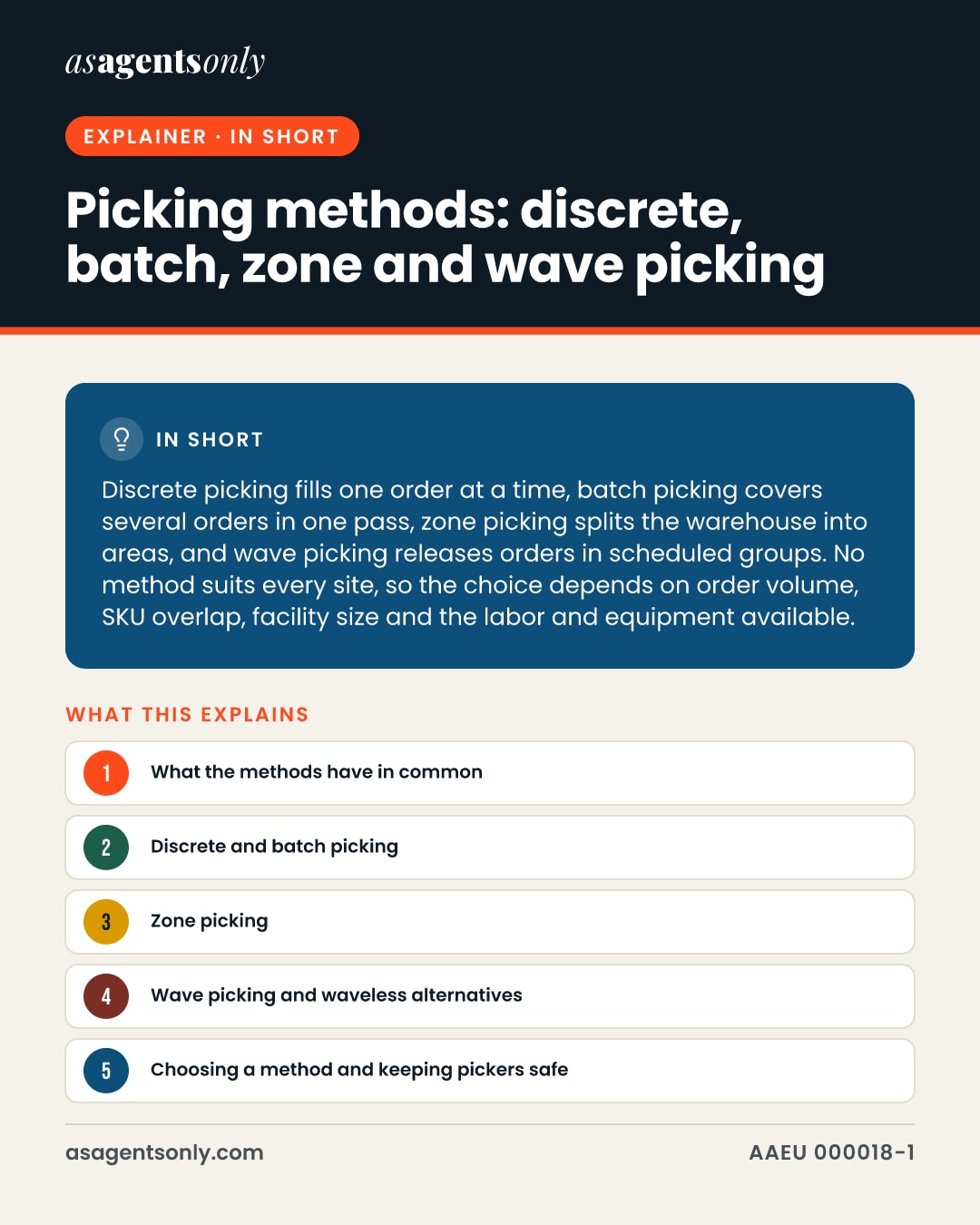
Discrete picking fills one order at a time, batch picking covers several orders in one pass, zone picking splits the warehouse into areas, and wave picking releases orders in scheduled groups. No method suits every site, so the choice depends on order volume, SKU overlap, facility size and the labor and equipment available.
Order picking is the step where workers or machines pull goods from storage to fill customer orders. Because it is labor-heavy, the method a warehouse uses to organize picking has a large effect on cost, speed and accuracy. The four methods below are the ones most often named in warehouse guidance, though sources do not always define them the same way.
What the methods have in common
Picking is one of the most resource-intensive steps in a warehouse. The ASEAN warehousing chapter notes that order picking uses 50-60% of warehousing resources, so even modest gains in method choice can matter.
The four methods differ mainly in how orders are grouped, whether pickers stay in one area, and whether orders are released on a schedule. Trade sources disagree on the boundaries. For example, one trade article describes wave picking as a mix of discrete and batch picking, while FreightWaves describes it as a mix of batch and zone picking, and the ASEAN chapter treats it as close to discrete picking with a scheduling window. Read each site's own definitions before comparing systems.
Discrete and batch picking
Discrete picking, also called single-order picking, has one picker collect every line for one order before starting the next. The ASEAN chapter calls it the most common type of order pick. Trade guidance says it suits smaller operations with limited order volume, and it is simple to control and check for accuracy.
Batch picking has a picker gather items for several orders on one pass through the aisles. Orders that share stock-keeping units (SKUs) benefit most, because each location is visited once for the whole group. Items are then separated into individual orders at a packing or sorting point. Trade sources describe batch picking as a fit for higher-volume sites with many small orders sharing SKUs, and they note that it needs a sortation step afterward.
The trade-off is that batching adds handling. Items must be sorted, and a mistake at the sort can send the wrong item to the wrong order. Sites that batch should plan the sort area and verify the split before dispatch.
Zone picking
Zone picking divides the storage area into zones, each with its own picker or team. In parallel zone picking, every zone works on the same orders at the same time, and the parts are brought together later for packing. In pick-and-pass zone picking, an order moves from zone to zone, and the zone's picker completes only the lines located there. The ASEAN chapter describes this as completing an order zone by zone when its items sit in several zones.
Zone picking limits how far each person walks. A technical paper from the Material Handling Institute notes that zone picking is often run as a handoff, though zones can also be set up in series or in parallel. Trade guidance adds that building zone expertise can improve accuracy, and that zones need enough work to keep each picker busy.
For illustration only: a site with three zones might find that an order touching two zones needs a handoff, while an order in one zone never leaves it.
Wave picking and waveless alternatives
Wave picking releases groups of orders on a schedule. Orders are grouped by factors such as ship time, carrier, destination or product type, and each wave is picked as a unit. Trade press describes wave picking as common in large e-commerce operations that need both structure and speed. The ASEAN chapter notes that a wave may include several releases in a shift, while batch picking typically uses one picking window per shift.
Wave picking can leave equipment and people idle at the end of a wave while the last orders finish. Some operations therefore use waveless processing, in which rules release each order into picking as it arrives. Trade coverage notes that this approach has been adopted in Europe and by a few United States companies, and that it requires a flexible warehouse execution system.
Before choosing a method, a site should test it against its own order profile, not against a generic description.
Choosing a method and keeping pickers safe
Walking and searching take up a large share of picking time. One trade article reports that pickers spend about 70% of their time traveling and searching. Reducing walking is therefore a common goal, but it should not push work rates past what people can sustain.
OSHA's grocery warehousing eTool says its emphasis on traditional order picking reflects the large number of musculoskeletal disorders linked to that work. The same guidance notes that when product must be handled at least twice, lifting frequency rises. Whatever method is chosen, ergonomic review of shelf heights, case weights and pick paths is part of the design.
A practical sequence is to measure order profile, SKU overlap and travel time first, then pilot one method in one area before changing the whole site.
Side by side
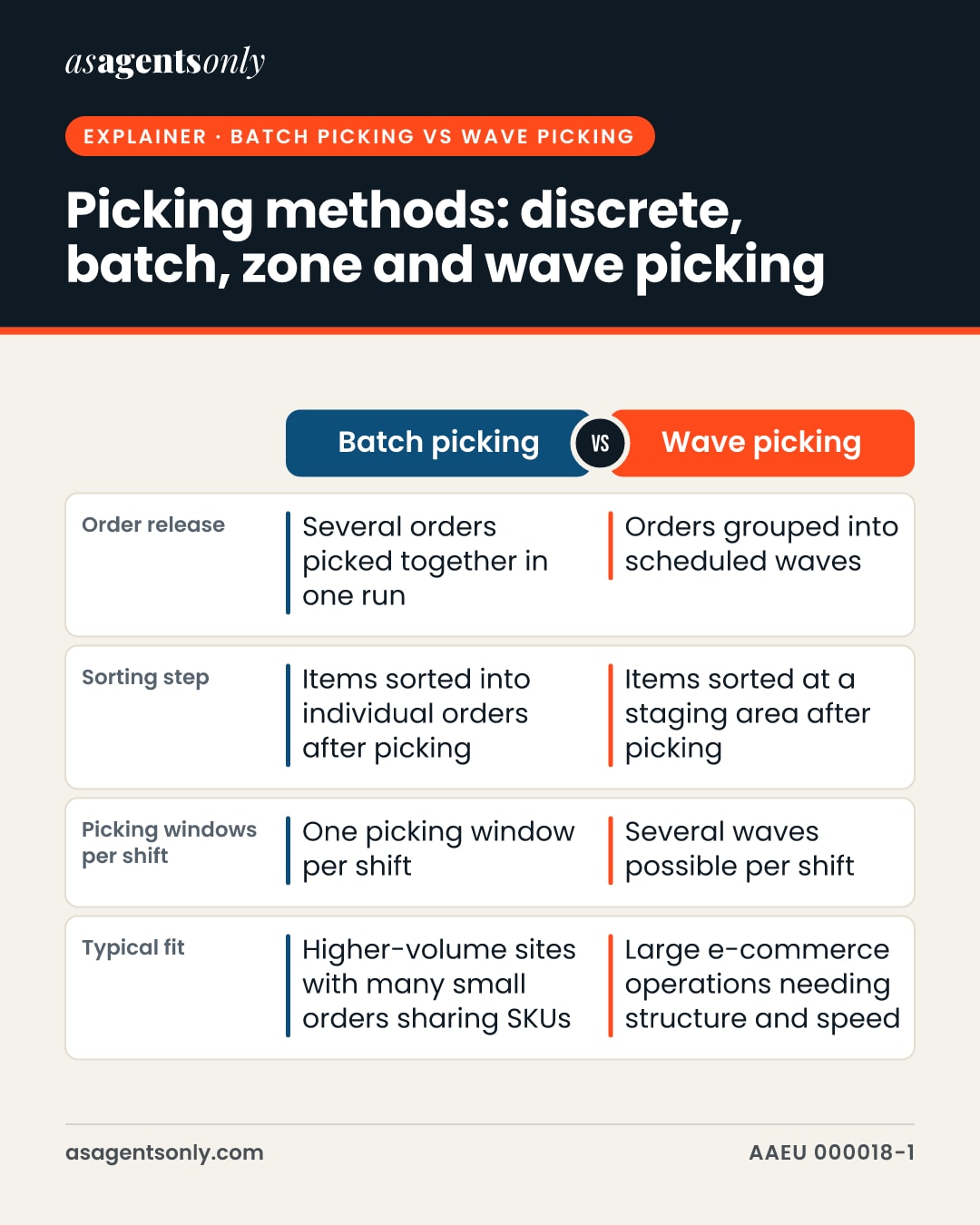
| Compared | Batch picking | Wave picking |
|---|---|---|
| Order release | Several orders picked together in one run | Orders grouped into scheduled waves |
| Sorting step | Items sorted into individual orders after picking | Items sorted at a staging area after picking |
| Picking windows per shift | One picking window per shift | Several waves possible per shift |
| Typical fit | Higher-volume sites with many small orders sharing SKUs | Large e-commerce operations needing structure and speed |
Example
Illustrative example only: a small site receives four orders in one morning, and each order needs two of the same three SKUs. Under discrete picking, a picker walks the aisles four separate times. Under batch picking, one picker collects all four orders in one pass and sorts them at the pack bench afterward. The batch run reduces walking, but the sort step adds handling and needs a check to confirm each order is complete.
In pictures
The same facts as this page, as images to save or share. Tap one to open it full size.
Official sources
- Which Picking Method is Best for Your Operation?Supply Chain 24/7
- What Is Pick and Pack Fulfillment?FreightWaves Ratings
- Batch Picking Vs Wave Picking – What is what?Supply Chain 24/7
- Eliminate Batch Processing to Speed DC ThroughputSupply Chain 24/7
- How to Choose an Order-Picking SystemMaterial Handling Institute
- Warehouse Order Picking MethodsSupply Chain 24/7
Claims ledger: 20 facts and where each comes from
- Order picking uses 50-60% of warehousing resources, according to the ASEAN warehousing chapter.2
- Discrete picking is described by ASEAN as the most widespread form of order pick, handled one order at a time.2
- Under discrete picking, a worker collects all required items for one order before moving to the next order.1
- Smaller sites with limited order volume tend to fit discrete picking best.1
- Batch picking gathers items for several orders in one trip, cutting travel time.1
- Combining orders that share SKUs lowers walking distance and raises throughput, most noticeably at high volume.1
- Batch sites sort items into individual orders at the packing station after picking.5
- Batch picking fits higher-volume facilities that handle many small orders with shared SKUs, and it needs a later sortation step.1
- In parallel zone picking, every zone works on the same orders at the same time, with parts brought together later for packing and shipping.1
- Zone picking is often run as a handoff, though zones can also be set up in series or in parallel.7
- An order spanning several zones is finished one zone at a time under zone picking.2
- Zone picking limits travel by assigning pickers to specific areas, and building zone expertise can improve accuracy.1
- Wave picking groups orders by criteria such as ship time or location.1
- Large e-commerce operations frequently rely on wave picking to combine structure and speed.1
- FreightWaves describes wave picking as a combination of batch and zone methods.4
- ASEAN treats the scheduled release window as the main difference between wave picking and discrete picking.2
- Wave operations can run several releases within one shift, whereas batch operations use one picking window per shift.5
- Waveless processing, adopted in Europe and by some United States companies, lets rules decide when each order enters picking.6
- Trade-press figures put walking and searching at roughly 70% of a picker's working time.8
- OSHA states that its focus on traditional order picking reflects the large number of musculoskeletal disorders linked to that work.3
Every figure on this page is tied to a cited source, last checked on 22 October 2026. Pages like this are re-checked every six months. Found something out of date? Tell the desk.