- How-To
- Exporting
- 4 min read
- Last verified 21 November 2026
How to use an ATA Carnet
Learn how to obtain, use and close an ATA Carnet so goods can cross borders temporarily without duty, and what security and deadlines apply.

General information, not legal advice. Rules, fees and forms change. Confirm with the agency named in the sources, or a licensed professional, before you file or ship.
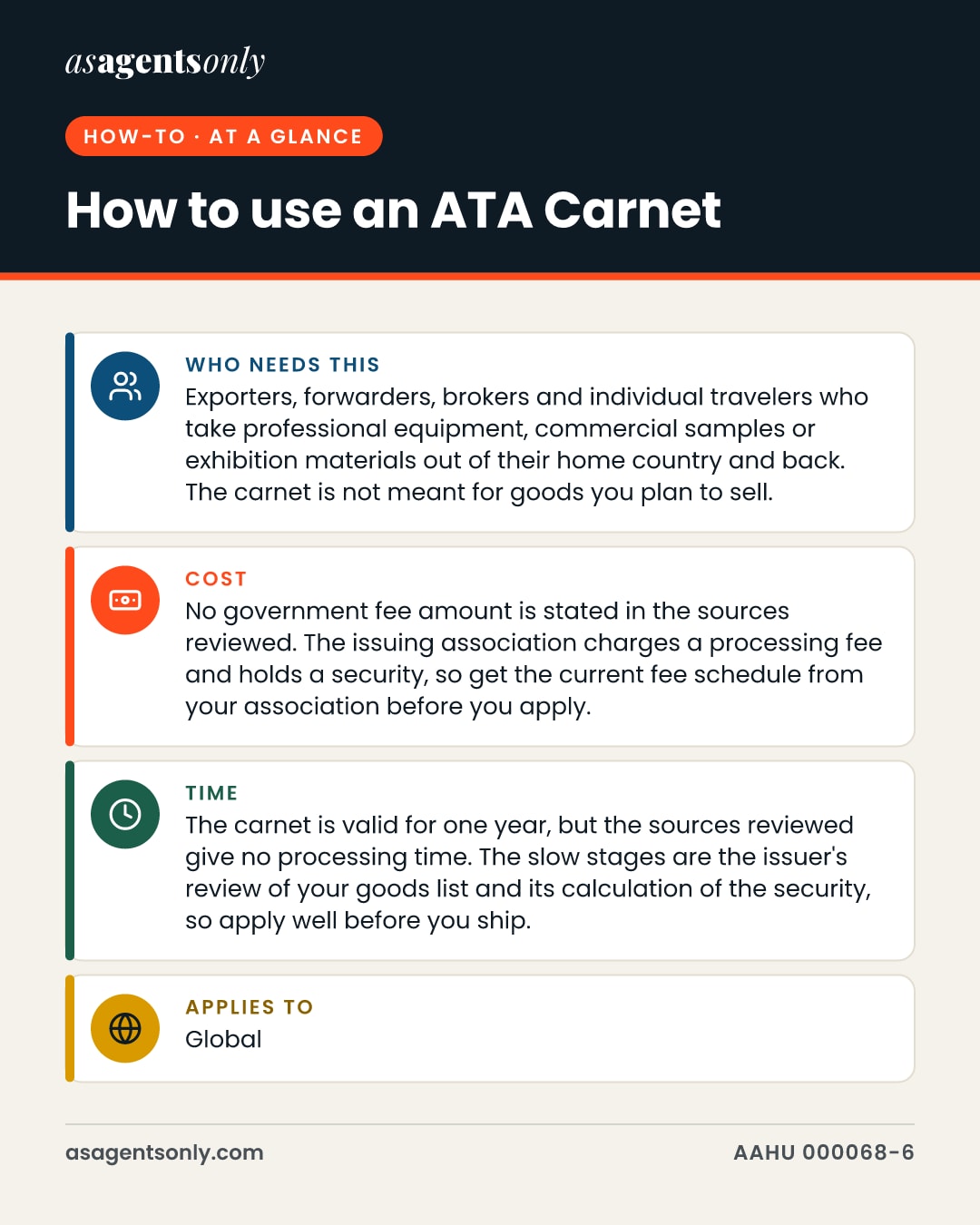
- Who needs this
- Exporters, forwarders, brokers and individual travelers who take professional equipment, commercial samples or exhibition materials out of their home country and back. The carnet is not meant for goods you plan to sell.
- Cost
- No government fee amount is stated in the sources reviewed. The issuing association charges a processing fee and holds a security, so get the current fee schedule from your association before you apply.
- Time
- The carnet is valid for one year, but the sources reviewed give no processing time. The slow stages are the issuer's review of your goods list and its calculation of the security, so apply well before you ship.
- Applies to
- Global
An ATA Carnet is an international customs document that lets you take goods abroad temporarily without paying import duty and taxes at each border, as long as the goods come back or are destroyed. You use one for trade fairs, commercial samples and professional equipment that will visit more than one country.
Step by step
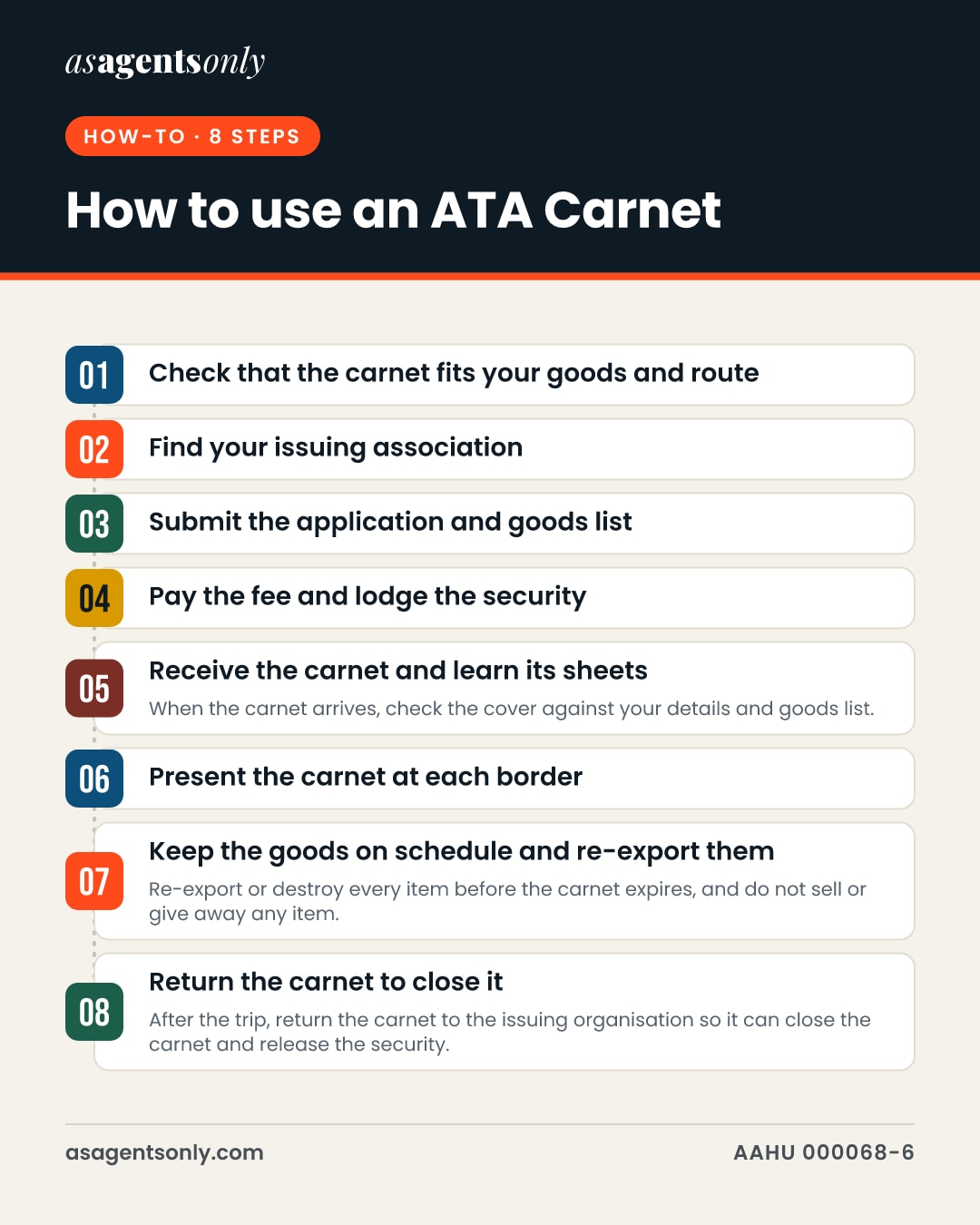
Check that the carnet fits your goods and route
Confirm that your goods are professional equipment, commercial samples or exhibition materials that will be re-exported, and that every country on your route accepts the carnet. Ask your issuing association to confirm coverage for any extended or overseas areas. You get a clear yes or no before paying anything.
Find your issuing association
In the United States, the issuing and guaranteeing association is the United States Council for International Business (USCIB), designated by U.S. Customs and Border Protection (CBP). Elsewhere, the customs authority appoints a national guaranteeing association, which works through issuing associations. Apply through the association in your own country.
Submit the application and goods list
Apply through the issuer's online process, or through an authorized service provider in the United States, giving the holder, representatives, goods and trip details. Describe each item with its value, because the carnet lists the goods and the processing fee depends on their total value. Once the carnet is issued, no item can be added to the list.
Pay the fee and lodge the security
Pay the processing fee and provide the security the issuer requires, which it calculates from the goods, their value and the countries on the itinerary. The security is returned when the carnet is discharged correctly. Keep proof of payment and of the security arrangement with your trip file.
Receive the carnet and learn its sheets
When the carnet arrives, check the cover against your details and goods list. Its sheets are used in a fixed way: one colour for export and re-import from your home country, another for temporary import and re-export in foreign countries, and another for transit. For a digital carnet, download it into the ATA Carnet App using the Carnet ID and PIN the issuer gives you.
Present the carnet at each border
At each customs office, present the goods and the carnet, and let the officer complete the relevant counterfoil or confirm the digital transaction. For a digital transaction, show the QR code or transaction code from the app. Check that the officer has recorded the entry before you leave.
Keep the goods on schedule and re-export them
Re-export or destroy every item before the carnet expires, and do not sell or give away any item. If goods are sold, penalties apply in addition to the duties owed. If an item is not accounted for, the guaranteeing association faces a claim from customs.
Return the carnet to close it
After the trip, return the carnet to the issuing organisation so it can close the carnet and release the security. Do this promptly, because the security stays tied up until the carnet is discharged.
Documents you will need
- Full name and address of the holder, and the name of any representative authorized to handle customs for you
- Itinerary: each country you will enter and the planned dates
- Itemized goods list with a description and value for each item
- Proof of the security form the issuer accepts, such as a certified check or surety bond, as your issuer specifies
- Smartphone with the ATA Carnet App and the Carnet ID and PIN, if your carnet is digital
Common mistakes
- Using the carnet for goods you plan to sell: the carnet is not recommended for that purpose, and sold goods trigger penalties, so use a different customs procedure for sales.
- Missing the re-export deadline: goods must leave or be destroyed before the carnet expires, or liquidated damages equal to 110 percent of duties apply, so track the expiry date from the first day.
- Assuming the carnet replaces permits: an ATA Carnet does not exempt you from licenses or permits, so check import and export licensing for each country separately.
- Adding goods after issue or ignoring country coverage: no extra item can be added once issued, so list everything before you apply and confirm coverage for each destination.
- Forgetting to return the carnet: the security is released only after the carnet is returned and discharged, so send it back to the issuer as soon as the trip ends.
In pictures
The same facts as this page, as images to save or share. Tap one to open it full size.
Official sources
- ATA Carnet: The ATA System (ATA and Istanbul Conventions)World Customs Organization
- Customs Convention on the A.T.A. Carnet for the temporary admission of goods (text)World Customs Organization
- ATA CarnetICC - International Chamber of Commerce
- ATA CarnetICC World Chambers Federation
- eATA CarnetICC - International Chamber of Commerce
- ATA Carnet Frequently Asked Question (FAQ's)U.S. Customs and Border Protection
- Traveling with SamplesU.S. Customs and Border Protection
- ATA CarnetInternational Trade Administration (trade.gov)
- Mitigation Guidelines: Fines, Penalties, Forfeitures and Liquidated Damages (Carnets)U.S. Customs and Border Protection
- 19 CFR Part 114 - CarnetseCFR (U.S. Code of Federal Regulations)
- Digitization of ATA Carnets: from pilot to implementationWorld Customs Organization (WCO News)
- Global Trade Takes a Digital Leap with eATA Rollout in 30 CountriesWorld Customs Organization
- Mexico joins Carnet systemFreightWaves (trade press)
Claims ledger: 31 facts and where each comes from
- The carnet can stand in for the goods declaration at export, transit and import, and it is backed by an international guarantee system.1
- The WCO expects ATA Carnet procedures to be fully digital worldwide by 1 January 2028.1
- The WCO says more countries and Customs territories will join the digital procedure as they confirm they are ready.1
- The World Customs Organization and ICC announced an eATA rollout in 30 countries.13
- The ATA Carnet is accepted in 81 countries and Customs territories, according to the WCO.12
- Processing fees apply, along with a security deposit or bond that is returned if the carnet has been used correctly.12
- The carnet permits duty-free and tax-free temporary import of goods for up to one year.4
- The carnet is valid for one year, and the holder may make as many trips as wanted while it remains valid.7
- A fee is charged for the carnet service, according to CBP.7
- A carnet holder in the United States must present the goods and the carnet to CBP on export, on entry and re-exit abroad, and on re-importation.6
- Failing to complete those operations with the carnet may result in charges of 110% of the duty and import tax.6
- Goods entered under an ATA carnet must be re-exported or destroyed before the carnet period expires, or liquidated damages equal to 110 percent of the duties due are assessed.9
- CBP has designated the United States Council for International Business (USCIB) as the United States guaranteeing association.6
- USCIB has appointed two ATA Carnet service providers to issue carnets on its behalf.6
- ATA Carnets may be obtained from USCIB and its authorized service providers through an online application process.8
- The value of the goods on the carnet determines the carnet processing fees, and a USCIB claims handling fee may also apply.8
- The ATA Carnet is not recommended for goods intended for sale, and selling goods covered by it triggers a penalty equal to 10% of the duties and taxes in addition to the duties and taxes owed on the goods sold.8
- The issuing chamber uses the holder, representative, goods and trip details to prepare the carnet and calculate the security required.11
- Carnet security covers the highest rate of duty, VAT and a 10% penalty in any country on the itinerary.11
- The security is released upon the carnet's return, provided that all temporary admission conditions have been met.3
- To close the carnet and release the security, the holder returns it to the issuing organisation.3
- The carnet cover shows the holder, the national guaranteeing association, the issue date, the carnet number, the countries of use and the goods; yellow sheets are used on export and re-importation into the issuing country, white sheets for temporary importation and re-exportation abroad, and blue sheets for transit.6
- In the United States, the carnet serves simultaneously as a Customs entry document and as a Customs bond.10
- Once an ATA carnet has been issued, no extra item may be added to the list of goods.2
- Customs authorities may not require payment from the guaranteeing association if no claim has been made within a year of the carnet's expiry date.2
- The guaranteeing association has six months from the date of a claim to furnish proof of re-exportation.2
- The issuing association should confirm carnet coverage in extended or overseas areas of the listed countries.1
- A carnet does not exempt holders from obtaining necessary licenses or permits, according to a trade press report.14
- The USCIB is required to take security, usually 40 percent of shipment value, to cover any Customs claim from a misused carnet, according to a trade press report.14
- Acceptable forms of security are a certified check or a surety bond.14
- Under the digital procedure, the holder applies through the issuing association, receives a Carnet ID and a PIN, and downloads the ATA Carnet App to store the digital carnet.5
Every figure on this page is tied to a cited source, last checked on 21 November 2026. Pages like this are re-checked every three months. Found something out of date? Tell the desk.