- How-To
- Exporting
- 4 min read
- Last verified 20 November 2026
How to claim USMCA preferential treatment
Learn how to claim USMCA preferential treatment on imports into the US, Canada or Mexico, covering the certification, the entry claim, records and late claims.

General information, not legal advice. Rules, fees and forms change. Confirm with the agency named in the sources, or a licensed professional, before you file or ship.
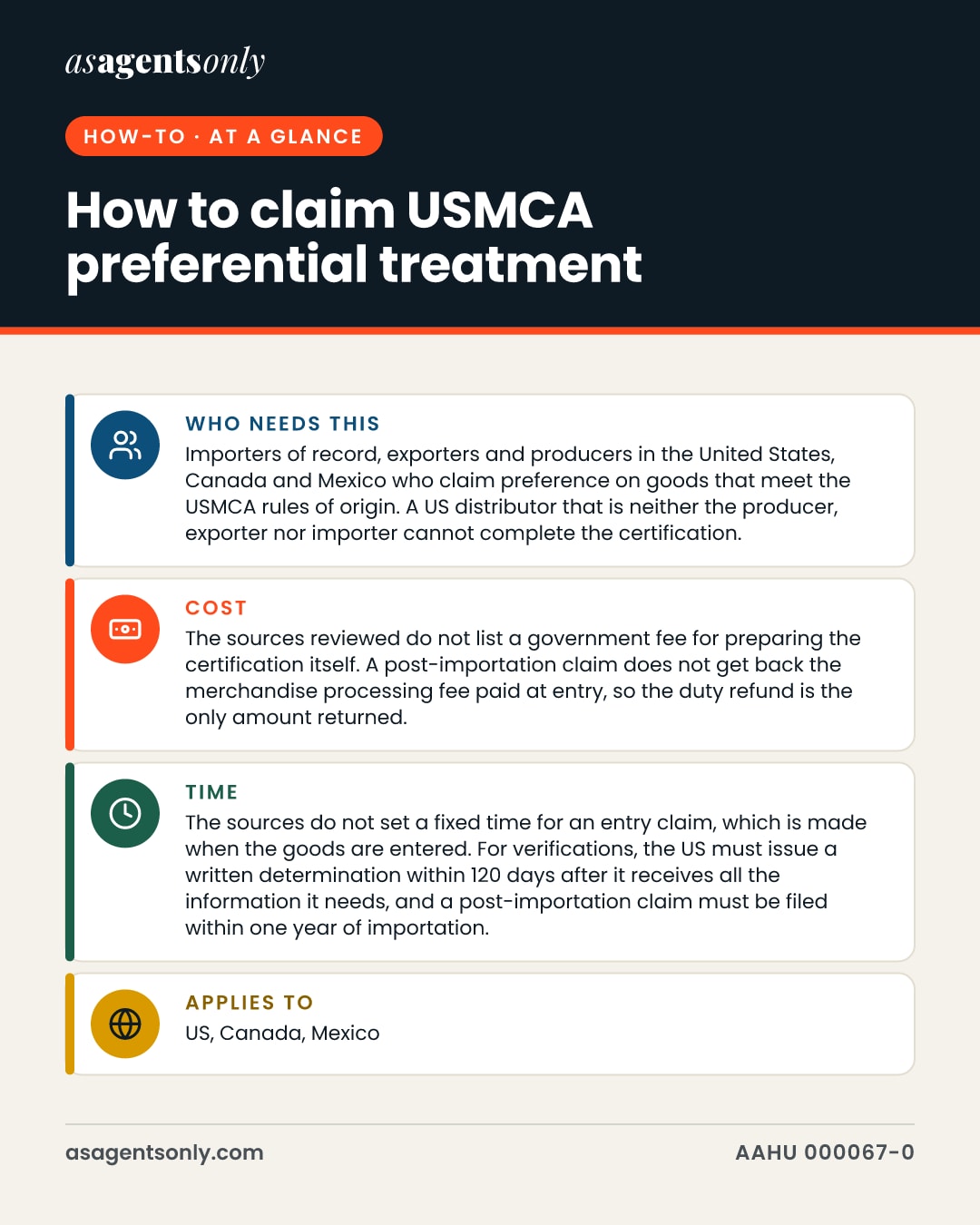
- Who needs this
- Importers of record, exporters and producers in the United States, Canada and Mexico who claim preference on goods that meet the USMCA rules of origin. A US distributor that is neither the producer, exporter nor importer cannot complete the certification.
- Cost
- The sources reviewed do not list a government fee for preparing the certification itself. A post-importation claim does not get back the merchandise processing fee paid at entry, so the duty refund is the only amount returned.
- Time
- The sources do not set a fixed time for an entry claim, which is made when the goods are entered. For verifications, the US must issue a written determination within 120 days after it receives all the information it needs, and a post-importation claim must be filed within one year of importation.
- Applies to
- US, Canada, Mexico
USMCA, called CUSMA in Canada, lets qualifying goods enter a member country at preferential duty rates. Use this guide when you ship or import goods between the three countries and need to show that the goods originate. Each country sets its own proof rules, so check the rules for the country where the goods enter.
Step by step
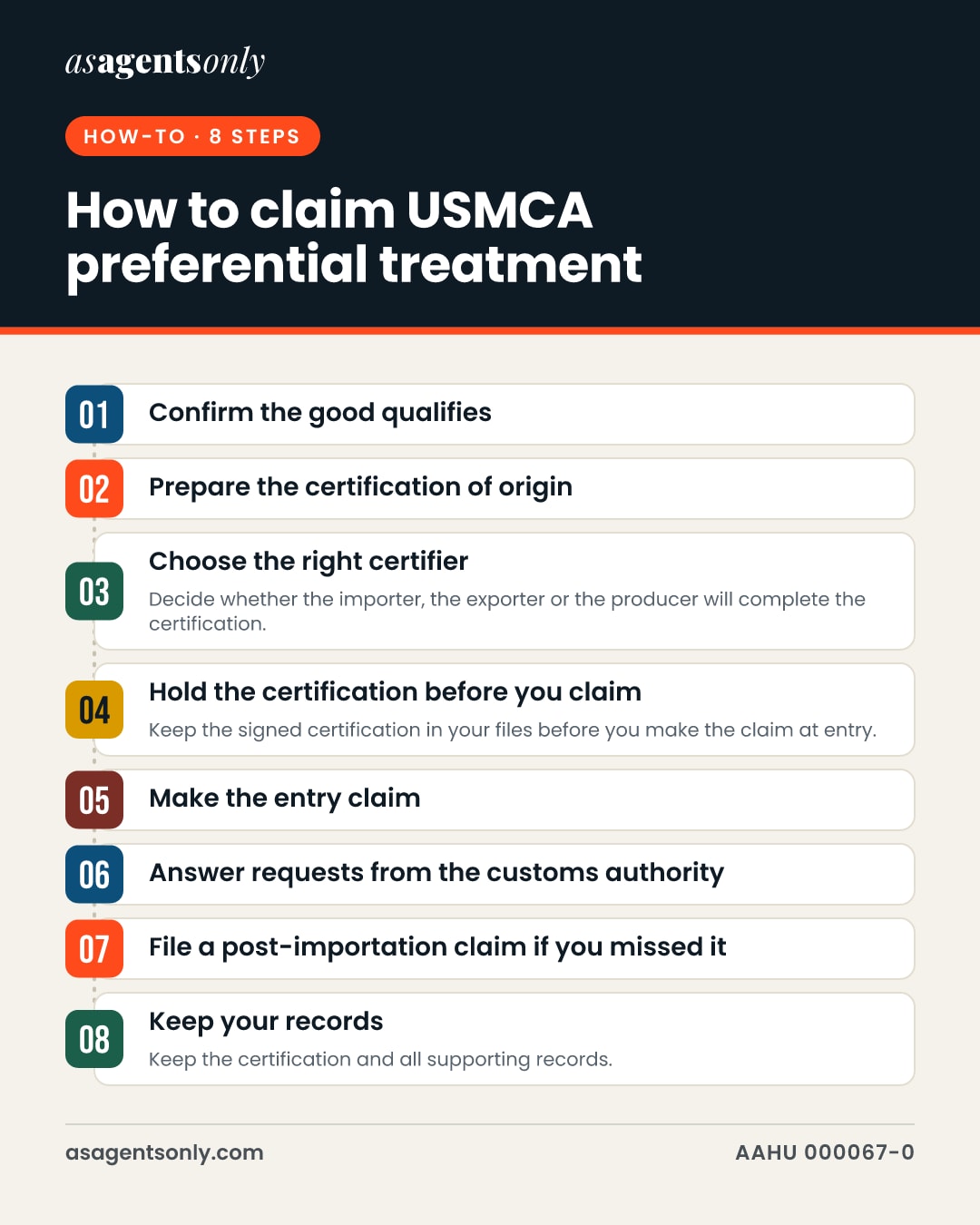
Confirm the good qualifies
Check the product-specific rule for your tariff classification in General Note 11 to the Harmonized Tariff Schedule of the United States (HTSUS) for US entries. For Canada, check the rules in the CUSMA Rules of Origin Regulations, and for Mexico check the rules with your customs broker. Only goods that meet the rule can be claimed.
Prepare the certification of origin
Build a written or electronic certification that contains the nine minimum data elements listed in Annex 5-A of the USMCA. You can place it on an invoice or another document, and no official form is required. Include the statement that the goods are originating and the signature and date of the responsible official.
Choose the right certifier
Decide whether the importer, the exporter or the producer will complete the certification. The certifier must have information that shows the goods are originating, or reasonably rely on the producer's written statement. In Canada, the CBSA gives the same options.
Hold the certification before you claim
Keep the signed certification in your files before you make the claim at entry. In the United States, the importer must have it when the claim is made, and Canada applies the same requirement at importation.
Make the entry claim
In the United States, file the entry in the Automated Commercial Environment (ACE) with the Special Program Indicator (SPI) S or S+ to claim USMCA treatment. In Canada, claim preference under CUSMA on the import declaration as the CBSA directs. In Mexico, use the procedure set by the Mexican Tax Administration Service (SAT).
Answer requests from the customs authority
If US Customs and Border Protection (CBP) or the CBSA asks for the certification, send a copy in English, Spanish or French, with an English translation if needed. If a copy is illegible, defective or incomplete, CBP gives at least five working days to send a corrected one. Canada accepts electronic copies, including scanned documents.
File a post-importation claim if you missed it
If you did not claim at entry, file a post-importation claim with CBP within one year of importation under 19 USC 1520(d). Include a declaration that the goods qualified at importation, the entry number and date, and a copy of the certification. Corrections are allowed until the one-year period ends.
Keep your records
Keep the certification and all supporting records. In the United States, the importer keeps records for five years from the date of importation. Canadian exporters, producers or importers keep them for six years, and US exporters and producers keep their origin records for at least five years after the certification date.
Documents you will need
- Certification of origin with the nine minimum data elements from Annex 5-A
- Commercial invoice showing the description and the invoice number
- Six-digit Harmonized System classification and a description that matches the invoice
- Certifier, exporter, producer and importer names, addresses, email addresses and telephone numbers, as the data elements require
- Origin criterion for the good, such as the product-specific rule
- Bills of materials, production records and cost or purchase records that prove origin
- Blanket period, if one certification covers identical goods for a set period
- For a post-importation claim: a declaration, the entry number and the entry date
Common mistakes
- Using the old NAFTA form: CBP Form 434 is no longer in use, and a goods that qualified under NAFTA must still be recertified under USMCA.
- Claiming before the certification exists: the importer must hold a valid certification when the claim is made, so get it signed first.
- Assuming the $2,500 threshold removes the paperwork: a written statement may still be required even when the value is under US $2,500.
- Splitting shipments to stay under the Canadian limit: the CBSA may ask for a certificate if a series of shipments would exceed CAD$3,300 in total.
- Losing records after the entry clears: the US requires five years of records from the date of importation, so set a retention date.
In pictures
The same facts as this page, as images to save or share. Tap one to open it full size.
Official sources
- U.S. – Mexico – Canada Agreement (USMCA) Frequently Asked QuestionsU.S. Customs and Border Protection
- United States-Mexico-Canada Agreement (USMCA) Implementing InstructionsU.S. Customs and Border Protection
- 19 CFR Part 182 Subpart B - Import RequirementsU.S. Government (eCFR)
- 19 CFR Part 182 - United States-Mexico-Canada AgreementU.S. Government (eCFR)
- Agreement Between the United States of America, the United Mexican States, and Canada (USMCA) Implementing RegulationsFederal Register (CBP rule), published 6 July 2021
- Certifying the origin of goodsCanada Border Services Agency
- The Canada-United States-Mexico Agreement: What importers need to knowCanada Border Services Agency
- Memorandum D11-4-14 - Certification of Origin Under Free Trade AgreementsCanada Border Services Agency, published 29 June 2022
- Mexico Certification of Origin UpdateU.S. International Trade Administration (trade.gov)
- Mexico - Import Requirements and DocumentationU.S. International Trade Administration (trade.gov)
Claims ledger: 22 facts and where each comes from
- CBP Form 434 is no longer in use for USMCA claims.1
- A USMCA claim should contain nine minimum data elements set out in Annex 5-A.1
- A written statement certifying origin may still be required even when non-originating goods are valued under US $2,500.1
- Only the producer, exporter or importer may complete a USMCA Certification of Origin.1
- A post-importation claim under 19 USC 1520(d) may be made within one year of importation.2
- The merchandise processing fee paid at entry is not refunded for post-importation USMCA claims.2
- Importers must have a valid certification of origin in their possession when the USMCA preference claim is made.2
- If CBP finds a certification illegible, defective or incomplete, the importer receives not less than five working days to provide a corrected copy.2
- Preference claims for goods entered on or after July 1, 2020 use the Special Program Indicator S or S+.2
- The product-specific rules of origin are contained in General Note 11(o) of the HTSUS.2
- A certification of origin may be placed on an invoice or any other document, except an invoice issued in a non-USMCA country.3
- A certification of origin is valid for four years following the date it was completed.4
- The importer must keep the certification and supporting records for a minimum of five years from the date of importation.5
- CBP must issue a written determination within 120 days after it has received all information needed to decide an origin verification.5
- In Canada, a certification of origin is required to claim CUSMA preferential tariff treatment, and the importer must provide it to the CBSA on request.6
- The CBSA does not require a certification of origin where the value for duty does not exceed $3,300.7
- Importers in Canada must have the CUSMA certification of origin in their possession at the time of importation.7
- Canadian exporters, producers or importers certifying origin must retain the certificate and related documents for six years.8
- The CBSA may request that the importer obtain a certificate if a series of shipments would increase the total value above CAD$3,300.8
- Mexico started accepting the importer as an authorized certifier starting January 1, 2024.9
- Mexico conducts origin verifications under USMCA, which may include on-site visits to US exporter or producer facilities.10
- The Mexican Tax Administration Service (SAT) leads USMCA origin verification procedures under Chapter Five.10
Every figure on this page is tied to a cited source, last checked on 20 November 2026. Pages like this are re-checked every three months. Found something out of date? Tell the desk.