- How-To
- Exporting
- 4 min read
- Last verified 18 November 2026
How to check EU dual‑use export controls
Learn how to classify an item against the EU dual-use control list and decide whether an export authorisation is needed under Regulation (EU) 2021/821.

General information, not legal advice. Rules, fees and forms change. Confirm with the agency named in the sources, or a licensed professional, before you file or ship.
- Who needs this
- Exporters, freight forwarders, brokers, and anyone who arranges or documents the shipment of goods, software or technology that might be controlled. The Regulation also reaches service providers, researchers, consultants and people who transmit controlled items electronically.
- Cost
- Reading Regulation (EU) 2021/821 and its Annex I on EUR-Lex costs nothing, and the sources reviewed here show no government fee for checking the list yourself. Any fee for an authorisation application depends on your national competent authority, so confirm it with that authority before you apply.
- Time
- No standard processing time for classification or licence decisions appears in the sources reviewed; timing depends on your national competent authority. The Commission states that the Annex I list is typically amended at least once a year, so confirm the version in force on your shipment date.
- Applies to
- EU
Dual-use items are goods, software and technology with both civil and military uses, and the EU controls their export under Regulation (EU) 2021/821. Use this check before you quote, ship or transmit an item that might be on the Annex I list, or when an intra-EU shipment of listed items is involved. The check gives you a documented position, but it does not replace a decision from your national competent authority.
Step by step
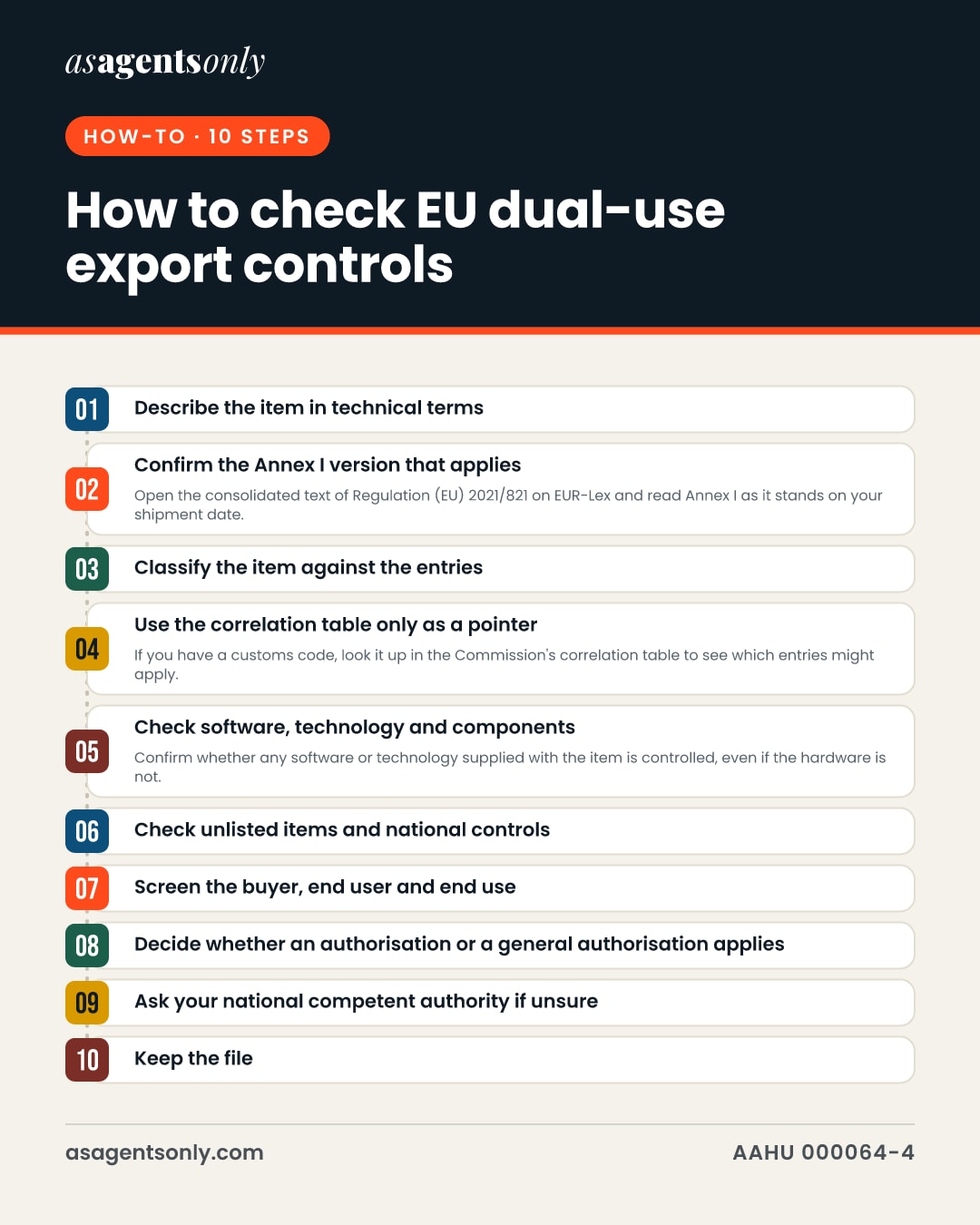
Describe the item in technical terms
Collect the manufacturer's specification sheet, part numbers, performance figures, and any software or technology that goes with the item. Write the description in technical words that can be matched to the control entries, not only the sales name.
Confirm the Annex I version that applies
Open the consolidated text of Regulation (EU) 2021/821 on EUR-Lex and read Annex I as it stands on your shipment date. Check the Commission's trade page for the latest Delegated Regulation, and do not rely on the Commission's Excel copy of the list, which is for information only.
Classify the item against the entries
Work through the ten categories of Annex I, comparing the technical parameters with each entry, its notes and its definitions. Note the matching classification number, which combines a category digit, a subcategory letter and the entry, or record that no entry matches.
Use the correlation table only as a pointer
If you have a customs code, look it up in the Commission's correlation table to see which entries might apply. Then check the technical specification against that entry before you decide, because the code alone does not settle the control status.
Check software, technology and components
Confirm whether any software or technology supplied with the item is controlled, even if the hardware is not. Then check whether a controlled component is the principal element of an uncontrolled product that can be removed or used separately.
Check unlisted items and national controls
If no Annex I entry matches, check whether the Article 4 rules apply, whether your Member State has adopted national measures, and whether a competent authority has informed you of a concerning end use. Compare your Member State's national rules with the list the Commission publishes.
Screen the buyer, end user and end use
Identify the consignee, the end user, the stated end use and any EU sanctions or embargoes that apply to the destination. Stop the shipment and seek advice if a warning sign appears that you cannot resolve from the documents.
Decide whether an authorisation or a general authorisation applies
Establish whether an individual export authorisation is needed from your national competent authority, or whether a Union General Export Authorisation covers the item and destination. Read the exact conditions of any general authorisation before relying on it, because each one sets its own items, destinations and reporting duties.
Ask your national competent authority if unsure
Find the competent authority for your Member State in the list published in the Official Journal of the European Union and on the Commission's dual-use webpage. Send a written description and the entry you matched, and ask for a written position before you ship.
Keep the file
Keep your classification notes, specification sheets, end-user statements and export records for at least five years after the end of the calendar year of export. For intra-EU sales, make sure the invoice, dispatch note or contract states that the items are controlled if exported from the EU.
Documents you will need
- Manufacturer's specification sheet and part numbers for each item
- Description of any software and technology supplied with the item
- Matched Annex I classification number, or a written note that no entry matches
- Customs (CN) code declared or proposed, with the technical check recorded
- Consignee, end user and stated end use, with a signed end-user statement where you hold one
- Sanctions and embargo screening record for the destination
- Any authorisation or general authorisation relied on, with its conditions
- Name and contact details of your national competent authority and any written position it has given
- Commercial documents that show the control statement for intra-EU shipments
Common mistakes
- Relying on the customs code alone: check the technical specification against the Annex I entry, because the correlation table does not settle control status by itself.
- Using an old or unofficial copy of the list: check the consolidated Regulation on EUR-Lex and remember that the Commission's Excel file has no force in law.
- Assuming an unlisted item needs no check: screen the end use and end user, since catch-all rules can apply to items close to the controlled parameters.
- Forgetting technology and software sent electronically: treat e-mails, downloads and cloud access as possible exports and check them against Annex I.
- Discarding records early: keep them for at least five years after the end of the calendar year of export.
In pictures
The same facts as this page, as images to save or share. Tap one to open it full size.
Official sources
- Regulation - 2021/821 - EN - EUR-LexEUR-Lex (Publications Office of the European Union)
- 2026 Update of the EU Control List of Dual-Use ItemsEuropean Commission, Directorate-General for Trade and Economic Security, published 14 September 2026
- Exporting dual-use itemsEuropean Commission, Trade and Economic Security
- Commission Recommendation (EU) 2021/1700 on internal compliance programmes for controls of research involving dual-use itemsEUR-Lex (Official Journal of the European Union), published 23 September 2021
- Official Journal L 338/2021 (guidance annex to Recommendation (EU) 2021/1700)EUR-Lex (Official Journal of the European Union), published 23 September 2021
- Export-related restrictions for dual-use goods and advanced technologies (FAQ)European Commission, Directorate-General for Financial Stability, Financial Services and Capital Markets Union
- Council document 5797/25 RELEX.5 (dual-use export control report)Council of the European Union, published 30 January 2025
- White Paper on export controls for dual-use items (COM(2024) 25 final)European Commission, published 24 January 2024
- Regulation - 2021/821 - EN - EUR-Lex - European Union (Official Journal version)EUR-Lex (Publications Office of the European Union)
- Regulation - 2021/821 - EN - EUR-Lex (consolidated text)EUR-Lex (Publications Office of the European Union)
Claims ledger: 23 facts and where each comes from
- The Commission adopted a Delegated Regulation on 14 September 2026 that updates the Annex I dual-use list of Regulation (EU) 2021/821.2
- Annex I, the EU dual-use list, is typically amended at least once each year through a Delegated Act.2
- The Commission's Excel file listing Annex I items is a supporting tool for information only and has no force in law.3
- Exporting an item listed in Annex I requires an authorisation.1
- An authorisation is required for an unlisted item when the competent authority has informed the exporter that the item may be intended for a use of concern.1
- A Member State may adopt national legislation requiring authorisation for unlisted items when the exporter has grounds for suspecting a concerning use.1
- An authorisation is also required for an unlisted item when another Member State imposes one under a national control list published by the Commission.1
- Commercial documents for intra-Union transfers of listed items, such as contracts, invoices and dispatch notes, must clearly state that the items are controlled if exported from the Union.1
- Exporters must keep registers or records and documents for at least five years from the end of the calendar year in which the export took place.1
- A correlation table linking dual-use list numbers to customs (CN) codes is available on the Commission's DG Trade dual-use webpage.4
- Classifying items solely by customs codes using the correlation table is not sufficient, so the technical specification must also be verified.4
- Listed dual-use technology remains under control even when it is applicable to an item that is not controlled.5
- Items are classified by comparing their technical characteristics against the EU and national dual-use control lists.5
- Dual-use software and technology sent by e-mail or made available through a cloud service abroad require careful classification.5
- Non-listed dual-use items may require an export authorisation if end-use or diversion screening raises concern under the catch-all provisions of Article 4.5
- The object of Annex I controls should not be defeated by exporting non-controlled goods that contain controlled components, where those components are the principal element and can feasibly be removed or used for other purposes.9
- The Commission compiles national measures on non-listed items and publishes them in the Official Journal.4
- The list of Member States' competent authorities under the EU Dual-Use Regulation is published in the Official Journal of the European Union, and a copy is on the Commission's dual-use webpage.6
- Union General Export Authorisations such as EU001 cover exports to listed countries including Australia, Canada and the United States, while EU002 covers certain items to certain destinations.7
- Dual-use items are goods, software and technology that can be used for both civil and military purposes.8
- Various categories of persons can be involved in exporting dual-use items, including service providers, researchers, consultants and persons transmitting items electronically.10
- In the classification number 9A012.a (illustrative example), the 9 means Category 9 and the A means Subcategory A.5
- An export authorisation is needed for the movement or transmission outside the customs territory of the Union of any listed dual-use item in Annex I.5
Every figure on this page is tied to a cited source, last checked on 18 November 2026. Pages like this are re-checked every three months. Found something out of date? Tell the desk.