- How-To
- Exporting
- 4 min read
- Last verified 19 November 2026
How to get a certificate of origin
Learn how to pick the right certificate of origin, who can complete it, where to have it issued, and what records to keep for customs.

General information, not legal advice. Rules, fees and forms change. Confirm with the agency named in the sources, or a licensed professional, before you file or ship.
- Who needs this
- Exporters, producers, forwarders and importers who must show origin for a shipment. Under some agreements the importer, exporter or producer may complete the certificate, but a distributor that is neither the importer, exporter nor producer may not.
- Cost
- No single government fee applies to every certificate. Chambers of commerce and other issuers may charge fees, and the fee depends on the issuer, so ask the issuer before you apply. Check the issuer's published fee schedule for the current amount.
- Time
- Timing depends on the issuer's verification. Preferential certificates are generally issued only after the origin criteria are checked, and chamber issuance includes a manual validation stage. Allow time for any legalisation the destination country requires.
- Applies to
- Global
A certificate of origin states the country in which goods were produced or substantially transformed. Buyers, banks and customs officials use it to decide whether a shipment qualifies for a reduced duty under a trade agreement or must meet another origin-based requirement. Start by confirming whether the buyer or the destination country needs a preferential or a non-preferential certificate, because the route to obtaining it differs.
Step by step
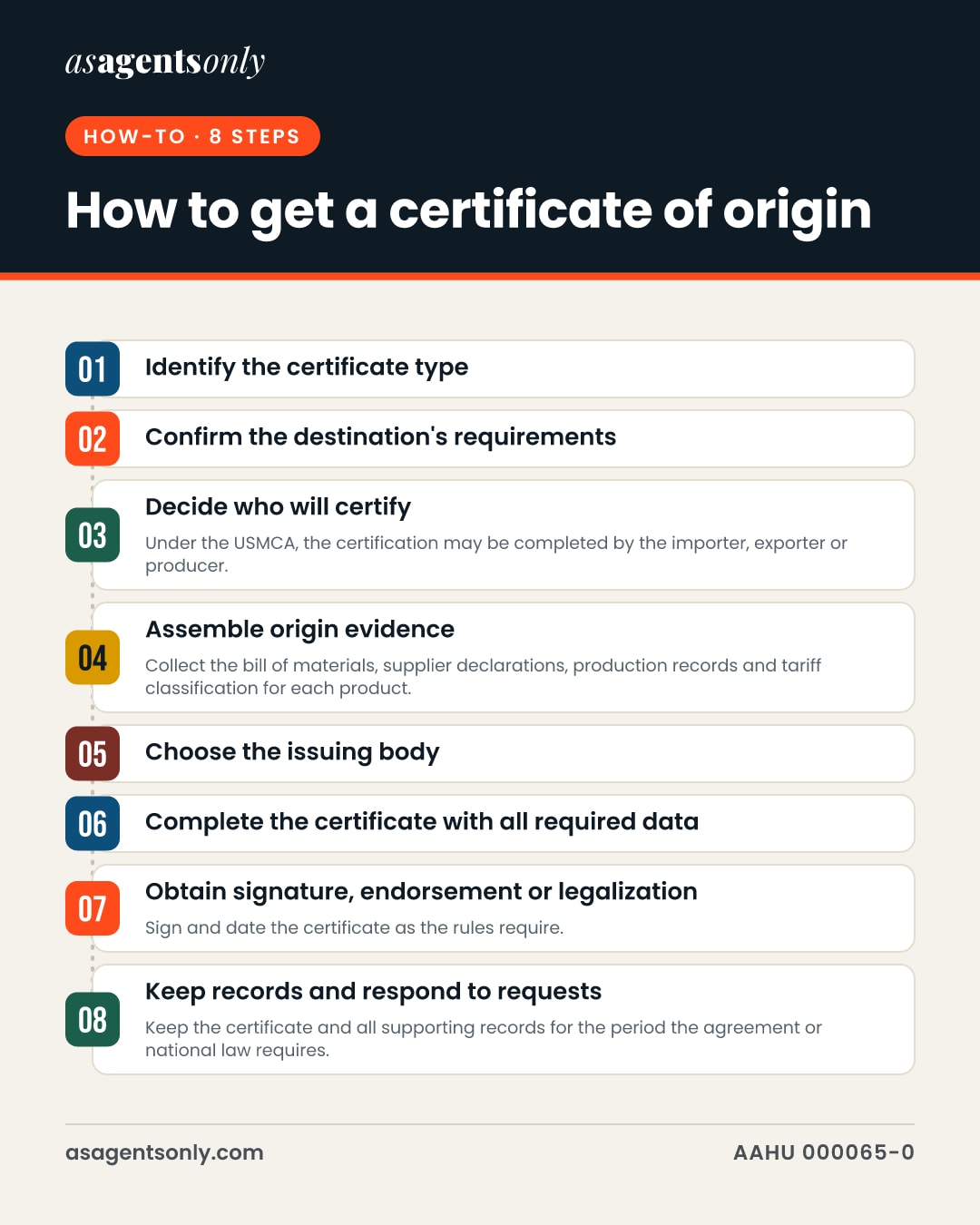
Identify the certificate type
Read the rules of origin in the trade agreement, or ask the buyer, to learn whether the destination requires a preferential certificate (for a reduced tariff) or a non-preferential one. Your buyer, freight forwarder or the customs administration can confirm the form and data they need before you start.
Confirm the destination's requirements
Ask the importer or customs broker whether the destination country requires a specific form, notarization, chamber certification or legalization. Some countries require a certificate to be notarized, certified by a chamber of commerce and legalized by the destination country's consulate.
Decide who will certify
Under the USMCA, the certification may be completed by the importer, exporter or producer. Under United States rules, a certifier must have information showing the good is originating, or reasonably rely on the producer's written statement. Assign one responsible person and record who that is.
Assemble origin evidence
Collect the bill of materials, supplier declarations, production records and tariff classification for each product. The importing country's customs authority may ask for this evidence later, so keep it with the shipment file.
Choose the issuing body
For preferential certificates in the European Union, apply to the customs authority of the exporting country or an appointed body such as a chamber of commerce. For non-preferential certificates, many countries use a chamber of commerce; ICC Genesis lets exporters apply online to a participating chamber for certification of an invoice declaration. Verify that the issuer is recognized in your country.
Complete the certificate with all required data
For a USMCA claim, include the nine minimum data elements, such as the certifier's details, the exporter and producer, the good's description with HS classification, the origin criteria and the signature with date. The form need not follow a prescribed format and may appear on an invoice or other document.
Obtain signature, endorsement or legalization
Sign and date the certificate as the rules require. EU movement certificates are returned to the customs authority for endorsement. Chamber certificates may carry a chamber stamp and signature or be issued electronically. If the destination requires legalization, follow the process of the issuing country's legalization office and the destination's authorities.
Keep records and respond to requests
Keep the certificate and all supporting records for the period the agreement or national law requires. Under the USMCA, United States exporters and producers must keep origin records for at least five years, and must provide copies to customs when asked. Notify the parties you gave the certificate to if you later find an error.
Documents you will need
- Commercial invoice showing the goods, quantities, values and buyer details
- Product description and HS tariff classification for each good
- Bill of materials or records of non-originating inputs, with their tariff codes
- Production process description or supplier declarations for inputs
- Exporter, producer and importer names, addresses, telephone numbers and email addresses
- Destination country's form or template, if the buyer or customs requires one
- Signed and dated certificate, or the issuer's approved electronic certificate
Common mistakes
- Claiming a preferential certificate for goods that do not meet the agreement's rules of origin; confirm the required data elements and the origin criterion in the agreement before you certify.
- Using a certificate without the required data elements; check the minimum data elements in the agreement or the issuer's template before you sign.
- Treating a certificate as valid indefinitely; under the USMCA, a properly completed certification is accepted for four years after it was completed, so check the validity period in the agreement you rely on.
- Relying on a document that claims an ICC logo without verifying it; use the ICC Certificate of Origin verification platform for certificates that carry the ICC label.
- Asking for a certificate after shipment without grounds; in the EU, retrospective issuance is only allowed in exceptional circumstances and must be endorsed as issued retrospectively.
In pictures
The same facts as this page, as images to save or share. Tap one to open it full size.
Official sources
- U.S.-Mexico-Canada Agreement (USMCA) Frequently Asked QuestionsU.S. Customs and Border Protection
- 19 CFR 182.12 Certification of origineCFR (U.S. Code of Federal Regulations)
- USMCA Chapter 5 Origin ProceduresOffice of the United States Trade Representative
- USMCA Implementing InstructionsU.S. Customs and Border Protection
- Special DocumentsInternational Trade Administration (trade.gov)
- Guidelines on Certification of OriginWorld Customs Organization
- Frequently Asked Questions (FAQ) for Rules of OriginWorld Customs Organization
- Certificates of OriginICC International Chamber of Commerce
- The ICC Guide to Authenticate Certificates of Origin for International BusinessICC International Chamber of Commerce
- ICC GenesisICC International Chamber of Commerce
- Beware of fraudulent documents mentioning ICCICC International Chamber of Commerce
- Movement Certificate EUR.1European Commission, Access2Markets
- Rules of origin in the Pan-Euro-Mediterranean ConventionEuropean Commission, Access2Markets
- Proposal for the EU-EAC protocol procedure for movement certificates EUR 1European Commission (COM(2016) 64 final)
- 19 CFR Part 182 United States-Mexico-Canada AgreementeCFR (U.S. Code of Federal Regulations)
Claims ledger: 32 facts and where each comes from
- Certificates of origin may be required to comply with the requirements of foreign customs (i.e., country of importation), for letters of credit, or simply at the request of the buyer.5
- Some countries may require that a COO be notarized, certified by a chamber of commerce, and legalized by the commercial section of the consulate of the destination country.5
- Detailed FTA certification requirements for claims of preferential tariff treatment under the FTA are usually found in its rules of origin (ROO) chapter.8
- A proof of origin is generally needed to obtain a preferential treatment, according to the provisions in the relevant FTA.7
- Under the USMCA, the importer may make a claim for preferential tariff treatment based on a certification of origin completed by the importer, exporter, or producer.4
- A certification of origin may be completed by the importer, exporter, or producer of the good on the basis of the certifier having information, including documents, that demonstrate that the good is originating.2
- The USMCA does not require a specific certificate of origin form.1
- A claim for preferential treatment under the USMCA should contain nine minimum data elements.1
- A certification of origin that is properly completed, signed, and dated in accordance with the requirements of this section will be accepted as valid for four years following the date on which it was completed.2
- A certification of origin is not required for a commercial importation for which the value of the originating goods does not exceed US $2,500, provided the importation does not form part of a series of importations that may be considered to have been undertaken or arranged for purposes of evading United States laws.1
- An exporter or producer who completes a certification of origin or a producer who provides a written representation for a good exported from the United States must maintain records for a period of at least five years after the date the certification was completed.16
- Only the producer, exporter, or importer may complete a Certification of Origin.1
- A Certificate of Origin (CO) confirms the 'nationality' of a product and serves as a declaration to satisfy customs or trade requirements.8
- Local chambers have the unique position to operate as the natural and trusted agent in issuing COs, which can issue two types: non-preferential and preferential.8
- In most countries, the organisations that issue certificates of origin are chambers of commerce, who issue manual and electronic CO (eCO).9
- Certificates of Origin are not issued by ICC directly but generally by a chamber of commerce.11
- If the CO bears the ICC World Chambers Federation Certificate of Origin logo, it has been issued by a chamber of commerce that is a member of the ICC WCF CO Accreditation Chain and has received an accreditation from ICC WCF.11
- Exporters can apply online in just a few steps to their local chamber of commerce to obtain the certification of the invoice declaration and origin statement.10
- You can request a movement certificate EUR.1 or EUR-MED from your Customs authority or an appointed body (e.g. Chambers of Commerce).12
- The exporter or his authorised representative shall fill out both the movement certificate EUR.1 and the application form.14
- A movement certificate EUR 1 shall be issued by the customs authorities and made available to the exporter as soon as actual exportation has been effected or ensured.14
- The certificate and application must be completed by the exporter or the exporter's authorised representative and returned to the Customs authority for endorsement.12
- A movement certificate EUR.1 may exceptionally be issued after exportation if it was not issued at the time of exportation because of errors or involuntary omissions or special circumstances.14
- Chamber issuance involves treatment and manual validation by the chamber's officer before the certificate is issued.10
- If a chamber issues a CO manually using a specific paper form, the document will bear the chamber's stamp and signature.9
- If a CO is issued online as a pdf, the documents are generally printed, and no wet stamp and signature is necessary.9
- Importers, customs authorities, chambers and trade stakeholders can verify the authenticity of a CO bearing an ICC CO label via the ICC WCF Certificate of Origin Verification website.9
- The issuance of a certificate of origin may be subject to certain fees, which will increase the cost of doing business.6
- Customs and/or the competent authority shall establish and make available to the public the detailed requirements and procedures regarding the issuance of a proof of origin.6
- For a movement certificate, the exporter must submit documents proving the originating status of the products concerned.13
- You can get a UK document legalised by the Legalisation Office, which checks signatures, stamps or seals against its records and attaches an apostille.15
- A certification of origin shall not be rejected due to minor errors or discrepancies that do not create doubts concerning the correctness of the import documentation.3
Every figure on this page is tied to a cited source, last checked on 19 November 2026. Pages like this are re-checked every three months. Found something out of date? Tell the desk.