- Explainer
- Regulation
- 4 min read
- Last verified 21 November 2026
What cabotage is
Cabotage is moving goods between two points in one country by an operator based elsewhere, and this page explains how the EU, UK and US limit it.

General information, not legal advice. Rules, fees and forms change. Confirm with the agency named in the sources, or a licensed professional, before you file or ship.
In short
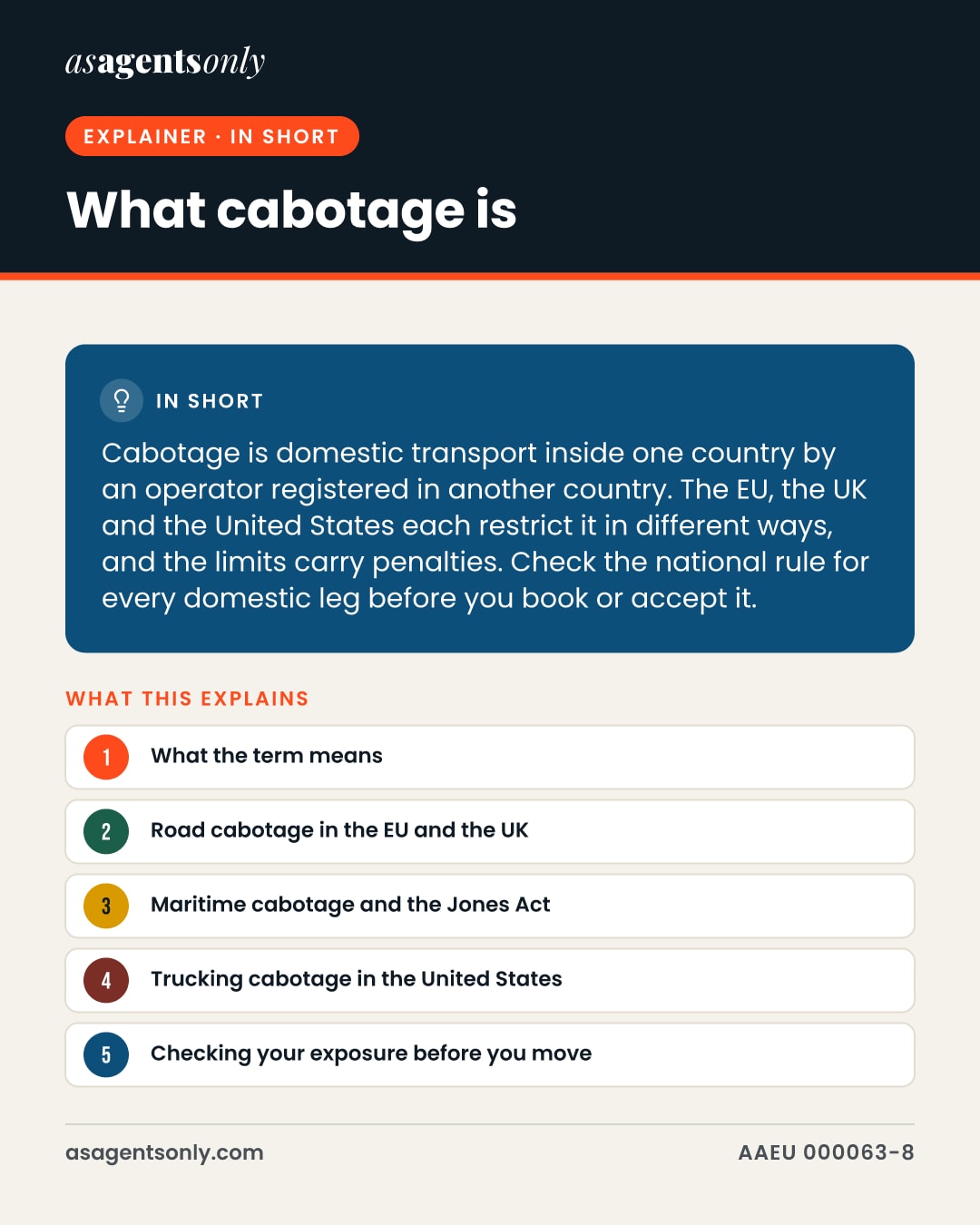
Cabotage is domestic transport inside one country by an operator registered in another country. The EU, the UK and the United States each restrict it in different ways, and the limits carry penalties. Check the national rule for every domestic leg before you book or accept it.
Cabotage shows up in road haulage, shipping and air transport, and the word means the same thing in each: domestic carriage by a foreign operator. Whether it is allowed, and how far, is decided by national or regional law, so the rule that applies depends on where the goods move. This explainer sets out the core meaning and the main rules in the European Union, the United Kingdom and the United States.
What the term means
Cabotage is the carriage of goods between two places inside one country by an operator based or registered in another country. The European Parliament describes it as domestic transport performed by a company registered in another Member State. The UK government gives an example: a French operator hauling goods from London to Manchester.
The term is older than road haulage. The WTO glossary defines the maritime sense as sea shipping between ports of the same country, usually along coasts. Australia uses the word for airlines, where a foreign airline may carry passengers or cargo between two Australian airports only with government permission.
The core idea is the same in each mode. A carrier that is not from the country is moving freight inside it, and that is why governments limit it.
Road cabotage in the EU and the UK
The EU's road haulage rules are set out in one regulation, as amended by Regulation (EU) 2020/1055. A non-resident haulier may carry out up to three cabotage operations after the incoming international goods have been delivered. Within the seven-day window, it may carry out no more than one cabotage operation in any given Member State, and that operation must take place within three days of its unladen entry into that country.
The window is counted in calendar days. After a haulier's last cabotage operation in a Member State, the same vehicle must wait four days before doing another cabotage operation in that country.
The UK applies its own limits to EU operators. They may make two cabotage movements within seven days of arriving and unloading in the UK, and then the vehicle must leave. Outside the EU, always check the current national rule, because it can differ from the EU text.
Maritime cabotage and the Jones Act
The best-known maritime rule in the United States is the Jones Act. Under it, a vessel that is not coastwise-qualified may not carry merchandise between coastwise points, whether directly or through a foreign port. A coastwise-qualified vessel is generally built in, owned in, and documented in the United States with a coastwise endorsement.
Two agencies share the work. U.S. Customs and Border Protection decides whether a movement counts as coastwise trade, and the U.S. Coast Guard's vessel documentation center decides whether a vessel is eligible. The Jones Act reaches the territorial sea, which is three nautical miles wide along the coast, so a move entirely within those waters can still count.
The penalty for a breach is forfeiture of the merchandise, or a sum up to its value. Waivers exist only in limited cases, and CBP processes those requests.
Trucking cabotage in the United States
For road freight, CBP's guidance treats cabotage as point-to-point carriage within one country. Goods crossing the border on a commercial vehicle must be entering or leaving the United States to remain in international commerce. Foreign national drivers may qualify for B-1 business-visitor admission to pick up or deliver that cargo, but the B-1 status does not give them a right to carry domestic freight.
CBP states that the aim of these rules is to keep domestic traffic with U.S. trucking companies, using U.S. equipment and U.S. drivers. Read the CBP compliance guidance for commercial vehicles before taking any load that starts and ends inside the United States.
Checking your exposure before you move
Shippers, forwarders and brokers can carry risk as well as carriers. The EU's joint rules require each Member State to set sanctions against consignors, freight forwarders, contractors and subcontractors that knew, or should have known, that a commissioned service broke the regulation.
Enforcement is active. Member States must carry out concerted roadside checks on cabotage at least twice per year, and national authorities enforce the rules in their own territory.
Before you book a domestic leg with a foreign carrier, ask for proof that its incoming international load was delivered, confirm the national rule for the country where the domestic leg runs, and keep a record of each unloading and each drop. Ask a customs broker or national transport regulator when a rule is unclear.
Side by side
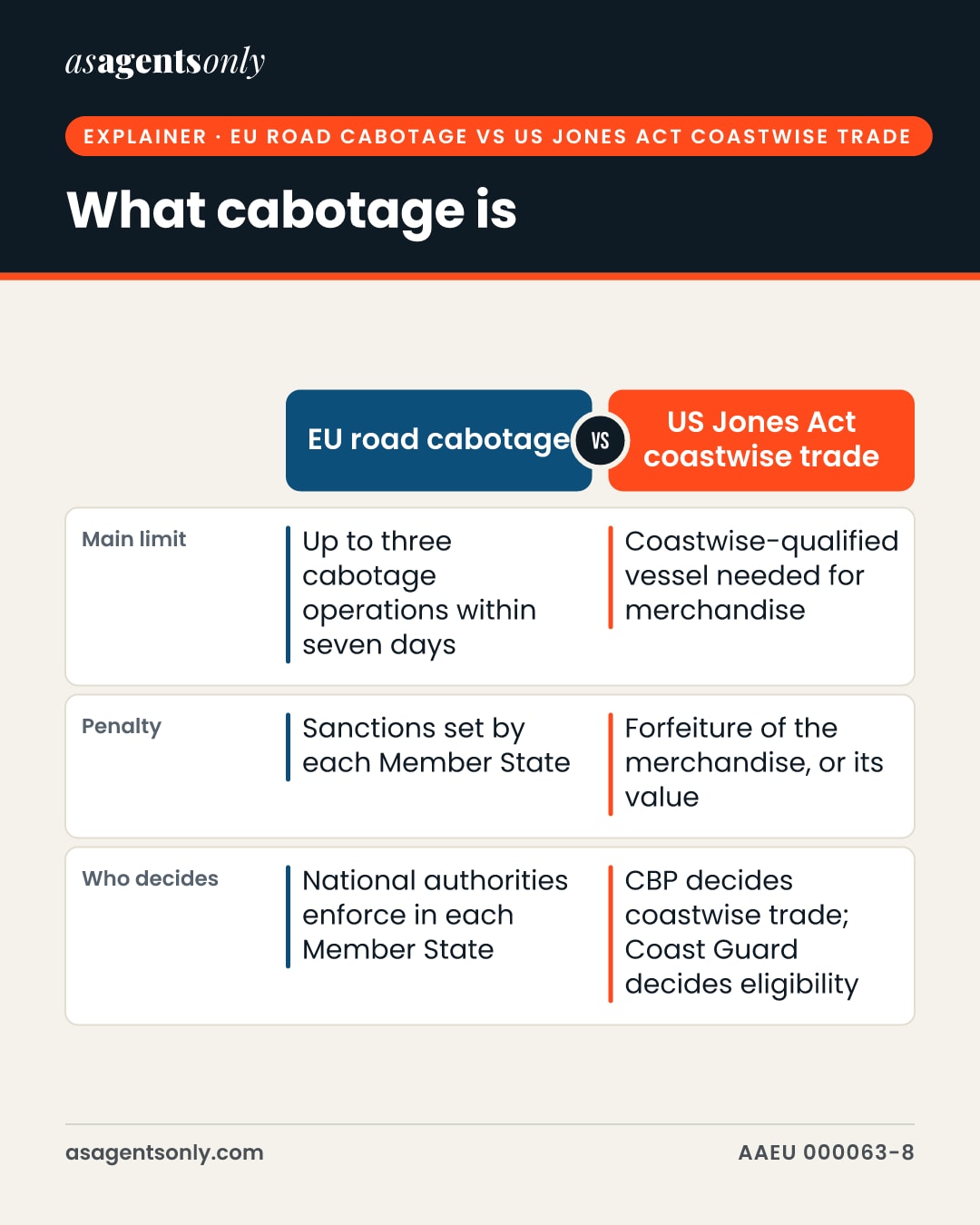
| Compared | EU road cabotage | US Jones Act coastwise trade |
|---|---|---|
| Main limit | Up to three cabotage operations within seven days | Coastwise-qualified vessel needed for merchandise |
| Penalty | Sanctions set by each Member State | Forfeiture of the merchandise, or its value |
| Who decides | National authorities enforce in each Member State | CBP decides coastwise trade; Coast Guard decides eligibility |
Example
Illustrative example only, not a real shipment: a carrier registered in Country A, an EU Member State, unloads an international load in Country B, another EU Member State, on a Monday. The seven-day window starts at 00:00 on the following day and must close by 23:59 on the seventh day. Within that window the carrier may complete three cabotage operations in Country B, with no more than one in that country, and each must start within three days of unladen entry. After its last cabotage operation there, the same vehicle must wait four days before any further domestic work in Country B.
In pictures
The same facts as this page, as images to save or share. Tap one to open it full size.
Official sources
- International road transport and cabotageEuropean Parliament
- EUR-Lex - 02009R1072-20220221 - ENEuropean Union (EUR-Lex)
- Rules on cabotage as applicable from 21 February 2022European Commission, Mobility and Transport
- Joint rules on access to the EU road haulage marketEUR-Lex (summary)
- The Jones Act, Informed Compliance Publication, December 2024U.S. Customs and Border Protection
- CTPAT Alert - Cabotage Rules Violations and CTPATU.S. Customs and Border Protection
- Guidelines for international airlines - Cabotage requestsAustralian Government, Department of Infrastructure, Transport, Regional Development, Communications and the Arts
- cabotage (WTO glossary)World Trade Organization
Claims ledger: 21 facts and where each comes from
- The European Parliament describes cabotage as domestic transport in an EU country by a company registered in another Member State.1
- The EU regulation defines a cabotage operation as domestic carriage for payment, carried out temporarily in the host Member State.2
- UK government guidance treats a haul from London to Manchester by a French-based operator as cabotage.4
- The WTO glossary places maritime cabotage in sea shipping between ports of one country, usually along coasts.9
- Australia defines airline cabotage as a foreign airline carrying passengers or cargo between two airports within Australia.8
- Up to 3 cabotage operations following an international carriage can be performed, at the maximum.3
- The seven-day period starts from 0h00 on the day after the incoming international carriage, and the cabotage must end at 23h59 on the seventh day.3
- Only one cabotage operation is allowed in a given Member State other than the one of the incoming international transport, performed within 3 days of unladen entry.3
- A motor vehicle that carries out cabotage operations is prohibited from carrying out cabotage operations in the same Member State within 4 days after its last cabotage operation there.3
- Regulation (EU) 2020/1055 amends the EU road rules, and the amendment applies from 21 February 2022.5
- For EU operators, the UK allows two cabotage movements within seven days of arriving and unloading in the UK.4
- Under the Jones Act, a vessel may not provide any part of the transportation of merchandise between points in the United States unless it meets the statute's ownership and documentation conditions.6
- The penalty for carrying merchandise between coastwise points on a non-qualified vessel is forfeiture of the merchandise, or forfeiture of an amount up to its value.6
- CBP determines whether transportation counts as coastwise trade, while the Coast Guard's National Vessel Documentation Center determines whether a vessel is qualified.6
- The Jones Act applies to the territorial sea, which is three nautical miles wide and adjacent to the U.S. coast.6
- CBP's guidance describes cabotage as point-to-point transportation of property within one country.7
- Goods crossing the U.S. border on a commercial vehicle must be entering or leaving the United States and remain in the stream of international commerce.7
- Foreign national truck drivers may qualify for admission as B-1 visitors for business to pick up or deliver cargo in the stream of international commerce.7
- The objective of the U.S. regulations is to ensure that domestic traffic is performed by U.S. trucking companies, with U.S. equipment and U.S. drivers.7
- Member States must set sanctions against consignors, freight forwarders, contractors and subcontractors that knew or should have known that the services they commissioned infringed the regulation.5
- At least twice per year, Member States shall undertake concerted roadside checks on cabotage operations.2
Every figure on this page is tied to a cited source, last checked on 21 November 2026. Pages like this are re-checked every six months. Found something out of date? Tell the desk.