- Explainer
- Customs
- 5 min read
- Last verified 22 November 2026
Free trade agreements and preferential duty
How free trade agreements can lower import duty, what makes goods qualify, and the proof you must hold to claim the lower rate.

General information, not legal advice. Rules, fees and forms change. Confirm with the agency named in the sources, or a licensed professional, before you file or ship.
In short
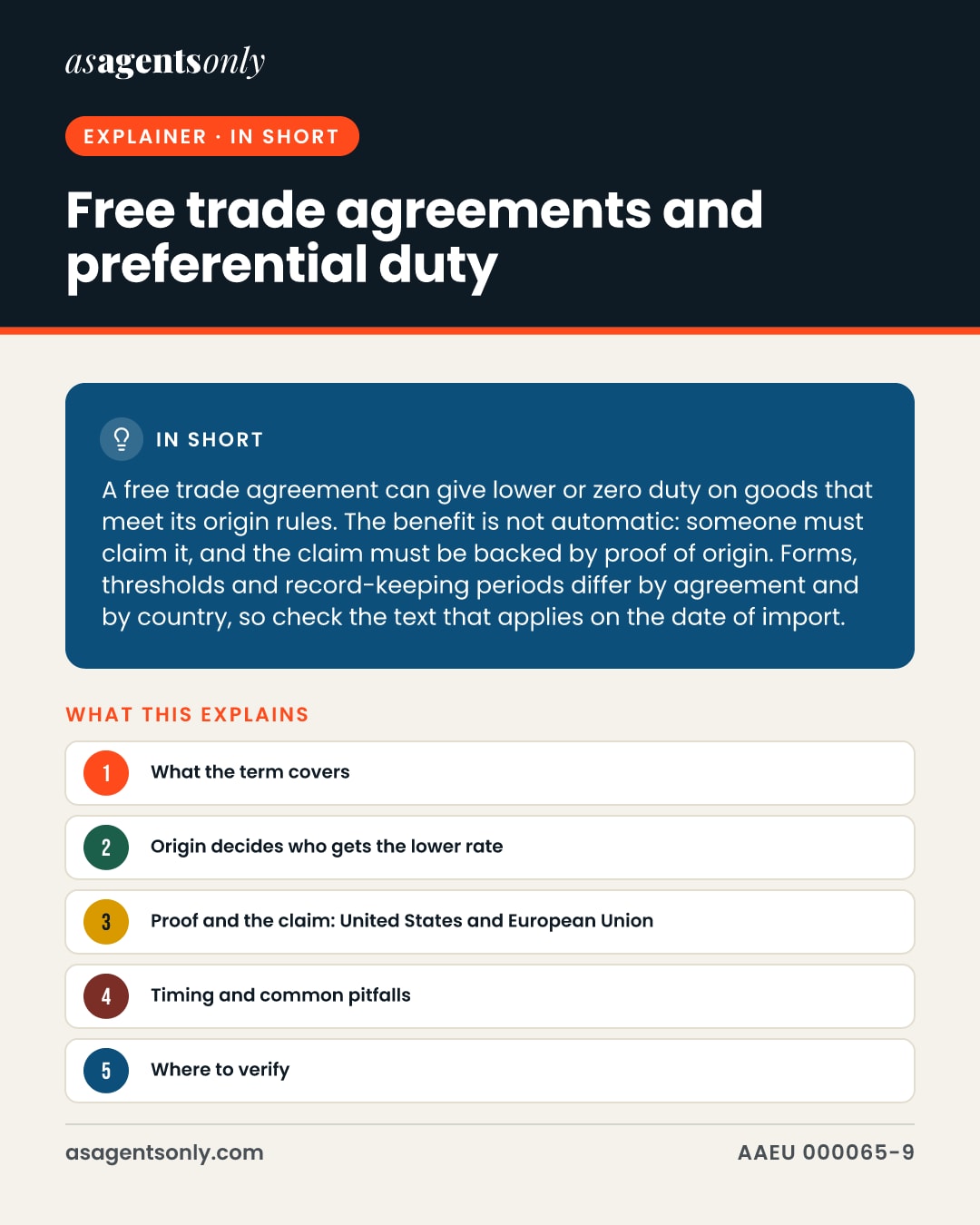
A free trade agreement can give lower or zero duty on goods that meet its origin rules. The benefit is not automatic: someone must claim it, and the claim must be backed by proof of origin. Forms, thresholds and record-keeping periods differ by agreement and by country, so check the text that applies on the date of import.
Import duty is normally charged at a general rate. Trade agreements between partners can give goods from those partners a lower or zero rate, which is called preferential duty. This explainer covers what these agreements are, how origin rules decide eligibility, and what the paperwork looks like in the United States and the European Union.
What the term covers
In WTO usage, a regional trade agreement is a reciprocal arrangement between two or more partners, and the WTO keeps a database of those notified to it. Many people call these agreements free trade agreements, but the legal titles vary, so the instrument you need is the specific text and its origin chapter.
A separate category is the preferential trade arrangement. The WTO describes these as unilateral trade preferences, such as generalized system of preferences schemes, under which developed countries give preferential tariffs to imports from developing countries. Your duty claim may rest on either type, so confirm which instrument applies to your product and lane.
Origin decides who gets the lower rate
A partner's membership in an agreement does not by itself give a product the lower rate. The product must meet the origin conditions of that agreement. The European Commission explains that goods must either be wholly obtained in a partner, or sufficiently worked or processed there under the product-specific rules in the origin protocol.
Those product-specific rules usually test a change in tariff classification, a value limit, or a specific working or processing operation. Some arrangements allow a small tolerance for non-originating material, and some allow materials from another partner to count toward origin, a practice called cumulation. The working that confers origin must also take place inside the partner territories, and originating goods generally lose that status if they leave them.
For example, the Commission's guidance lists musical instruments under a rule that caps the value of all materials used at a share of the ex-works price. Read the exact cap in the product row, because the wording changes from heading to heading.
Proof and the claim: United States and European Union
In the United States, the USMCA does not require a specific form. CBP says a claim should contain nine minimum data elements, which may appear on an invoice or any other document. The importer must hold the certification when making the claim, and the certifier may be the importer, exporter or producer. Records supporting the claim must be kept for five years from importation.
CBP's FAQ also states a certification is not required for a commercial importation where the value of originating goods does not exceed US $2,500, as long as the shipment is not part of a series arranged to evade the rules. Even below that value, a written statement that the goods originate may still be required.
The European Union works differently. Proof of origin is usually a certificate of preferential origin, issued by the customs authorities of the exporting country and presented at customs clearance. The form depends on the agreement: Form A, EUR-MED or the €1 certificate. A claim can rest on proof produced on request or on the importer's knowledge, and the goods must generally travel directly from the partner.
Timing and common pitfalls
Claims are normally made when goods are entered, and CBP's guidance on earlier agreements says importers must claim the benefit to receive preferential treatment. Some newer agreements allow later claims. The European Commission's guidance on the EU-Mercosur interim trade agreement says importers may claim retrospectively if they did not claim at release, and a statement on origin made after export must be presented within two years of import.
CBP may deny a preferential claim when the importer does not supply information it requests. For a good that leaves the USMCA territories, CBP may also deny the claim if the importer cannot document the transit. Where verification reveals a pattern of false or unsupported claims, CBP may withhold preference from identical goods in later entries.
The practical lesson is to decide the claim before the entry is filed, collect the origin proof at the same time as the commercial invoice, and keep the file for the full retention period.
Where to verify
Start with the origin chapter of the agreement and its product rules, then check the importing country's customs authority for forms and procedures. The WTO's Rules of Origin Facilitator is a free online tool; the WTO reported that its database covered product-specific rules in 484 trade agreements as of June 2022, so confirm the current text rather than relying on older summaries.
Agreements are amended, partners join or leave, and forms change. Use the version in force on the day the goods are imported, and record the source you used in your file.
Side by side
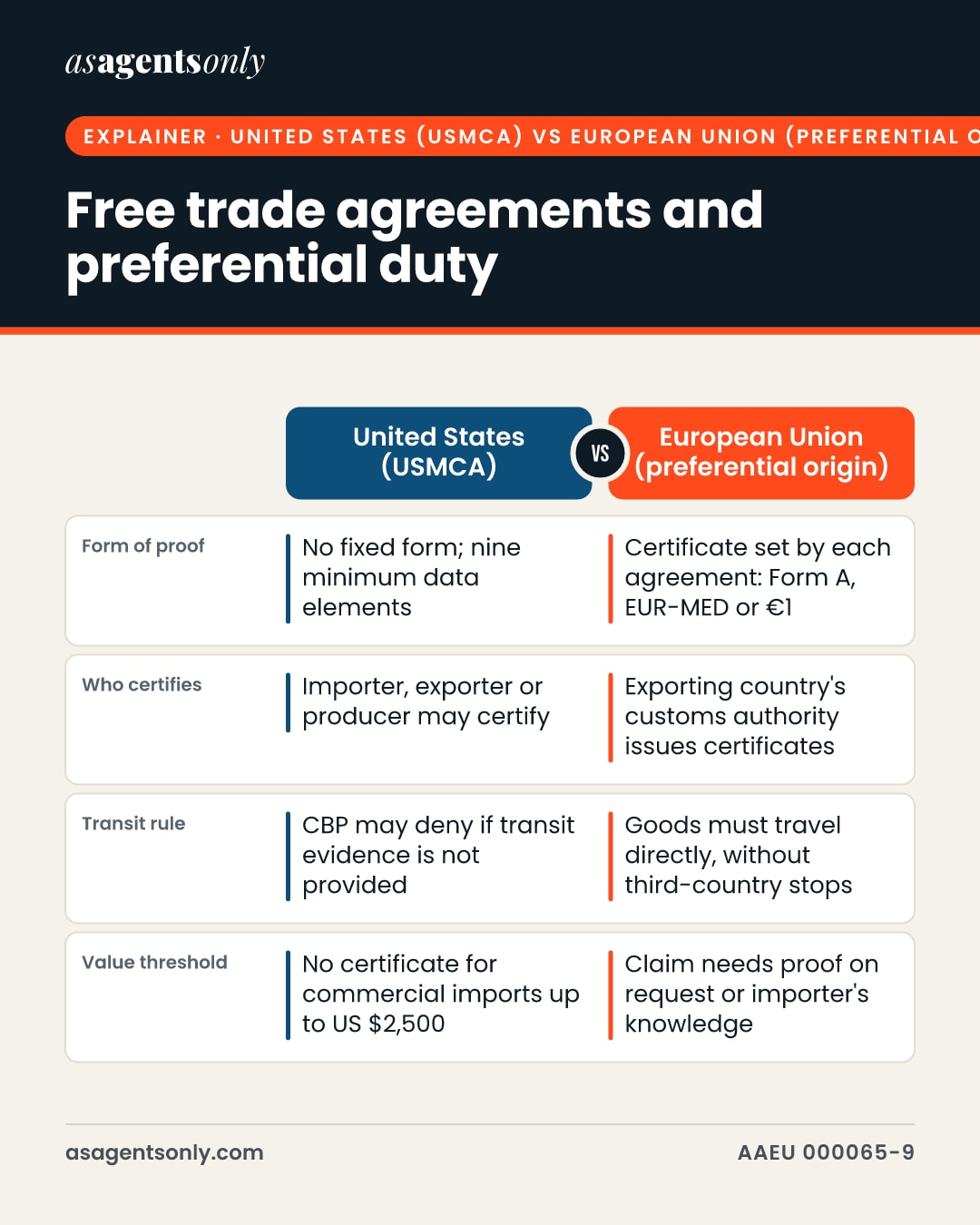
| Compared | United States (USMCA) | European Union (preferential origin) |
|---|---|---|
| Form of proof | No fixed form; nine minimum data elements | Certificate set by each agreement: Form A, EUR-MED or €1 |
| Who certifies | Importer, exporter or producer may certify | Exporting country's customs authority issues certificates |
| Transit rule | CBP may deny if transit evidence is not provided | Goods must travel directly, without third-country stops |
| Value threshold | No certificate for commercial imports up to US $2,500 | Claim needs proof on request or importer's knowledge |
Example
Illustrative example (figures invented for teaching): an importer in the United States brings in four cartons of ceramic tableware from a partner country under the USMCA. The originating value of the shipment is two thousand dollars, which is below the US $2,500 level, so no certification is needed for this commercial importation if it is not part of a series arranged to evade the rules. The importer still has to claim the preference on the entry, and a written statement that the goods originate may still be required. The importer should keep the supporting records for five years from importation.
In pictures
The same facts as this page, as images to save or share. Tap one to open it full size.
Official sources
- U.S. – Mexico – Canada Agreement (USMCA) Frequently Asked QuestionsU.S. Customs and Border Protection
- 19 CFR Part 182 — United States-Mexico-Canada AgreementU.S. Government (eCFR)
- NAFTA - Guide to Customs and ProceduresU.S. Customs and Border Protection
- Preferential rules of originEuropean Commission, Taxation and Customs Union
- Quick guide to rules of originEuropean Commission, Trade
- Rules of originEuropean Commission, Trade
- Regional trade agreementsWorld Trade Organization
- Regional trade agreements and the WTOWorld Trade Organization
- Preferential trade arrangementsWorld Trade Organization
- Preferential rules of origin in international tradeWorld Trade Organization
- About the Database — Regional Trade AgreementsWorld Trade Organization
- EU-Mercosur interim trade agreement guidance on rules of originEuropean Commission, Taxation and Customs Union
- FAQs - TradeU.S. Customs and Border Protection
Claims ledger: 29 facts and where each comes from
- As of 1 October 2026, 388 RTAs were in force.7
- RTAs are reciprocal preferential trade agreements between two or more parties.11
- Preferential trade arrangements in the WTO are unilateral trade preferences, including Generalized System of Preferences schemes.9
- Under GSP schemes, developed countries grant preferential tariffs to imports from developing countries.9
- To qualify for a lower or zero tariff, a product must fulfil the relevant conditions laid down in the origin protocol to a trade agreement or autonomous arrangement.4
- Goods must be wholly obtained, or undergo sufficient working or processing in the EU or the beneficiary country under the product-specific rules.4
- The value-added rule: the value of all non-originating materials used cannot exceed a certain percentage of the ex-works price of the product.4
- Musical instruments under Chapter 92: manufacture in which the value of all the materials used does not exceed 40 % of the ex-works price of the product.4
- Cumulation allows materials originating in one party to be used in production in another party, and treated as originating there.5
- The principle of territoriality means the working or processing that confers origin must be carried out in the territories of the parties.5
- In principle, originating products leaving the territories covered by the preferential trade arrangement lose their originating status.5
- Originating products must be transported directly from the exporting party to the EU without passing through any third country.5
- In the country of destination, a claim for preferential tariff treatment must be supported by a proof of origin, presented on request, or by importer's knowledge.5
- Proof of origin is a certificate of preferential origin, and these certificates must be issued by the customs authorities of the exporting country and presented at the time of customs clearance.6
- Which type of certificate to use is determined by each preferential agreement: Form A (for GSP regime), EUR MED (for some concrete cases in the PEM system) or €1 (all the rest of the cases).6
- The USMCA does not require a specific certificate of origin form.1
- A claim for preferential treatment under the USMCA should contain nine minimum data elements.1
- A certification of origin is not required for a commercial importation for which the value of the originating goods does not exceed US $2,500, provided the importation does not form part of a series arranged to evade US preference rules.1
- Even if the value of non-originating goods is less than US $2,500, a written statement certifying that the goods originate may still be required.13
- An importer claiming USMCA preferential tariff treatment must maintain records for a minimum of five years from the date of importation.2
- The certification of origin must be in the possession of the importer at the time the claim for preferential tariff treatment is made.2
- The certifier may be the importer, exporter, or producer.2
- CBP may deny preferential treatment to an originating good transported outside the USMCA territories if the importer does not provide requested evidence about transshipment.2
- If the importer fails to comply with applicable requirements, CBP may deny preferential tariff treatment to the imported good.2
- As with other trade preference programs, importers must claim NAFTA benefits to receive preferential duty treatment.3
- Importers may apply retrospectively for preferential tariff treatment if they have not already claimed it when the products were declared for release for free circulation.12
- Where a statement on origin is made out after the date of exportation, it must be presented in the Party of import no later than 2 years after the import of the products.12
- The Rules of Origin Facilitator covers product-specific rules of origin in 484 trade agreements, as of June 2022.10
- Regional trade agreements must cover substantially all trade, unless they are under the Enabling Clause, and help trade flow more freely without raising barriers to trade with the outside world.8
Every figure on this page is tied to a cited source, last checked on 22 November 2026. Pages like this are re-checked every six months. Found something out of date? Tell the desk.