- How-To
- Warehousing
- 3 min read
- Last verified 13 October 2026
How to strip (devan) a shipping container safely
You will be able to check, ventilate, test and empty a shipping container in a safe order, from seal check to clean-out.

- Who needs this
- The consignee or receiver of the container, and any person who unloads, removes or empties the cargo, which the CTU Code calls the unpacker. Anyone who enters a container must also be trained and equipped for the risks.
- Cost
- No government fee was identified in the sources reviewed for this guide. Costs come from gas monitoring equipment, protective equipment, lifting equipment and labor, which this guide does not price.
- Time
- The sources give no fixed duration for unloading. Ventilation is the slow stage: it can take many hours, and Australian guidance gives a minimum of 12 hours of natural ventilation where mechanical ventilation is not practicable.
- Applies to
- Worldwide
Stripping, or devanning, means emptying a container so its cargo can be received and checked. A closed container can hold harmful gas from fumigation or from some goods, dangerous goods that have leaked, and loads that shift when the doors open. The IMO/ILO/UNECE CTU Code is the main global guide to this work, but it is non-mandatory, so national rules, dangerous goods rules and your employer's procedures still apply.
Step by step
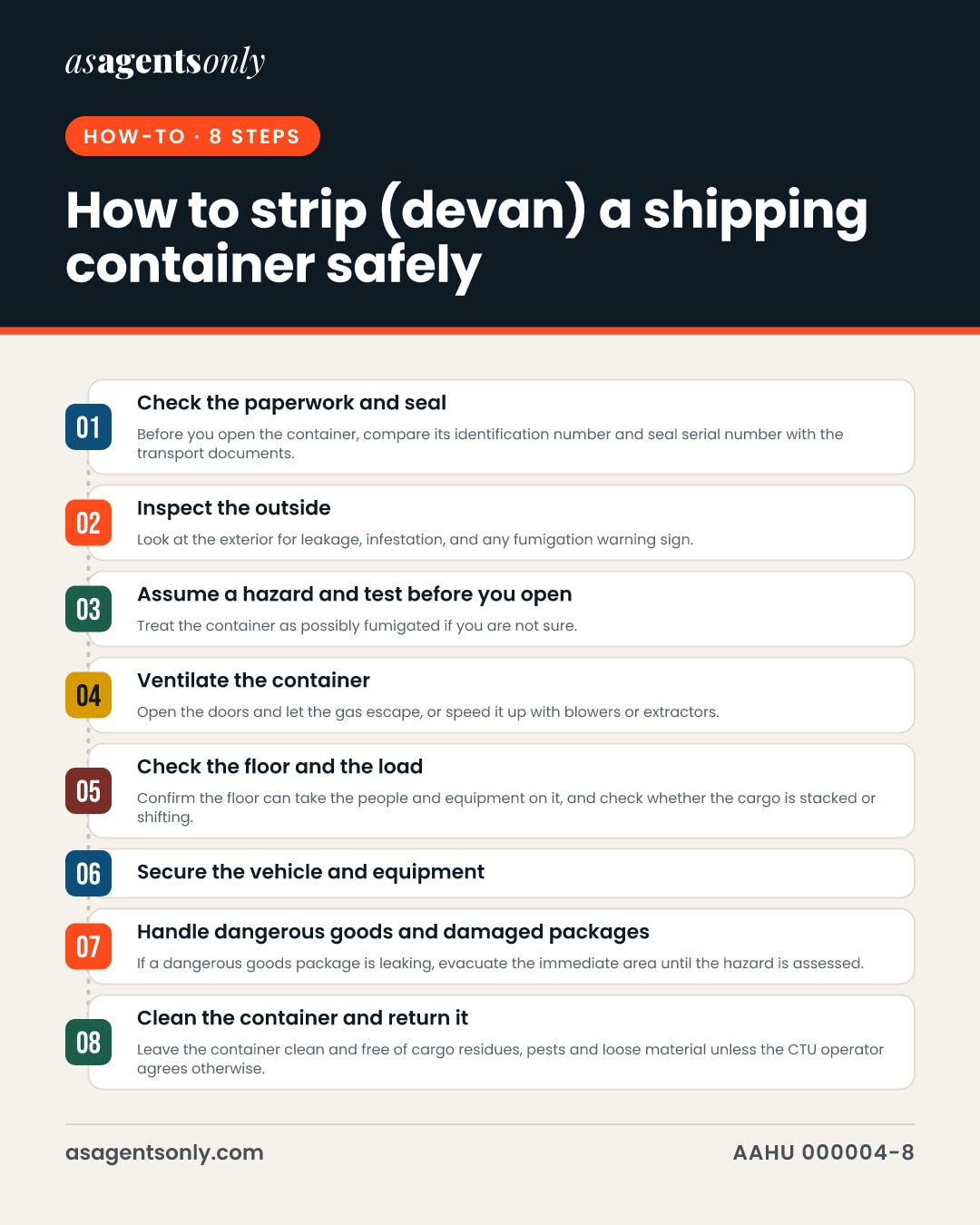
Check the paperwork and seal
Before you open the container, compare its identification number and seal serial number with the transport documents. If the mismatch is real, check with the transport operator before you go on. Cut any seal with proper equipment.
Inspect the outside
Look at the exterior for leakage, infestation, and any fumigation warning sign. Check the door joints and vents, since tape there can signal fumigant. Note any damage and tell the carrier.
Assume a hazard and test before you open
Treat the container as possibly fumigated if you are not sure. Use a gas detector, with the doors still closed, to measure the atmosphere before you open them. Test in several places, not only at the door, because a safe reading at the entrance does not clear the far end.
Ventilate the container
Open the doors and let the gas escape, or speed it up with blowers or extractors. Keep the doors open long enough that the inside air matches the outside. Do not enter until the atmosphere is confirmed safe.
Check the floor and the load
Confirm the floor can take the people and equipment on it, and check whether the cargo is stacked or shifting. Loads that fall or shift can crush workers, so approach the load from a position of safety and remove packages in a controlled order.
Secure the vehicle and equipment
If the container is still on a chassis or semi-trailer, make sure the vehicle cannot tip while a lift truck works inside. Use proper lifting equipment for heavy packages.
Handle dangerous goods and damaged packages
If a dangerous goods package is leaking, evacuate the immediate area until the hazard is assessed. Ask the consignor for the safety data sheet where possible, and choose protective equipment from it.
Clean the container and return it
Leave the container clean and free of cargo residues, pests and loose material unless the CTU operator agrees otherwise. Remove the fumigation warning sign only after the unit is completely ventilated, and confirm no hazard remains after dangerous goods are removed.
Documents you will need
- Transport document showing the container identification number, seal serial number and gross mass
- Any packing certificate or fumigation information, including fumigation date, fumigant type and amount where it is an international shipment
- Container or CTU operator contact details and the carrier's damage notification route
- Safety data sheets for any dangerous goods, if carried
- Calibrated gas detector covering oxygen and the fumigant you expect, with instructions for use
- Personal protective equipment and any respiratory protection required by your risk assessment
- Cargo manifest or packing list to compare against what is found inside
Common mistakes
- Trusting a safe reading at the door: test several locations inside, because the far end of the container can still hold gas.
- Opening the doors before ventilation and measurement: the CTU Code expects measurement that no harmful atmosphere is present before the doors open.
- Assuming an unmarked container is clean: not every fumigated container carries a marking or declaration, so look for tape, residue and smell.
- Assuming ordinary goods are harmless: some goods, such as shoes, textiles and furniture, can emit harmful substances after long voyages.
- Ignoring the load and the chassis: shifting cargo and tipping trailers have caused serious injuries and deaths.
In pictures
The same facts as this page, as images to save or share. Tap one to open it full size.
Official sources
- IMO/ILO/UNECE Code of Practice for Packing of Cargo Transport Units (CTU Code), MSC.1/Circ.1497International Maritime Organization, published 16 December 2014
- IMO/ILO/UNECE Code of Practice for Packing of Cargo Transport Units (CTU Code)International Maritime Organization
- Managing risks of methyl bromide exposure when unpacking shipping containersSafe Work Australia
- Gas monitoring equipmentEuropean Commission, SAMANCTA sampling manual
Claims ledger: 23 facts and where each comes from
- The CTU Code is a non-mandatory global code of practice for handling and packing shipping containers for transport by sea and land.2
- The CTU Code's 2025 revision was finalised by an expert group at its meeting held from 15 to 19 December 2025.3
- The consignee or receiver of a container is responsible for not overstressing the container floor during unpacking.1
- The consignee or receiver is responsible for correctly ventilating the unit before entering and for confirming the atmosphere is not hazardous before anyone enters.1
- Before the doors are opened, the CTU Code says it should be established by measurement that no harmful atmosphere is present in the unit.1
- The CTU Code warns that the atmosphere inside a container may be dangerous and says to ventilate before entering.1
- Goods such as shoes, textile products and furniture can emit harmful substances after long sea voyages, making the internal atmosphere dangerous.1
- The CTU Code says to check the identification number and seal serial number against the transport documentation, and to use proper equipment to cut any seal.4
- Ventilation can be natural or accelerated by blowers or extractors, and the process can take many hours.6
- Before entering a container, personnel should assess whether it is safe and, if appropriate, determine the level of fumigant present, and gas detection equipment may be required.6
- Oxygen meters give a warning if oxygen drops below 19 percent, which is a danger to life, or exceeds 23 percent, which is a fire and explosion hazard.9
- Oxygen meters measure only oxygen, not other gases.9
- A safe reading at the container entrance does not show that the far end of the container is free of methyl bromide.8
- Where mechanical ventilation is not reasonably practicable, natural ventilation for at least 12 hours before entry is one option, or testing the air to confirm methyl bromide is below the exposure standard of 5 ppm.8
- Not every fumigated container is marked as fumigated, and signs such as tape on door joints or vents, powdery residue, or a fishy garlic-like smell can indicate fumigant.6
- In the United States, the FUMIGANT marking must remain on a freight container until it has been completely ventilated.7
- For international shipments, transport documents should show the date of fumigation, the type and amount of fumigant used, and disposal instructions for residual fumigant.7
- OSHA reported that employees were killed or suffered crushing injuries from slabs shifting inside a container during unloading.5
- Care should be taken that a trailer or chassis cannot tip while a lift truck is used inside the unit.4
- If a dangerous goods package is so damaged that its contents leak, the immediate area should be evacuated until the hazard has been assessed.4
- A safety data sheet should be requested from the consignor where possible, to decide the measures and protective equipment needed.4
- The consignee is responsible for detecting any damage to the container and notifying the carrier.4
- Unless otherwise agreed, the consignee is responsible for making sure the container is completely clean, free of cargo residues, noxious materials and visible pests after unpacking.1
Every figure on this page is tied to a cited source, last checked on 13 October 2026. Pages like this are re-checked every three months. Found something out of date? Tell the desk.