- How-To
- Licenses
- 4 min read
- Last verified 24 October 2026
How to get an EORI number
Learn who needs an EORI number, which prefix applies to the UK or the EU, what to prepare, and how to apply for free.

General information, not legal advice. Rules, fees and forms change. Confirm with the agency named in the sources, or a licensed professional, before you file or ship.
- Who needs this
- Businesses and persons that are established in the UK or an EU Member State and that move goods across customs borders. Businesses outside those areas may also need one, but usually must first meet the rules of the country where they will import or export.
- Cost
- No government fee. HMRC's online application is free, and the European Commission says EU numbers are assigned free of charge by the competent customs authorities.
- Time
- In the UK, a GB number is issued immediately unless HMRC must run checks, which can take up to 5 working days. In the EU, timing depends on the national customs authority, so ask the authority of the Member State where you are established.
- Applies to
- EU, UK
An EORI (Economic Operators Registration and Identification) number is the identifier that customs authorities use for businesses and other persons who move goods. This guide covers the United Kingdom and the European Union. Get one before you lodge a customs declaration or appoint someone to handle customs for you, because late applications can delay goods.
Step by step
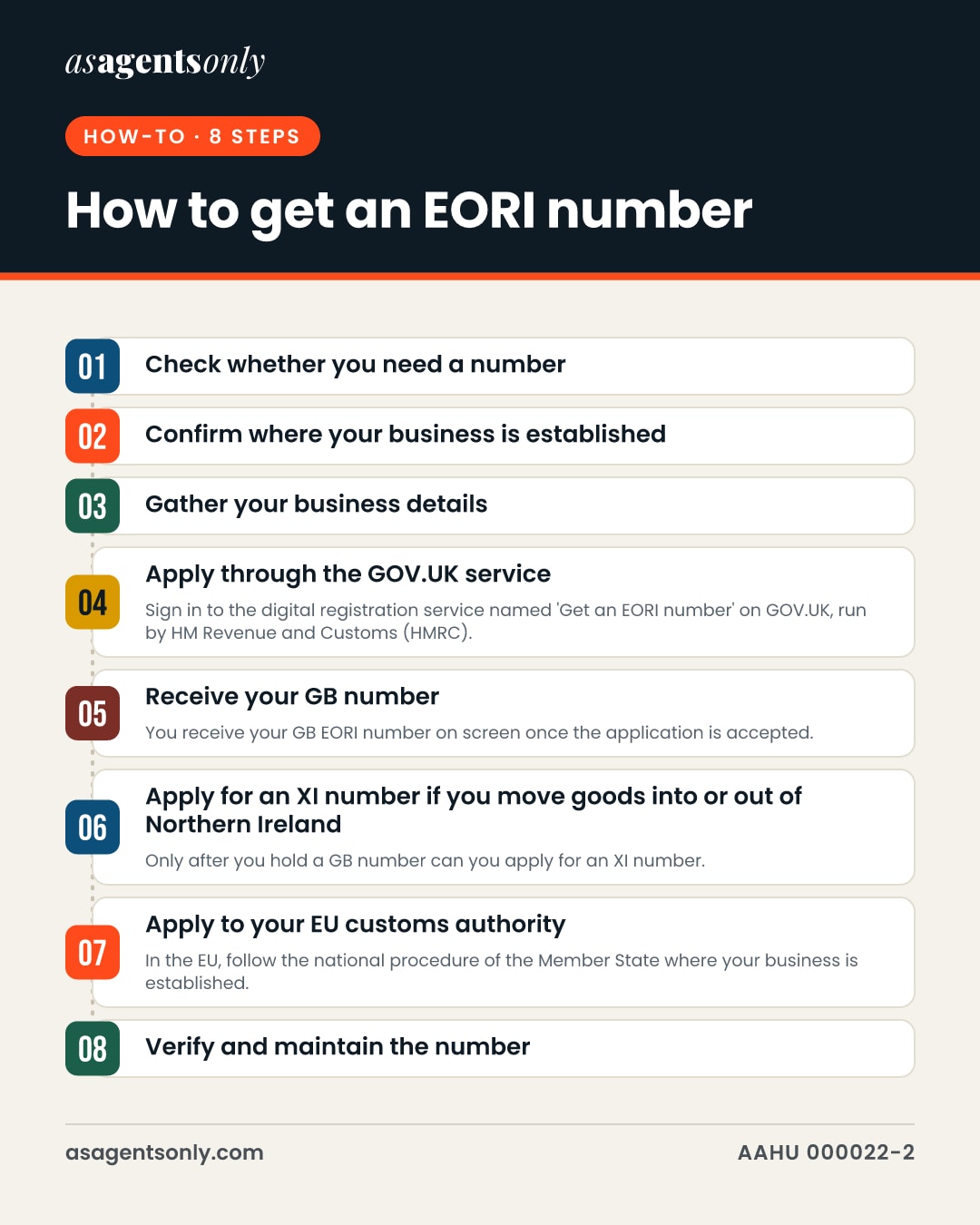
Check whether you need a number
Decide which country you are moving goods to or from, and whether the movement requires customs declarations or a customs decision. Use the GOV.UK 'Get an EORI number' guidance for the UK, or the customs authority of your EU Member State for the EU. You may need more than one number.
Confirm where your business is established
For a UK number, your business usually needs premises in the country you move goods to or from, such as a registered office, a central headquarters, or a permanent business establishment. If you have no qualifying premises, appoint a customs agent who will obtain the number for you. In the EU, apply to the customs authority of the Member State where you are established.
Gather your business details
For a GB number, prepare your Unique Taxpayer Reference, your business start date and Standard Industrial Classification code, your VAT number and its effective date, and your National Insurance number if you are a sole trader or individual. Businesses not based in the UK do not need the UTR, SIC code or National Insurance number.
Apply through the GOV.UK service
Sign in to the digital registration service named 'Get an EORI number' on GOV.UK, run by HM Revenue and Customs (HMRC). Create sign-in details first if you do not have them. Complete the form, which HMRC describes as taking about 10 minutes.
Receive your GB number
You receive your GB EORI number on screen once the application is accepted. If HMRC runs extra checks, you are told within 5 working days. Keep the number and check it with the GB EORI checker when needed.
Apply for an XI number if you move goods into or out of Northern Ireland
Only after you hold a GB number can you apply for an XI number. Fill in the XI EORI registration form on GOV.UK, and supply any XI VAT number, any EU VAT numbers, and proof of a permanent business establishment in Northern Ireland where HMRC asks for it. HMRC says the XI number arrives within 5 days.
Apply to your EU customs authority
In the EU, follow the national procedure of the Member State where your business is established. Each authority publishes its own application form and list of supporting documents, and you present them to that authority. The number you receive works across the EU and follows the EU format of a two-letter country code plus an identifier.
Verify and maintain the number
Check that a UK number is valid with the GB EORI checker on GOV.UK, or use the Commission's EORI validation tool for EU numbers. Report changes through your VAT online account, or with the change of circumstance form if you are not VAT registered. Cancelling your VAT registration also cancels the linked EORI.
Documents you will need
- Unique Taxpayer Reference (UTR) for a UK application, or a note that your business is not based in the UK
- Business start date and Standard Industrial Classification (SIC) code, from the Companies House register
- VAT number and its effective date of registration, if you are VAT registered
- National Insurance number, if you are an individual or sole trader
- GOV.UK sign-in details for the digital registration service
- For an XI number: your XI VAT number if you have one, any EU VAT numbers, and two documents proving a permanent business establishment in Northern Ireland, such as a bank statement and a utility bill
- For an EU application: the form and supporting documents required by the customs authority of your Member State
Common mistakes
- Applying in the wrong country: an EU business must apply in the Member State where it is established, and a UK business must register with HMRC for the place it is established, so check before you apply.
- Requesting an XI number first: you must have a GB number before an XI number can be requested, so apply in that order.
- Holding two numbers for the same business: each person may hold only one valid EORI at a time, so do not request a second number to replace one you have.
- Cancelling VAT and losing the EORI: deregistering from VAT cancels the EORI automatically, and you must then apply again for a number that is not tied to a VAT number.
- Applying at the last minute: without a number, goods can face customs delays, increased costs and storage, so apply before your first declaration.
In pictures
The same facts as this page, as images to save or share. Tap one to open it full size.
Official sources
- Get an EORI number: Who needs an EORIGOV.UK (HM Revenue and Customs)
- Get an EORI number: Apply for an EORI numberGOV.UK (HM Revenue and Customs)
- Economic Operators Registration and Identification (EORI) - Registration processGOV.UK (HM Revenue and Customs)
- Economic Operators Registration and Identification (EORI) - Place of registrationGOV.UK (HM Revenue and Customs)
- Economic Operators Registration and Identification number (EORI)European Commission, Taxation and Customs Union
- EORI Guidance documentEuropean Commission, Taxation and Customs Union
- EORI MythbusterGOV.UK (HM Revenue and Customs)
- Economic Operators Registration and Identification (EORI) - Finding and checking an EORIGOV.UK (HM Revenue and Customs)
Claims ledger: 28 facts and where each comes from
- EU customs clearance for imports, exports and transit requires an EORI number.5
- A person may hold only one valid EORI number at any point in time.5
- An EU EORI number combines a two-letter code for the issuing country with an identifier of up to 15 alphanumeric characters.5
- Registering for customs in one Member State produces a number that is valid throughout the European Union.6
- A business that is established in one Member State must ask that state for its number, even if its first operation takes place in another Member State.6
- Customs authorities of the Member States assign the EORI number free of charge.6
- Applicants follow the national provisions of the Member State that issues the number.6
- Businesses without a number should start registration before they lodge a summary or customs declaration.6
- A UK business is usually established where it has premises, such as a registered office, a central headquarters, or a permanent business establishment.1
- A business without qualifying premises in the country must appoint someone else to deal with customs, and that person obtains the EORI number.1
- An EORI number is needed to make customs declarations, to use customs systems such as the Customs Declaration Service, and to apply for a customs decision.1
- Businesses based in the Channel Islands generally do not need an EORI for UK movements, but they need one if they use HMRC customs systems such as CDS.4
- Moving goods to or from Great Britain requires an EORI number starting with GB, and a number without that prefix means a GB number must be applied for.1
- Moving goods to or from Northern Ireland may require an EORI number starting with XI.1
- An XI number is not required if the business already holds an EU EORI number, moves goods only on the island of Ireland, or is established in an EU country but not in Northern Ireland.1
- A business based in Northern Ireland registers for an XI EORI with HMRC, and the XI number can also be used throughout the EU.4
- To get an XI number, a business must first register for a GB EORI number.4
- A GB application asks for the Unique Taxpayer Reference, business start date, SIC code, VAT number with effective date if VAT registered, and National Insurance number for individuals and sole traders.2
- Businesses not based in the UK do not need a UTR, SIC code or National Insurance number to apply.2
- Applicants must sign in to apply, and new users can create sign-in details.2
- The digital registration service takes 10 minutes to complete.3
- A GB EORI number is issued immediately unless HMRC needs to run checks, and then it is issued within 5 working days.3
- The XI application requires an XI registration form, an XI VAT number if held, any VAT numbers issued by an EU country, and 2 documents proving a permanent business establishment in Northern Ireland, and the XI EORI is issued within 5 days.2
- The GB EORI checker confirms whether a GB EORI number is valid.8
- Deregistering from VAT cancels the linked EORI number at the same time, and a new application is needed for a number that is not tied to a VAT number.3
- Without the correct EORI number, goods may face customs delays, increased costs, and storage until a number is issued.1
- The UK online application takes five to ten minutes to complete and is totally free.7
- The UK number is issued straight away, or within five working days if HMRC needs more checks.7
Every figure on this page is tied to a cited source, last checked on 24 October 2026. Pages like this are re-checked every three months. Found something out of date? Tell the desk.