- How-To
- Warehousing
- 4 min read
- Last verified 21 October 2026
How to consolidate LCL cargo into a full container
Learn how to plan, load, secure and document less-than-container-load cargo packed into one full container, including the US filing that applies to US-bound cargo.

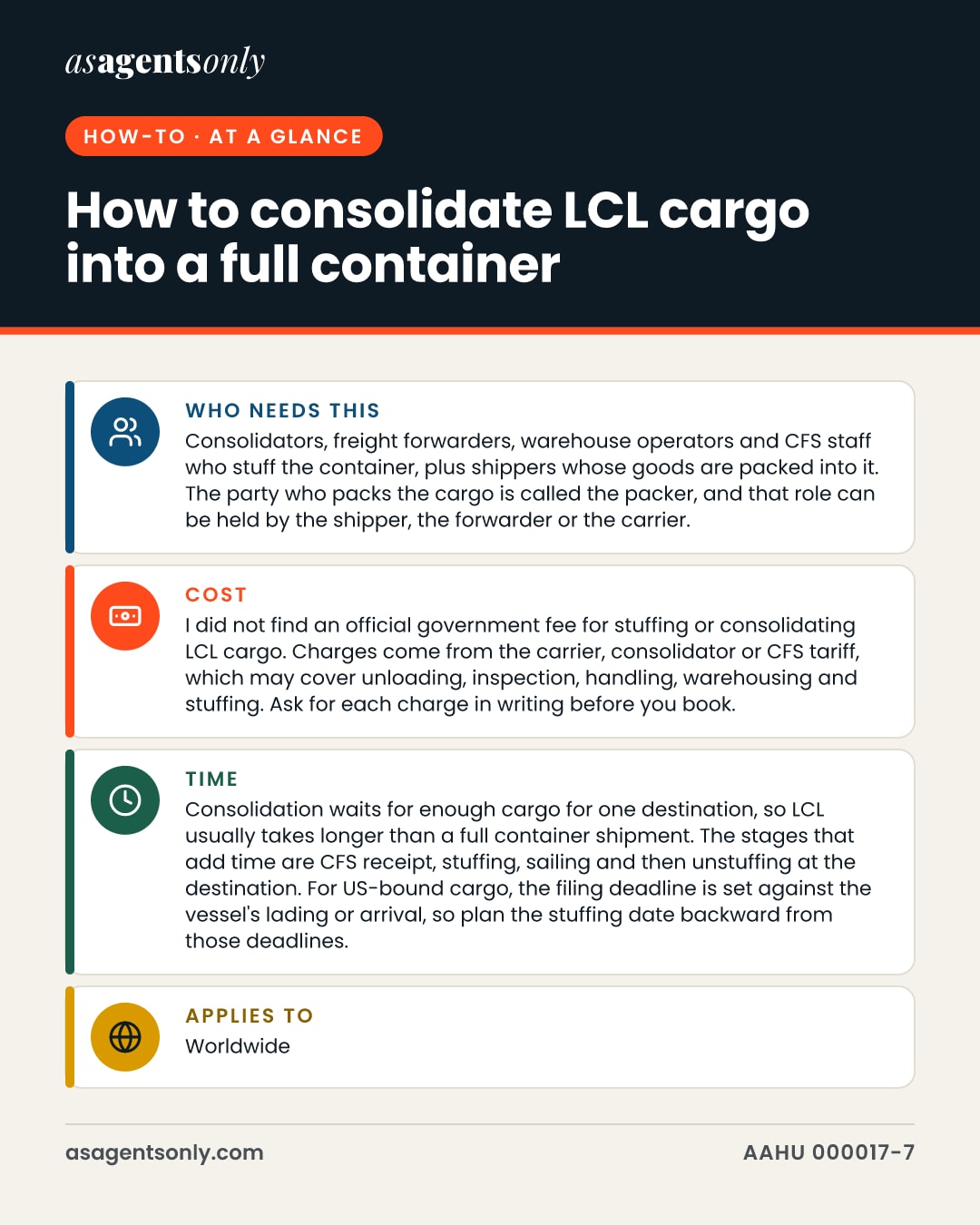
- Who needs this
- Consolidators, freight forwarders, warehouse operators and CFS staff who stuff the container, plus shippers whose goods are packed into it. The party who packs the cargo is called the packer, and that role can be held by the shipper, the forwarder or the carrier.
- Cost
- I did not find an official government fee for stuffing or consolidating LCL cargo. Charges come from the carrier, consolidator or CFS tariff, which may cover unloading, inspection, handling, warehousing and stuffing. Ask for each charge in writing before you book.
- Time
- Consolidation waits for enough cargo for one destination, so LCL usually takes longer than a full container shipment. The stages that add time are CFS receipt, stuffing, sailing and then unstuffing at the destination. For US-bound cargo, the filing deadline is set against the vessel's lading or arrival, so plan the stuffing date backward from those deadlines.
- Applies to
- Worldwide
Less-than-container-load (LCL) cargo is shipments from several shippers that share one container. Consolidation means packing those shipments into a single container at a container freight station (CFS) or warehouse. You need this guide when you pack or receive LCL goods for a full container, or when you manage a CFS or warehouse that does the stuffing. The packing rules come from the IMO/ILO/UNECE CTU Code, and the filing rules depend on the country the container is going to.
Step by step
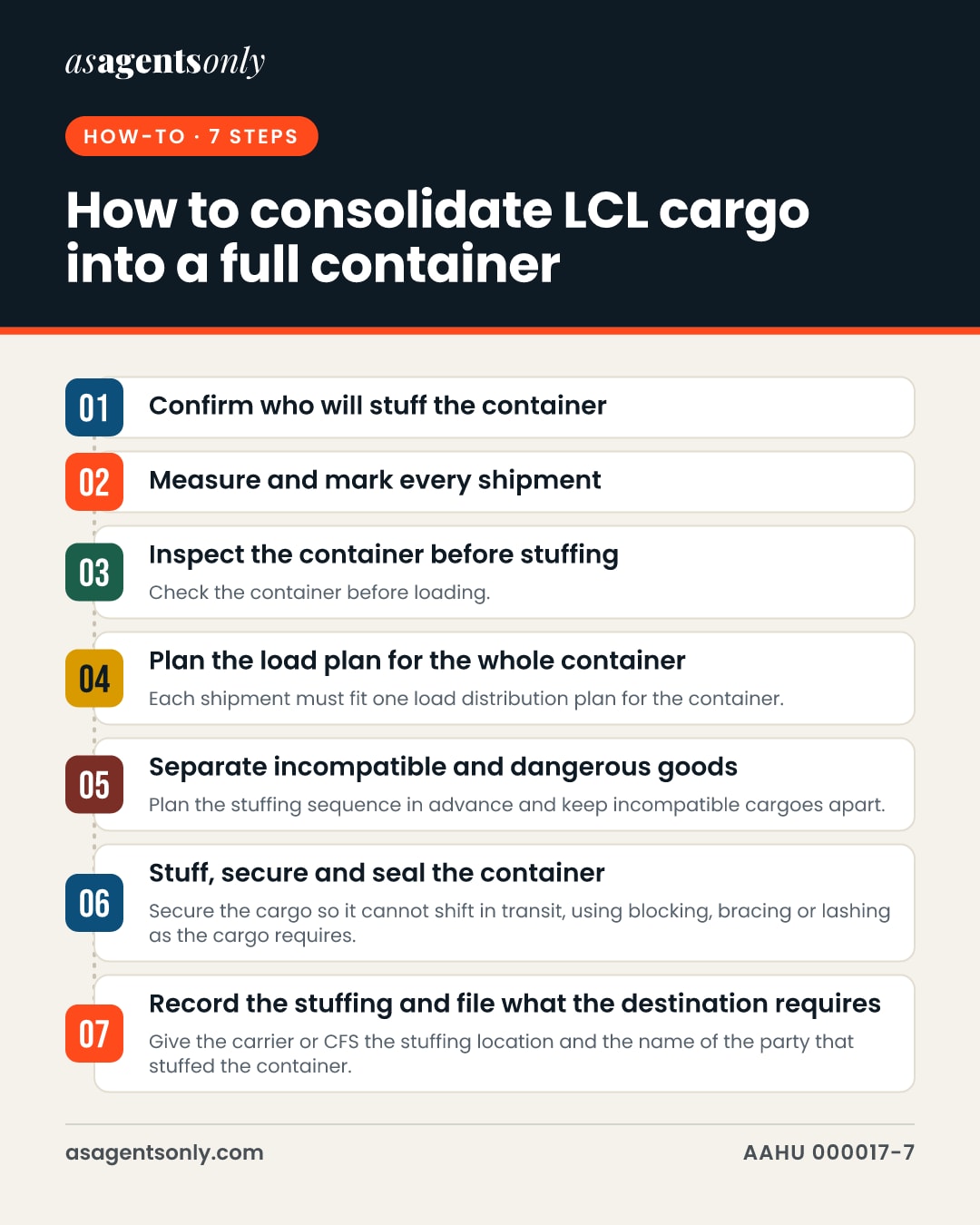
Confirm who will stuff the container
Check whether the shipping line or a freight consolidator will run the LCL service at your load port, since this depends on the country and on which ports the line serves. Ask the operator in writing who acts as the packer and who is named as consolidator. The operator will tag each shipment to its destination and then consolidate once it has enough cargo for that destination.
Measure and mark every shipment
Send the dimensions and weights of each shipment including its pallet, not just the box size, because pallets take up container space that you will be charged for. Mark packages according to their handling symbols and markings, and pack them according to those markings. Poorly packed or unpalletized cargo may attract extra charges under some carrier tariffs.
Inspect the container before stuffing
Check the container before loading. The CTU Code says the packer must make sure the unit is checked and suitable for the cargo, and that the floor will not be overstressed. A C-TPAT security criteria document recommends a seven-point inspection before stuffing, covering the walls, floor, ceiling and door locks.
Plan the load plan for the whole container
Each shipment must fit one load distribution plan for the container. Do not exceed the payload limits of the unit or the allowed gross mass under national road and rail rules. Place heavy items low and distribute weight over the floor, and keep the centre of gravity correctly located in the unit.
Separate incompatible and dangerous goods
Plan the stuffing sequence in advance and keep incompatible cargoes apart. Dangerous goods must be correctly classified, packed and labelled, and their transport document must be completed and passed to the carrier. Check the applicable dangerous goods regulations for segregation distances before you put goods of different classes in the same unit.
Stuff, secure and seal the container
Secure the cargo so it cannot shift in transit, using blocking, bracing or lashing as the cargo requires. Follow written sealing procedures at the point of stuffing and affix a seal that meets the required standard. Only designated employees should hand out seals. Record the seal number on the container paperwork.
Record the stuffing and file what the destination requires
Give the carrier or CFS the stuffing location and the name of the party that stuffed the container. For cargo bound for the United States by vessel, the Importer Security Filing must include the container stuffing location and consolidator, filed as early as possible and no later than 24 hours before the vessel arrives. If more than one consolidator is involved, list each one.
Documents you will need
- Commercial invoice and packing list for each LCL shipment, showing package count, weight and dimensions including pallets
- Dimensions and gross weight of each shipment and each pallet
- Handling instructions and package markings for each shipment
- Booking reference and the bill of lading number at the lowest level, since the US filing must be made at that level
- Name and address of the physical stuffing location and of the party that stuffed or arranged the stuffing
- Container number, size, seal numbers and the seal record
- Dangerous goods transport document, where any shipment is dangerous goods
- Load distribution plan showing weight by position in the container
- Destination country customs data requirements, such as the US Importer Security Filing data elements for US-bound cargo
Common mistakes
- Giving the carrier only box dimensions and leaving out pallets, which causes charges and space problems at stuffing. Ask for dimensions that include the pallet.
- Loading without a container inspection or sealing procedure, which leaves the container open to unauthorized entry. Inspect, then seal, and record each seal number.
- Filing the US Importer Security Filing late or without the stuffing location and consolidator. Name each party and file no later than 24 hours before arrival.
- Overloading or ignoring the payload limit, which the CTU Code warns can cause injury and damage. Weigh the container and check the limit before it leaves the warehouse.
- Treating the CTU Code as binding law. It is a non-mandatory code, so check the national rules that apply to your shipment, and check whether the 2025 revision has been adopted before you cite it.
In pictures
The same facts as this page, as images to save or share. Tap one to open it full size.
Official sources
- IMO/ILO/UNECE Code of Practice for Packing of Cargo Transport Units (CTU Code)International Maritime Organization
- Code of Practice for Packing of Cargo Transport Units (2014 edition)ILO, IMO and UNECE
- IMO/ILO/UNECE Code of Practice for Packing of Cargo Transport Units (CTU Code) 2025 revisionUNECE Working Party on Intermodal Transport and Logistics
- Importer Security Filing 10+2 Frequently Asked QuestionsU.S. Customs and Border Protection
- 19 CFR 149.2 Importer security filing requirement, time of transmissioneCFR (U.S. Government)
- 19 CFR 149.3 Data elementseCFR (U.S. Government)
- C-TPAT Security Guidelines for Air Freight Consolidators, OceanU.S. Customs and Border Protection
- Security Profile (C-TPAT importer)U.S. Customs and Border Protection
- Rule 23, Full Container Load ConsolidationTropical Shipping tariff
Claims ledger: 30 facts and where each comes from
- The CTU Code is a non-mandatory global code of practice for the handling and packing of shipping containers for transportation by sea and land.1
- The CTU Code provides guidance to those who receive and unpack cargo units as well as to those who pack and secure cargo.2
- The CTU Code could be used as a reference base for national regulations.2
- The packer is responsible for ensuring the CTU is checked before packing and that its condition is suitable for the cargo to be transported.4
- Packers must ensure the floor of the CTU is not overstressed during packing operations.4
- Packers should not exceed the permitted payload limits of the unit or the maximum allowed gross mass under national road and rail regulations.4
- Heavy cargo should be distributed appropriately over the floor area, and loading should keep the centre of gravity correctly located in the CTU.4
- Packages should be handled and packed in accordance with their markings.4
- Packers should ensure the packing process is planned in advance as far as practical, and that incompatible cargoes are segregated.4
- Ensuring that dangerous goods are correctly classified, packed and labelled, and that the dangerous goods transport document is completed, signed and transmitted to the packer, forwarder and carrier as applicable.4
- Consolidated loads can be a major contributor to poor stowage within containers, and each cargo needs to be integrated into the final load distribution plan for the container.3
- Many incidents in transport are attributed to poor packing practices, including inadequate securing of the cargo, overloading, and incorrect declaration of contents.3
- LCL shipments need to be loaded onto containers along with other shipments, or consolidated, at a Container Freight Station, which is sometimes called container stuffing.12
- At arrival in the destination country, LCL shipments need to stop at a CFS for deconsolidation, or unstuffing.12
- LCL tends to take slightly longer than FCL due to consolidation and deconsolidation.12
- Pallets take up container space, which you will be charged for, so dimensions including pallets should be requested.12
- In an LCL shipment, multiple LCL cargoes belonging to multiple shippers and consignees are packed into a single container for shipment.13
- Clients deliver their LCL cargo to the packing station, which is the CFS, and the LCL operator tags the cargo to the destinations it is meant for.13
- When a consolidator accepts LCL cargo, it accepts responsibility from the CFS at the load port to the CFS at the discharge port.13
- When Carrier provides consolidation services for LCL cargo, the consolidation charges cover unloading, count, inspection for damages, handling charges, receiving, warehousing and stuffing unless otherwise specified in the tariff.14
- Container stuffing location and consolidator (stuffer) must be provided as early as possible, and in no event later than 24 hours prior to arrival in a United States port, or upon lading at a foreign port less than a 24-hour voyage from the closest United States port.7
- The container stuffing location means the name and address of the physical location where the goods were stuffed into the container.8
- The consolidator (stuffer) means the name and address of the party who stuffed the container or arranged for the stuffing of the container.8
- When multiple consolidators are involved, such as in co-load situations, multiple consolidators need to be provided as part of the Importer Security Filing.6
- The Importer Security Filing needs to be submitted at the lowest bill of lading level, which is the house bill or the regular bill, that is transmitted into the Automated Manifest System.6
- A seven-point inspection process is recommended for all containers prior to stuffing, covering the front wall, left side, right side, ceiling or roof, and inside and outside doors.9
- Written procedures must stipulate how seals are to be controlled and affixed to loaded containers, and only designated employees should distribute container seals for integrity purposes.9
- A high security seal must be affixed to all loaded containers bound for the U.S., and seals must meet or exceed the PAS ISO 17712 standard.10
- The 2025 revision of the CTU Code has been submitted to the UNECE Working Party for consideration and possible adoption, and was not yet adopted in the document.5
- The 2025 proposed revision is a draft consolidated text, and the earlier 2014 text is the version that has been published as the CTU Code.11
Every figure on this page is tied to a cited source, last checked on 21 October 2026. Pages like this are re-checked every three months. Found something out of date? Tell the desk.