- How-To
- Warehousing
- 5 min read
- Last verified 2 November 2026
How to meet OSHA forklift operator training rules
Learn what OSHA requires for forklift operator training under 29 CFR 1910.178(l), from training content and evaluations to certification records.

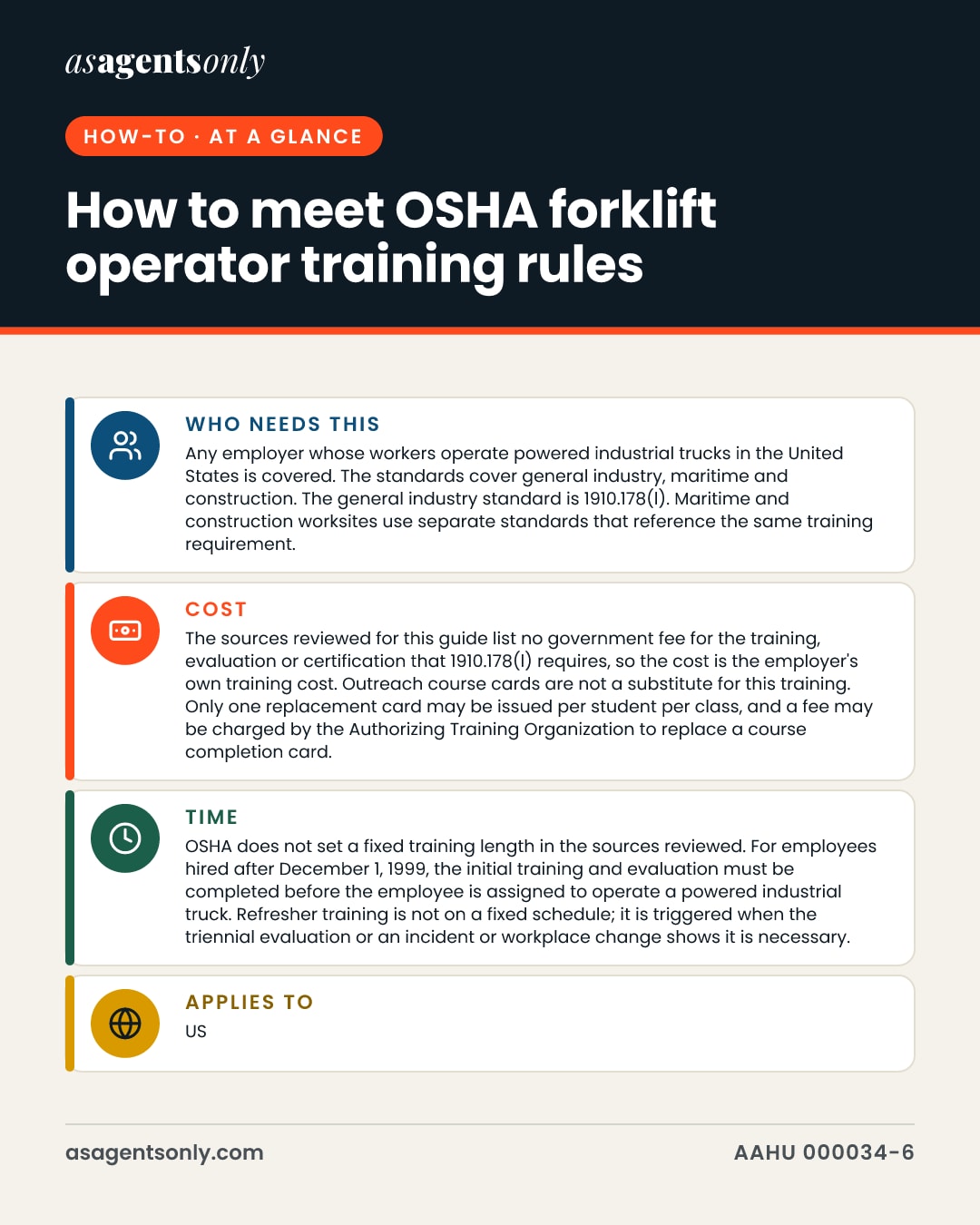
- Who needs this
- Any employer whose workers operate powered industrial trucks in the United States is covered. The standards cover general industry, maritime and construction. The general industry standard is 1910.178(l). Maritime and construction worksites use separate standards that reference the same training requirement.
- Cost
- The sources reviewed for this guide list no government fee for the training, evaluation or certification that 1910.178(l) requires, so the cost is the employer's own training cost. Outreach course cards are not a substitute for this training. Only one replacement card may be issued per student per class, and a fee may be charged by the Authorizing Training Organization to replace a course completion card.
- Time
- OSHA does not set a fixed training length in the sources reviewed. For employees hired after December 1, 1999, the initial training and evaluation must be completed before the employee is assigned to operate a powered industrial truck. Refresher training is not on a fixed schedule; it is triggered when the triennial evaluation or an incident or workplace change shows it is necessary.
- Applies to
- US
This guide covers the United States rule that governs powered industrial truck operators, including forklifts. The employer is responsible for implementing a training program and ensuring that only trained drivers who have successfully completed the training program are allowed to operate powered industrial trucks. Use this page when you hire or reassign someone to drive a forklift, or when you run or buy a training program.
Step by step
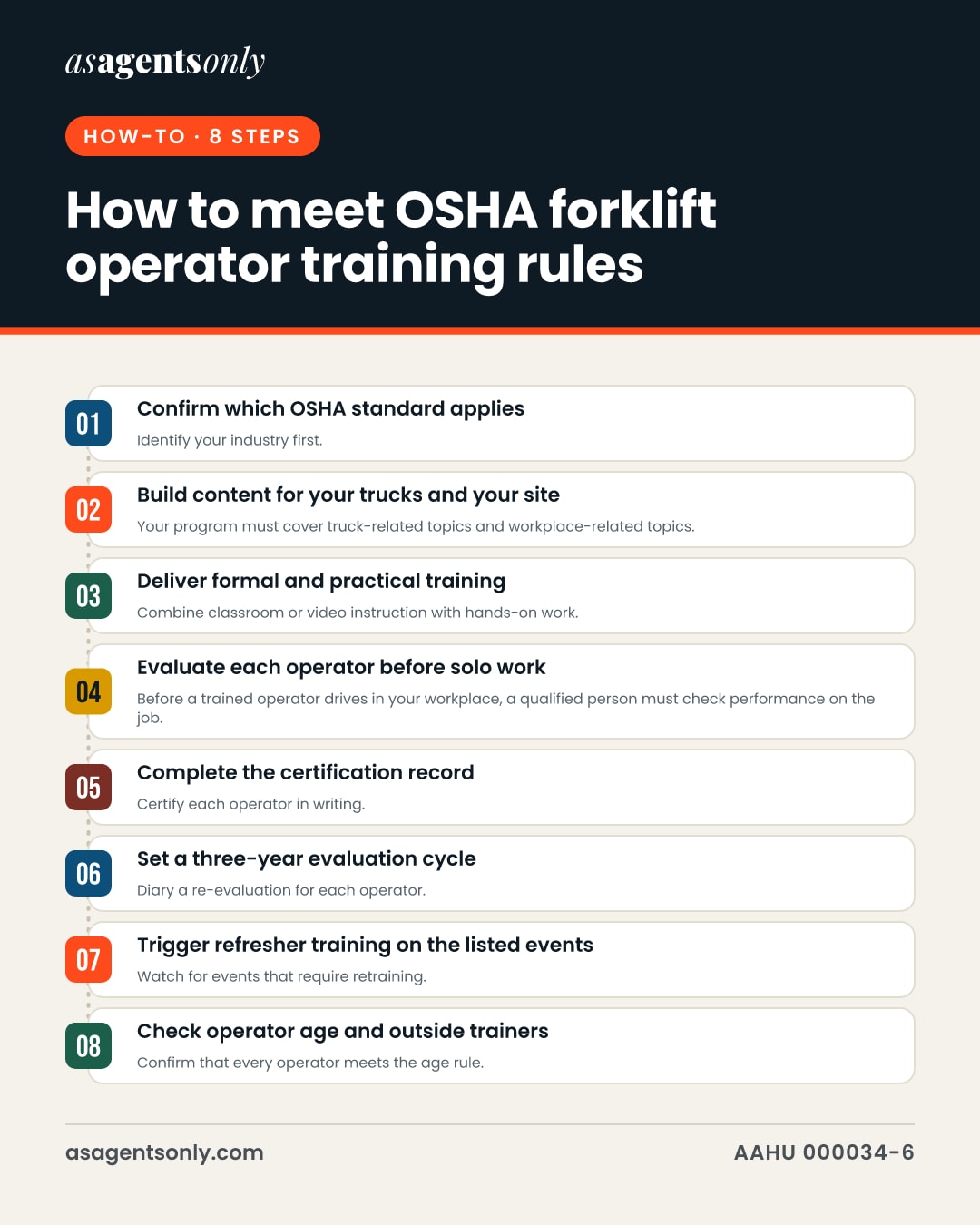
Confirm which OSHA standard applies
Identify your industry first. For most warehouses and plants, the governing text is 29 CFR 1910.178(l) in the eCFR, which is the operator training paragraph of the Powered Industrial Trucks standard. Maritime and construction worksites use separate standards that reference the same training requirement, so check your sector before you write your program.
Build content for your trucks and your site
Your program must cover truck-related topics and workplace-related topics. Truck-related topics include vehicle stability, any vehicle inspection and maintenance the operator will perform, refueling and/or charging and recharging of batteries, operating limitations, and other operating instructions, warnings or precautions in the operator's manual. Workplace topics include surface conditions where the vehicle will be operated. Drop a topic only if you can show it does not apply to safe operation in your workplace.
Deliver formal and practical training
Combine classroom or video instruction with hands-on work. The training must be a combination of formal (lecture, video, etc.) and practical (demonstration and practical exercises), and include an evaluation of operator performance in the workplace. Trainees who are not yet evaluated may run a truck only under direct supervision, and direct supervision means the qualified individual who is observing and evaluating operators is physically located at the location where any practical training and evaluation takes place.
Evaluate each operator before solo work
Before a trained operator drives in your workplace, a qualified person must check performance on the job. Prior to operating the truck in the workplace, the employer must evaluate the operator's performance and determine the operator to be competent to operate a powered industrial truck safely. The trainer needs the knowledge, training and experience to do this, as all operator training and evaluation shall be conducted by persons who have the knowledge, training, and experience to train powered industrial truck operators and evaluate their competence.
Complete the certification record
Certify each operator in writing. The certification shall include the name of the operator, the date of the training, the date of the evaluation, and the identity of the person(s) performing the training or evaluation. OSHA's compliance directive adds that the certification records must identify the types of equipment on which the operator has been trained and evaluated.
Set a three-year evaluation cycle
Diary a re-evaluation for each operator. An evaluation of each trained operator must be conducted during the initial training, at least once every three years, and after refresher training. The triennial evaluation is more than a formality, so record it on the same certification basis as the initial one.
Trigger refresher training on the listed events
Watch for events that require retraining. Refresher training is required when the operator has been observed driving unsafely, been involved in an accident or near-miss, received an evaluation that indicates unsafe operation, is assigned to drive a different type truck, or if a workplace condition affecting safe operation changes. After refresher training, an evaluation of the effectiveness of that refresher training must be performed.
Check operator age and outside trainers
Confirm that every operator meets the age rule. Youth employment regulations (29 CFR 570) promulgated under the Fair Labor Standards Act prohibit most employees under the age of 18 years from operating forklifts for non-agricultural operations. If a union, association or other outside organization delivers the training, that is permitted, but citations for failure to train will always be issued to the employer.
Documents you will need
- The make, model and type of each powered industrial truck your operators will use, including attachments
- A written training program covering the truck-related and workplace-related topics for each truck type
- Hazard and surface information for each area where trucks run, such as ramps, floor conditions and loading zones
- The operator manufacturer's manual sections on instructions, warnings and precautions, including seat belt use
- Names and qualifications of the trainers and evaluators
- Each operator's name, training date, evaluation date and trainer or evaluator identity
- Date of the next three-year evaluation for each operator
- Records of refresher training after incidents, near-misses or assignment changes
- Proof of each operator's date of birth or age verification
Common mistakes
- Treating an outreach course card as proof of OSHA training. The OSHA FAQ says an OSHA card is not considered a certification or license and is not required by OSHA. Use it only as background, and still run your own operator training and evaluation.
- Certifying an operator on one truck type and assuming the training carries over to all forklifts. OSHA's interpretation says that an operator must be trained and evaluated in the safe operation for the type of truck that the operator will be assigned to operate in the employer's workplace.
- Skipping the seat belt topic. OSHA's compliance guidance notes that employers not providing training in the operating instructions, warnings, or precautions listed in the manufacturer's operator's manual related to seat belt use may be cited under 1910.178(l)(3)(i)(M).
- Relying on prior experience without an evaluation. Prior training counts only if the operator has been evaluated and found competent to operate the truck safely.
- Letting a trainee run a truck alone. Trainees may operate only under direct supervision, and the supervisor must be physically present at the training and evaluation location, so plan staffing before the first practical session.
In pictures
The same facts as this page, as images to save or share. Tap one to open it full size.
Official sources
- 29 CFR 1910.178 Powered industrial trucksU.S. Government Publishing Office, eCFR
- 1910.178 - Powered industrial trucksOccupational Safety and Health Administration (OSHA)
- eTool: Powered Industrial Trucks (Forklift) - Training AssistanceOccupational Safety and Health Administration (OSHA)
- Powered Industrial Truck Operator Training for General IndustryOccupational Safety and Health Administration (OSHA)
- Compliance Assistance for the Powered Industrial Truck Operator Training Standards (CPL 02-01-028)Occupational Safety and Health Administration (OSHA)
- Powered Industrial Trucks - Forklifts OverviewOccupational Safety and Health Administration (OSHA)
- Frequently Asked Questions (FAQs)Occupational Safety and Health Administration (OSHA)
- Powered industrial truck training: different types of trucks (standard interpretation)Occupational Safety and Health Administration (OSHA)
- Requirements of Powered Industrial Truck Training Program Implementation (standard interpretation)Occupational Safety and Health Administration (OSHA)
- Outreach Training ProgramOccupational Safety and Health Administration (OSHA)
Claims ledger: 21 facts and where each comes from
- The employer shall ensure that each powered industrial truck operator is competent to operate a powered industrial truck safely, as demonstrated by the successful completion of the training and evaluation specified in this paragraph (l).1
- Before a powered industrial truck operator is permitted to operate (except for training purposes), the operator must have successfully completed the required training.1
- Powered industrial truck operators shall receive initial training in topics such as vehicle stability, vehicle inspection and maintenance, refueling and battery charging, operating limitations, surface conditions, and the requirements of the section.1
- Training must be a combination of formal instruction, practical training, and evaluation of the operator's performance in the workplace.4
- The employer is responsible for implementing a training program and ensuring that only trained drivers who have successfully completed the program are allowed to operate powered industrial trucks.4
- An evaluation of each trained operator must be conducted during the initial training, at least once every three years, and after refresher training.4
- Refresher training is required when the operator has been observed driving unsafely, been involved in an accident or near-miss, received an evaluation that indicates unsafe operation, is assigned to drive a different type truck, or if a workplace condition affecting safe operation changes.4
- Prior to operating the truck in the workplace, the employer must evaluate the operator's performance and determine the operator to be competent to operate a powered industrial truck safely.3
- The certification must include the name of the operator, the date of the training, the date of the evaluation, and the identity of the person(s) performing the training or evaluation.1
- The certification records must identify the types of equipment on which the operator has been trained and evaluated.5
- Trainees may operate a powered industrial truck only under the direct supervision of persons who have the knowledge, training, and experience to train operators and evaluate their competence, and where such operation does not endanger the trainee or other employees.1
- Direct supervision means the qualified individual who is observing and evaluating operators is physically located at the location where any practical training and evaluation takes place.9
- Citations for failure to train will always be issued to the employer, even when a third party provides the training.5
- For employees hired after December 1, 1999, the initial training and evaluation must be completed before the employee is assigned to operate a powered industrial truck.2
- Youth employment regulations (29 CFR 570) under the Fair Labor Standards Act prohibit most employees under the age of 18 from operating forklifts for non-agricultural operations.6
- An OSHA card is not considered a certification or license and is not required by OSHA.7
- An operator must be trained and evaluated in the safe operation for the type of truck that the operator will be assigned to operate in the employer's workplace.8
- Employers not providing training in the operating instructions, warnings, or precautions listed in the manufacturer's operator's manual related to seat belt use may be cited under 1910.178(l)(3)(i)(M).5
- Prior training is not required again if the operator has been evaluated and found competent to operate the truck safely.1
- Refresher training and an evaluation of its effectiveness must be conducted to ensure the operator has the knowledge and skills needed to operate the truck safely.2
- A replacement Outreach course card may carry a fee set by the Authorizing Training Organization.10
Every figure on this page is tied to a cited source, last checked on 2 November 2026. Pages like this are re-checked every three months. Found something out of date? Tell the desk.