- Explainer
- Warehousing
- 3 min read
- Last verified 28 October 2026
Pallet types and sizes: GMA, EUR and ISO pallets
Learn the plan sizes of GMA, EUR and ISO pallets, what each standard covers, and how to check which size a shipment needs.

In short
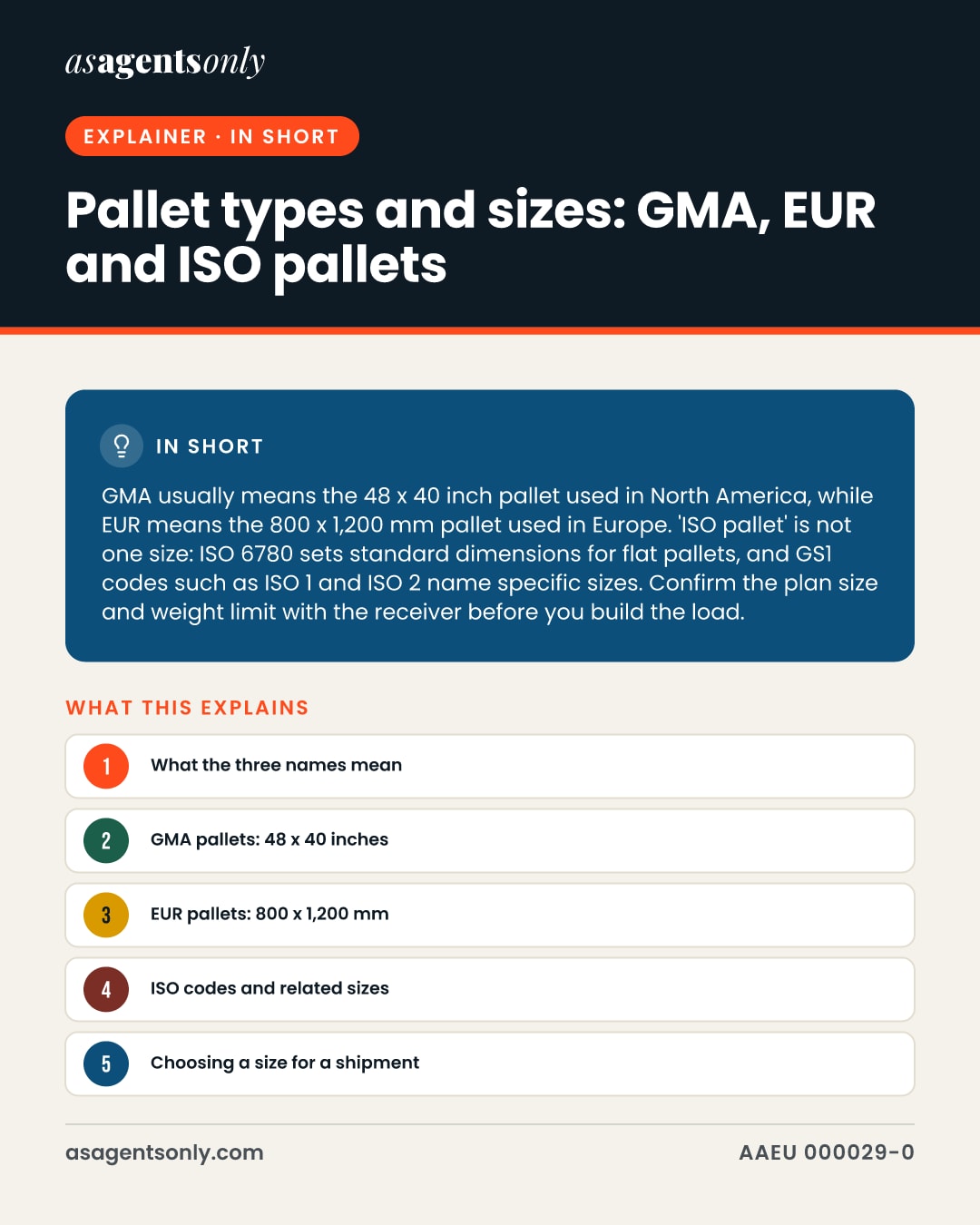
GMA usually means the 48 x 40 inch pallet used in North America, while EUR means the 800 x 1,200 mm pallet used in Europe. 'ISO pallet' is not one size: ISO 6780 sets standard dimensions for flat pallets, and GS1 codes such as ISO 1 and ISO 2 name specific sizes. Confirm the plan size and weight limit with the receiver before you build the load.
A pallet sets the footprint for stacking, storage and transport, so a size mismatch can cost time at the dock. Three names come up most often in trade: GMA, EUR and ISO. They overlap in some sizes but are not interchangeable, because each traces to a different body, region or code list.
What the three names mean
GMA is the size family most associated with North American grocery and retail. The EUR pallet is the standard European wooden pallet, also called the Euro-pallet or EPAL pallet. ISO refers to an international standards body, so 'ISO pallet' can mean a standard document or a size code, not one fixed size.
The main ISO document for flat pallets is ISO 6780:2003, which covers principal dimensions and tolerances for flat pallets used in intercontinental materials handling. Its 1988 predecessor has been withdrawn. When someone writes 'ISO pallet' on a booking, ask which standard or code they mean.
GMA pallets: 48 x 40 inches
The GMA-style pallet is the size most often seen in North American grocery, beverage and big box retail. The Grocery Manufacturers Association advises a standard of 48 x 40 inches with a maximum weight limit of 4,600 pounds. That weight figure is an industry recommendation, not a national legal limit.
A 2020 reader survey by a trade publication found that most respondents shipped on this size. Treat trade press as context rather than a rule, and check the current design and load ratings with your pallet supplier or pooling provider.
EUR pallets: 800 x 1,200 mm
The EUR pallet measures 800 mm by 1,200 mm by 144 mm and has a surface of 0.96 square metres. Europe's main footprints are 800 x 1,200 mm and 1,000 x 1,200 mm, and some European markets are moving from the larger size to the EUR size.
Sources do not agree on a single 'European' size. The UNECE paper states that the EU, China and South Korea use 1,200 x 1,000 mm as the standard pallet size. When a shipment goes to Europe, confirm with the buyer which footprint the receiving site handles.
ISO codes and related sizes
In the GS1 EANCOM code list, code 201 denotes an ISO 1 pallet of 80 x 120 cm, and code 202 denotes an ISO 2 pallet of 100 x 120 cm. Code 200 is the ISO 0 pallet at 80 x 60 cm. These codes are what EDI messages use when they name a pallet size.
The UNECE paper notes that the North American 1,219 x 1,016 mm size is close to 1,200 x 1,000 mm, and that 48 x 40 and 40 x 48 inch pallets share a plan size but are built differently. A matching plan size therefore does not guarantee that two pallets are the same product.
Choosing a size for a shipment
Start with the receiver. Ask the buyer, the warehouse and the carrier which pallet they use, and whether they run a pallet exchange. Check that the cargo does not overhang the footprint, because overhang causes damage and handling problems.
If a load mixes sizes, plan the layout against the container's internal dimensions and calculate pallet counts with your own figures. Published counts per container depend on the container, the pallet height and the load, so treat them as estimates only.
Side by side
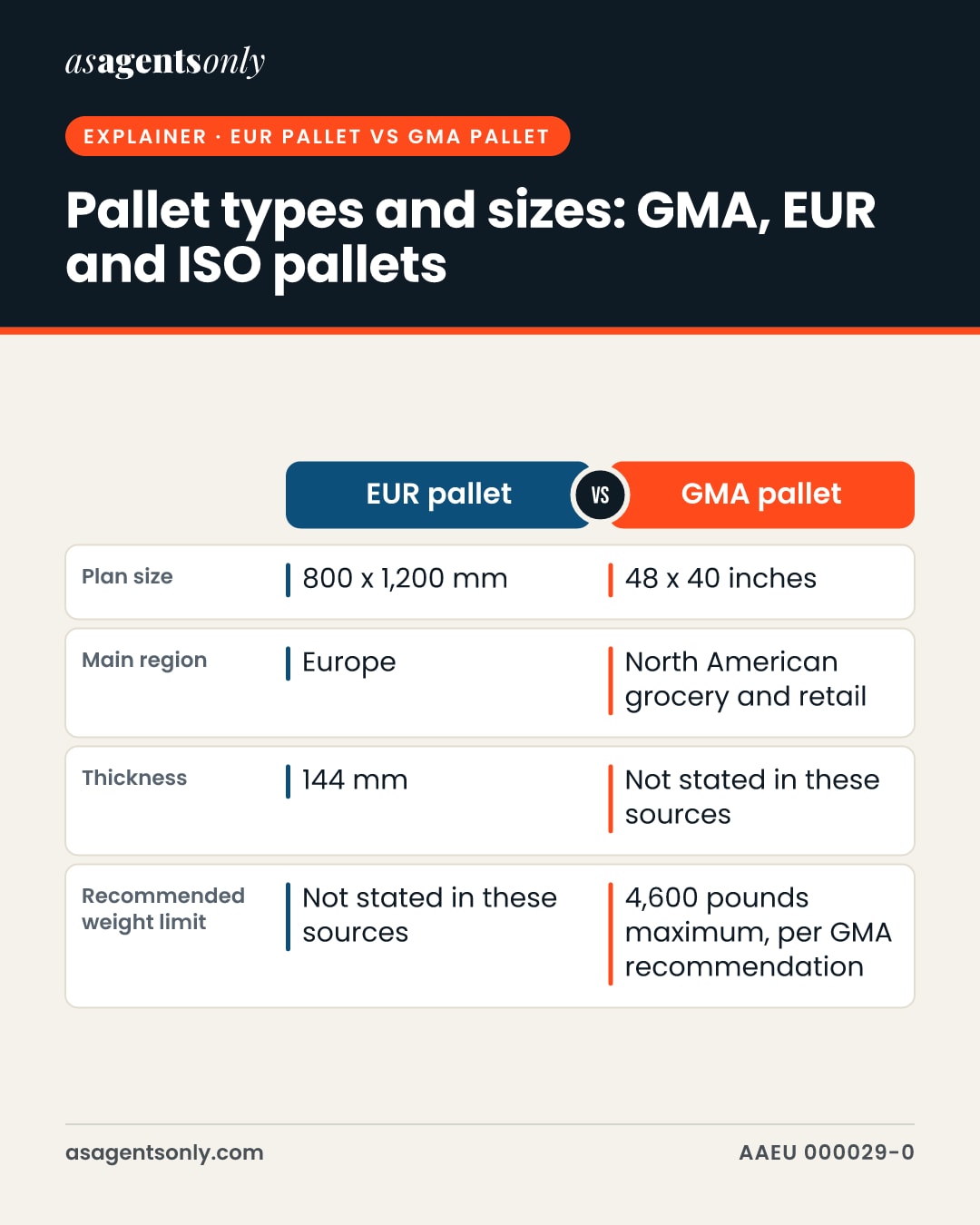
| Compared | EUR pallet | GMA pallet |
|---|---|---|
| Plan size | 800 x 1,200 mm | 48 x 40 inches |
| Main region | Europe | North American grocery and retail |
| Thickness | 144 mm | Not stated in these sources |
| Recommended weight limit | Not stated in these sources | 4,600 pounds maximum, per GMA recommendation |
Example
Illustrative example (not real data): a shipper sends ten EUR pallets to a warehouse in Germany. Each pallet has a surface of 0.96 square metres, so the ten pallets together need ten times that area of floor space on a flat pallet-to-pallet basis, before aisles and clearances.
In pictures
The same facts as this page, as images to save or share. Tap one to open it full size.
Official sources
- Pallets: Is a global pallet in your future?Supply Chain 24/7
- Annual Pallet Report: 2020 market evaluationSupply Chain 24/7
Claims ledger: 14 facts and where each comes from
- Flat pallets for intercontinental materials handling are covered by ISO 6780:2003, which fixes principal dimensions and tolerances.1
- Edition 1 of ISO 6780, dated 1988, has been withdrawn, and ISO 6780:2003 is named as its replacement.2
- Under the GS1 code list, code 201 denotes an ISO 1 pallet measuring 80 x 120 cm.5
- Code 202 is assigned to the ISO 2 pallet, which measures 100 x 120 cm.5
- Code 200 refers to the ISO 0 pallet at 80 x 60 cm.5
- The Grocery Manufacturers Association advises a 48 x 40 inch standard pallet with a 4,600 pound maximum weight limit.6
- In a 2020 reader survey, 68% of respondents chose the 48 x 40-inch size.8
- Grocery, beverage and big box retail chains are built largely around the 48 x 40-inch design.7
- The EUR pallet, also called Euro-pallet or EPAL-pallet, has dimensions of 800 mm by 1,200 mm by 144 mm and a 0.96 m² surface.4
- Europe's main pallet footprints are 800 x 1,200 mm and 1,000 x 1,200 mm.3
- Some European markets are moving from 1,000 x 1,200 mm pallets to the EUR size of 800 x 1,200 mm.3
- The EU, China and South Korea treat 1,200 x 1,000 mm as their standard pallet size.3
- North American pallets of 1,219 x 1,016 mm are close to the 1,200 x 1,000 mm size.3
- The 48 x 40 inch and 40 x 48 inch pallets share a plan size but are built differently.3
Every figure on this page is tied to a cited source, last checked on 28 October 2026. Pages like this are re-checked every six months. Found something out of date? Tell the desk.