- How-To
- Warehousing
- 4 min read
- Last verified 31 October 2026
How to label pallets with a GS1 SSCC
Learn how to create an SSCC for a pallet, encode it in a GS1-128 barcode, and place the label so receiving scanners can read it.

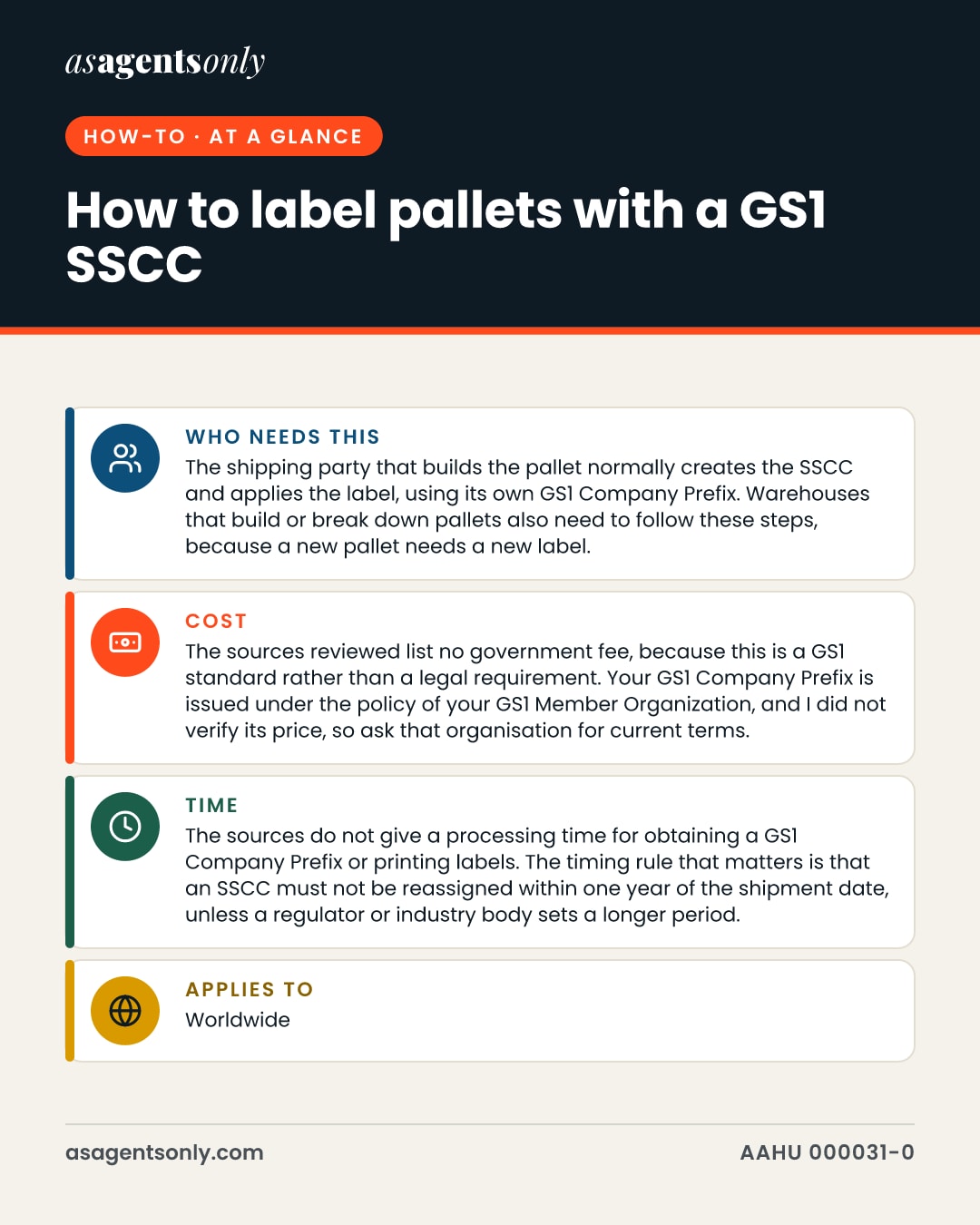
- Who needs this
- The shipping party that builds the pallet normally creates the SSCC and applies the label, using its own GS1 Company Prefix. Warehouses that build or break down pallets also need to follow these steps, because a new pallet needs a new label.
- Cost
- The sources reviewed list no government fee, because this is a GS1 standard rather than a legal requirement. Your GS1 Company Prefix is issued under the policy of your GS1 Member Organization, and I did not verify its price, so ask that organisation for current terms.
- Time
- The sources do not give a processing time for obtaining a GS1 Company Prefix or printing labels. The timing rule that matters is that an SSCC must not be reassigned within one year of the shipment date, unless a regulator or industry body sets a longer period.
- Applies to
- Worldwide
A pallet that will not scan at a receiving dock can stall a whole shipment. This guide covers how to give a pallet a Serial Shipping Container Code (SSCC) and print it as a GS1 logistic label. Use it when you build a shipment that a buyer, carrier or warehouse will track as one logistic unit.
Step by step
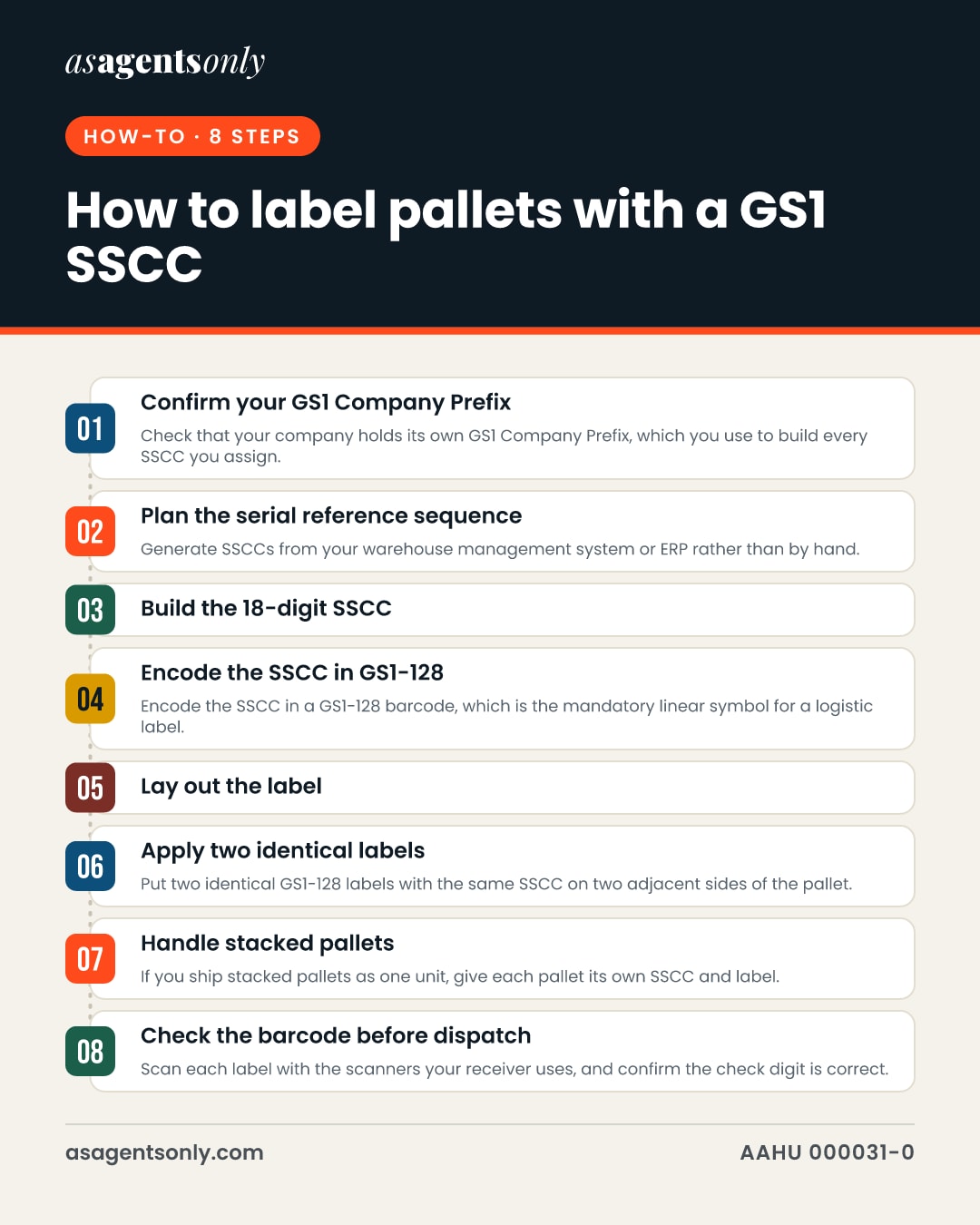
Confirm your GS1 Company Prefix
Check that your company holds its own GS1 Company Prefix, which you use to build every SSCC you assign. If you do not have one, request it from your GS1 Member Organization, which sets its own allocation rules. Use only the prefix assigned to you, never one belonging to a supplier or customer.
Plan the serial reference sequence
Generate SSCCs from your warehouse management system or ERP rather than by hand. Assign serial references in sequence, and do not build meaning into the digits. Keep a record of every SSCC issued so none is reused.
Build the 18-digit SSCC
Assemble the SSCC from the Application Identifier 00, an Extension Digit, your GS1 Company Prefix, a Serial Reference and a Check Digit. The Extension Digit is chosen by the company that builds the SSCC and runs from 0 to 9. The Extension Digit, prefix and Serial Reference together always total 17 digits, and the Check Digit is calculated with the GS1 algorithm; the GS1 US Check Digit Calculator can confirm it.
Encode the SSCC in GS1-128
Encode the SSCC in a GS1-128 barcode, which is the mandatory linear symbol for a logistic label. GS1-128 must carry the special Function 1 character after the start character so scanners can tell it apart from ordinary Code 128. Leave the parentheses around the Application Identifier out of the barcode data, and print the readable text beside it.
Lay out the label
Place the barcode carrying the SSCC in the lowest barcode position on the label, and keep the barcode at least 31.75 mm tall. Where the GS1 US pallet guidance applies, put the label on the side of the pallet, 16 to 32 inches from the base, with the SSCC in the upper right half. Check the height rule your customer or carrier uses, because another GS1 US guide gives 14 to 28 inches.
Apply two identical labels
Put two identical GS1-128 labels with the same SSCC on two adjacent sides of the pallet. This lets a scanner read the code when the pallet is turned or stored sideways. Do not add labels that carry different identifiers to the same side.
Handle stacked pallets
If you ship stacked pallets as one unit, give each pallet its own SSCC and label. Apply a master label with the group SSCC to the outside of the wrap, and hide the original labels. The wrap and master label can be removed on receipt, and each pallet label is then used again.
Check the barcode before dispatch
Scan each label with the scanners your receiver uses, and confirm the check digit is correct. Send the SSCC to the receiver in your advance shipping notice or EDI message so it can match the scan to the shipment. Keep the printed and electronic SSCC identical.
Documents you will need
- Your GS1 Company Prefix and the certificate issued to your company
- A list of the logistic units to label, with the SSCC you assigned to each
- The GS1 Logistic Label layout you will print, including the GS1-128 barcode and readable text
- Your advance shipping notice or EDI message that carries the same SSCCs
- The receiver's labelling requirements, including the pallet label height and placement they accept
Common mistakes
- Reusing an SSCC that has already been shipped, which breaks the one-year rule for reassigning SSCCs; issue a new serial reference instead.
- Printing a plain Code 128 label in place of GS1-128, which is not the GS1 format; use a GS1-128 symbol that carries the Function 1 character.
- Placing the parentheses around the Application Identifier inside the barcode, which the GS1 guidance says must not happen; encode only the data.
- Using only one label, or placing the label where it cannot be scanned; put two identical labels on adjacent sides and check the height against the current GS1 guidance.
- Leaving the original labels visible on a stacked group shipped as one unit; cover them with the wrap and apply a master label with the group SSCC.
In pictures
The same facts as this page, as images to save or share. Tap one to open it full size.
Official sources
Claims ledger: 34 facts and where each comes from
- The SSCC is an 18-digit GS1 identifier used to track logistic units such as pallets.1
- The SSCC is made up of an Extension Digit, a GS1 Company Prefix, a Serial Reference and a Check Digit.1
- The combined length of the Extension Digit, GS1 Company Prefix and Serial Reference is always 17 digits.1
- The Extension Digit is assigned by the company that constructs the SSCC and ranges from 0 to 9.1
- The Check Digit is a modulo 10 digit used to check for input errors.1
- The Application Identifier 00 shows that the data field contains an SSCC.1
- The SSCC is used only in distribution or warehouse environments, not at the point of sale.1
- The SSCC should appear on the upper right half of the pallet.1
- Labels with barcodes should appear on the side of the pallet, 16 to 32 inches from the base of the pallet, and at least 2 inches from the vertical edge.1
- Each pallet should have at least one barcode, and an additional barcode is recommended on the adjacent side.1
- Labels with barcodes should appear on the side of the pallet, from 14 to 28 inches above the surface on which the pallet stands.7
- The SSCC is the single mandatory element for all GS1 Logistic Labels, and it must be unique for each logistic unit.2
- The Check Digit of an SSCC is calculated using the algorithm defined by GS1.2
- The SSCC should be assigned by the company that creates the logistic unit, using its own GS1 Company Prefix.2
- SSCC numbers should be generated from the logistic management system, such as a warehouse management system or ERP.2
- The simplest way to allocate the serial number is sequentially.2
- The SSCC, defined by Application Identifier 00, must always appear in the lowest barcode on the label.2
- GS1-128 barcodes must be distinguished from Code 128 barcodes by the special Function 1 character after the start character.2
- Concatenation shall not be used with an SSCC on cartons and outer cases, or on A6 or 4x6 labels.2
- A minimum barcode height of 31.75 mm (1.250 inches) applies to all GS1-128 barcodes on the label.2
- If stacked pallets are shipped as one unit, a master label with the SSCC for the pallet group should be applied to the outside of the wrapping.2
- The correct check digits of the SSCC presented in the barcode are part of GS1 label verification.2
- Each warehouse should have scanners that read the GS1-128 barcodes printed on labels.2
- The mandatory data carrier used to represent the SSCC on individual logistic units is the GS1-128 barcode.8
- Parentheses around any Application Identifier must not be encoded into the barcode.6
- Generic Code 128 does not meet industry requirements using the GS1 System of Standards, and its use is not recommended.6
- Two identical GS1-128 barcode labels must be placed on two adjacent sides of the logistic unit, often a pallet.6
- Calculate the check digit in the SSCC correctly using the GS1 US check digit calculator.6
- The SSCC is assigned for the lifetime of the logistic unit.4
- An individual SSCC number must not be reallocated within one year of the shipment date from the SSCC assignor to a trading partner, unless regulatory or industry requirements extend that period.4
- When building a shipment for the buyer, the shipping party creates an SSCC using the shipper's GS1 Company Prefix and places a logistics label on the shipping unit.3
- The length of a GS1 Company Prefix depends on each GS1 Member Organization's policy on number allocation.3
- A GS1-128 barcode containing the SSCC is mandatory on all GS1 logistic labels.5
- Assigning an SSCC to cases and pallets shipped internationally is required by many retailers and logistics partners to monitor via EDI and Advanced Shipping Notice systems.9
Every figure on this page is tied to a cited source, last checked on 31 October 2026. Pages like this are re-checked every three months. Found something out of date? Tell the desk.