- How-To
- Importing
- 5 min read
- Last verified 3 November 2026
How to import goods into the US, step by step
Learn the steps to bring goods into the United States: get an importer number, file entry with CBP, pay duties and fees, and meet the deadlines.

General information, not legal advice. Rules, fees and forms change. Confirm with the agency named in the sources, or a licensed professional, before you file or ship.
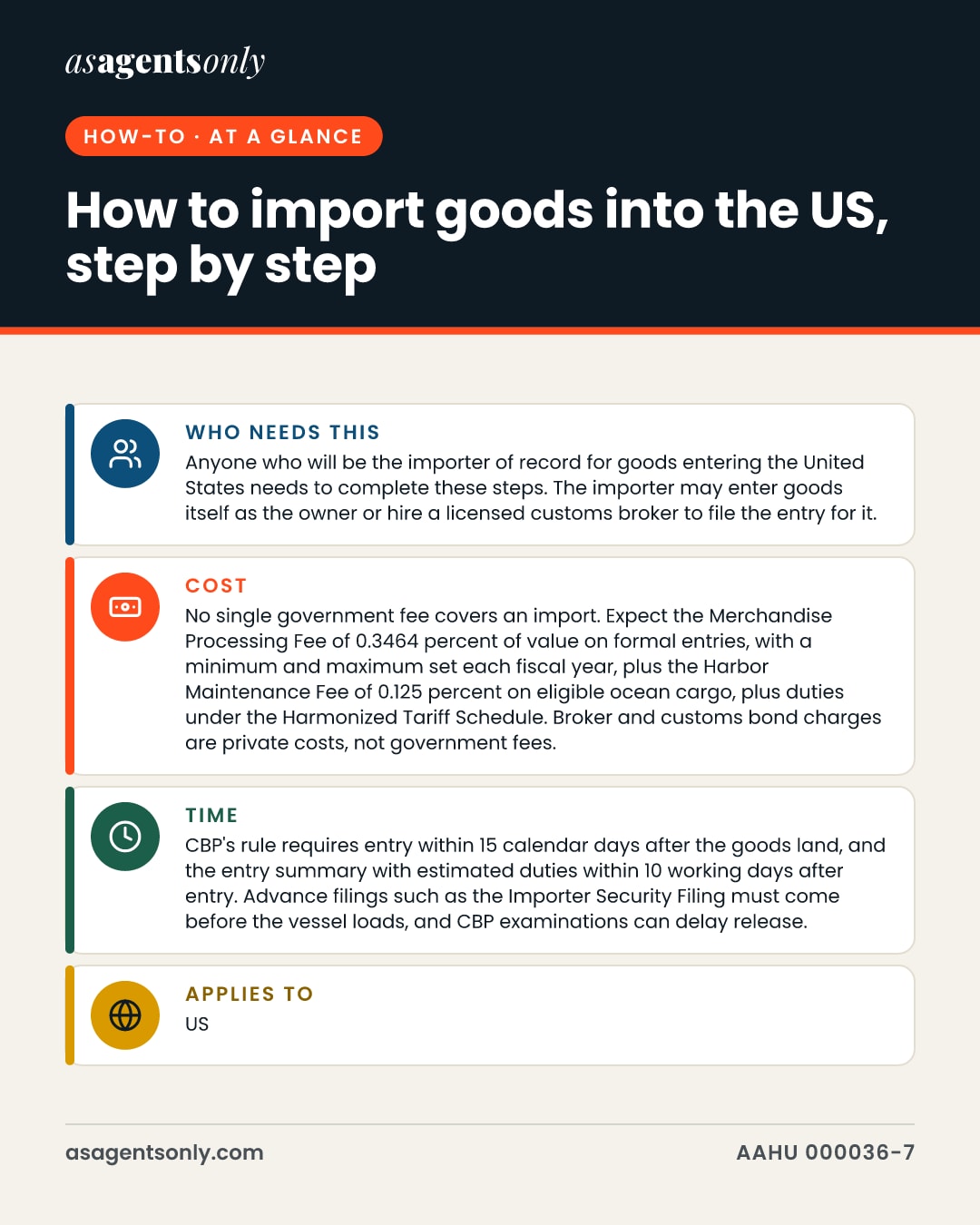
- Who needs this
- Anyone who will be the importer of record for goods entering the United States needs to complete these steps. The importer may enter goods itself as the owner or hire a licensed customs broker to file the entry for it.
- Cost
- No single government fee covers an import. Expect the Merchandise Processing Fee of 0.3464 percent of value on formal entries, with a minimum and maximum set each fiscal year, plus the Harbor Maintenance Fee of 0.125 percent on eligible ocean cargo, plus duties under the Harmonized Tariff Schedule. Broker and customs bond charges are private costs, not government fees.
- Time
- CBP's rule requires entry within 15 calendar days after the goods land, and the entry summary with estimated duties within 10 working days after entry. Advance filings such as the Importer Security Filing must come before the vessel loads, and CBP examinations can delay release.
- Applies to
- US
Importing into the United States means bringing goods across the border under an entry filed with U.S. Customs and Border Protection (CBP), with duties and fees handled before release. This guide sets out the order of the steps for a shipment that arrives by ocean, air or land and is cleared at a U.S. port of entry. Read it before your first shipment and again when rules change, because low-value and postal rules changed in 2026.
Step by step
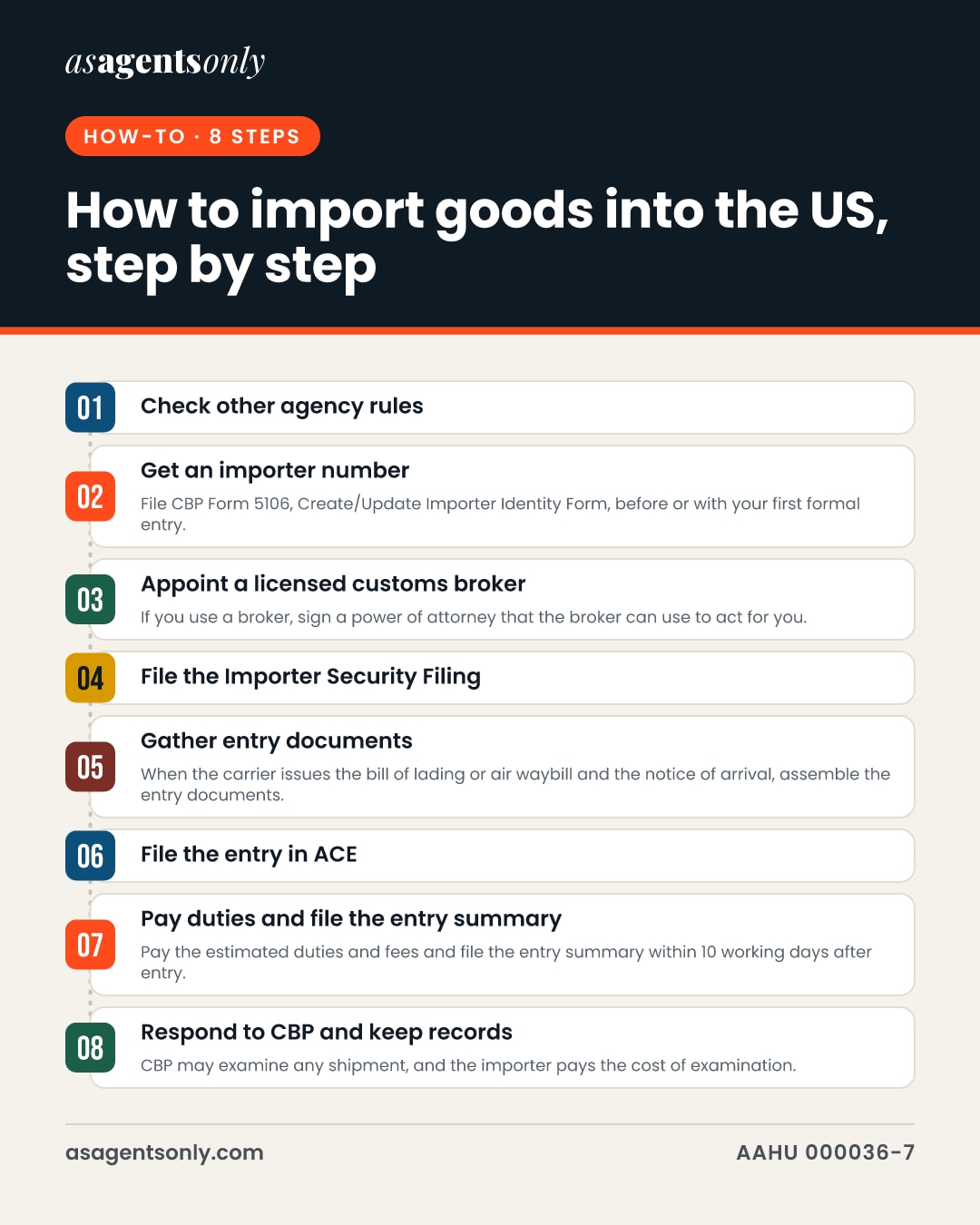
Check other agency rules
Confirm whether your product needs a permit, license or certification from another federal agency, such as the Food and Drug Administration for regulated foods and drugs. Goods from embargoed countries need a specific license from the Office of Foreign Assets Control of the U.S. Department of the Treasury, so check before you buy. If classification is unclear, contact a CBP import specialist at the port or the Center of Excellence and Expertise before shipping.
Get an importer number
File CBP Form 5106, Create/Update Importer Identity Form, before or with your first formal entry. Give your IRS Employer Identification Number or Social Security Number, or request a CBP-assigned number if you have neither. Submit it through the Automated Broker Interface (ABI) or by email to a Center of Excellence and Expertise, and you receive an importer of record number to use on entries.
Appoint a licensed customs broker
If you use a broker, sign a power of attorney that the broker can use to act for you. Confirm the broker holds a CBP license and will file through ACE. Remember that CBP officers may advise you but cannot act as your agent.
File the Importer Security Filing
For cargo arriving by vessel, the importer or its agent must send the Importer Security Filing (ISF) to CBP no later than 24 hours before the cargo is loaded at the foreign port. Update the ISF as better information arrives, and no later than 24 hours before arrival at the first U.S. port. Bulk cargo is outside this requirement.
Gather entry documents
When the carrier issues the bill of lading or air waybill and the notice of arrival, assemble the entry documents. Keep the commercial invoice, packing lists, evidence of your right to make entry, and the entry form details. Confirm each package carries the country of origin marking the product requires.
File the entry in ACE
File the entry through the Automated Commercial Environment (ACE), usually through the ABI interface, at the port where the goods arrived, within 15 calendar days after landing. Formal entries require a customs bond. Goods under $2,500 often clear as informal entries, but value is not the only factor CBP considers.
Pay duties and file the entry summary
Pay the estimated duties and fees and file the entry summary within 10 working days after entry. Check the entry summary timing against your broker's calendar, because a public CBP page describes the deadline from release of the cargo.
Respond to CBP and keep records
CBP may examine any shipment, and the importer pays the cost of examination. If CBP issues a CBP Form 28 request, respond within 30 calendar days of the form date. Keep importer records; for Harbor Maintenance Fee purposes, keep documentation for five years from the fee calculation date.
Documents you will need
- CBP Form 5106 details: importer name, IRS Employer Identification Number, Social Security Number or CBP-assigned number, mailing and physical addresses, phone, email and certification
- Bill of lading for ocean cargo or air waybill for air cargo
- Notice of arrival from the carrier
- Commercial invoice, or a pro forma invoice where the commercial invoice cannot be produced, and packing lists
- Entry manifest on CBP Form 7533 or Form 3461, or other release form the port director requires
- Evidence of your right to make entry
- Customs bond for formal entries
- ISF data: seller, buyer, importer number, consignee number, manufacturer or supplier, ship-to party, country of origin, and the six-digit Harmonized Tariff Schedule number
- Product description, composition, intended use, and price or payment details for classification and valuation
- Any permit, license or certification required by another agency
- Power of attorney for your customs broker
Common mistakes
- Submitting Form 5106 with incomplete or inaccurate data. CBP has said it will void an importer number where the information is inaccurate or incomplete, starting September 18, 2026, so verify every field before submitting.
- Filing the ISF on the day the vessel sails. CBP treats a filing made that late as untimely, so send it well before the 24-hour deadline.
- Assuming a shipment valued at $800 or less enters duty free. The de minimis exemption is suspended for these shipments outside the postal network, so they must use formal or informal entry procedures.
- Missing the entry or entry summary deadline. Late entry summaries can trigger liquidated damages against the bond, so calendar both deadlines from the arrival date.
- Signing a power of attorney that does not match the broker's actual role. Brokers submitting Form 5106 for a client need a valid power of attorney from the importer, so confirm the document before you rely on the broker.
In pictures
The same facts as this page, as images to save or share. Tap one to open it full size.
Official sources
- Tips for New Importers and ExportersU.S. Customs and Border Protection
- Entry Summary and Post Release ProcessesU.S. Customs and Border Protection
- 19 CFR Part 142 Entry ProcessU.S. Government (eCFR)
- Importer Create/Update Identity Form (CBP Form 5106) FAQU.S. Customs and Border Protection
- 19 CFR 24.5 Filing identification numberU.S. Government (eCFR)
- Executive Order 14411 notice on CBP Form 5106 information reviewFederal Register (U.S. Government)
- 19 CFR Part 149 Importer Security FilingU.S. Government (eCFR)
- Importer Security Filing and Additional Carrier RequirementsU.S. Customs and Border Protection
- Introduction to the CBP Import ProcessU.S. Customs and Border Protection
- User Fee TableU.S. Customs and Border Protection
- 19 CFR 24.23 Fees for processing merchandiseU.S. Government (eCFR)
- 19 CFR 24.24 Harbor maintenance feeU.S. Government (eCFR)
- Indefinite Suspension of the De Minimis Exemption for Merchandise Arriving Through All Modes Other Than the International Postal NetworkFederal Register (U.S. Government)
- Prohibited and Restricted ItemsU.S. Customs and Border Protection
- Importing into the United States: A Guide for Commercial ImportersU.S. Customs and Border Protection
- ACE Entry Summary (ES) Filing and Single Transaction Webinar SlidesU.S. Customs and Border Protection
- Accuracy of Importer of Record DataU.S. Customs and Border Protection
- Frequently Asked Questions: Importer Security Filing (ISF)U.S. Customs and Border Protection
- Test Concerning Entry of Section 321 Low-Value Shipments Through the Automated Commercial EnvironmentFederal Register (U.S. Government)
- ACE Entry Summary Business Rules and Process Document Trade Version 10.5U.S. Customs and Border Protection
Claims ledger: 34 facts and where each comes from
- CBP does not issue a general import license, but other agencies may require a permit, license or certification for certain commodities.1
- Licenses from the Office of Foreign Assets Control are required to bring in merchandise from embargoed countries, and such licenses are rarely granted.14
- An individual or entity must have an importer of record number to make entry or request certain CBP services that may result in a bill or refund.4
- Under 19 CFR 24.5, CBP Form 5106 must be filed with the first formal entry, and a Form 5106 must also be filed for the ultimate consignee.5
- CBP issues a CBP-assigned importer number when the requester has neither an IRS Employer Identification Number nor a Social Security Number.4
- To become an importer of record, a party or its licensed customs broker submits CBP Form 5106 through the Automated Broker Interface or by email to a Center of Excellence and Expertise.6
- Customs brokers submitting CBP Form 5106 on a client's behalf must hold a valid power of attorney executed directly with the importer.17
- Beginning September 18, 2026, CBP will void an importer of record number where the information provided is incomplete or inaccurate.17
- Customs brokers are licensed by CBP and are described as experts in these procedures.9
- CBP officers may give advice to inexperienced importers but are not authorized to act as agents for importers.15
- The Importer Security Filing must be transmitted no later than 24 hours before the cargo is laden aboard the vessel at the foreign port.7
- The Importer Security Filing must be updated as more accurate data becomes available and no later than 24 hours before the ship's arrival at a U.S. port.8
- A filing completed on the day the vessel sails is treated as untimely, because CBP measures timeliness from the vessel departure date minus 24 hours.18
- An Importer Security Filing is not required for bulk cargo.8
- The HTSUS number on an Importer Security Filing must be provided to the six-digit level.18
- Merchandise must be entered within 15 calendar days after landing from a vessel, aircraft or vehicle.3
- The entry summary with estimated duties must be filed within 10 working days after the time of entry.3
- A public CBP page states that the entry summary must be filed within 10 days of the cargo's release from CBP custody, which uses a different starting point than the regulation.2
- Formal entries require a customs bond.9
- An informal entry may involve goods valued less than $2,500, while a formal entry covers goods valued at $2,500 or more, though value may not be the only determining factor.9
- The notice of arrival and the bill of lading let the importer file entry documents with CBP at the port where the goods arrived.9
- Entry documents include an entry manifest on CBP Form 7533 or CBP Form 3461, evidence of right to make entry, a commercial invoice or pro forma invoice, and packing lists where appropriate.15
- The Automated Broker Interface is the interface that allows electronic data interchange transmissions to ACE.20
- The Merchandise Processing Fee is an ad valorem fee of 0.3464 percent for formal entries, due and payable by the importer of record at presentation of the entry summary.11
- The specific merchandise processing fee amounts and limitations are subject to adjustment each fiscal year.11
- The Merchandise Processing Fee is paid as part of the customs entry process, and the Harbor Maintenance Fee for imports is 0.125 percent ad valorem of merchandise.10
- Commercial cargo loaded on or unloaded from a commercial vessel at a covered port is subject to a port use fee of 0.125 percent of its value.12
- Importers must maintain Harbor Maintenance Fee documentation for 5 years from the date of fee calculation.12
- CBP may examine any shipment imported into the United States, and the importer must bear the cost of cargo exams.1
- For CBP Form 28 requests, trade participants must respond within 30 calendar days from the date of the form.16
- Failure to timely file the entry summary can result in an immediate demand for liquidated damages in the entire amount of the bond.19
- Goods must be marked legibly with their country of origin unless specifically exempted.15
- The de minimis exemption is indefinitely suspended for merchandise valued at $800 or less arriving through all modes other than the international postal network, so those entries must use formal or informal entry procedures.13
- The statutory repeal of the de minimis basis takes effect starting on July 1, 2027.13
Every figure on this page is tied to a cited source, last checked on 3 November 2026. Pages like this are re-checked every three months. Found something out of date? Tell the desk.