- Explainer
- Risk
- 5 min read
- Last verified 3 November 2026
What general average is and when it is declared
General average is the shared-loss rule for deliberate sacrifices and costs that save a voyage, and this page explains when a declaration is made.

In short
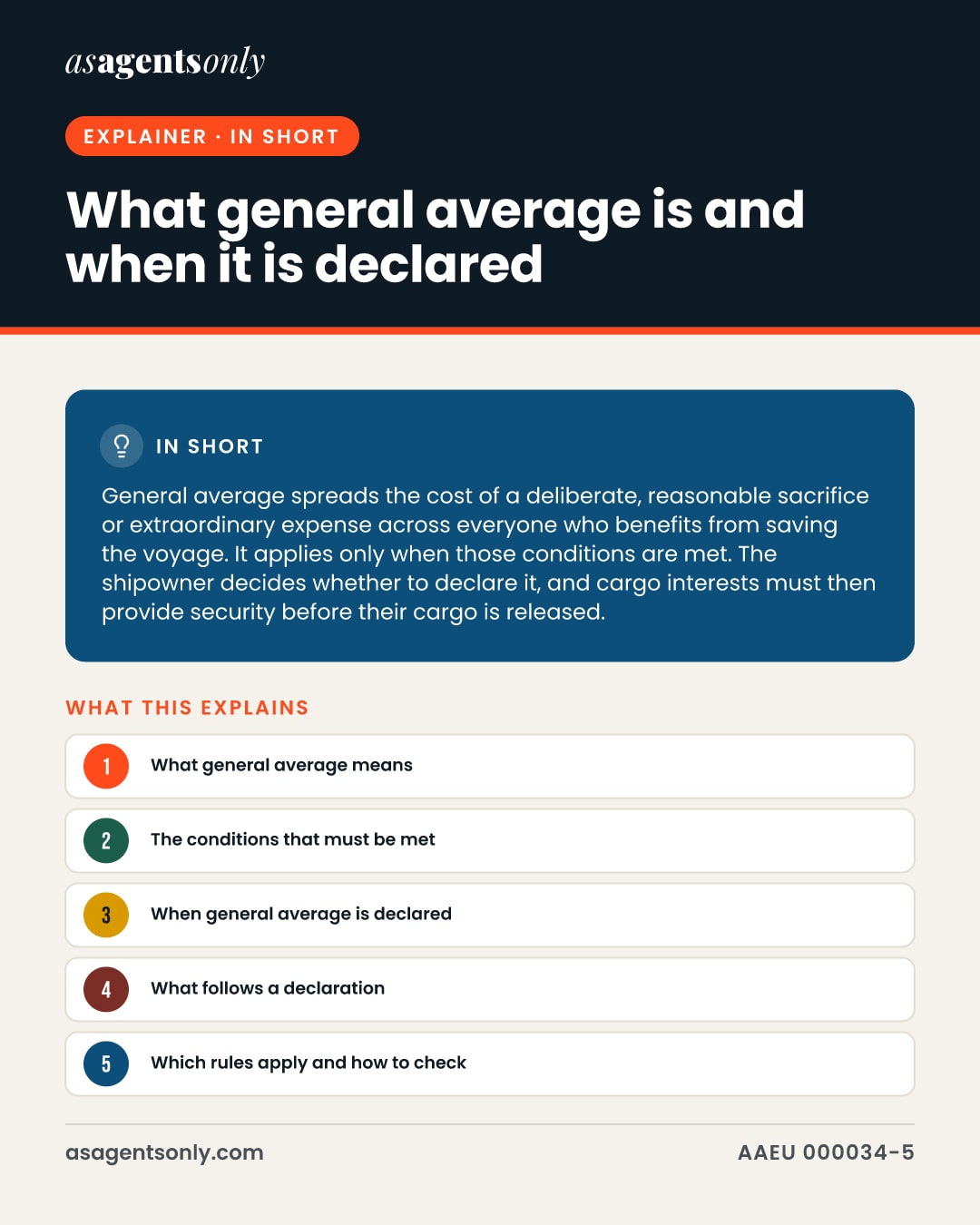
General average spreads the cost of a deliberate, reasonable sacrifice or extraordinary expense across everyone who benefits from saving the voyage. It applies only when those conditions are met. The shipowner decides whether to declare it, and cargo interests must then provide security before their cargo is released.
Most cargo moves without any general average claim, yet the rule can reach a shipper's cargo long after the goods have left the port. Anyone who ships, forwards, insures or carries goods by sea should know what the doctrine covers, who makes the call and what a declaration sets in motion.
What general average means
General average is a principle of maritime law that shares a loss among the parties who gain when a voyage is saved. Without it, a loss at sea normally stays with the party that suffers it. The principle is an exception that spreads part of that loss across the whole adventure.
The York-Antwerp Rules are the set of rules by which general average is adjusted, and most modern contracts of affreightment refer to them. The UK Marine Insurance Act 1906 contains a parallel definition, and UNCTAD's review finds Rule A of the 1974 York-Antwerp Rules substantially the same in meaning.
The term is used in three senses: the act itself, the loss that results from it, and the contribution that each interest pays toward that loss. Readers should keep these apart when reading an adjuster's statement.
The conditions that must be met
A general average act needs an extraordinary sacrifice or expenditure, made intentionally and reasonably, for the purpose of preserving the property from peril. Rule A limits the scope to that narrow category. Ordinary costs of running the voyage do not qualify just because the ship is in difficulty.
The act must aim to keep all interests in the common maritime adventure out of danger. Typical examples are jettisoning cargo to keep a ship afloat and towing a stricken vessel into port. Under Rule I of the 1974 York-Antwerp Rules, jettisoned cargo is not made good unless it was carried in line with the recognized custom of the trade.
Reasonableness is a condition even where a rule does not repeat it. The 1994 text makes this explicit, so a claimant must show that the loss or expense was reasonably made or incurred.
When general average is declared
The declaration is normally made by the shipowner, which has the choice. UNCTAD notes that it is for the owner to decide whether it is convenient to declare and proceed with general average. The owner may also decide not to claim the cargo's share under its hull policy and pursue cargo interests instead.
Declarations can come while a casualty is still unresolved. Evergreen declared general average on the Ever Forward for cautionary purposes and named an adjuster while refloating attempts continued. In the Ever Given case, the ship was stuck for six days before its owner declared general average.
A declaration is a notice, not proof that every item qualifies. The conditions in the previous section still decide what is allowed, and a shipper cannot avoid the procedure simply by calling the declaration unjustified.
What follows a declaration
Once the owner declares general average, it may hold a lien over property on board, which is usually the cargo, the containers and the fuel owned by time charterers. Cargo owners and their insurers must give security for the expected contribution to release the property.
An independent average adjuster assesses the allowable expenses and divides the total in proportion to the value of property saved and arriving at destination. Uninsured owners pay a cash deposit that the nominated adjuster holds until the adjustment is issued and any disputes are settled.
Time limits matter. The 1994 text required notice of claims to the average adjuster within 12 months of the adventure's end. A 2024 CMI guarantee form asks that defences be notified within three months of the adjustment's issue. Check the text that governs your contract before relying on either period.
Which rules apply and how to check
The York-Antwerp Rules are contractual unless a contract or national law brings them in. The CMI adopted the revised York-Antwerp Rules 2016 at its conference in New York, so readers should confirm which version their contract names.
Under the rule of interpretation in the 1994 text, the listed rules apply to the exclusion of any inconsistent law and practice. National law still matters for insurance questions, such as the UK approach to recovering a general average loss from an insurer.
To check your position, read the bill of lading or charter party, ask your forwarder which adjuster has been appointed, and compare the security demanded with the adjustment notice before paying.
Side by side
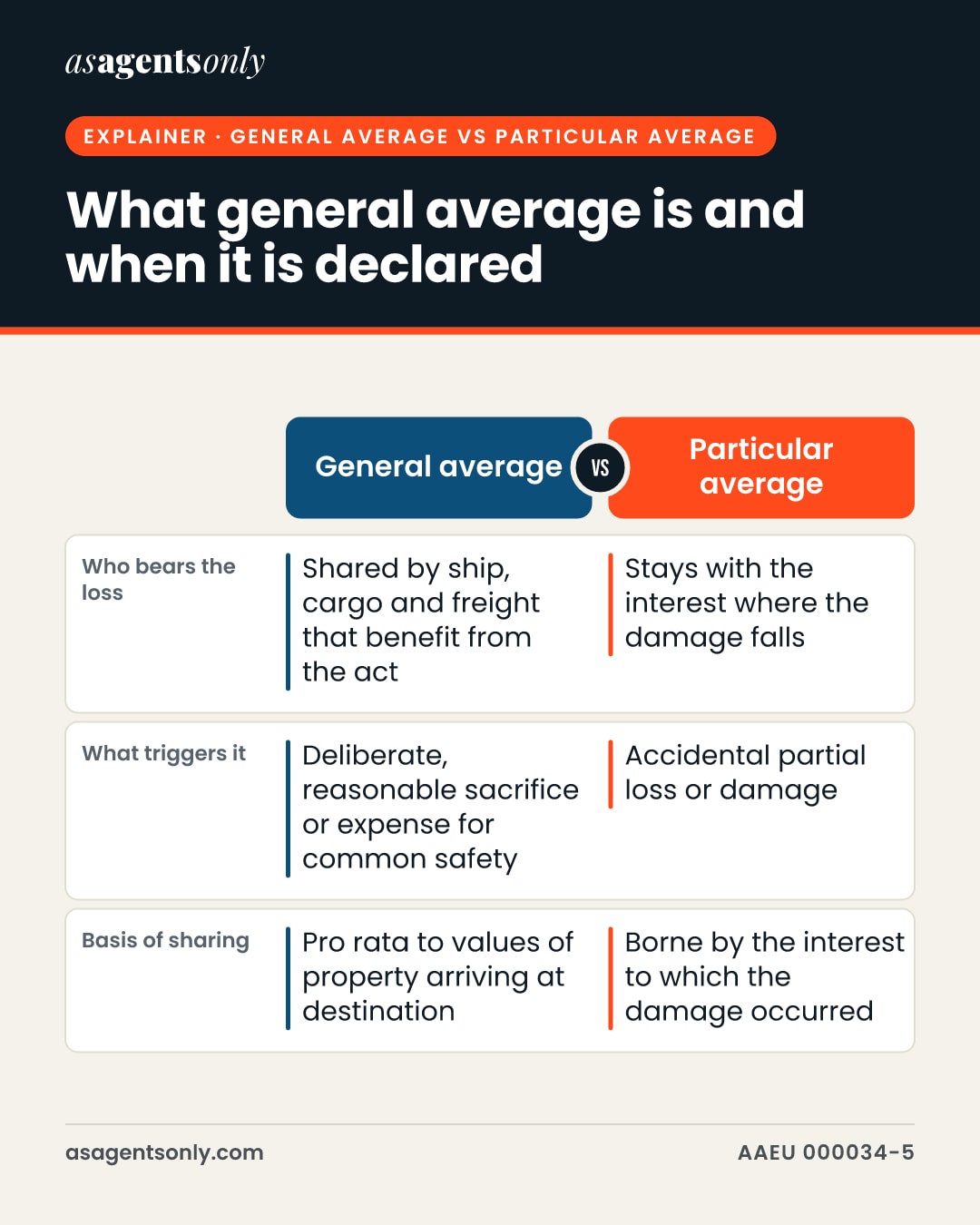
| Compared | General average | Particular average |
|---|---|---|
| Who bears the loss | Shared by ship, cargo and freight that benefit from the act | Stays with the interest where the damage falls |
| What triggers it | Deliberate, reasonable sacrifice or expense for common safety | Accidental partial loss or damage |
| Basis of sharing | Pro rata to values of property arriving at destination | Borne by the interest to which the damage occurred |
Example
Illustrative example only, with no real figures: a container ship loses power in heavy weather and its master orders part of a deck cargo jettisoned to keep the vessel from sinking. The ship then makes port under tow, and the towing and port costs are added. If the sacrifice and the expenses were extraordinary, deliberate and reasonable, and made for common safety, the owner may declare general average. The adjuster then values the lost cargo, the saved ship and the saved cargo at destination and calls for security from each cargo interest before release. A shipper whose goods were not sacrificed still pays a share, in proportion to the value of its cargo that arrives.
In pictures
The same facts as this page, as images to save or share. Tap one to open it full size.
Official sources
- General Average - Reform of the SystemUNCTAD, published 9 March 1995
- Marine Insurance Act 1906, section 66legislation.gov.uk (UK National Archives)
- Tune-up for general average formThe Baltic Exchange
- IUMI Welcomes Revised York-Antwerp RulesMaritime Executive (reporting IUMI)
- TTM15230 - Background material: General averageHM Revenue & Customs, published 19 March 2016
Claims ledger: 30 facts and where each comes from
- UNCTAD's review says the Rule A definition in the 1974 York-Antwerp Rules is substantially the same as the one in the UK Marine Insurance Act.1
- Rule A confines a general average act to an extraordinary sacrifice or expenditure that is deliberate, sensible and aimed at shared safety.1
- Losses from navigation normally remain with the party that first suffers them, unless an exception applies.1
- A party that suffers a general average loss can recover a general contribution from everyone who benefited, pro rata to the value of the property saved.1
- Rule A requires that the act aim to keep every interest in the common maritime adventure out of danger.1
- Rule A's scope is narrow: only extraordinary sacrifices or expenditure made for common safety qualify.1
- Every interest at risk when the act occurs, usually ship, cargo and freight, contributes based on the values that arrive at destination.1
- Under Rule I of the 1974 York-Antwerp Rules, jettisoned cargo is not made good unless it was carried in line with the recognized custom of the trade.1
- Under the 1994 text, a claimant must show that the loss or expense was reasonably made or incurred, even where the rule does not say so.2
- The Conference adopted the York-Antwerp Rules 1994 and recommended applying them as soon as practicable after 31 December 1994.2
- Under the 1994 rule of interpretation, the listed rules apply to the exclusion of any inconsistent law and practice.2
- Under the 1994 text, claimants must notify the average adjuster of their claims within 12 months of the end of the common maritime adventure.2
- The UK Marine Insurance Act 1906 treats a general average act as existing when an extraordinary sacrifice or expenditure is made voluntarily and reasonably in time of peril to preserve the imperilled property.3
- The CMI adopted the revised York-Antwerp Rules 2016 at its conference in New York.5
- The York-Antwerp Rules are the set of rules by which general average is adjusted.5
- It is for the owner to decide whether it is convenient to declare and proceed with general average.6
- Even without an express option, a shipowner can skip claiming the cargo's share under its hull policy and pursue cargo interests instead.6
- An independent average adjuster assesses the allowable expenses and divides the total in proportion to the value of property saved that reaches destination.7
- Shippers cannot escape the general average procedure by arguing that the declaration is abusive.7
- Evergreen declared general average for cautionary purposes on the Ever Forward and nominated an adjuster.8
- The Ever Given was stuck in the canal for six days before its owner declared general average.9
- Particular average is a partial loss or damage from accidental causes that the affected interest bears alone, unlike general average.10
- Once an owner declares general average, it may hold a lien over property on board, which is usually cargo, containers and fuel owned by time charterers.4
- Cargo owners and their insurers must give the shipowner security for the expected contribution before the property is released from the lien.4
- Uninsured owners pay a cash deposit that the nominated adjusters hold until the adjustment is issued and any disputes are resolved.4
- In June 2024 the CMI produced a new form of general average guarantee.4
- The guarantee says defences should be notified to the adjuster within three months of the issue of the adjustment.4
- After a declaration, involved parties must provide security before their cargo can be released.11
- Most modern contracts of affreightment refer to the York-Antwerp Rules, according to HMRC.12
- An example of a general average loss is jettisoning cargo to keep a ship afloat, and an example of general average expenditure is towing a stricken vessel into port.13
Every figure on this page is tied to a cited source, last checked on 3 November 2026. Pages like this are re-checked every six months. Found something out of date? Tell the desk.