- Explainer
- Warehousing
- 3 min read
- Last verified 14 October 2026
Cross‑docking explained
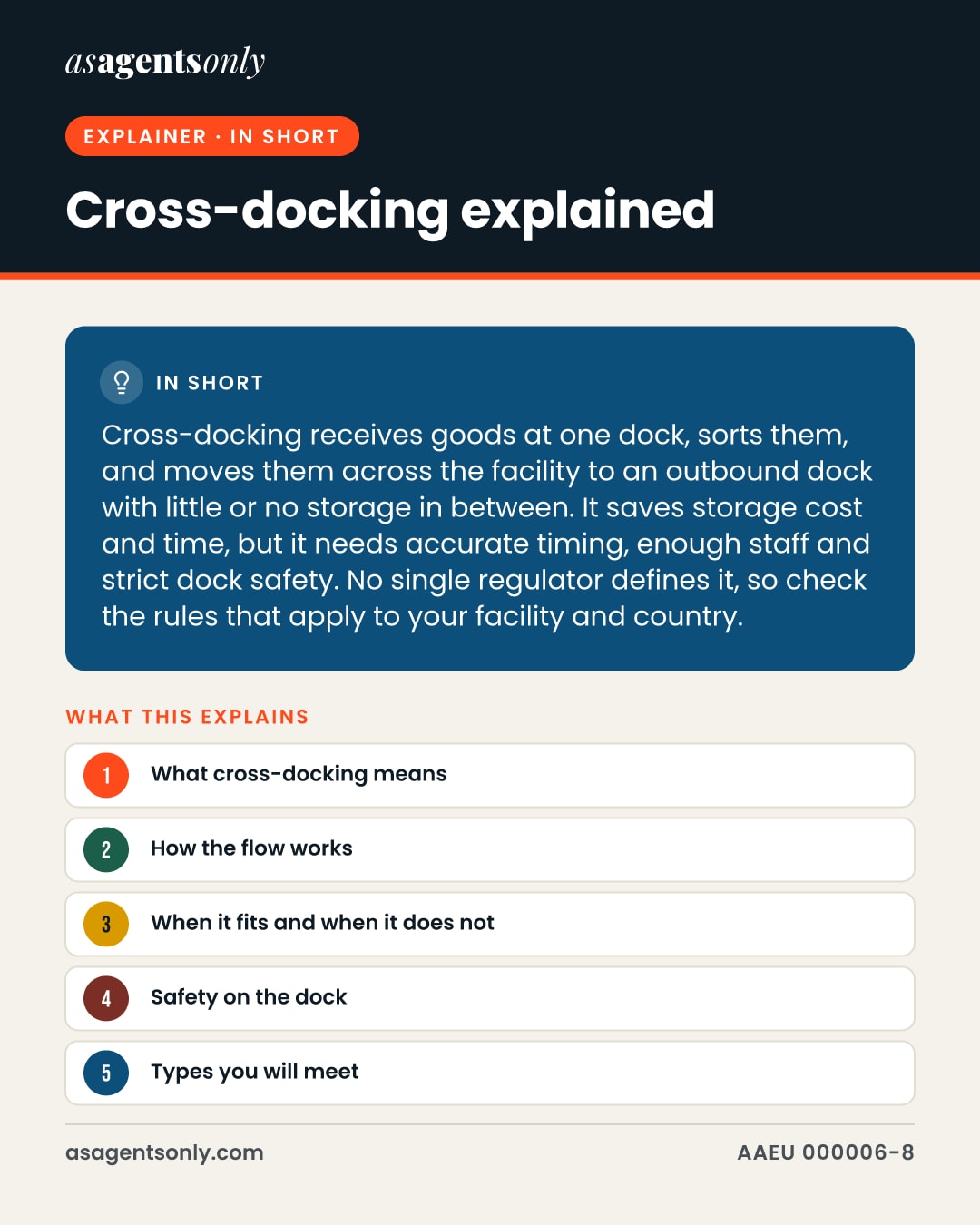
Cross-docking moves inbound freight straight to outbound trucks with little or no storage, and it depends on tight timing, staffing and dock safety.

In short
Cross-docking receives goods at one dock, sorts them, and moves them across the facility to an outbound dock with little or no storage in between. It saves storage cost and time, but it needs accurate timing, enough staff and strict dock safety. No single regulator defines it, so check the rules that apply to your facility and country.
Cross-docking is a warehouse and transport method that skips the usual put-away and storage step. It is common in less-than-truckload networks, retail distribution and port-adjacent operations. Definitions below come from academic papers, a company filing and industry guides, while the safety rules come from OSHA and the IMO/ILO/UNECE CTU Code.
What cross-docking means
In cross-docking, goods arrive on an inbound truck, are unloaded and sorted, and are placed directly on the outbound truck that will carry them onward. Academic work describes a cross-dock as a facility where goods are received from many origins, consolidated by destination, and shipped with minimal handling and little or no storage.
The term comes from the movement of freight across the facility, from the inbound dock to the outbound dock, rather than into racks or a stock location.
How the flow works
Inbound and outbound trucks usually arrive at about the same time, so the building does not need to hold the goods for long. Freight is moved across the dock by forklift, conveyor or pallet truck. Because many inbound trucks are handled at once, goods from several suppliers can share one outbound load.
The method depends on timing. If the outbound truck is not ready, goods must be stored, and that defeats the purpose of cross-docking.
When it fits and when it does not
Cross-docking suits freight with stable, predictable demand, perishable or time-sensitive goods, and consolidation of many small shipments into full loads. Pre-sold orders can also move straight through, since they are never put away.
It has real costs. Setup can be expensive, it needs close planning with suppliers and carriers, and a tight schedule leaves little room to recover from a late delivery. It also needs enough staff to unload, sort and load at the same time. Full pallets moving in and out are the easiest case; loose quantities work but need more labor.
Safety on the dock
Dock work carries known hazards. The US Occupational Safety and Health Administration (OSHA) reports that injuries occur when forklifts run off a dock, products fall, or equipment strikes a person, and recommends slow driving, secured dock plates and keeping clear of dock edges. In the United States, general industry dockboards must be able to carry the maximum intended load under OSHA's dockboard standard, and wheel chocks or sand shoes are used to stop a truck moving while people are on the dockboard.
The IMO/ILO/UNECE Code of Practice for Packing of Cargo Transport Units (CTU Code) is a non-mandatory global code. It gives advice on safe packing and securing of containers and other units for sea and land transport. A 2025 revision has been proposed but this text is a draft, not an adopted rule, so check the current edition before you rely on it.
Types you will meet
Practitioners describe several forms: manufacturing cross-docking, which receives materials for production; distributor cross-docking, which consolidates inbound products from different vendors; transportation cross-docking, which combines shipments from several carriers; and retail cross-docking. Cross-docks are often used for hub-and-spoke networks, consolidation or deconsolidation.
Check the facility's own procedures and the rules for your country before you design a cross-dock, since the mix of labor, space and safety rules differs by site.
Side by side
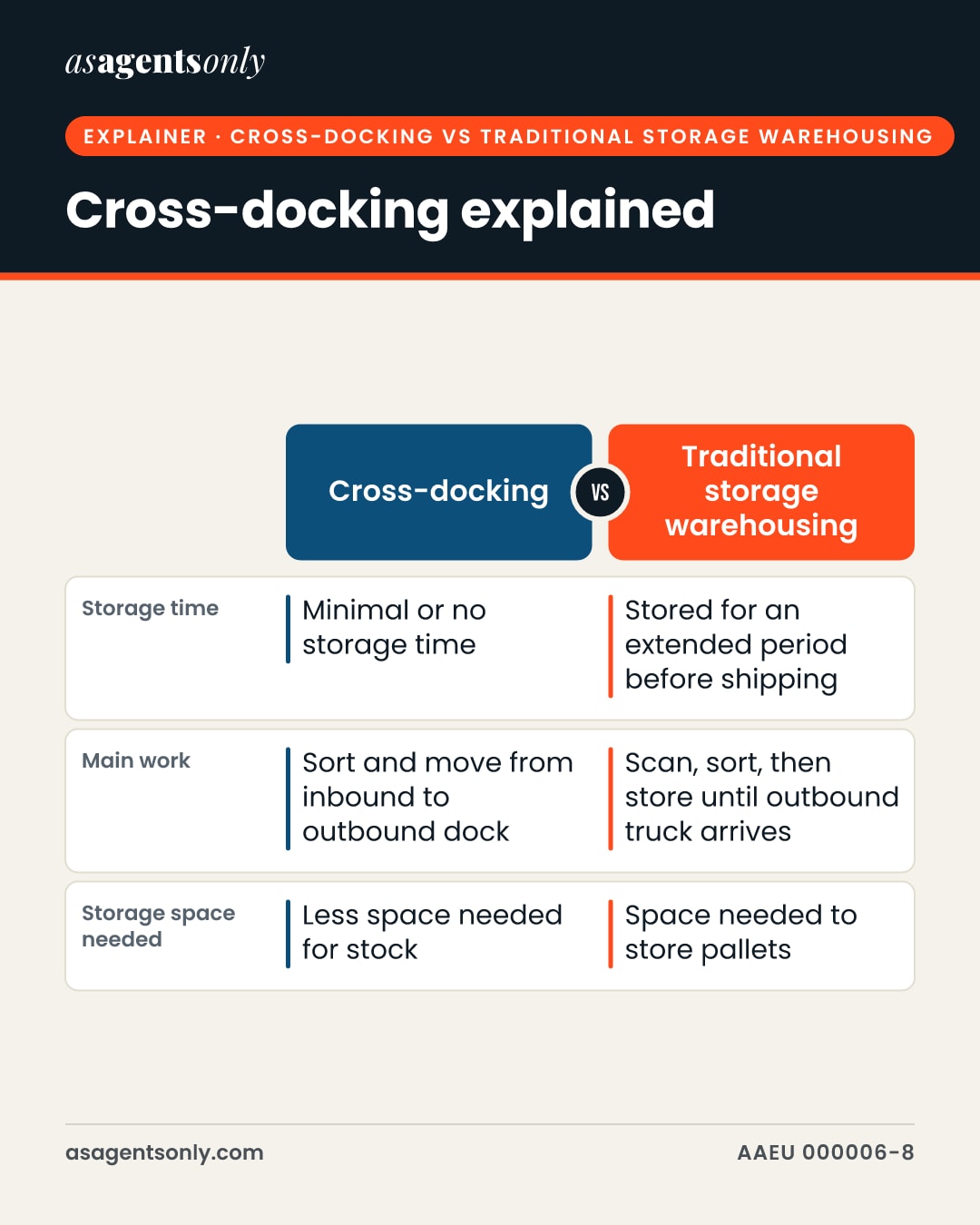
| Compared | Cross-docking | Traditional storage warehousing |
|---|---|---|
| Storage time | Minimal or no storage time | Stored for an extended period before shipping |
| Main work | Sort and move from inbound to outbound dock | Scan, sort, then store until outbound truck arrives |
| Storage space needed | Less space needed for stock | Space needed to store pallets |
Example
Illustrative example only (the numbers are invented for teaching): three inbound trucks from different suppliers arrive at a cross-dock early in the morning. Their goods are sorted by store, and four outbound trucks leave for the stores later the same day. Nothing is put into racks, so the building needs only sorting space and staging lanes. If the outbound trucks had not arrived in time, the goods would have had to be stored, and the savings would have been lost.
In pictures
The same facts as this page, as images to save or share. Tap one to open it full size.
Official sources
- 424B4U.S. Securities and Exchange Commission (EDGAR filing)
- What Is Cross Docking?FreightWaves Ratings
- Cross-Docking & CrowdfundingFreightos
- Execs Say Cross-Docking Can Help Build BusinessTransport Topics
- Ultimate Cross-Docking GuideSupply Chain 24/7 (Saddle Creek Logistics Services)
- Capitalizing on Cross-DockingSupply Chain 24/7
- Cross Docking & Warehouse SystemCanadian Centre for Occupational Health and Safety (Seymour Hub)
- Revision of the Code of Practice for Packing of Cargo Transport Units, informal documentUNECE Working Party on Intermodal Transport and Logistics, published 1 December 2025
Claims ledger: 30 facts and where each comes from
- A cross-docking distribution center receives goods from many suppliers and consolidates them to shared final destinations, with little or no storage between unloading and loading.15
- Cross-docking means moving inbound products onto outbound transport through a company's warehouse docks without storing them in the warehouse.1
- Cargo is received at an inbound dock, moved across the warehouse, and then goes to the outbound transportation dock, which is the source of the name.5
- At a cross-dock, goods are unloaded, sorted and placed on the matching outbound truck immediately after the inbound truck docks.2
- In a cross-dock, inbound and outbound trucks generally arrive around the same time, so the warehouse does not need to store the products.2
- Goods can be moved across the dock by forklift, conveyor belt or pallet truck.2
- Products from several inbound trucks can end up on the same outbound truck at a cross-dock.2
- Where cross-docking is not used, an outbound truck may not arrive until the next day, so the goods must be scanned, sorted and stored until it does.2
- If inbound products cannot leave through distribution right away, they end up being stored, which defeats the purpose of cross-docking.2
- A cross-dock needs enough staff to unload all inbound trucks, sort the products and load all outbound trucks.2
- Cross-docking is used when inventory demand is stable and consistent, and when goods are time-sensitive or perishable.4
- Common types of cross-docking include manufacturing, distributor, transportation and retail cross-docking.4
- Shippers value cross-docking because it saves warehousing charges, gives quicker access to market, and usually involves less handling of merchandise.6
- Full-pallet-in, full-pallet-out products are the easiest to cross-dock, while less-than-pallet quantities can work but are more labor intensive.8
- Cross-docks are generally used for hub-and-spoke arrangements, consolidation or deconsolidation.7
- One common use of cross-docking is consolidating less-than-truckload shipments into full truckloads.7
- Products usually spend less than 24 hours on the dock in a cross-docking operation, according to one industry guide.3
- Cross-docking has high startup costs, requires considerable management attention and planning, and carries a risk of late supplier delivery on a tight timetable.3
- In one academic model, products can go straight to outbound vehicles or be held temporarily in the cross-dock for no more than 24 hours.14
- Traditional warehousing stores products for an extended period before they are shipped, while cross-docking aims to reduce handling and storage costs.9
- Cross-docking involves the immediate distribution of incoming goods to outgoing transportation, with minimal to no storage time.9
- The IMO/ILO/UNECE CTU Code is a non-mandatory global code of practice for handling and packing shipping containers and other cargo transport units by sea and land.10
- Many transport incidents are attributed to poor packing practices, including inadequate securing of cargo and overloading.10
- The CTU Code applies to the whole intermodal transport chain, including those who receive and unpack the units.10
- A proposed revision of the CTU Code was circulated as a 2025 document; it is a proposal, not an adopted text.11
- OSHA identifies injuries when forklifts run off a dock, products fall on employees, or equipment strikes a person as a warehouse dock hazard.12
- OSHA recommends driving forklifts slowly on docks and dock plates, securing dock plates, and keeping clear of dock edges.12
- Under OSHA's dockboard standard, dockboards must be capable of supporting the maximum intended load.13
- Dockboards put into initial service on or after January 17, 2017 must be designed and maintained to prevent transfer vehicles from running off the dockboard edge, unless the employer shows there is no such hazard.13
- Wheel chocks or sand shoes are used to prevent a transport vehicle from moving while employees are on the dockboard.13
Every figure on this page is tied to a cited source, last checked on 14 October 2026. Pages like this are re-checked every six months. Found something out of date? Tell the desk.