- Explainer
- Customs
- 4 min read
- Last verified 24 November 2026
What an Authorised Economic Operator is
This explainer shows who can hold Authorised Economic Operator status, what criteria apply, what benefits it brings, and how it is recognised abroad.

General information, not legal advice. Rules, fees and forms change. Confirm with the agency named in the sources, or a licensed professional, before you file or ship.
In short
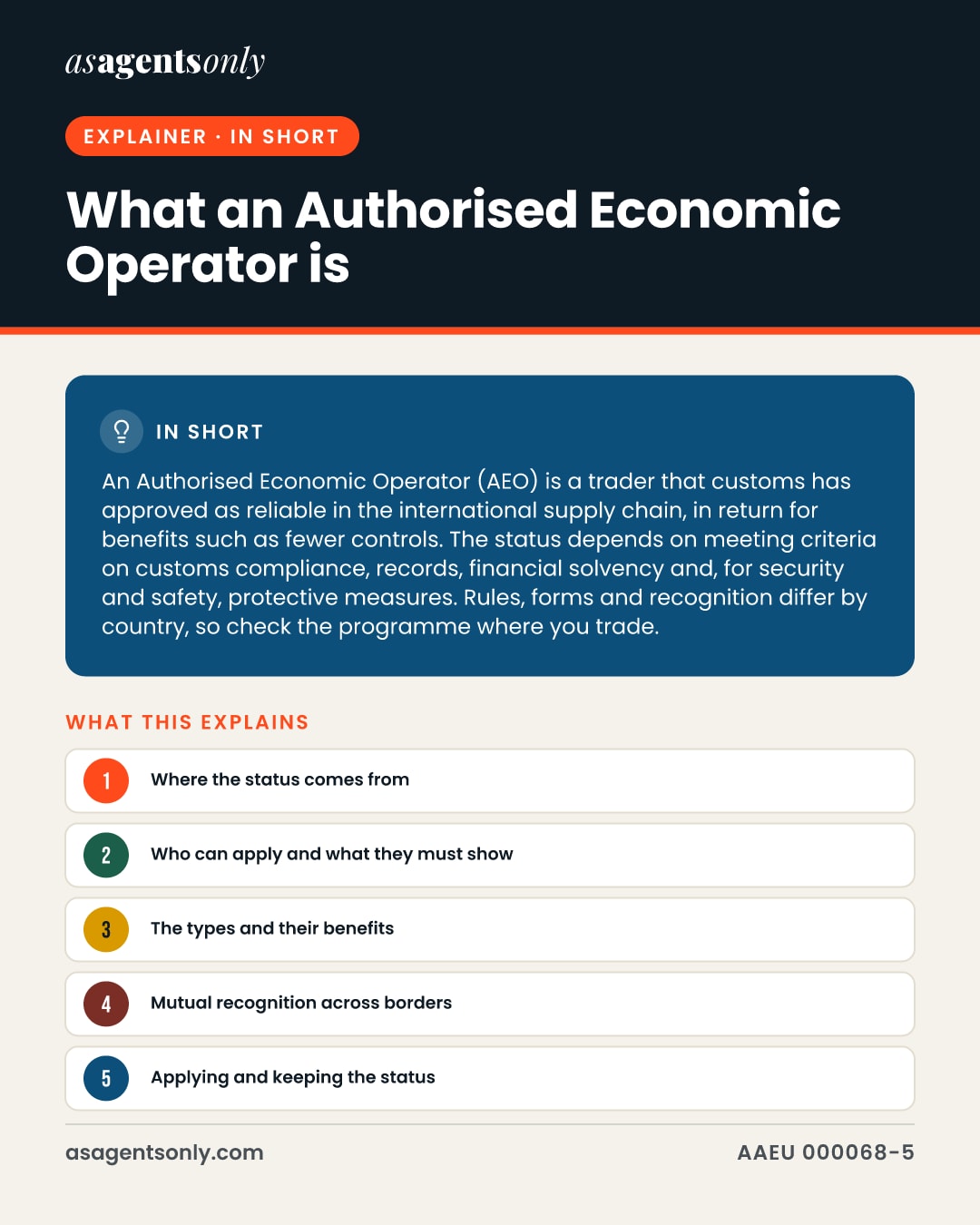
An Authorised Economic Operator (AEO) is a trader that customs has approved as reliable in the international supply chain, in return for benefits such as fewer controls. The status depends on meeting criteria on customs compliance, records, financial solvency and, for security and safety, protective measures. Rules, forms and recognition differ by country, so check the programme where you trade.
Customs administrations need to focus their checks on risky cargo, and they can give lighter treatment to traders they trust. The Authorised Economic Operator concept was developed by the World Customs Organization for that purpose. This explainer sets out where the status comes from, who can apply, what the criteria and benefits are, how recognition works between countries, and how to apply.
Where the status comes from
An Authorised Economic Operator, usually shortened to AEO, is a trader that a customs administration has approved as reliable in the international supply chain. The idea was developed by the World Customs Organization, which adopted its SAFE Framework of Standards in June 2005. A customs-business partnership programme followed in 2007, and the WCO describes the SAFE Framework as a starting point for national AEO programmes.
The status is a matter of choice. In the EU, there is no legal obligation to become an AEO, and no obligation for an AEO to require its business partners to hold the status either.
Who can apply and what they must show
In the EU, a trader established in a customs territory of the Union can apply if it holds an EORI number and takes part in an international supply chain as a customs-related operator. A trader can hold only one AEO status in the EU, and a status granted by one Member State is recognised in all of them. In Great Britain and Northern Ireland, HMRC asks for a legal entity that is actively involved in customs operations and international trade and holds an EORI number.
The criteria cover compliance, records, finances and, for some types, security. Applicants must show no serious or repeated infringements of customs rules, a high level of control over their operations and the flow of goods, and financial solvency. HMRC examines compliance over three years before the application and checks solvency over the same period. Activities that only move goods in free circulation, or that only give customs opinions, are examples of businesses that cannot apply.
The types and their benefits
The EU offers three forms: AEOC for customs simplification, AEOS for security and safety, or a combination of the two. Both types can be held at the same time. AEOC holders can use simplified procedures more easily, while AEOS holders gain security and safety facilitations. Benefits shared by the types include fewer physical and document-based controls, priority treatment if selected for control, and the option to request controls at a specific location.
The WCO describes the general aim as faster processing of goods by customs, for example through reduced examination rates, which saves time and cost. The exact benefits depend on the authorisation granted and on the national programme, so confirm them with your customs authority.
Mutual recognition across borders
Mutual recognition means one customs administration recognises another's AEO status and gives the associated benefits. The EU has agreements with partners including Canada, China, Japan, Norway, Switzerland, the United States, Türkiye and the United Kingdom. Holders of AEOS or AEOC/AEOS authorisations are eligible to take part. Each agreement sets out its own benefits, so a status does not carry over automatically to every country.
On the United States side, the counterpart is the Customs-Trade Partnership Against Terrorism (CTPAT), a voluntary public-private partnership run by U.S. Customs and Border Protection. Its mutual recognition arrangements are based on security, and they do not replace standard U.S. import obligations, which still apply to importers.
Applying and keeping the status
In the EU, an application goes to the competent customs authority where the trader's main customs accounts are accessible, and it can be submitted online through the EU Trader Portal. An application sent to a different country's authority will not be accepted. In Great Britain and Northern Ireland, HMRC gives applicants 28 days from starting an application to complete it, and documented procedures should be ready before applying.
Approval involves audit visits by HMRC staff. If the required security plan or risk and threat assessment is not available when HMRC visits, the visit may be halted or the application rejected. Status is also monitored. Applicants must report customs business changes to HMRC within 30 days, and a customs authorisation that has been withdrawn or revoked is taken into account in reviewing compliance. Confirm current rules and forms with your national customs authority before you apply.
Side by side
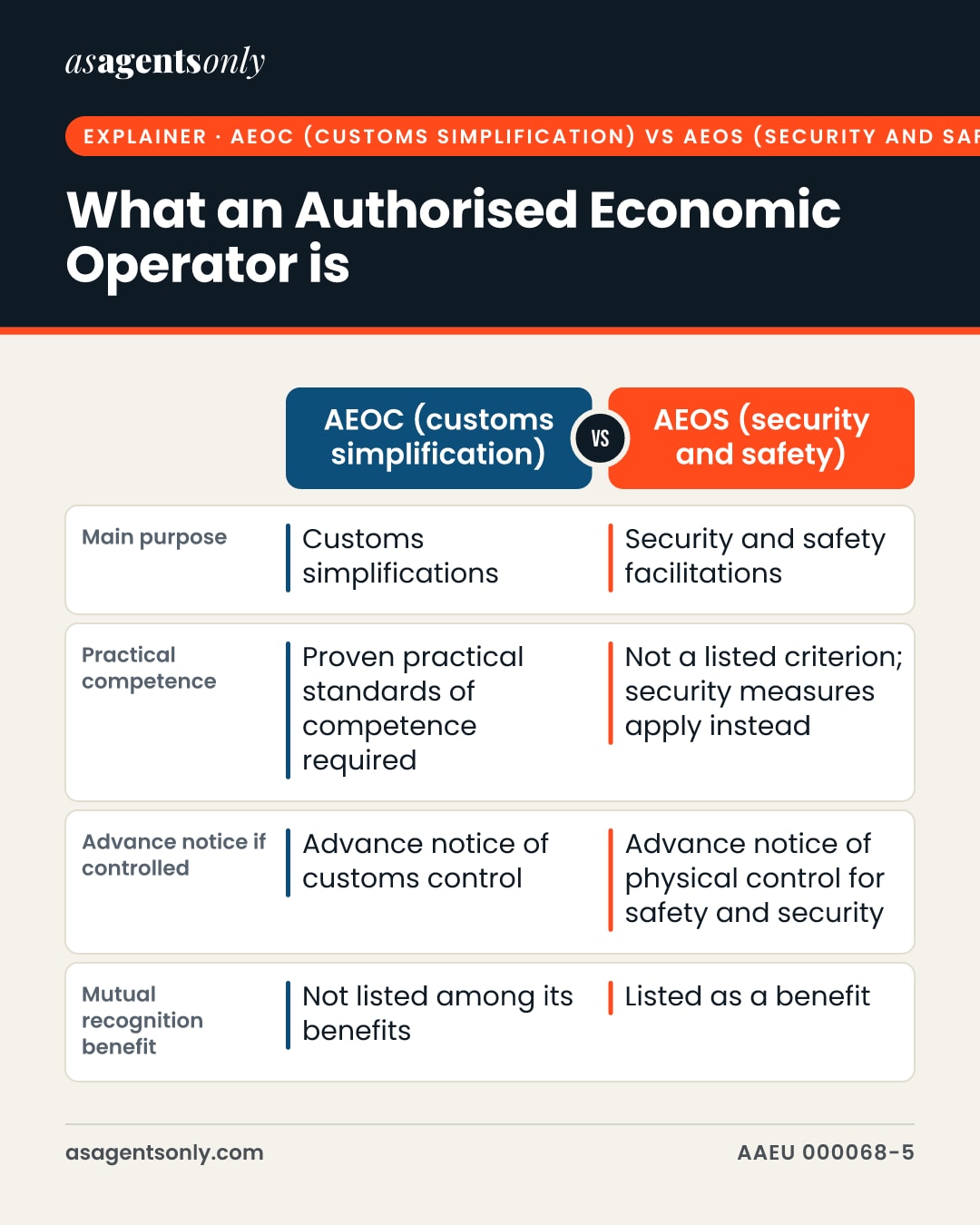
| Compared | AEOC (customs simplification) | AEOS (security and safety) |
|---|---|---|
| Main purpose | Customs simplifications | Security and safety facilitations |
| Practical competence | Proven practical standards of competence required | Not a listed criterion; security measures apply instead |
| Advance notice if controlled | Advance notice of customs control | Advance notice of physical control for safety and security |
| Mutual recognition benefit | Not listed among its benefits | Listed as a benefit |
Example
Illustrative example, not a real company: a fictional importer, Harbor Lantern Imports, applies in Great Britain for AEOC status. It has made customs declarations for three years under its own EORI number, which can serve as evidence of the experience HMRC looks for. HMRC will still check three years of compliance records and solvency, and it expects procedures to report customs business changes within 30 days. If the required security plan or risk assessment is not ready when HMRC visits, the visit may be halted or the application rejected.
In pictures
The same facts as this page, as images to save or share. Tap one to open it full size.
Official sources
- Authorised Economic Operator programmeEuropean Commission, Taxation and Customs Union
- Authorised Economic OperatorEuropean Commission, Taxation and Customs Union
- Authorised Economic Operators GuidelinesEuropean Commission, Taxation and Customs Union
- Regulation (EU) No 952/2013 consolidated textEUR-Lex, European Union
- Mutual recognition of AEOsEuropean Commission, Taxation and Customs Union
- SAFE Framework of Standards, June 2025World Customs Organization
- AEO Validator GuideWorld Customs Organization
- Find out what types of Authorised Economic Operator status you can apply forHM Revenue & Customs
- Authorised Economic Operator Criteria - ComplianceHM Revenue & Customs
- Authorised Economic Operator Criteria - Proven Financial SolvencyHM Revenue & Customs
- Authorised Economic Operator Criteria - Customs Competence (AEOC Only)HM Revenue & Customs
- Apply for Authorised Economic Operator statusHM Revenue & Customs
- C118-6 section 6HM Revenue & Customs
- Customs Trade Partnership Against Terrorism (CTPAT)U.S. Customs and Border Protection
- Customs Trade Partnership Against Terrorism - Mutual RecognitionU.S. Customs and Border Protection
- Authorised Economic OperatorEuropean Commission, Access2Markets
Claims ledger: 39 facts and where each comes from
- The WCO Council adopted the SAFE Framework of Standards in June 2005.1
- The WCO's AEO Programme was introduced in 2007 as a customs-business partnership.1
- The EU AEO programme is based on the WCO SAFE Framework and has been fully operational since 1 January 2008.2
- The SAFE Framework is described as a starting point for implementing AEO programmes at national level.7
- AEO participation is voluntary; there is no legal obligation for economic operators to become an AEO.3
- There is no legal obligation for AEOs to require their business partners to obtain AEO status.3
- The EU programme is open to a trader established in an EU customs territory who holds an EORI number and is part of an international supply chain involved in customs-related operations.1
- A trader can hold only one AEO status and one EORI status in the EU.1
- Once one EU country grants AEO status, the other EU countries recognise it.1
- Economic operators who move only goods in free circulation, or who only give customs opinions, cannot apply for AEO status in the examples given.3
- In Great Britain and Northern Ireland, an applicant must be a legal entity, actively involved in customs operations and international trade, and hold an EORI number.8
- The criteria under EU law include no serious or repeated infringements of customs legislation and taxation rules, including serious criminal offences.4
- Applicants must demonstrate a high level of control of their operations and the flow of goods through commercial and transport records.4
- HMRC examines the applicant's record of compliance with customs and tax requirements over the last 3 years before the application.9
- HMRC checks financial solvency over the 3 years up to the date of application.10
- HMRC expects an applicant's current net assets to be positive, taking special circumstances into account.8
- Applicants must report customs business changes to HMRC within 30 days of them happening.9
- HMRC takes into account any customs authorisation that has been withdrawn or revoked when assessing compliance.9
- The EU offers AEOC for customs simplification, AEOS for security and safety, or a combination of the two.1
- Both types of authorisation may be held at the same time.4
- AEOC holders find it easier to qualify for simplified customs procedures.1
- Priority treatment if selected for control applies to both AEOC and AEOS holders.1
- AEOs may benefit from faster processing of goods by customs, for example through reduced examination rates.6
- For AEOC, HMRC requires proven practical experience of a minimum of 3 years in customs matters.11
- Regular customs activity for at least 3 years, shown by the EORI number on declarations, can serve as evidence of that experience.11
- Mutual recognition with third countries is listed as a benefit for the AEOS authorisation.1
- The EU has mutual recognition agreements with Canada, China, Japan, Moldova, Norway, Switzerland, the US, Türkiye and the UK.5
- Holders of AEOS or AEOC/AEOS authorisations are eligible to participate in mutual recognition.5
- The benefits are detailed in each individual Mutual Recognition Agreement.5
- Mutual recognition recognises the status of a company as issued by the partner country and provides the associated benefits.5
- Mutual recognition with the US is currently based solely on security, not on customs compliance.15
- Participation in a country with a mutual recognition arrangement does not exempt participants from standard CBP regulatory mandates.15
- CTPAT is a voluntary program, and CBP describes it as a public-private partnership.14
- Before applying, the business must have documented procedures available.8
- Applicants have 28 days from the date they start an application to complete it.12
- Approval for AEO status involves audit visits from HMRC staff.8
- The applicant must provide a security plan or a risk and threat assessment when HMRC visits, or HMRC might halt the visit or reject the application.13
- An application submitted to the customs authority of a different EU country than the one specified will not be accepted.1
- Applications are submitted online through the EU Trader Portal and go to the competent customs authority where the main customs accounts are accessible.16
Every figure on this page is tied to a cited source, last checked on 24 November 2026. Pages like this are re-checked every six months. Found something out of date? Tell the desk.