- Explainer
- Customs
- 4 min read
- Last verified 23 November 2026
De minimis thresholds explained
Learn what a de minimis threshold is and how the United States, EU and UK treat low-value imports today, so you can check each shipment.

General information, not legal advice. Rules, fees and forms change. Confirm with the agency named in the sources, or a licensed professional, before you file or ship.
In short
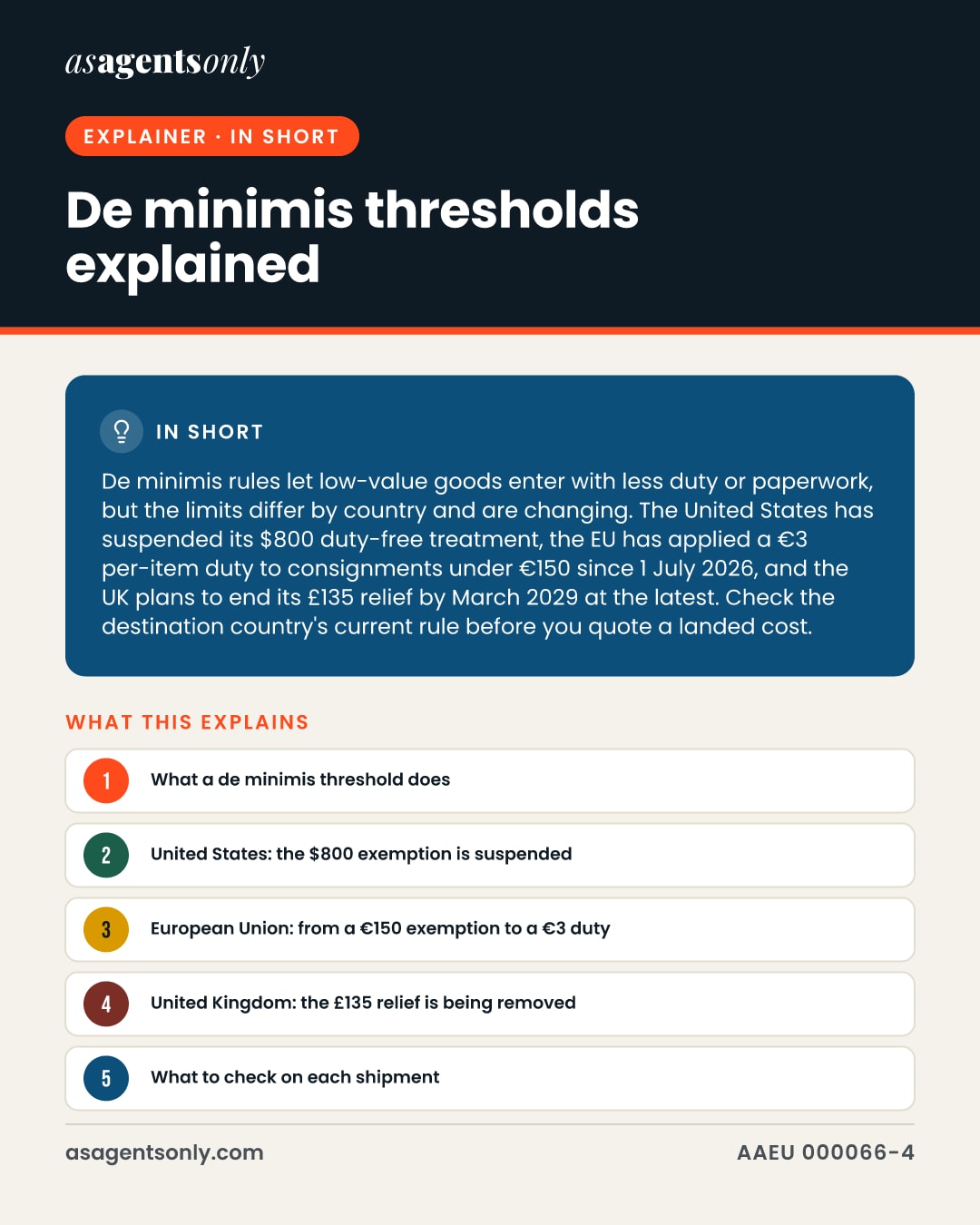
De minimis rules let low-value goods enter with less duty or paperwork, but the limits differ by country and are changing. The United States has suspended its $800 duty-free treatment, the EU has applied a €3 per-item duty to consignments under €150 since 1 July 2026, and the UK plans to end its £135 relief by March 2029 at the latest. Check the destination country's current rule before you quote a landed cost.
A de minimis threshold is a value below which low-value goods receive different customs treatment, often duty-free. The idea is used worldwide, but each country sets its own limit and conditions, and several large markets are now removing their reliefs. Shippers, forwarders, brokers and carriers need the rule at the destination on the date of import, not one they remember from another market.
What a de minimis threshold does
A de minimis threshold marks a value below which a government stops collecting duty or collects it through a simpler route. The purpose is usually to save administrative cost on small consignments. Officials in several markets now argue that electronic data has reduced that cost, and that the relief has been abused. The European Union's reform, for example, describes the old exemption as a loophole, with importers often splitting imports or undervaluing goods to avoid duty.
Each threshold carries conditions, such as who is importing, how many shipments arrive, and which goods are excluded. The headline value alone rarely settles the outcome.
United States: the $800 exemption is suspended
Duty-free de minimis treatment is suspended indefinitely for low-value imports valued at $800 or less. Genuine gifts valued at $100 or less are excepted from the duty rule. The suspension dates back to at least August 29, 2025, and a February 2026 executive order continues it. A 2025 federal law ends the statutory exemption from July 1, 2027, so the position may change again before then.
The entry route depends on how the goods arrive. Non-postal shipments valued at $800 or less must use formal or informal entry, while postal shipments valued at $2,500 or less use a newer informal process. For the $800 limit, CBP tests what one person imports on one day. Confirm the current position in the Federal Register or on the CBP website before relying on it.
European Union: from a €150 exemption to a €3 duty
Before the reform, parcels arriving in the EU with a value up to €150 were exempt from customs duties under the de minimis rules. Since 1 July 2026, a temporary flat duty of €3 per item applies to low-value consignments up to €150 arriving from outside the EU. The charge follows tariff classification rather than quantity, so identical items pay one charge and mixed goods can pay several.
The flat duty runs until 1 July 2028, after which normal tariffs apply. A Union handling fee of €2 per item applies from 1 November 2026, and the Commission sets its amount. The seller or importer declares and pays the duty as part of the customs process.
United Kingdom: the £135 relief is being removed
Goods valued at £135 or less can currently claim a customs duty relief when imported into the UK. The Chancellor's Autumn Budget 2025 announced removing that relief from March 2029 at the latest, with new customs arrangements to replace it. Goods subject to excise duty and goods requiring an import licence are excluded from the new arrangements, according to the government's consultation response.
HM Revenue & Customs lists the removal as a measure on its GOV.UK page, which was last updated 28 October 2026. That page describes the removal in present terms, while the consultation timetable gives March 2029 as the latest date. Confirm the commencement date on GOV.UK before relying on either. Gifts sent from one private individual to another and valued at £39 or less are planned to keep their relief.
What to check on each shipment
Start with the destination country's current rule and the date of entry, not the rule you used last year. Confirm the value basis: the United States applies its $800 limit to one person's imports on one day, the EU applies its flat duty per item category within a consignment, and the UK tests consignment value against £135.
Check whether the goods fall outside the simple routes, since licensed goods and excise goods often need the standard process. Keep the tariff classification on file, because it drives the EU charge and affects how duty is calculated in other markets.
Side by side
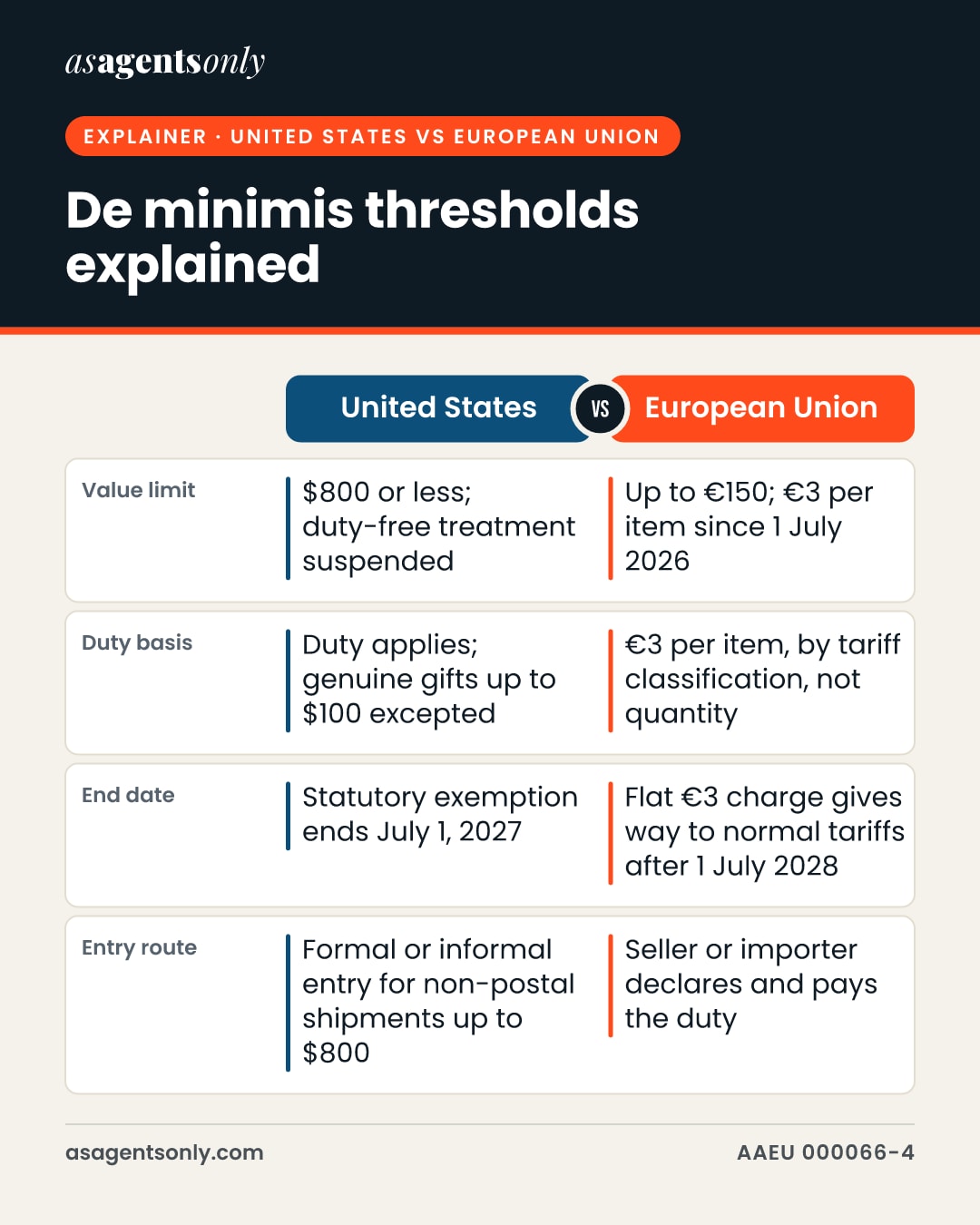
| Compared | United States | European Union |
|---|---|---|
| Value limit | $800 or less; duty-free treatment suspended | Up to €150; €3 per item since 1 July 2026 |
| Duty basis | Duty applies; genuine gifts up to $100 excepted | €3 per item, by tariff classification, not quantity |
| End date | Statutory exemption ends July 1, 2027 | Flat €3 charge gives way to normal tariffs after 1 July 2028 |
| Entry route | Formal or informal entry for non-postal shipments up to $800 | Seller or importer declares and pays the duty |
Example
Example (illustrative, not a real shipment): A seller outside the EU sends one parcel to a buyer in an EU member state. The parcel holds three T-shirts and one watch, and its total value is under €150. The T-shirts and the watch fall under two tariff classifications, so the flat duty for the parcel is €6 under the Commission's own example. The seller or importer declares and pays that amount. The figure shows the method only; the actual duty depends on the classifications declared for the goods.
In pictures
The same facts as this page, as images to save or share. Tap one to open it full size.
Official sources
- CBP modernizes low-value shipment processingU.S. Customs and Border Protection
- Low-Value ShipmentsFederal Register (U.S. Customs and Border Protection), published 8 October 2026
- Indefinite Suspension of the De Minimis Exemption for Mail Shipments and New Postal Informal Entry ProcessFederal Register (U.S. Customs and Border Protection), published 24 June 2026
- Non-postal de minimis suspension interim final rule (document 2026-12670)Federal Register (U.S. Customs and Border Protection)
- Guidance and legal text on temporary flat fee on low-value imports which will apply until 1 July 2028European Commission, Taxation and Customs Union, published 8 June 2026
- Ensuring fairness and safety: €3 customs duty for low-value parcelsEuropean Commission, published 29 June 2026
- EU Customs ReformEuropean Commission, Taxation and Customs Union
- EU action on the influx of small parcelsCouncil of the European Union
- Reforming the customs treatment of low value imports into the United KingdomGOV.UK (HM Treasury and HM Revenue & Customs)
- Reforming the customs treatment of low value imports into the United Kingdom (consultation document)GOV.UK (HM Treasury and HM Revenue & Customs)
- Reforming customs rules for low value importsGOV.UK (HM Revenue & Customs), published 13 July 2026
- 19 CFR Part 10, CBP DEC. 26-12 (interim final rule, non-postal low-value shipments)U.S. Customs and Border Protection
- Reforming the customs treatment of low value imports: consultation responseGOV.UK (HM Treasury and HM Revenue & Customs)
Claims ledger: 21 facts and where each comes from
- Duty-free de minimis treatment is suspended indefinitely for low-value imports valued at $800 or less.1
- Genuine gifts valued at $100 or less are excepted from the duty rule, with a $200 limit for gifts sent from the Virgin Islands, Guam, and American Samoa.1
- The One Big Beautiful Bill Act, enacted July 4, 2025, ends the de minimis exemption from July 1, 2027.2
- Executive Order 14388, dated February 20, 2026, kept duty-free de minimis treatment suspended for all countries.3
- Postal shipments valued at $2,500 or less now use an informal entry process created by a June 2026 rule.3
- For non-postal arrivals, merchandise valued at $800 or less must go through formal or informal entry procedures.4
- The $800 limit is tested against merchandise imported by one person on one day.12
- The suspension of the exemption dates back to at least August 29, 2025.2
- Since 1 July 2026, a temporary flat duty of €3 per item has covered low-value consignments up to €150 arriving from outside the EU.5
- Before the reform, parcels arriving in the EU with a value up to €150 were exempt from customs duties under the de minimis rules.7
- The charge does not depend on quantity; it follows the distinct tariff classifications in a consignment.6
- Three T-shirts and a watch attract €6, because the T-shirts and the watch fall under two tariff classifications.6
- The seller or importer declares and pays the duty as part of the customs process.6
- Normal customs tariffs replace the temporary €3 charge after 1 July 2028.5
- The Commission sets the per-item amount of the Union handling fee, which is €2 from 1 November 2026.8
- Goods valued at £135 or less can currently claim a customs duty relief when imported into the UK.9
- The Chancellor's Autumn Budget 2025 announced removing the relief from March 2029 at the latest.9
- HM Revenue & Customs lists removing the £135 customs duty relief as a measure, with the page last updated 28 October 2026.11
- Gifts sent from one private individual to another, valued at £39 or less, are planned to keep their relief.10
- The EU reform describes the old exemption as a loophole, with importers often splitting imports or undervaluing goods to avoid duty.7
- Goods subject to excise duty, and goods requiring an import licence, are excluded from the new UK low-value arrangements.13
Every figure on this page is tied to a cited source, last checked on 23 November 2026. Pages like this are re-checked every six months. Found something out of date? Tell the desk.