- Explainer
- Customs
- 5 min read
- Last verified 16 November 2026
What a customs broker does
Learn what a licensed customs broker does for an importer, what authority the role needs, and which duties the United States rules place on the broker.

General information, not legal advice. Rules, fees and forms change. Confirm with the agency named in the sources, or a licensed professional, before you file or ship.
In short
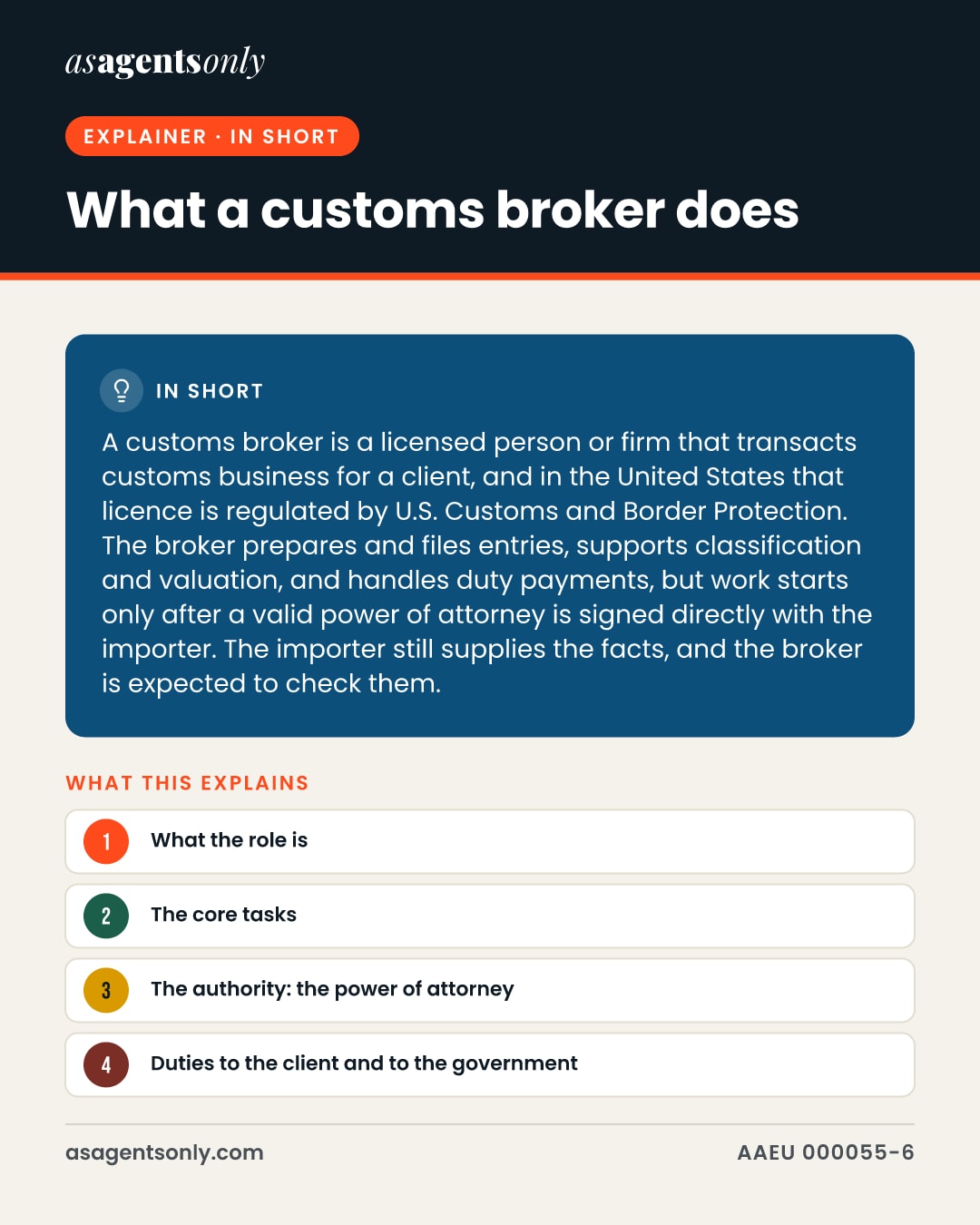
A customs broker is a licensed person or firm that transacts customs business for a client, and in the United States that licence is regulated by U.S. Customs and Border Protection. The broker prepares and files entries, supports classification and valuation, and handles duty payments, but work starts only after a valid power of attorney is signed directly with the importer. The importer still supplies the facts, and the broker is expected to check them.
Anyone who imports or exports goods will meet a customs broker sooner or later. The broker sits between the client and the customs authority, turning commercial paperwork into filings the government accepts. This explainer sets out the role as the United States defines it, the authority a broker needs before acting, and the duties that come with the work. Other countries run their own licensing and agent rules, so check your national customs authority before applying these points elsewhere.
What the role is
Under the U.S. customs broker regulations, a customs broker is a person who holds a licence to transact customs business for other people. Customs business covers more than filing. It includes the entry and admissibility of merchandise, its classification and valuation, the payment of duties, taxes and other charges, and the refund or drawback of those amounts.
The definition also reaches the preparation of documents that will be filed with CBP, even when the preparer does not sign them. A plain electronic relay of data that someone else has prepared does not count as customs business, so a company that only transmits files is not automatically acting as a broker.
CBP describes brokers as private individuals, partnerships, associations or corporations licensed, regulated and empowered by CBP to help importers meet federal requirements. Brokers also assist exporters in some cases, according to CBP's own summaries of the role.
The core tasks
Most of the day-to-day work falls into four groups: preparing and filing entries, supporting the correct classification and value of goods, paying duties and fees, and keeping records. Trade.gov lists the same core subjects, namely entry and admissibility, classification, valuation and payment of duties, taxes or other charges, including refunds and drawbacks.
The broker's documentation work is wide. A broker tracks the status of shipments and prepares and stores the documents that go with them, such as detailed invoices with country of origin and weight, and any special forms required by other federal agencies. Brokers can also monitor a shipment as it moves through customs to check compliance at each stage.
Classification is where errors are most costly. The broker must exercise due diligence and make sure the data supplied by the importer is correct, including the classification of goods. The broker does not replace the importer's own responsibility, and a shipment with wrong data can still be delayed or penalised.
The authority: the power of attorney
A broker cannot act for a client on customs matters until it holds a customs power of attorney. Since the modernised rules took effect, the broker must sign that power of attorney directly with the importer of record or the drawback claimant. A freight forwarder or other unlicensed third party cannot be the one who signs or negotiates it in the client's place.
CBP explains that directly means the importer or claimant signs by communicating with the broker, and that an agent cannot sign or negotiate in their stead. A forwarder may still be named as a third party inside that agreement, and a broker may designate another licensed broker to handle parts of the work if the client's original power of attorney allows it.
The broker must keep powers of attorney until they are revoked. Revoked powers and revocation letters must be kept for five years after revocation, or five years after the client stops being an active client, whichever period is later.
Duties to the client and to the government
A broker must pay duties, taxes or other obligations on or before the date they fall due, and must pass on late payments received from a client within a short period. Payments that a broker receives from a client after the due date have to reach the government within five working days of receipt.
If a broker learns that a client has not complied with the law or has made an error or omission in a document, the broker must advise the client on the correct corrective action and keep a record of that communication. Brokers are also expected to act on communications and notices from CBP.
The rules are changing. A recent CBP interim final rule on foreign importers of record adds a duty for brokers to verify, before filing a declaration for a client, that the client qualifies as a U.S. importer of record. That rule has a 60-day delayed effective date, so it is not yet in force on the day this page was written, and readers should confirm its status on the Federal Register before relying on it.
Side by side
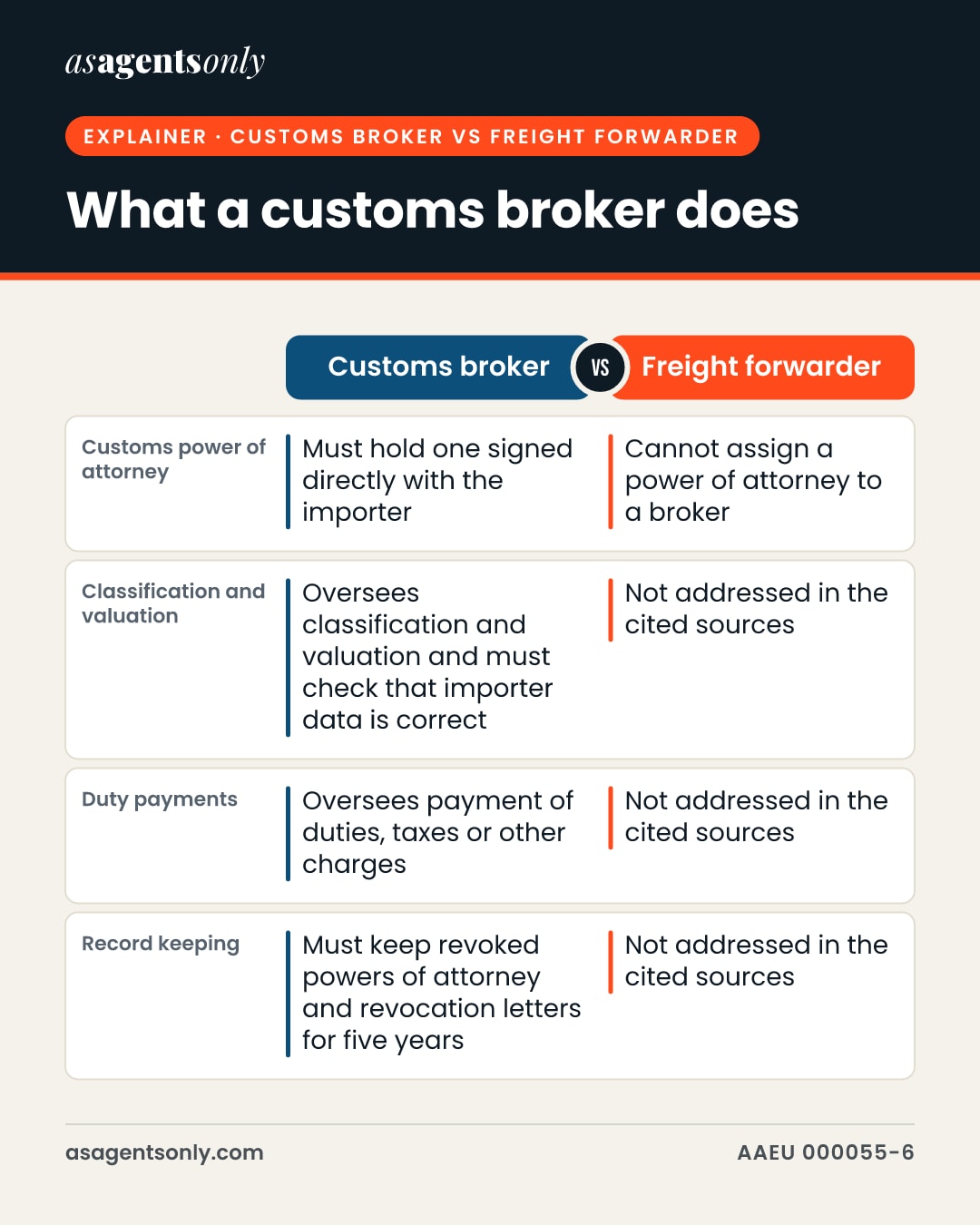
| Compared | Customs broker | Freight forwarder |
|---|---|---|
| Customs power of attorney | Must hold one signed directly with the importer | Cannot assign a power of attorney to a broker |
| Classification and valuation | Oversees classification and valuation and must check that importer data is correct | Not addressed in the cited sources |
| Duty payments | Oversees payment of duties, taxes or other charges | Not addressed in the cited sources |
| Record keeping | Must keep revoked powers of attorney and revocation letters for five years | Not addressed in the cited sources |
Example
This is an illustrative example with invented facts. A fictional company, Harbor Lamp Co., wants to bring in a shipment of ceramic lamps from a supplier abroad. It signs a customs power of attorney directly with a licensed broker, not through its freight forwarder. The broker asks for the commercial invoice, checks the supplier's description and proposes a classification, then prepares and files the entry. The broker pays the duties on the due date from the client's account. When the broker notices that the invoice omits a material assist, it tells Harbor Lamp Co. in writing what needs correcting and keeps a record of that advice. Harbor Lamp Co. remains responsible for the accuracy of the facts it provided.
In pictures
The same facts as this page, as images to save or share. Tap one to open it full size.
Official sources
- eCFR :: 19 CFR Part 111 -- Customs BrokerseCFR (Office of the Federal Register)
- Customs Broker Modernization Regulations 19 CFR 111U.S. Customs and Border Protection
- Customs Broker Frequently Asked QuestionsU.S. Customs and Border Protection
- Modernization of the Customs Broker RegulationsFederal Register (U.S. Customs and Border Protection), published 18 October 2022
- Heightened Requirements for Foreign Importers of RecordFederal Register (U.S. Customs and Border Protection), published 6 November 2026
- Customs Brokers and Freight ForwardersInternational Trade Administration (trade.gov)
- Customs broker: Career OutlookU.S. Bureau of Labor Statistics
- eCFR :: 19 CFR Part 111 Customs Brokers (current)eCFR (Office of the Federal Register)
Claims ledger: 18 facts and where each comes from
- "Customs broker" means a person who is licensed under this part to transact customs business on behalf of others.1
- "Customs business" means those activities involving transactions with CBP concerning the entry and admissibility of merchandise, its classification and valuation, the payment of duties, taxes, or other charges assessed or collected by CBP on merchandise by reason of its importation, and the refund, rebate, or drawback of those duties, taxes, or other charges.8
- "Customs business" also includes the preparation, and activities relating to the preparation, of documents in any format and the electronic transmission of documents and parts of documents intended to be filed with CBP in furtherance of any other customs business activity, whether or not signed or filed by the preparer.8
- However, "customs business" does not include the mere electronic transmission of data received for transmission to CBP and does not include a corporate compliance activity.8
- Customs brokers are private individuals, partnerships, associations or corporations licensed, regulated and empowered by CBP to assist importers and exporters in meeting federal requirements governing imports and exports.6
- Customs brokers oversee transactions related to customs entry and admissibility of merchandise, product classification, customs valuation, payment of duties, taxes, or other charges such as refunds, rebates, and duty drawbacks.6
- Customs brokers track the status of clients' international shipments and prepare, submit, and store required documents.7
- The broker must exercise due diligence and make sure that the data from the importer is correct, e.g., that the classification of goods is correct.4
- A customs broker is required to have a customs power of attorney prior to transacting any customs business on behalf of the importer of record.4
- Brokers must execute a customs power of attorney directly with the importer of record or drawback claimant, and not via a freight forwarder or other (unlicensed) third party, to transact customs business for that importer of record or drawback claimant.2
- The term "directly" means the IOR or claimant must execute and sign the POA by directly communicating with the broker, and cannot have an agent or third party sign or negotiate the POA in their stead.3
- A freight forwarder (FF) may not assign a power of attorney (POA) to conduct customs business to a customs broker on behalf of a client.3
- Powers of attorney must be retained until revoked, and revoked powers of attorney and letters of revocation must be retained for 5 years after the date of revocation or for 5 years after the date the client ceases to be an "active client" as defined in § 111.29(b)(2)(ii), whichever period is later.8
- Brokers must advise the client on the proper corrective actions required in the case of noncompliance or an error or an omission on the client's part and retain a record of their communication with the client.2
- Payments received by a broker from a client after the due date must be transmitted to the Government within five working days from receipt by the broker.5
- A customs broker, prior to filing a declaration on behalf of a client pursuant to § 141.22, must verify that the client qualifies as a U.S. IOR.5
- CBP is also amending § 111.29 by redesignating paragraph (a) as a new paragraph (a)(1) and adding a new paragraph (a)(2) to include a customs broker's responsibility for verifying a client's qualification as a U.S. IOR.5
- The rule is published as an interim final rule with a 60-day delayed effective date to give IORs and brokers time to modify the relevant business processes.5
Every figure on this page is tied to a cited source, last checked on 16 November 2026. Pages like this are re-checked every six months. Found something out of date? Tell the desk.