- How-To
- Classification
- 4 min read
- Last verified 24 November 2026
How to find the right HS code
Learn how to move from a product description to a defensible HS code, check the national tariff line, and request a binding ruling when you remain unsure.

General information, not legal advice. Rules, fees and forms change. Confirm with the agency named in the sources, or a licensed professional, before you file or ship.
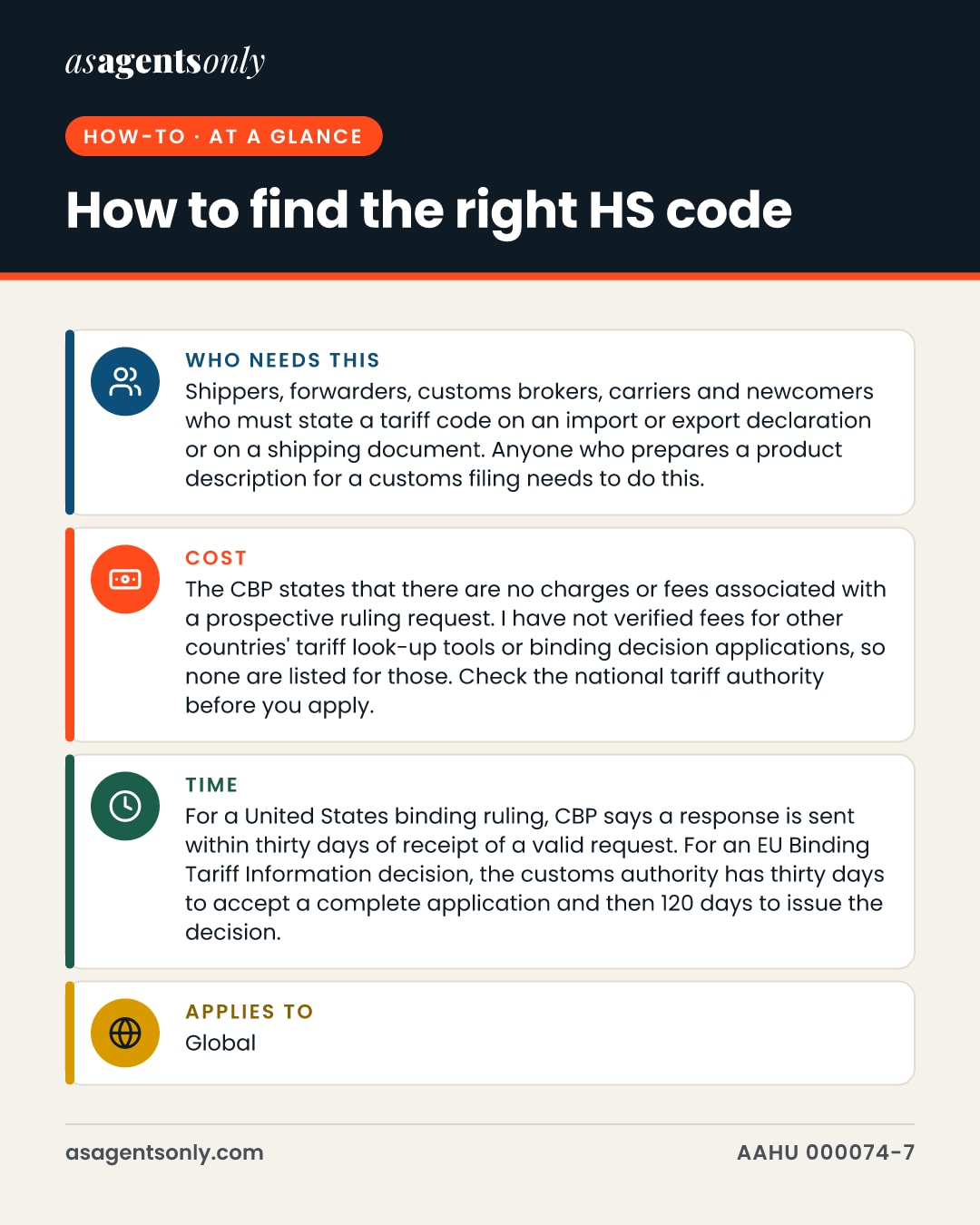
- Who needs this
- Shippers, forwarders, customs brokers, carriers and newcomers who must state a tariff code on an import or export declaration or on a shipping document. Anyone who prepares a product description for a customs filing needs to do this.
- Cost
- The CBP states that there are no charges or fees associated with a prospective ruling request. I have not verified fees for other countries' tariff look-up tools or binding decision applications, so none are listed for those. Check the national tariff authority before you apply.
- Time
- For a United States binding ruling, CBP says a response is sent within thirty days of receipt of a valid request. For an EU Binding Tariff Information decision, the customs authority has thirty days to accept a complete application and then 120 days to issue the decision.
- Applies to
- Global
The Harmonized System (HS) is the international product nomenclature that customs authorities use to classify goods. You need an HS code whenever you prepare a customs declaration, price duties, or check whether an import or export needs a licence or certificate. The first six digits are shared worldwide, but the codes that follow are set by each country, so the search has two layers: the international structure and the national tariff.
Step by step
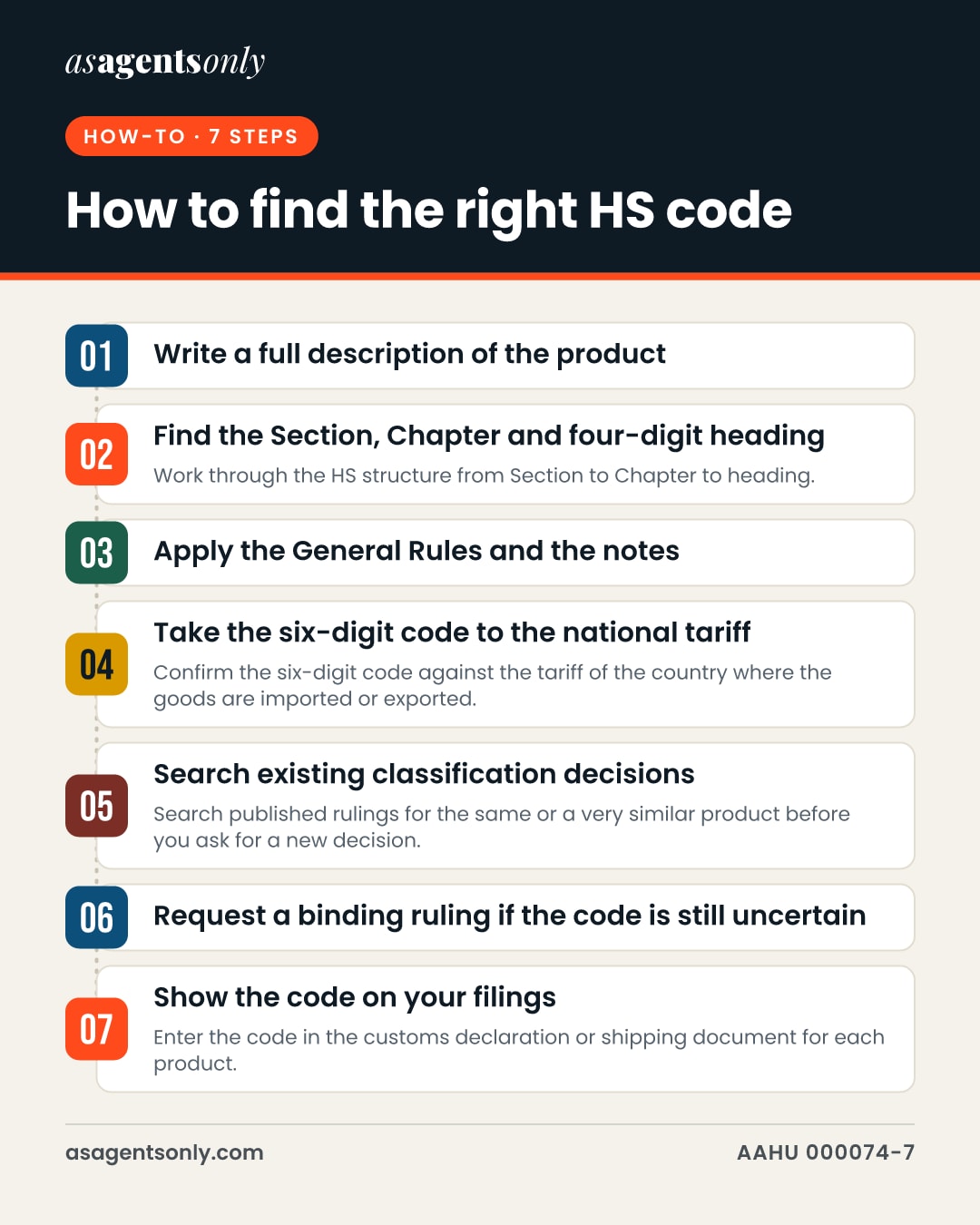
Write a full description of the product
Describe the goods as they will be imported or exported: physical form, materials, function, principal use, commercial name and any packaging or sets. Include the component materials and their shares where they affect classification. A description with brand names or vague terms will lead to the wrong heading.
Find the Section, Chapter and four-digit heading
Work through the HS structure from Section to Chapter to heading. Use the terms of the headings and any Section or Chapter Notes first, because the General Rules for the Interpretation of the Harmonized System apply in order. Check the four-digit heading before you look at any subheading.
Apply the General Rules and the notes
If more than one heading seems to fit, apply the General Rules for the Interpretation of the Harmonized System in order, using the later rules only where needed. Check the Section and Chapter notes and the subheading texts. Use the subheading rule to choose the six-digit subheading, comparing only subheadings at the same level.
Take the six-digit code to the national tariff
Confirm the six-digit code against the tariff of the country where the goods are imported or exported. The national tariff adds digits beyond the six-digit level and sets the duty and control measures. In the UK, use the Trade Tariff service. In the United States, use the Harmonized Tariff Schedule of the United States (HTSUS). In the EU, use the Combined Nomenclature and the duty tools provided by the European Commission.
Search existing classification decisions
Search published rulings for the same or a very similar product before you ask for a new decision. In the United States, use the Customs Rulings Online Search System (CROSS) run by CBP. In the EU, search the public EBTI database of Binding Tariff Information decisions. A ruling covers only the goods it describes, so compare the descriptions closely.
Request a binding ruling if the code is still uncertain
In the United States, submit a request to the National Commodity Specialist Division (NCSD) through the eRulings Template or in writing; the request must describe a specific product to be imported, not a hypothetical one. In the EU, apply for a BTI decision through the EU Customs Trader Portal, with a separate application for each type of product, to the customs authority of the country where you are established or where you will import or export. Keep the reference number.
Show the code on your filings
Enter the code in the customs declaration or shipping document for each product. If you hold a United States ruling, the classification in it must be stated in the documents filed for each later entry of that merchandise. If you hold an EU BTI decision, you must declare it in the customs declaration.
Documents you will need
- A complete written description of each product in its imported or exported condition
- Component materials and, where relevant, their shares by weight or cost
- Principal use, commercial name and technical designation of the goods
- Product images, drawings, data sheets or samples
- Chemical analysis or ingredient lists for chemical, food or cosmetic products
- Your EORI number or the national trader identifier where the application requires it
- Any existing ruling or BTI decision reference numbers and their codes
Common mistakes
- Matching the product to a code by its trade name alone; describe the goods by their function, materials and form, using general terms, because the tariff uses formal language.
- Stopping at the six-digit code; the national tariff may add further digits that decide the duty rate and controls, so confirm the full code in the country of import or export.
- Copying a supplier's code without checking it; a code used by an overseas supplier may not give the same treatment in your country, and the national part of the code can differ.
- Applying a ruling to goods that differ from the one it describes; a United States ruling applies only to articles identical to the sample or described in the same way.
- Relying on the "other" or "not elsewhere specified" heading without checking the specific headings first; residual headings are used only when no specific heading fits.
In pictures
The same facts as this page, as images to save or share. Tap one to open it full size.
Official sources
- What is the Harmonized System (HS)?World Customs Organization
- Instruments and ToolsWorld Customs Organization
- General Rules for the Interpretation of the Harmonized System (2017)World Customs Organization
- How to create an Informed Compliance Publication (Tariff Classification)U.S. Customs and Border Protection
- ICP - CBP Rulings ProgramU.S. Customs and Border Protection
- Title 19 CFR Part 177 Administrative RulingseCFR (U.S. National Archives)
- MTB 2019: Get Out Ahead of the Pack with a Binding Ruling from CBPU.S. International Trade Commission
- European Binding Tariff Information (EBTI)European Commission, Taxation and Customs Union
- Binding Tariff Information - Quick InfoEuropean Commission, Taxation and Customs Union
- Administrative Guidance on the Binding Tariff Information ProcessEuropean Commission, Taxation and Customs Union
- EU Customs Trader Portal (EUCTP)European Commission, Taxation and Customs Union
Claims ledger: 31 facts and where each comes from
- The HS is a multipurpose international product nomenclature developed by the WCO, with more than 5,000 commodity groups each identified by a six-digit code.1
- The HS 2022 edition is the seventh edition and entered into force on 1 January 2022.2
- The HS 2028 edition, the eighth edition, will enter into force on 1 January 2028.2
- The General Rules for the Interpretation of the HS are applied in hierarchical order, with the first step being classification at the four-digit heading level.16
- Under General Rule 1, classification is determined by the terms of the headings and any relevant Section or Chapter Notes, before the other General Rules are considered.16
- Under General Rule 3(c), goods that cannot be classified under Rule 3(a) or 3(b) go under the heading that occurs last in numerical order among those that equally merit consideration.3
- To make sure a good is classified under only one heading and subheading, the six General Rules must be used.4
- The rules are applied in this order: heading, then subheading, then tariff item, repeating for each level.4
- Each country may add further subdivisions beyond the six-digit level of the HS, and the national tariff sets the rates of duty.5
- When merchandise is not specifically provided for in the HS, the residual provision (using wording such as not elsewhere specified or other) generally applies.5
- The only first six digits are used worldwide, and product-specific decisions are particular to each country.13
- If you rely on the commodity code from an overseas supplier, you need to check whether the treatment is the same and how much of the code applies in the UK.13
- To find a commodity code in the UK Trade Tariff, you must specify what the item is, and brand names should not be used.15
- If you cannot find the right commodity code in the UK, you can contact HMRC for advice or for a decision on your goods.14
- The Customs Rulings Online Search System (CROSS) can be used to research the classification of merchandise, and the correct HTSUS classification of many items can be found there.8
- If the merchandise is not described in any ruling on CROSS, a binding ruling request can be submitted to CBP's National Commodities Specialist Division.8
- A valid CBP ruling request for classification must include a full and complete description of the good in its imported condition, its component materials, and its principal use in the United States.6
- A CBP ruling request must describe a specific product to be imported; a hypothetical request is not a valid request.6
- In the eRulings system, the requester receives an email acknowledgement and a binding ruling control number within one business day of a successful transmission.6
- A CBP binding ruling response is sent within thirty days of receipt of a valid ruling request.12
- There are no charges or fees associated with a CBP prospective binding ruling request.6
- A ruling setting out the tariff classification must be stated in the documents filed for any later entry of that merchandise.7
- Each CBP ruling letter applies only to transactions involving articles identical to the sample submitted or whose description is identical to the description in the ruling.7
- The EU Binding Tariff Information decision is a legal decision issued by EU countries' customs authorities on the tariff classification of a product.9
- A separate BTI application must be made for each type of product, with a detailed description of the goods including images or samples where possible.9
- A BTI application must be submitted through the EU Customs Trader Portal, and applicants must apply where they are legally established or where they intend to import or export the goods.9
- The customs authority has thirty days after receipt of an application to accept it, and then 120 days to issue a BTI decision.10
- A BTI decision is valid for three years and is valid throughout the customs territory of the Union regardless of the Member State that issued it.10
- The holder of a BTI decision must declare the decision in the customs declaration.10
- A BTI application relates to one product, and the applicant is responsible for providing all the information needed to classify the goods.11
- Four EU Member States host a national BTI system and national trader portal: Croatia, Germany, Spain and Poland.12
Every figure on this page is tied to a cited source, last checked on 24 November 2026. Pages like this are re-checked every three months. Found something out of date? Tell the desk.