- How-To
- Licenses
- 4 min read
- Last verified 20 October 2026
How to get IATA cargo agent accreditation
You will be able to prepare, file and track an IATA cargo agent accreditation application, from the country checklist through the Customer Portal to approval.

General information, not legal advice. Rules, fees and forms change. Confirm with the agency named in the sources, or a licensed professional, before you file or ship.
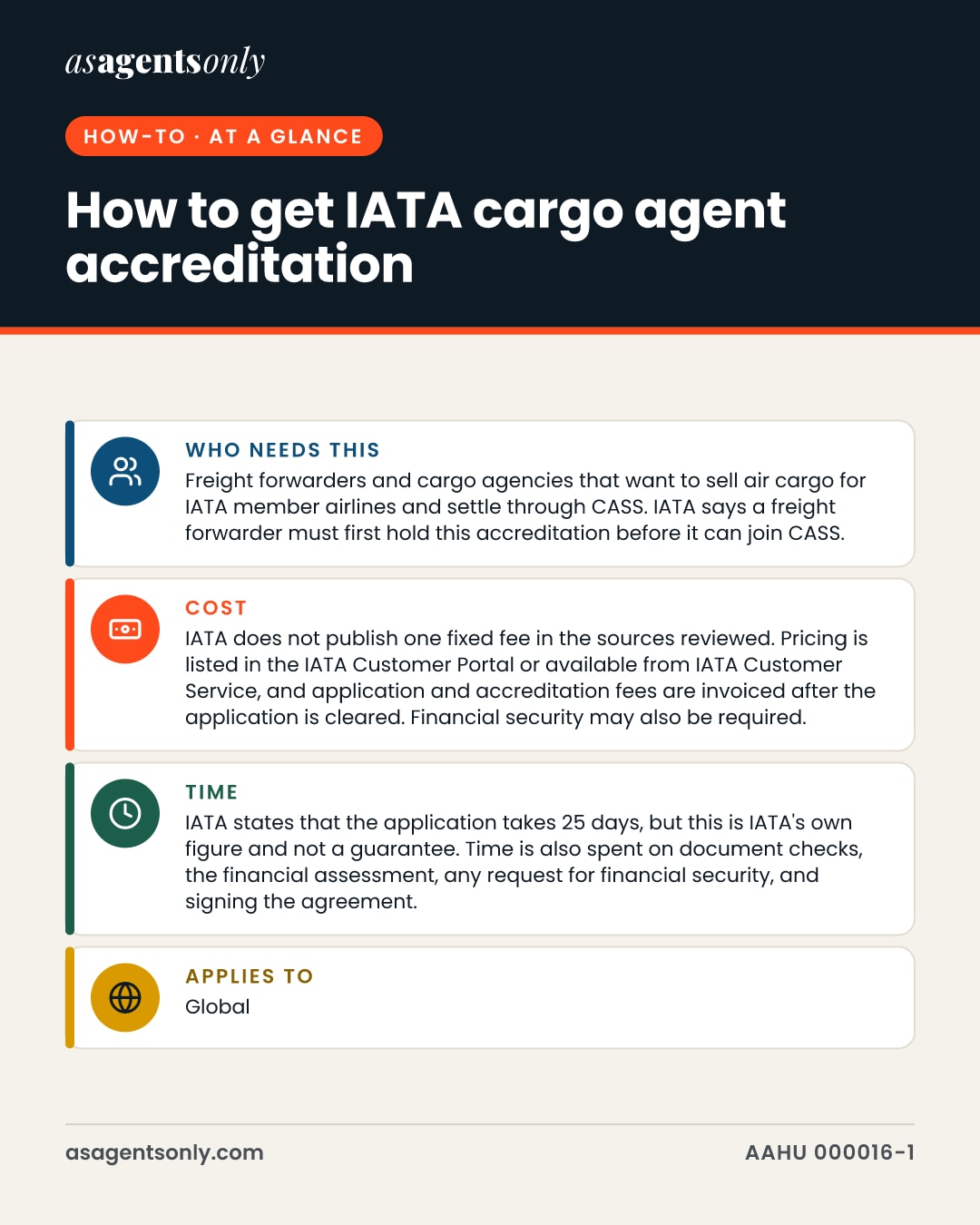
- Who needs this
- Freight forwarders and cargo agencies that want to sell air cargo for IATA member airlines and settle through CASS. IATA says a freight forwarder must first hold this accreditation before it can join CASS.
- Cost
- IATA does not publish one fixed fee in the sources reviewed. Pricing is listed in the IATA Customer Portal or available from IATA Customer Service, and application and accreditation fees are invoiced after the application is cleared. Financial security may also be required.
- Time
- IATA states that the application takes 25 days, but this is IATA's own figure and not a guarantee. Time is also spent on document checks, the financial assessment, any request for financial security, and signing the agreement.
- Applies to
- Global
IATA Cargo Agency Accreditation lets a freight forwarder or cargo agency become an IATA-accredited agent, which airlines use to recognize it. The rules are set country by country, so you start from your country's checklist and the current Cargo Agent's Handbook. This guide covers the general process; the checklist for your country controls the details.
Step by step
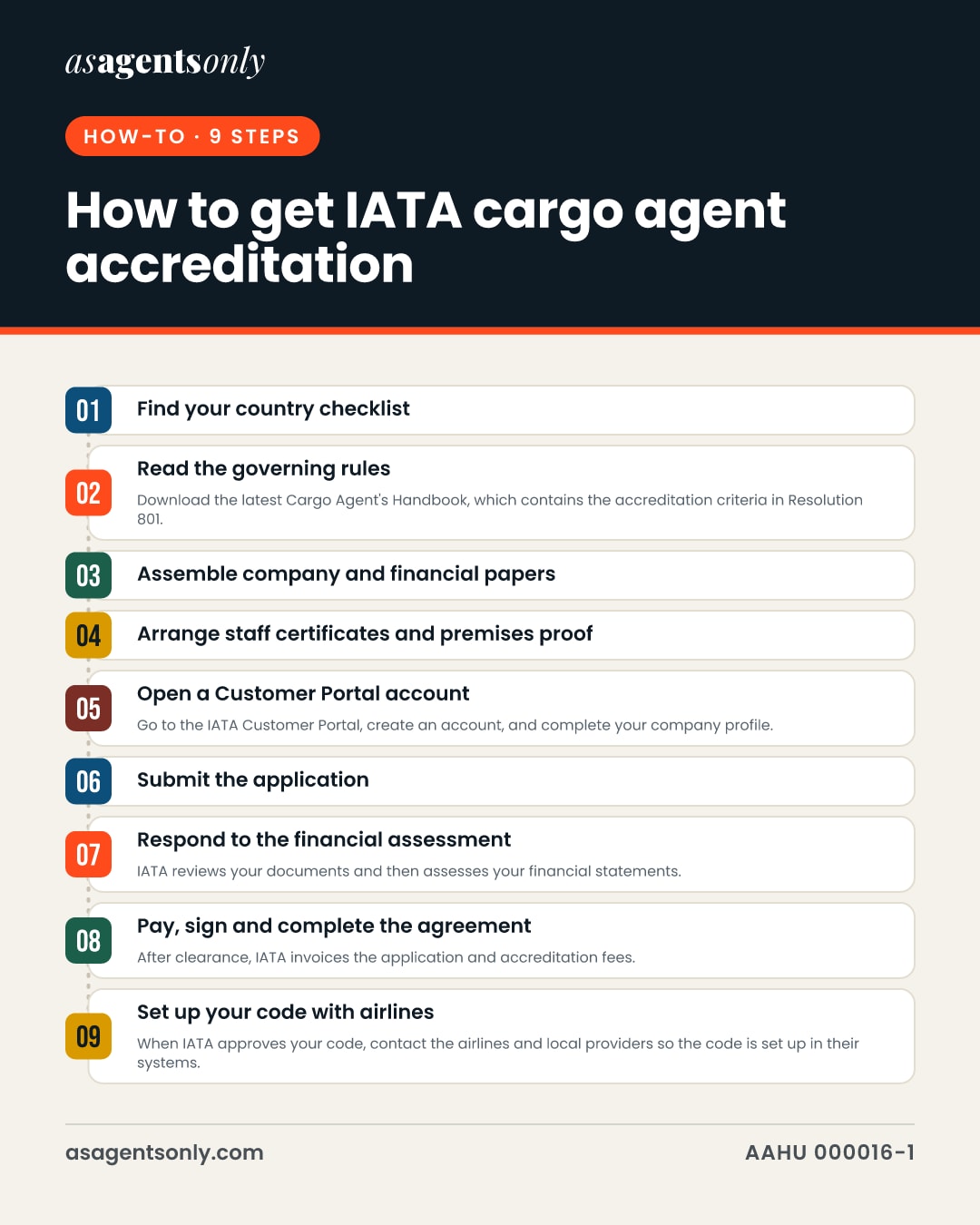
Find your country checklist
Open the IATA Cargo Agency Accreditation country requirements pages and select your country under the cargo agent option. Download the Application Guide and the requirement list, because the list differs by country and can be long.
Read the governing rules
Download the latest Cargo Agent's Handbook, which contains the accreditation criteria in Resolution 801. Check the Financial Criteria and the agency rules, since your application is judged against them.
Assemble company and financial papers
Gather your company registration, a license to operate, owner identification, bank details, articles of association, and certified or audited financial statements. The statements must be recent for your country's checklist, and the Cargo Agency Conference evaluates them under the Financial Criteria.
Arrange staff certificates and premises proof
Confirm that your staff hold the required Dangerous Goods Regulations (DGR) certificates and cargo handling training, or the experience letters the checklist allows. Prepare proof of your premises, staff listing, photos of the inside and outside of the office, and an insurance policy covering all risks.
Open a Customer Portal account
Go to the IATA Customer Portal, create an account, and complete your company profile. The portal guides you through a questionnaire on legal identification, ownership, company registration and branch addresses.
Submit the application
In the Customer Portal, open Services, then Available Services, then IATA Accreditation & Changes, and file your application. Complete the online Application Form, then download, sign and scan it as the portal requires, with the signature of an authorized signatory and the company seal if applicable.
Respond to the financial assessment
IATA reviews your documents and then assesses your financial statements. Your financial assessment contact uploads the statements through IATA's Financial Assessment Portal (IFAP) if asked, and IATA may request financial security, with the amount set after the assessment.
Pay, sign and complete the agreement
After clearance, IATA invoices the application and accreditation fees. Pay them and sign the Cargo Agency Agreement, which obliges you to pay agency fees as the Cargo Agency Rules set out.
Set up your code with airlines
When IATA approves your code, contact the airlines and local providers so the code is set up in their systems. To join CASS, use the same portal route to apply for CASS Associate service after accreditation.
Documents you will need
- Official company registration or trade registration certificate
- License to operate issued by the appropriate authorities, where your country requires one
- Copy of the owners' identification
- Agency bank details, with a bank letter or statement if the checklist asks for it
- Memorandum and articles of association or articles of incorporation
- Certified or audited financial statements within the period your checklist sets
- Proof of lease or ownership of the premises
- Photos of the interior and exterior of the premises
- Staff listing
- Two full-time employees holding valid DGR certificates, valid for at least another six months, where the checklist requires two
- Two basic cargo training certificates, or two CVs and letters on letterhead confirming three or more years of air cargo experience (two years for Europe and Latin America)
- Insurance policy document covering all risks
- Signed Application Form, downloaded from the Customer Portal
- Recommendation from an airline, where required
Common mistakes
- Using one country's checklist for another country: the requirements are set per country, so always start from your own country's checklist on the IATA site.
- Submitting financial statements that are too old: the mandatory statements must not be older than six months at application, so check the date before you upload.
- Letting DGR certificates expire soon after filing: the DGR certificates must remain valid for at least six more months, so renew early if your staff certificates are near expiry.
- Leaving the Application Form unsigned or unscanned: the form must be completed online, then printed, signed, scanned and attached, so skipping a step delays the case.
- Missing the financial assessment contact: only the designated financial assessment contact can upload statements in IFAP, so confirm that person in the Customer Portal before IATA asks.
In pictures
The same facts as this page, as images to save or share. Tap one to open it full size.
Official sources
- IATA - Cargo Agency ProgramInternational Air Transport Association (IATA)
- IATA Cargo Agent or Intermediary AccreditationInternational Air Transport Association (IATA)
- Cargo Agent's Handbook Resolution 801 - Worldwide Edition 47International Air Transport Association (IATA)
- IATA - Cargo Agent's Handbook (accreditation requirement detail)International Air Transport Association (IATA)
- IATA - Cargo Accounts Settlement Systems (CASS)International Air Transport Association (IATA)
- IATA - Certificate of Cargo Basic (accreditation requirement detail)International Air Transport Association (IATA)
- IATA - Financial Statements (accreditation requirement detail)International Air Transport Association (IATA)
- IATA - Financial Guarantee (accreditation requirement detail)International Air Transport Association (IATA)
- Application Form with Signature (accreditation requirement detail)International Air Transport Association (IATA)
- Cargo Agency AgreementInternational Air Transport Association (IATA)
- IATA - Canada - Cargo AgentInternational Air Transport Association (IATA)
Claims ledger: 18 facts and where each comes from
- The IATA Cargo Agency Program includes IATA Cargo Agency Accreditation and the CASS Associate Service, and the process to become accredited takes 25 days, per IATA.1
- The application to join CASS takes only 25 days, and any freight forwarder must first be accredited by the IATA Cargo Agency Accreditation/Cargo Intermediary or CASS Associate to join CASS.5
- The Cargo Agency Conference Resolutions form the terms and conditions that IATA Accredited Agents must comply with.1
- Accreditation criteria are found in the latest version of the Cargo Agent's Handbook, Resolution 801.4
- The process begins with the IATA Customer Portal, which guides applicants through a questionnaire requiring legal identification, ownership, company registration, and branch office addresses.2
- In the Customer Portal, after creating an account, the applicant goes to Services, then Available Services, then IATA Accreditation & Changes.2
- The required documents include an official certificate of company trade registration, a license to operate issued by the appropriate authorities, copy of owners' ID, agency banking details, and memorandum and articles of association.2
- Two full-time employees with DGR certificates, valid for not less than another 6 months, are required.2
- Two basic training certificates in Cargo Handling, or two CVs and confirmation letters on company letterhead showing three or more years of air cargo experience (2 years for Europe and Latin America), are required.2
- The Head Office of an IATA Cargo Agent is required to have at least 2 full-time employees holding a valid Basic Cargo certification, and each subsequent branch at least 1 such employee.6
- Financial statements must be certified or audited, reflect the financial position of the Agency, and not be older than 6 months of the application.7
- The required bank guarantee amount and template are provided after receipt of the financial statements.8
- Valid financial security is required, and the amount will be informed after the financial assessment.2
- The Application Form must be completed online in the IATA Customer Portal, then downloaded and signed by an authorized signatory, with the company common seal affixed if applicable.9
- Pricing for fees is available in the IATA Customer Portal or from the IATA Customer Service Team.2
- The Agent shall pay to IATA agency fees in the amount and within the time prescribed in accordance with the Cargo Agency Rules.10
- The Cargo Agency Programme's fees are published in the IATA Customer Portal.3
- The Canada cargo agent requirements page lists a set of mandatory and optional requirements for each application type, and the checklist varies by country.11
Every figure on this page is tied to a cited source, last checked on 20 October 2026. Pages like this are re-checked every three months. Found something out of date? Tell the desk.