- Explainer
- Risk
- 5 min read
- Last verified 1 November 2026
Chokepoints: Suez, Panama, Hormuz, Malacca, Bab el‑Mandeb
Learn what limits each of five key chokepoints, how 2026 disruptions affect them, and what to check before you plan a routing.

In short
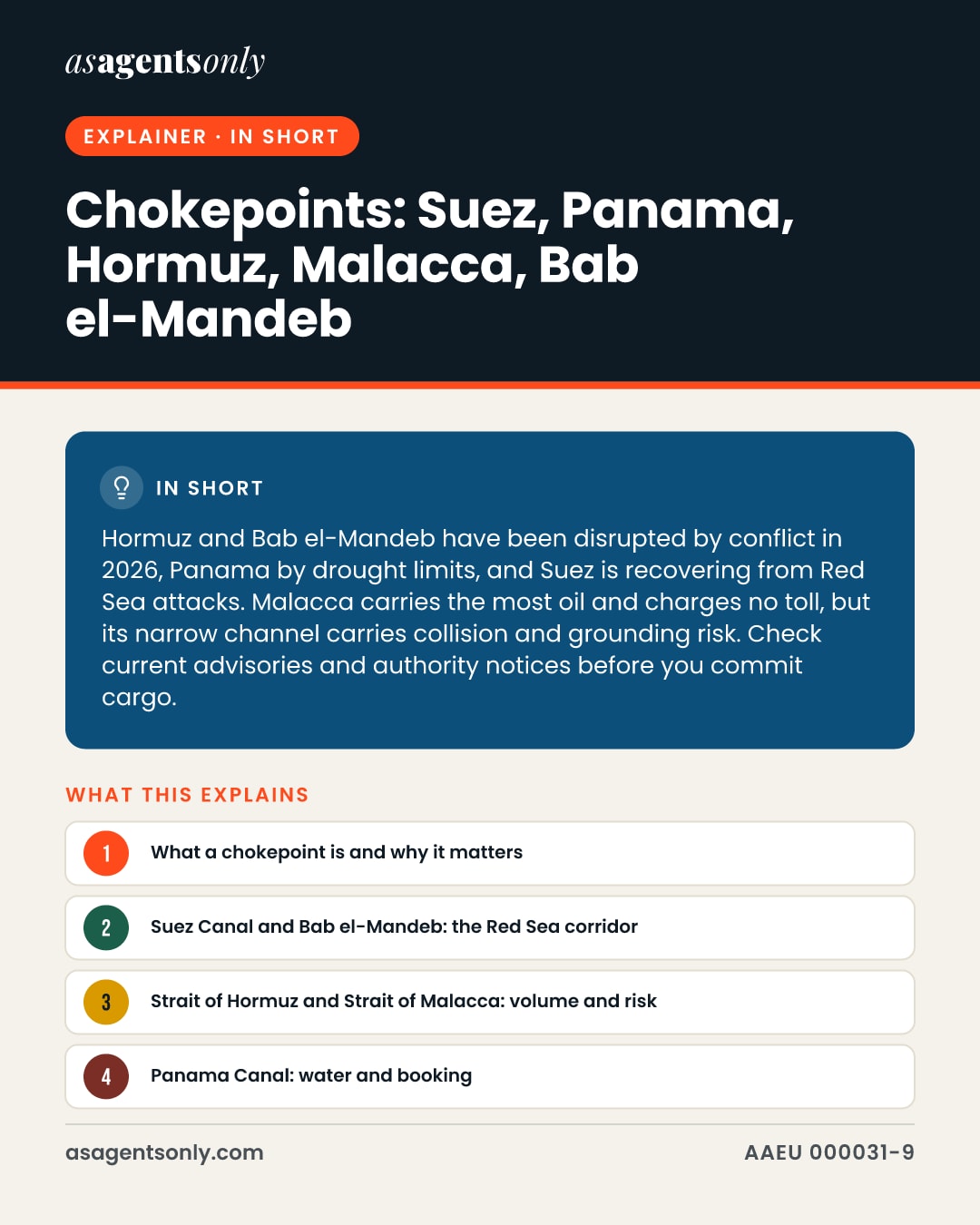
Hormuz and Bab el-Mandeb have been disrupted by conflict in 2026, Panama by drought limits, and Suez is recovering from Red Sea attacks. Malacca carries the most oil and charges no toll, but its narrow channel carries collision and grounding risk. Check current advisories and authority notices before you commit cargo.
Five narrow passages sit at the center of world sea trade. Each has physical limits and political or weather risks, and several changed sharply in 2026. This page explains what each chokepoint is, why it matters, and what to check before you plan a routing. Figures come from the sources listed and move quickly, so confirm the date of any number before you rely on it.
What a chokepoint is and why it matters
A chokepoint is a narrow passage on a major sea route. Most can be avoided by using a longer route, but the detour usually adds transit time and cost, and a few have no practical alternative. The U.S. Energy Information Administration (EIA) measures oil flows through seven chokepoints and treats Hormuz and Malacca as the most important by oil volume.
EIA figures are measured in barrels of oil per day. They describe oil and some gas only, not container or dry bulk trade, so a quiet chokepoint for oil can still matter for containers. Read each figure against its date and its definition before you use it in a contract or a risk report.
Suez Canal and Bab el-Mandeb: the Red Sea corridor
The Suez Canal, in Egypt, links the Red Sea with the Mediterranean. Ships that cannot use it must sail around the Cape of Good Hope. EIA estimates that closing the canal and the SUMED pipeline would send Saudi-to-US tankers around Africa, adding about 2,700 miles. Fully laden very large crude carriers often lighten their cargo before transit, because the canal is not deep enough for them at full draft.
Container traffic is returning slowly. The Suez Canal Authority reports that container ship net tonnage rose 54.2% in January to August 2026. BIMCO data show container capacity through the canal above half of pre-crisis levels in early October, still below the 80% share seen before the Red Sea attacks.
Bab el-Mandeb lies at the southern end of the Red Sea. After the Houthis announced a blockade of Saudi shipping on 20 July 2026, vessel traffic through the strait fell about 24% in the following week, then leveled off. The UKMTO and Joint Maritime Information Center advisory of 9 August 2026 kept the threat level at SUBSTANTIAL. Transit counts also undercount ships that switch off their transponders, so treat them as estimates and confirm current advisories and war-risk cover before you route through the area.
Strait of Hormuz and Strait of Malacca: volume and risk
Hormuz links the Persian Gulf with the Gulf of Oman and the Arabian Sea. In the first half of 2025 it carried about one-quarter of seaborne oil. Traffic collapsed after the Iran war began on 28 February 2026. Reuters, citing Kpler data, reported four vessel transits on 15 September against a 10-day average of 18. Those counts exclude ships sailing with transponders off. Iran and Oman announced a framework for a temporary corridor, but details were still being negotiated. Paying Iran for safe passage may breach U.S. sanctions administered by the Treasury Department's Office of Foreign Assets Control, so legal review is essential before any payment.
Malacca lies between Indonesia, Malaysia and Singapore and links the Indian Ocean with the South China Sea. It was the largest oil chokepoint in EIA's first-half 2025 estimates, and EIA's table shows oil flows of 16.6 million barrels per day in the second quarter of 2026. The narrowest point, in the Phillips Channel of the Singapore Strait, is about 1.7 miles wide. The three littoral states say ships are not charged a toll, and voluntary contributions pay for navigation aids. Under UNCLOS, the straits are transit passage routes that cannot be suspended. Alternatives are the Sunda and Lombok straits, both smaller routes around the Indonesian archipelago.
Panama Canal: water and booking
The Panama Canal Authority (ACP) runs the canal, and its locks depend on freshwater from Gatun Lake. When lake levels fall, the ACP cuts draft limits and daily transit slots. The 2023-24 drought cut canal throughput by as much as 40% below normal at its height.
In 2026 the ACP tightened limits over the summer during a developing El Nino, including a cut to 9 Neopanamax slots from 3 September. Later it eased them: the Neopanamax draft went back to 49 feet, and daily Neopanamax transits rise from nine to 10 from 15 October, for a total of 33 vessels a day. A planned cut to 47.5 feet for 1 October was dropped. The Transit Reservation System is still the only way to guarantee a transit date, and ships arriving without a booking could face indefinite delays. Check the latest ACP advisory before you book, because the rules have changed several times this year.
Side by side
| Compared | Suez Canal | Panama Canal |
|---|---|---|
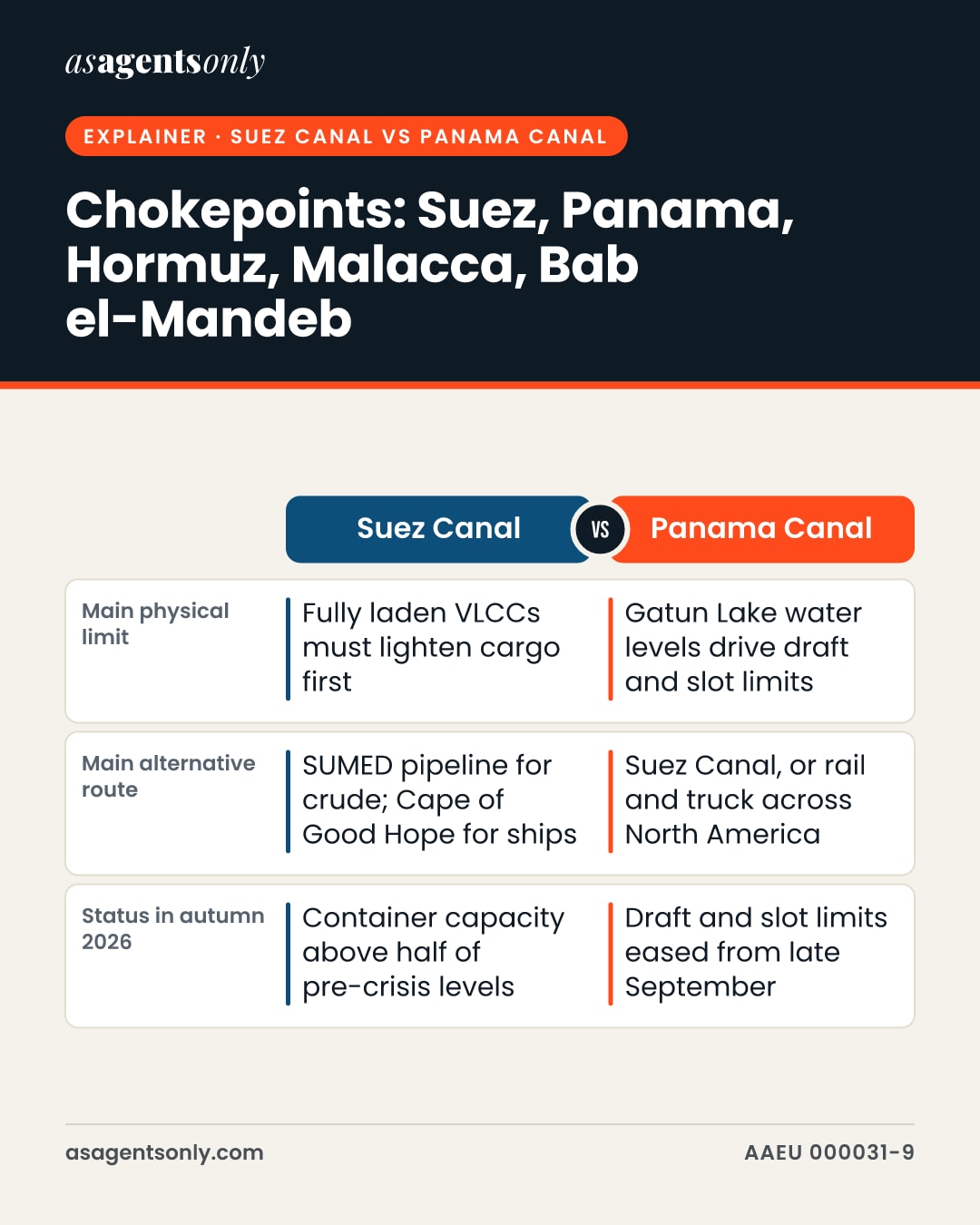
| Main physical limit | Fully laden VLCCs must lighten cargo first | Gatun Lake water levels drive draft and slot limits |
| Main alternative route | SUMED pipeline for crude; Cape of Good Hope for ships | Suez Canal, or rail and truck across North America |
| Status in autumn 2026 | Container capacity above half of pre-crisis levels | Draft and slot limits eased from late September |
Example
Illustrative example, not real data: a shipper's containership of 10,000 TEU is limited by a one-foot draft cut at the Panama Canal Neopanamax locks. Using the industry estimate that about 450 TEU of capacity is lost for each foot, the ship would carry roughly 450 TEU less cargo on that transit. A cargo owner without a reservation could also wait indefinitely, so the booking decision matters as much as the draft figure.
In pictures
The same facts as this page, as images to save or share. Tap one to open it full size.
Official sources
- Analysis of World Oil Transit ChokepointsU.S. Energy Information Administration
- Short-Term Energy Outlook: Global Energy Security DataU.S. Energy Information Administration
- Adm. Rabiee: The Suez Canal witnesses the first transit of the mega container ship OOCL PORTUGALSuez Canal Authority, published 16 September 2026
- Suez Canal container ship transits exceed half of pre-crisis levelsContainer News (citing BIMCO), published 15 October 2026
- Three important oil trade chokepoints are located around the Arabian PeninsulaU.S. Energy Information Administration
- The Week in Charts: Red Sea shipping stabilises after July's Houthi blockade shockLloyd's List, published 7 August 2026
- Houthi threat brings Bab El-Mandeb crossings down another 50%Seatrade Maritime (citing Clarksons Research)
- Strait of Hormuz Ship Crossings Remain in Single Digits, Data ShowsReuters via gCaptain, published 16 September 2026
- Hormuz Shipping Traffic Falls to Single Digits, Data ShowsReuters via gCaptain, published 10 September 2026
- Malacca Ship Tolls Divide Emerges Between Indonesia, SingaporeBloomberg, published 22 April 2026
- Shipping Traffic Through Strait of Hormuz Rises Slightly, Data ShowsReuters via gCaptain, published 27 August 2026
- Hormuz Shipping Traffic Shows No Sign of RecoverygCaptain, published 13 August 2026
- The Strait of Malacca, a key oil trade chokepoint, links the Indian and Pacific OceansU.S. Energy Information Administration
- Malacca Strait States Will Keep Waters Free, Open and SafeBloomberg via gCaptain, published 25 August 2026
- Singapore Calls for Global Action as Shadow Fleet Pressures Strategic StraitsgCaptain, published 6 February 2026
- Panama Canal Adds Transit Capacity as Rainfall Brings ReliefgCaptain, published 28 September 2026
- Panama Canal to Cut Daily Transits as Optimistic Water Outlook FadesgCaptain, published 21 August 2026
- Panama Canal to Tighten Draft Limits Again as Water Levels Continue to FallgCaptain, published 6 August 2026
- Major Shipping Lines Resume Suez Transit Despite Red Sea RisksCaixin Global, published 16 September 2026
- VLCCs lighten loads to slip through Suez as Houthi blockade bitesLloyd's List, published 30 July 2026
- World Oil Transit ChokepointsMaritime Executive (citing EIA)
Claims ledger: 39 facts and where each comes from
- EIA reports most chokepoints can be bypassed by other routes at added transit time, but some have no practical alternative.1
- EIA analyzes seven oil chokepoints and identifies Hormuz and Malacca as the most important by volume of oil transit.1
- Hormuz carried an estimated 20.9 million barrels per day of oil in the first half of 2025, about one-quarter of total seaborne oil trade.1
- Malacca carried an estimated 23.2 million barrels per day of oil in the first half of 2025, the largest volume of any chokepoint.1
- Alternatives to Malacca include the Sunda Strait and the Lombok Strait, two smaller routes through the Indonesian archipelago.1
- EIA's table puts Strait of Hormuz oil flows at 14.9 million barrels per day in the first quarter of 2026 and 4.9 million in the second quarter of 2026.2
- EIA's table puts Strait of Malacca oil flows at 16.6 million barrels per day in the second quarter of 2026.2
- EIA says ship-broadcast AIS data for Hormuz has been especially unreliable since the end of February 2026.2
- Before the Iran war began on 28 February 2026, Hormuz typically handled about 125 large commercial vessels a day.10
- Transits through Hormuz counts exclude vessels that may have crossed with their transponders switched off.10
- On 15 September 2026 Hormuz recorded four vessel transits, well below a 10-day average of 18.9
- Payments to Iran for safe passage through Hormuz could violate U.S. sanctions administered by the Treasury Department's Office of Foreign Assets Control.13
- Iran and Oman unveiled a framework for restoring safe navigation through Hormuz, including a temporary shipping corridor, while details remained under negotiation.12
- Iran pushed to levy fees on ships transiting Hormuz, which raised questions about whether Malacca tolls might follow.11
- The Strait of Malacca's narrowest point, in the Phillips Channel of the Singapore Strait, is about 1.7 miles wide, creating a bottleneck with potential for collisions, grounding or oil spills.14
- Ships transiting Malacca are not charged a toll; voluntary contributions help pay for buoys, beacons and lighthouses.15
- Indonesia, Malaysia and Singapore share primary stewardship of the Strait of Malacca and work with Thailand on the waterway.15
- The Straits of Malacca and Singapore are designated under UNCLOS as straits used for international navigation, where vessels hold a transit passage right that cannot be suspended.16
- The Suez Canal is located in Egypt and connects the Red Sea and the Gulf of Suez with the Mediterranean Sea.5
- Closure of the Suez Canal and SUMED Pipeline would require oil tankers to divert around the Cape of Good Hope, adding about 2,700 miles to the transit from Saudi Arabia to the United States.5
- SUMED is the only alternate route for crude oil from the Red Sea to the Mediterranean if ships cannot navigate the Suez Canal.5
- The Suez Canal is not deep enough for a fully laden VLCC, so part of the crude is offloaded at the SUMED terminal.24
- The Suez Canal Authority reports container ship net tonnage through the canal reached 72.1 million tons in January to August 2026, up 54.2% from the same period of 2025.3
- BIMCO reports container ship capacity through the Suez Canal exceeded half of pre-crisis levels in early October 2026, but remained below the 80% share seen before the Red Sea attacks.4
- Suez Canal transits in August 2026 totaled 1,232 ships, up 28% year on year, according to Lloyd's List Intelligence data.25
- VLCCs loading at Yanbu lightened their cargoes to use the Suez Canal instead of Bab el-Mandeb during the Houthi blockade.23
- The Houthis announced a blockade of Saudi Arabian shipping on 20 July 2026.8
- Bab el-Mandeb transits fell from 354 to 269 in the week beginning 20 July 2026, a drop of 24%, and later traffic stabilized.6
- The UKMTO and JMIC advisory note of 9 August 2026 rated the threat level for the Southern Red Sea and Bab el-Mandeb as SUBSTANTIAL.7
- Container capacity through Bab el-Mandeb was 23% of pre-crisis levels as of August 2026, according to Xeneta.22
- The Panama Canal Authority's locks draw freshwater from Gatun Lake, the reservoir that supplies the canal's lock system.20
- The 2023-24 drought forced Panama Canal throughput down by as much as 40% below normal at its height.21
- The Panama Canal Authority in August 2026 scheduled a Neopanamax draft of 48 feet from 26 August, then 47.5 feet from 3 September, and both dates were later postponed.18
- A planned cut to 47.5 feet for 1 October was scrapped in September 2026, and the Neopanamax maximum draft was raised to 49 feet.17
- Daily Neopanamax transits rise from nine to 10 from 15 October, bringing total capacity to 33 vessels a day across the Neopanamax and Panamax locks.17
- The Panama Canal is easing restrictions on vessel draft and daily transits after improved rainfall and water-saving measures.17
- The Transit Reservation System is the only way to guarantee a transit date through Panama, and vessels arriving without a reservation could face indefinite delays.19
- A 10,000-TEU containership can lose roughly 450 TEU of carrying capacity for every foot of draft restriction, according to one industry estimate.19
- Ships have been rerouted to rail and truck networks across North America, or to the Suez Canal, when Panama Canal restrictions tightened.20
Every figure on this page is tied to a cited source, last checked on 1 November 2026. Pages like this are re-checked every six months. Found something out of date? Tell the desk.